SmarterEd

Aussie Maths & Science Teachers: Save your time with SmarterEd

  • Login
  • Get Help
  • About

PHYSICS, M6 2019 VCE 7*

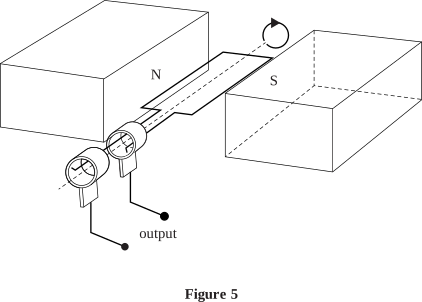
Students in a Physics practical class investigate the piece of electrical equipment shown in the diagram. It consists of a single rectangular loop of wire that can be rotated within a uniform magnetic field. The loop has dimensions 0.50 m × 0.25 m and is connected to the output terminals with slip rings. The loop is in a uniform magnetic field of strength 0.40 T.
 

  1. What name best describes the piece of electrical equipment shown in the diagram?   (1 mark)

    --- 1 WORK AREA LINES (style=lined) ---

  2. What is the magnitude of the flux through the loop when it is in the position shown in the diagram? Explain your answer.   (2 marks)

    --- 3 WORK AREA LINES (style=lined) ---
The students connect the output terminals of the piece of electrical equipment to an oscilloscope. One student rotates the loop at a constant rate of 20 revolutions per second.

  1. Calculate the period of the rotation of the loop.   (1 mark)

    --- 3 WORK AREA LINES (style=lined) ---

  2. Calculate the maximum flux through the loop. Show your working.   (1 mark)

    --- 4 WORK AREA LINES (style=lined) ---

  3. The loop starts in the position shown in the diagram.
  4. What is the average voltage measured across the output terminals for the first quarter turn? Show your working.   (2 marks)

    --- 3 WORK AREA LINES (style=lined) ---

Show Answers Only

a.    Alternator.

b.   \(0\ \text{Wb}\)

  • This is because the plane of the area of the coil is parallel to the direction of the magnetic field, not perpendicular.

c.    \(0.05\ \text{s}\)

d.    \(0.05\ \text{Wb}\)

e.    \(4\ \text{V}\)

Show Worked Solution

a.    The device is an alternator.

  • This is due to the input being mechanical motion and the output being AC current, whereas an AC motor is the opposite.
♦ Mean mark (a) 44%.
COMMENT: Many students incorrectly answered AC motor.

b.   \(0\ \text{Wb}\)

  • This is because the plane of the area of the coil is parallel to the direction of the magnetic field, not perpendicular.

c.    \(T=\dfrac{1}{f}=\dfrac{1}{20}=0.05\ \text{s}\)
 

d.    \(\Phi=BA=0.4 \times (0.5 \times 0.25)=0.05\ \text{Wb}\)
 

e.     \(\varepsilon\) \(=\dfrac{\Delta \Phi}{\Delta t_{\text{1/4 rotation}}}\)
    \(=\dfrac{0.05}{0.0125}\)
    \(=4\ \text{V}\)
♦ Mean mark (e) 51%.

Filed Under: Applications of the Motor Effect Tagged With: Band 3, Band 4, Band 5, smc-3695-40-Generators, smc-3695-40-Lenz's/Faraday's Laws

PHYSICS, M6 2019 VCE 7 MC

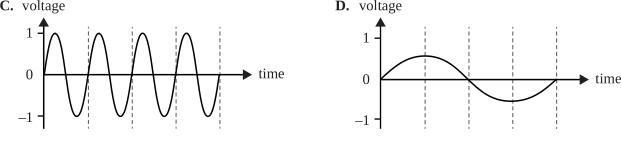
The coil of an AC generator completes 50 revolutions per second. A graph of output voltage versus time for this generator is shown below.
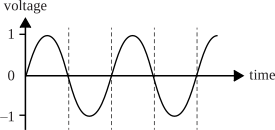
 

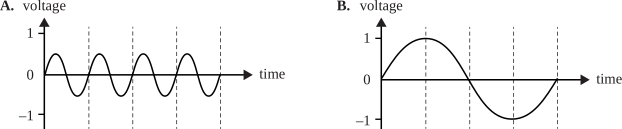
Which one of the following graphs best represents the output voltage if the rate of rotation is changed to 25 revolutions per second?
 

Show Answers Only

\(D\)

Show Worked Solution
  • \(f \propto \dfrac{1}{T}\), so if the frequency is halved to 25 revolutions per second, the period of the wave will be doubled.
  • The induced voltage is proportional to the rate of change of flux through the coil. As the rate of change of flux is halved, the induced voltage will also be halved.

\(\Rightarrow D\)

Filed Under: Applications of the Motor Effect Tagged With: Band 4, smc-3695-40-Generators, smc-3695-40-Lenz's/Faraday's Laws

Copyright © 2014–2025 SmarterEd.com.au · Log in