SmarterEd

Aussie Maths & Science Teachers: Save your time with SmarterEd

  • Login
  • Get Help
  • About

PHYSICS, M8 2024 HSC 22

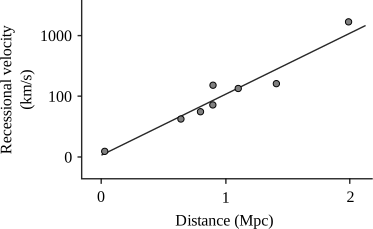
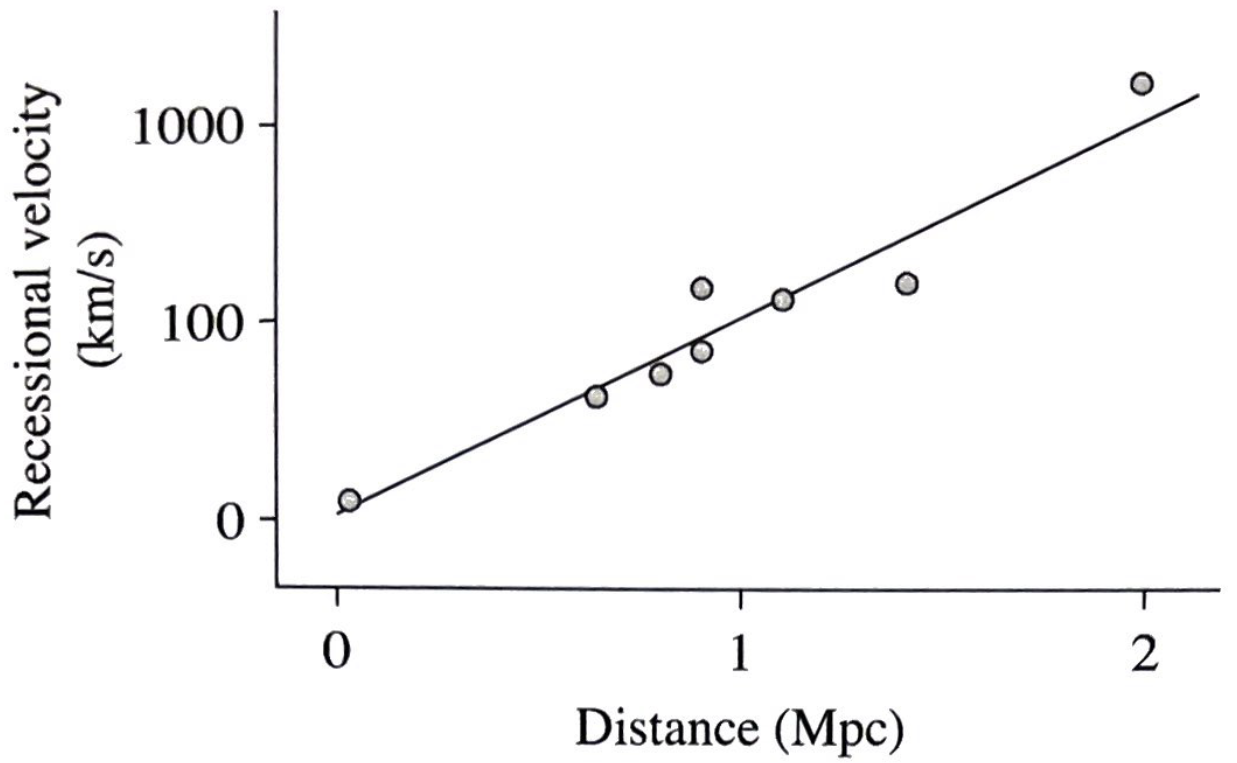
The following graph, based on the data gathered by Hubble, shows the relationship between the recessional velocity of galaxies and their distance from Earth.


  1. Describe the significance of the graph to our understanding of the universe.   (2 marks)

    --- 4 WORK AREA LINES (style=lined) ---

  2. How were the recessional velocities of galaxies determined?  (3 marks)

    --- 6 WORK AREA LINES (style=lined) ---

Show Answers Only

a.   Recessional velocity vs distance from Earth graph:

  • The graph shows that the further away galaxies are from Earth, the faster these galaxies are moving away from Earth.
  • This relationships depicts Hubble’s law:  \(v=H_0 D\). 
  • This graph provides evidence that the universe is constantly expanding as predicted by the big bang theory.
     

b.   Determining recessional velocities:

  • The recessional velocities of the galaxies were determined by analysing their absorption spectras.
  • Light waves that are moving away from the Earth will appear to be stretched (wavelength increased) according to the doppler effect.
  • The absorption spectra of galaxies were compared with the spectra of the same elements on Earth, revealing that the galaxies’ spectra were redshifted.
  • The greater the extent of the red shift in the spectra, the greater the recessional velocity of the galaxy. 

Show Worked Solution

a.   Recessional velocity vs distance from Earth graph:

  • The graph shows that the further away galaxies are from Earth, the faster these galaxies are moving away from Earth.
  • This relationships depicts Hubble’s law:  \(v=H_0 D\). 
  • This graph provides evidence that the universe is constantly expanding as predicted by the big bang theory.
     

b.   Determining recessional velocities:

  • The recessional velocities of the galaxies were determined by analysing their absorption spectras.
  • Light waves that are moving away from the Earth will appear to be stretched (wavelength increased) according to the doppler effect.
  • The absorption spectra of galaxies were compared with the spectra of the same elements on Earth, revealing that the galaxies’ spectra were redshifted.
  • The greater the extent of the red shift in the spectra, the greater the recessional velocity of the galaxy. 
♦ Mean mark (b) 49%.

Filed Under: Electromagnetic Spectrum, Origins of Elements Tagged With: Band 4, Band 5, smc-3696-10-Spectroscopy, smc-3700-20-Spectra, smc-3700-30-Hubble

PHYSICS, M7 2023 VCE 19*

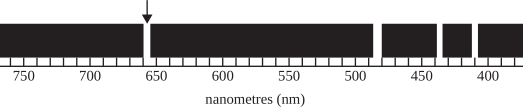
The diagram below shows the spectrum of light emitted by a hydrogen vapour lamp. The spectral line indicated by the arrow on the diagram is in the visible region of the spectrum.


Calculate the frequency of the light corresponding to the spectral line indicated by the arrow.   (2 marks)

--- 4 WORK AREA LINES (style=lined) ---

Show Answers Only

\(B\)

Show Worked Solution

\(\lambda = 655\ \text{nm}\ = 655 \times 10^{-9}\ \text{m}\)

\(f=\dfrac{c}{\lambda}=\dfrac{3 \times 10^8}{655 \times 10^{-9}} \approx 4.6 \times 10^{14}\ \text{Hz}\)

Filed Under: Electromagnetic Spectrum Tagged With: Band 4, smc-3696-10-Spectroscopy

PHYSICS, M7 2019 HSC 2 MC

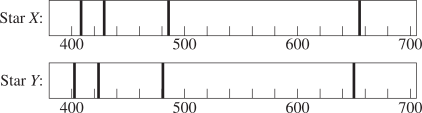
Two stars were observed from Earth. Their spectra are shown with the wavelength in nanometres.
 

Using these spectra, what can be concluded about the motion of the stars relative to Earth and their chemical compositions?
 

\begin{align*}
\begin{array}{l}
\rule{0pt}{2.5ex} \ \rule[-1ex]{0pt}{0pt}& \\
\rule{0pt}{2.5ex}\textbf{A.}\rule[-1ex]{0pt}{0pt}\\
\rule{0pt}{2.5ex}\textbf{B.}\rule[-1ex]{0pt}{0pt}\\
\rule{0pt}{2.5ex}\textbf{C.}\rule[-1ex]{0pt}{0pt}\\
\rule{0pt}{2.5ex}\textbf{D.}\rule[-1ex]{0pt}{0pt}\\
\end{array}
\begin{array}{|c|c|}
\hline
\rule{0pt}{1.5ex}\textit{Motion relative to Earth}\rule[-0.5ex]{0pt}{0pt}& \textit{Chemical composition} \\
\hline
\rule{0pt}{2.5ex}\text{The same}\rule[-1ex]{0pt}{0pt}&\text{The same}\\
\hline
\rule{0pt}{2.5ex}\text{Different}\rule[-1ex]{0pt}{0pt}& \text{The same}\\
\hline
\rule{0pt}{2.5ex}\text{The same}\rule[-1ex]{0pt}{0pt}& \text{Different} \\
\hline
\rule{0pt}{2.5ex}\text{Different}\rule[-1ex]{0pt}{0pt}& \text{Different} \\
\hline
\end{array}
\end{align*}

Show Answers Only

\(B\)

Show Worked Solution
  • Both stars have the same set of spectral lines → Chemical composition is the same.
  • Spectral lines at different wavelengths → Different doppler shift → Different motion relative to the earth.

\(\Rightarrow B\)

Filed Under: Electromagnetic Spectrum Tagged With: Band 3, smc-3696-10-Spectroscopy, smc-3696-30-Stars

PHYSICS, M7 2020 HSC 26

  1. Describe the difference between the spectra of the light produced by a gas discharge tube and by an incandescent lamp.   (2 marks)

--- 4 WORK AREA LINES (style=lined) ---

  1. The graph shows the curves predicted by two different models, `X` and `Y`, for the electromagnetic radiation emitted by an object at a temperature of 5000 K.
     

    Identify an assumption of EACH model which determines the shape of its curve.   (2 marks)

--- 4 WORK AREA LINES (style=lined) ---

  1. The diagram shows the radiation curve for a black body radiator at a temperature of 5000 K.


    On the same diagram, sketch a curve for a black body radiator at a temperature of 4000 K and explain the differences between the curves.   (4 marks)

    --- 6 WORK AREA LINES (style=lined) ---

Show Answers Only

a.   The spectra of light produced by a gas discharge tube will consist of lines only at a few discrete wavelengths.

The spectra of light produced by an incandescent lamp will be a continuous spectrum.

b.   Model `X` black bodies absorb and emit energy continuously.

Model `Y` assumes that black bodies absorb and emit energy in discrete quantities.

c.

  • Using `lambda_(max)=(b)/(T)\ \ =>\ \ lambda prop (1)/(T)`
  • Therefore, the 4000 K curve will have a peak wavelength greater than the 5000 K curve.
  • The area under the curve and the intensity at all wavelengths will be less for the 4000 K curve, as the total power output of a black body decreases as its temperature decreases.
Show Worked Solution

a.    Differences:

  • The spectra of light produced by a gas discharge tube will consist of lines only at a few discrete wavelengths.
  • The spectra of light produced by an incandescent lamp will be a continuous spectrum.

♦ Mean mark (a) 39%.

b.    Assumptions of EACH model:

  • Model `X` black bodies absorb and emit energy continuously.
  • Model `Y` assumes that black bodies absorb and emit energy in discrete quantities.

♦ Mean mark (b) 44%.

c.

  • Using `lambda_(max)=(b)/(T)\ \ =>\ \ lambda prop (1)/(T)`
  • Therefore, the 4000 K curve will have a peak wavelength greater than the 5000 K curve.
  • The area under the curve and the intensity at all wavelengths will be less for the 4000 K curve, as the total power output of a black body decreases as its temperature decreases.

Filed Under: Electromagnetic Spectrum, Light: Quantum Model, Light: Wave Model, Origins of Elements Tagged With: Band 4, Band 5, smc-3696-10-Spectroscopy, smc-3698-50-Blackbodies, smc-3698-80-Wave/Particle models, smc-3700-20-Spectra

PHYSICS, M7 2021 HSC 5 MC

The spectrum of an object is shown.
 

Which row of the table correctly identifies the most likely source of the spectrum and the features labelled \(Y\)?

\begin{align*}
\begin{array}{l}
\rule{0pt}{1.5ex} \ \rule[-0.5ex]{0pt}{0pt}& \\
\rule{0pt}{2.5ex}\textbf{A.}\rule[-1ex]{0pt}{0pt}\\
\rule{0pt}{2.5ex}\textbf{B.}\rule[-1ex]{0pt}{0pt}\\
\rule{0pt}{2.5ex}\textbf{C.}\rule[-1ex]{0pt}{0pt}\\
\rule{0pt}{2.5ex}\textbf{D.}\rule[-1ex]{0pt}{0pt}\\
\end{array}
\begin{array}{|l|l|}
\hline
\rule{0pt}{1.5ex}\text{Source of spectrum}\rule[-0.5ex]{0pt}{0pt}& \textit{Features labelled \(Y\)} \\
\hline
\rule{0pt}{2.5ex}\text{Star}\rule[-1ex]{0pt}{0pt}&\text{Absorption lines}\\
\hline
\rule{0pt}{2.5ex}\text{Discharge tube}\rule[-1ex]{0pt}{0pt}& \text{Absorption lines}\\
\hline
\rule{0pt}{2.5ex}\text{Star}\rule[-1ex]{0pt}{0pt}& \text{Emission lines} \\
\hline
\rule{0pt}{2.5ex}\text{Discharge tube}\rule[-1ex]{0pt}{0pt}& \text{Emission lines} \\
\hline
\end{array}
\end{align*}

Show Answers Only

\(A\)

Show Worked Solution
  • Overall shape resembles a blackbody curve so the source of the spectrum is a star. The wavelengths of lower intensity are absorption lines.

\(\Rightarrow A\)

Filed Under: Electromagnetic Spectrum, Origins of Elements Tagged With: Band 4, smc-3696-10-Spectroscopy, smc-3696-30-Stars, smc-3700-20-Spectra

Copyright © 2014–2025 SmarterEd.com.au · Log in