SmarterEd

Aussie Maths & Science Teachers: Save your time with SmarterEd

  • Login
  • Get Help
  • About

PHYSICS, M5 EQ-Bank 25

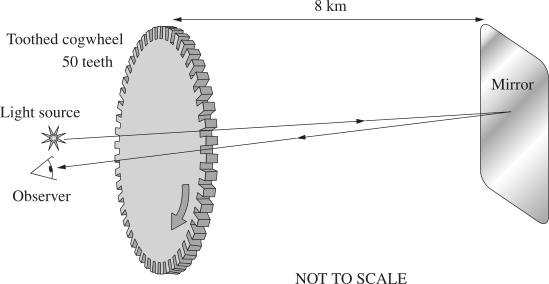
In the 1840s, French physicist, Hippolyte Fizeau performed an experiment to measure the speed of light. He shone an intense light source at a mirror 8 km away and broke up the light beam with a rotating cogwheel. He adjusted the speed of rotation of the wheel until the reflected light beam could no longer be seen returning through the gaps in the cogwheel.

The diagram shows a similar experiment. The cogwheel has 50 teeth and 50 gaps of the same width.
 

Explain why specific speeds of rotation of the cogwheel will completely block the returning light. Support your answer with calculations.   (5 marks)

--- 13 WORK AREA LINES (style=lined) ---

Show Answers Only
  • Light travelling through a gap in the cogwheel can be completely blocked by a tooth. This occurs if a tooth moves exactly the width of a gap in the time it takes for light to travel to the mirror and back.
  • Calculating the time taken:
  •    `t=(s)/(v)=(2xx8000)/(3.00 xx10^(8))=5.33 xx10^(-5)  text{s}`
  • To completely block the light, the tooth will have moved into the path of a gap in this time. Since there are 50 teeth and 50 gaps, the wheel will have undergone one hundredth of a rotation in this time.
  •    `omega=(Delta theta)/(t)=((2pi)/(100))/(5.33 xx10^(-5))=1180  text{rad s}^(-1)`
  • Additionally, the light will also be completely blocked if the cogwheel is spun at 3, 5, 7, or any odd multiple of this speed. In these cases, the wheel turns an odd number of gap-tooth intervals in the time it takes light to return.
  • For example, at three times this speed, the wheel rotates three hundredths of a full turn during the light’s round trip, so the returning light meets the second tooth instead of a gap and is blocked.
Show Worked Solution
  • Light travelling through a gap in the cogwheel can be completely blocked by a tooth. This occurs if a tooth moves exactly the width of a gap in the time it takes for light to travel to the mirror and back.
  • Calculating the time taken:
  •    `t=(s)/(v)=(2xx8000)/(3.00 xx10^(8))=5.33 xx10^(-5)  text{s}`
  • To completely block the light, the tooth will have moved into the path of a gap in this time. Since there are 50 teeth and 50 gaps, the wheel will have undergone one hundredth of a rotation in this time.
  •    `omega=(Delta theta)/(t)=((2pi)/(100))/(5.33 xx10^(-5))=1180  text{rad s}^(-1)`
  • Additionally, the light will also be completely blocked if the cogwheel is spun at 3, 5, 7, or any odd multiple of this speed. In these cases, the wheel turns an odd number of gap-tooth intervals in the time it takes light to return.
  • For example, at three times this speed, the wheel rotates three hundredths of a full turn during the light’s round trip, so the returning light meets the second tooth instead of a gap and is blocked.

Filed Under: Circular Motion, Electromagnetic Spectrum Tagged With: Band 4, Band 5, smc-3691-40-Angular Velocity, smc-3696-20-Measuring c

PHYSICS, M7 2022 HSC 23

Outline a method that could be used to determine a value for the speed of light. In your answer, identify ONE factor that would limit the accuracy of the experimental data.  (4 marks)

--- 10 WORK AREA LINES (style=lined) ---

Show Answers Only

Foucault’s cogwheel experiment (one possible method):

  • Set up a cogwheel and a mirror 8 km apart.
  • Shine a pulse of light through one of the gaps of the cogwheel.
  • Begin to rotate the cogwheel and record the lowest speed at which the returning light is completely blocked.
  • This is the speed at which, on the light’s journey, the cogwheel has rotated through half the distance between adjacent cogs (or the distance between a cog and the adjacent gap).
  • Using the rotation speed of the wheel and the distance between a cog and a gap, calculate the time taken for light to complete its journey.
  • Calculate the speed of light using  `c=(d)/(t)`, where  `d` = 16 km.

Limitation:

  • The accuracy of this experiment is limited by errors in measurement of the distance between the cogwheel and the mirror, as well as errors measuring the speed of rotation of the cogwheel.

Other valid methods:

  • Fizeau’s rotating mirror experiment.
  • Newton’s experiment.
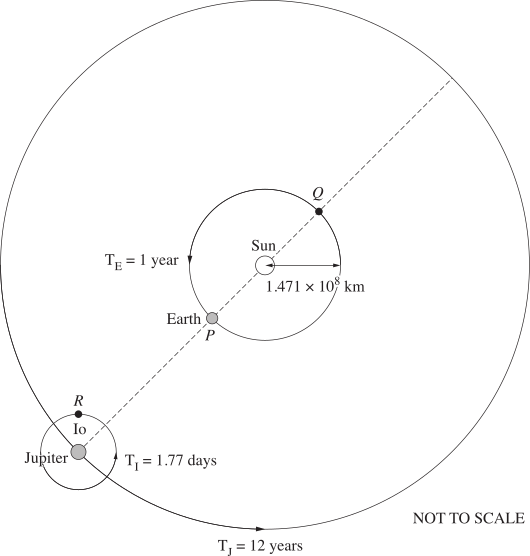
  • Ole Romer’s experiment observing moons of Jupiter.
  • Experiments involving resonant cavities.
Show Worked Solution

Foucault’s cogwheel experiment (one possible method):

  • Set up a cogwheel and a mirror 8 km apart.
  • Shine a pulse of light through one of the gaps of the cogwheel.
  • Begin to rotate the cogwheel and record the lowest speed at which the returning light is completely blocked.
  • This is the speed at which, on the light’s journey, the cogwheel has rotated through half the distance between adjacent cogs (or the distance between a cog and the adjacent gap).
  • Using the rotation speed of the wheel and the distance between a cog and a gap, calculate the time taken for light to complete its journey.
  • Calculate the speed of light using  `c=(d)/(t)`, where  `d` = 16 km.

Limitation:

  • The accuracy of this experiment is limited by errors in measurement of the distance between the cogwheel and the mirror, as well as errors measuring the speed of rotation of the cogwheel.

Other valid methods:

  • Fizeau’s rotating mirror experiment.
  • Newton’s experiment.
  • Ole Romer’s experiment observing moons of Jupiter.
  • Experiments involving resonant cavities.

Mean mark 56%.

Filed Under: Electromagnetic Spectrum Tagged With: Band 4, smc-3696-20-Measuring c

PHYSICS, M7 2020 HSC 18 MC

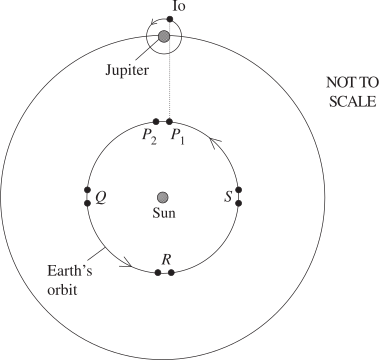
An observer sees Io complete one orbit of Jupiter as Earth moves from `P_1` to `P_2`, and records the observed orbital period as `t_p`. Similarly, the time for one orbit of Io around Jupiter was measured as Earth moved between the pairs of points at `Q`, `R` and `S`, with the corresponding measured periods of Io being `t_Q`, `t_R` and `t_S`.
 

Which measurement of the orbital period would be the longest?

  1. `t_P`
  2. `t_Q`
  3. `t_R`
  4. `t_S`
Show Answers Only

`B`

Show Worked Solution

When the Earth is travelling between the pairs of points at `Q `, it is moving away from Jupiter:

  • light must travel further to signal the end of an orbit than it does to signal the start of an orbit.
  • `t_(Q)`  would be the longest measured orbital period.

`=>B`


♦ Mean mark 21%.

Filed Under: Electromagnetic Spectrum Tagged With: Band 6, smc-3696-20-Measuring c

Copyright © 2014–2025 SmarterEd.com.au · Log in