SmarterEd

Aussie Maths & Science Teachers: Save your time with SmarterEd

  • Login
  • Get Help
  • About

PHYSICS, M7 2024 HSC 16 MC

The graph shows the relationship between the maximum kinetic energy of emitted photoelectrons and the incident photon energy for four different metal surfaces.
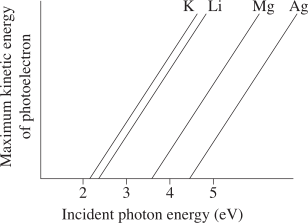
 

Light of frequency \(7 \times 10^{14}\ \text{Hz}\) is incident on the metals.

From which metals are photoelectrons emitted?

  1. \(\ce{K}\), \(\ce{Li}\) only
  2. \(\ce{Mg}\), \(\ce{Ag}\) only
  3. All of the metals
  4. None of the metals
Show Answers Only

\(A\)

Show Worked Solution
  • The photon energy for a light frequency of \(7 \times 10^{14}\ \text{Hz}\) is:
  •    \(E=hf = 6.626 \times 10^{-34} \times 7 \times 10^{14} = 4.64 \times 10^{-19}\ \text{J}\)
  • The energy of the light frequency in electron volts\(=\dfrac{4.64 \times 10^{-19}}{1.602 \times 10^{-19}} = 2.9\ \text{eV}\).
  • Photoelectrons will only be emitted if the energy of the incident photons is enough to overcome the work function of the metals. On the graph above, the work function of each metal is the same value as the x-intercepts of their respective graphs.
  • Therefore photoelectrons will be emitted from potassium and lithium as the energy of the incident photons \((2.9\ \text{eV})\) is greater than the work functions of these metals.

\(\Rightarrow A\)

♦ Mean mark 47%.

Filed Under: Light: Quantum Model Tagged With: Band 5, smc-3698-10-Photoelectric Effect, smc-3698-30-E=hf calcs

PHYSICS, M7 2021 VCE 15

A photoelectric experiment is carried out by students. They measure the threshold frequency of light required for photoemission to be 6.5 × 10\(^{14}\) Hz and the work function to be 3.2 × 10\(^{-19}\) J.

Using the students' measurements, what value would they calculate for Planck's constant? Outline your reasoning and show all your working. Give your answer in joule-seconds.   (3 marks)

--- 6 WORK AREA LINES (style=lined) ---

Show Answers Only

\(h=4.9 \times 10^{-34}\ \text{J s}\)

Show Worked Solution

\(f=6.5 \times 10^{14}\ \text{Hz},\ \ E=3.2 \times 10^{-19}\ \text{J}\)

\(E=hf\ \ \Rightarrow\ \ h=\dfrac{E}{f}\)

\(\therefore h=\dfrac{3.2 \times 10^{-19}}{6.5 \times 10^{14}} = 4.92 \times 10^{-34}\ \text{J s}\)

Filed Under: Light: Quantum Model Tagged With: Band 4, smc-3698-10-Photoelectric Effect, smc-3698-30-E=hf calcs

PHYSICS, M7 2023 HSC 23b

The James Webb Space Telescope (JWST) is sensitive to wavelengths from  6.0 \(\times\) 10\(^{-7}\) m  to  2.8 \(\times\) 10\(^{-5}\) m.

What is the minimum photon energy that it can detect?  (3 marks)

--- 6 WORK AREA LINES (style=lined) ---

Show Answers Only

\(E_{\text{min}}= 7.1 \times 10^{-21}\) \( \text{J}\)

Show Worked Solution

  • The minimum photon energy corresponds to the minimum frequency.
  • Minimum frequency occurs at the maximum wavelength as frequency and wavelength are inversely proportional.
\(E_{\text{min}}\) \(=hf\)  
  \(=\dfrac{hc}{ \lambda}\)  
  \(=\dfrac{6.626 \times 10^{-34} \times 3 \times 10^8}{2.8 \times 10^{-5}} \)  
  \(=7.1 \times 10^{-21}\) \(\text J\)  

Filed Under: Light: Quantum Model Tagged With: Band 4, smc-3698-20-Photons, smc-3698-30-E=hf calcs

PHYSICS, M7 EQ-Bank 32

Applying the law of conservation of energy, explain why  `K_max = h f-phi`.   (3 marks)

--- 6 WORK AREA LINES (style=lined) ---

Show Answers Only
  • The law of conservation of energy states that energy cannot be created or destroyed, only transferred or transformed into different forms. 
  • The initial energy of a photon is equal to `hf`.
  • If this photon strikes a metal surface, a photoelectron may be released. Some energy is required to remove the electron from the metal surface which is equal to the work function (`phi`) of the metal.
  • The electron will also possess kinetic energy, `K_(max)`.
  • Applying the law of conservation of energy, the energy before equals the energy after, or  `hf=K_(max)+phi`.
  • Rearranging this gives  `K_(max)=hf-phi`.
Show Worked Solution
  • The law of conservation of energy states that energy cannot be created or destroyed, only transferred or transformed into different forms. 
  • The initial energy of a photon is equal to `hf`.
  • If this photon strikes a metal surface, a photoelectron may be released. Some energy is required to remove the electron from the metal surface which is equal to the work function (`phi`) of the metal.
  • The electron will also possess kinetic energy, `K_(max)`.
  • Applying the law of conservation of energy, the energy before equals the energy after, or  `hf=K_(max)+phi`.
  • Rearranging this gives  `K_(max)=hf-phi`.

Filed Under: Light: Quantum Model Tagged With: Band 4, smc-3698-20-Kinetic energy calcs, smc-3698-30-E=hf calcs

PHYSICS, M7 2016 HSC 11 MC

What is the wavelength, in metres, of a photon with an energy of 3.5 eV?

  1. `1.2 × 10^(-6)`
  2. `3.5 × 10^(-7)`
  3. `1.18 × 10^(-15)`
  4. `5.67 × 10^(-26)`
Show Answers Only

`B`

Show Worked Solution
`E` `=3.5 xx1.602 xx10^(-19)`  
  `=5.607 xx10^(-19)  text{J}`  

 
`E=hf=(hc)/(lambda)\ \ => \ \ lambda=(hc)/(E)`

`:.lambda` `=(6.626 xx10^(-34)xx3xx10^(8))/(5.607 xx10^(-19))`  
  `=3.5 xx10^(-7)  text{m}`  

 
`=>B`

Filed Under: Light: Quantum Model Tagged With: Band 4, smc-3698-30-E=hf calcs

PHYSICS, M7 2017 HSC 21

A laser emits light of wavelength 550 nm.

  1. Calculate the frequency of this light.   (2 marks)

--- 4 WORK AREA LINES (style=lined) ---

  1. The electrons in a specific metal must absorb a minimum of  `5 × 10^(-19)\ text{J}`  in order to be ejected from its surface.
  2. Explain why electrons will not be ejected from this metal when photons of wavelength 550 nm strike its surface. Support your answer with relevant calculations.   (3 marks)

--- 6 WORK AREA LINES (style=lined) ---

Show Answers Only

a.   `f=5.45 xx10^(14)  text{Hz}`

b.    `E` `=3.63 xx10^(-19)  text{J}`
    `<5 xx10^(-19)  text{J}`

 
`text{So, no electrons are ejected.}`

Show Worked Solution
a. `v` `=flambda`
  `f` `=(v)/(lambda)=(3xx10^(8))/(550 xx10^(-9))=(3xx10^(8))/(550 xx10^(-9))`


b. `E` `=hf`
    `=6.62 xx10^(-34)xx5.46 xx10^(14)`
    `=3.63 xx10^(-19)  text{J}`
     
  •  The work function of the metal sample is  `5 xx10^(-19)\ text{J}`.
  • Since the incident photon energy of  `3.63 xx10^(-19)  text{J}`  is less than  `5 xx10^(-19)\ text{J}`, they are unable to eject electrons from the metal.

Filed Under: Light: Quantum Model Tagged With: Band 3, smc-3698-10-Photoelectric Effect, smc-3698-30-E=hf calcs

PHYSICS M7 2022 HSC 7 MC

A photon has an energy of  `9.0 xx10^(-24)\ text{J}`.

What is the frequency of this radiation?

  1. `1.00 xx10^(-40) \ text{Hz}`
  2. `7.36 xx10^(-11) \ text{Hz}`
  3. `1.36 xx10^(10) \ text{Hz}`
  4. `5.97 xx10^(11) \ text{Hz}`
Show Answers Only

`C`

Show Worked Solution
`E` `=hf`  
`f` `=(E)/(h)=(9.0 xx10^(-24))/(6.626 xx10^(-34))=1.36 xx10^(10)  text{Hz}`  

 
`=>C`

Filed Under: Light: Quantum Model Tagged With: Band 3, smc-3698-30-E=hf calcs

Copyright © 2014–2025 SmarterEd.com.au · Log in