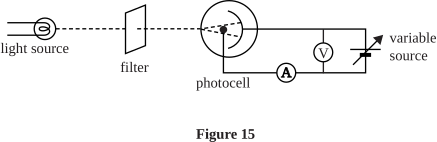
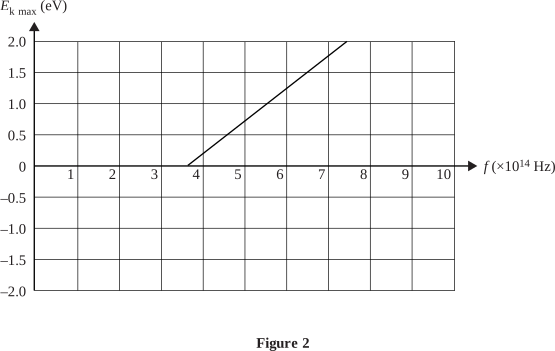
Students are studying the photoelectric effect using the apparatus shown in Figure 1. Figure 2 shows the results the students obtained for the maximum kinetic energy \((E_{\text{k max }})\) of the emitted photoelectrons versus the frequency of the incoming light. --- 2 WORK AREA LINES (style=lined) --- --- 2 WORK AREA LINES (style=lined) --- --- 2 WORK AREA LINES (style=lined) --- --- 0 WORK AREA LINES (style=blank) --- a.i. \(5.4 \times 10^{-15}\ \text{eV s}\) ii. \(811\ \text{nm}\) iii. \(1.9\ \text{eV}\). b. a.i. Planck’s constant \((h)\): \(\therefore h=\dfrac{\text{rise}}{\text{run}}=\dfrac{1.25-0}{6 \times 10^{14}-3.7\times 10^{-14}}=5.4 \times 10^{-15}\ \text{eV s}\) a.ii. Max wavelength = minimum frequency of emitted photoelectron. \(\lambda=\dfrac{c}{f}=\dfrac{3 \times 10^8}{3.7 \times 10^{14}}=811\ \text{nm}\) a.iii. b. Constructing the new graph:
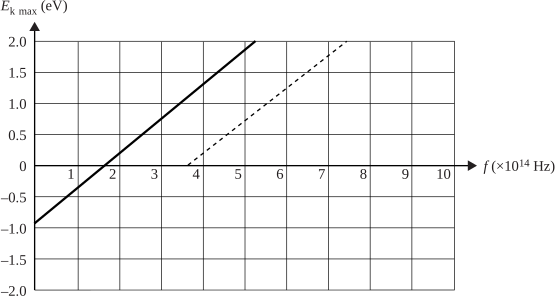
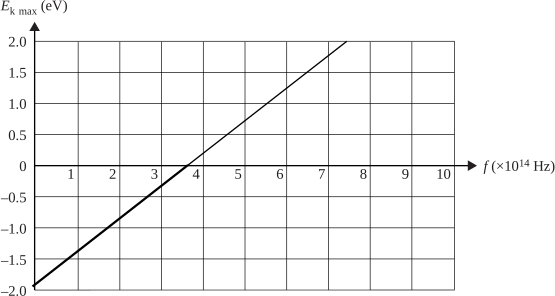
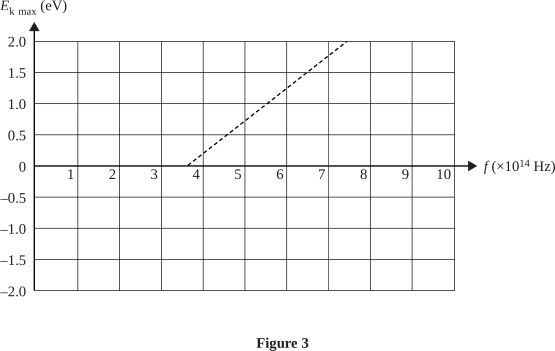
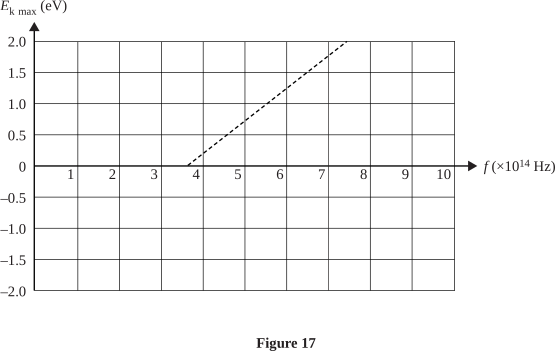
On Figure 3, draw the line that would be obtained if a different metal, with a work function of \(\dfrac{1}{2} \phi\), were used in the photocell. The original graph is shown as a dashed line. (2 marks)
PHYSICS, M7 2014 HSC 26
- Calculate the energy of a photon of wavelength 415 nm. (2 marks)
- An experiment was conducted using a photoelectric cell as shown in the diagram.
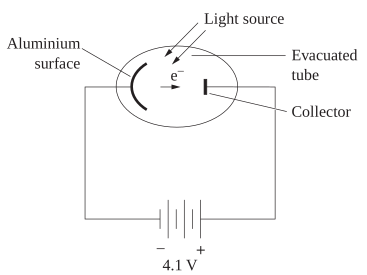
The graph plots the maximum kinetic energy of the emitted photoelectrons against radiation frequency for the aluminium surface.
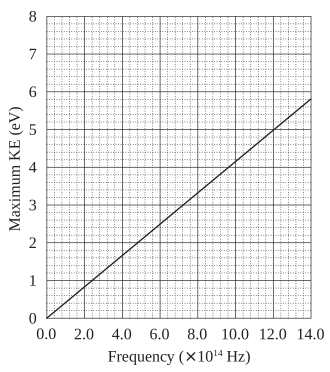
The experiment is planned to be repeated using a voltage of 0.0 V.
Draw a line on the graph to show the predicted results of the planned experiment, and determine the radiation frequency which would produce photoelectrons with a maximum kinetic energy of 1.2 eV using a voltage of 0.0 V. (3 marks)
Show Worked Solution
| a. | `c` | `= f lambda` |
| `= hf` | ||
| `= (hc)/lambda` | ||
| `= (6.626 xx 10^(-34) Js xx 3 xx 10^8 ms^(-1))/(415 xx 10^(-9)m)` | ||
| `= 4.79 xx 10^(-19) J` |
| b. | 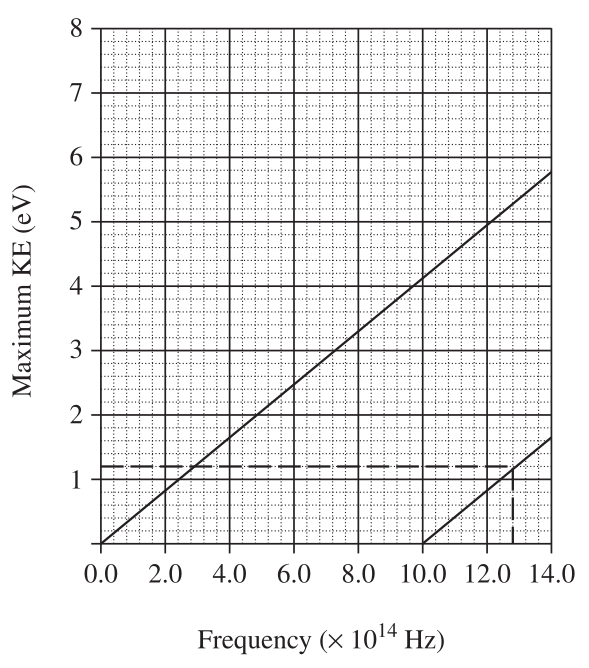 |
`text(To find intercept)`
| `4.1 text(V)` | `= 4.1 xx 1.602 xx 10^(-19)\ text(J)` | `text(of energy required to be)` `text(supplied by the photon.)` |
| `= 6.56 xx 10^(-19)\ text(J)` | ||
| `hf` | `= 6.56 xx 10^(-19)\ text(J)` | |
| `f` | `= (6.56 xx 10^(-19))/(6.626 xx 10^(-34))` | |
| `= 9.9 xx 10^14` |
`text(Gradient = same as A1)`
| `text{From graph maximum KE(eV)}` | `= 1.2\ text(eV)` |
| `text(Frequency)` | `= 12.8\ text(Hz)` |
| `= 12.8 xx 10^14\ text(Hz)` |