SmarterEd

Aussie Maths & Science Teachers: Save your time with SmarterEd

  • Login
  • Get Help
  • About

PHYSICS, M7 2024 HSC 32

Many scientists have performed experiments to explore the interaction of light and matter.

Analyse how evidence from at least THREE such experiments has contributed to our understanding of physics.   (8 marks)

--- 16 WORK AREA LINES (style=lined) ---
Show Answers Only

Students could include any of the following experiments:

  • Black body radiation experiments (M7 Quantum Nature of Light)
  • Photoelectric experiments (M7 Quantum Nature of Light)
  • Spectroscopy experiments (M8 Origins of Elements)
  • Polarisation experiments (M7 Wave Nature of Light)
  • Interference and diffraction (M7 Wave Nature of Light)
  • Cosmic gamma rays (M7 Special Relativity and/or M8 Deep Inside the Atom and standard model).

Young’s Double-Slit Experiment:

  • Young’s 1801 double slit experiment aimed to determine light’s wave-particle nature.
  • He passed coherent light through two slits and observed the pattern on a screen.
  • Instead of Newton’s predicted two bright bands, Young observed alternating bright and dark bands.
  • This interference pattern occurred due to light diffraction and interference, which  re wave properties.
  • The experiment provided strong evidence for light behaving as a wave at macroscopic scales. 

Planck and the Blackbody Radiation Crisis:

  • Late 19th century scientists studied the relationship between black body radiation’s wavelength and intensity.
  • Experimental observations showed intensity peaked at a specific wavelength, contradicting classical physics predictions.
  • Classical physics led to the “ultraviolet catastrophe,” which violated energy conservation.
  • Planck’s thought experiment resolved this by proposing energy was transferred in discrete packets (quanta) where  \(E=hf\).
  • This revolutionary idea marked a shift from classical physics to quantum theory. 

Einstein and the Photoelectric Effect:

  • In 1905, Einstein built upon Plank’s idea of quantised energy to propose that light was made up of quantised photons where \(E=hf\).
  • Einstein proposition explained why electrons are ejected from metal surfaces only when light exceeds a minimum frequency.
  • Previous to Einstein’s explanation of the photoelectric effect a high intensity of light corresponds to a high energy.
  • Einstein proposed that the KE of the emitted electrons was proportion to the frequency of the light rather than the intensity of the light. 
  • This development in the understanding of the interaction of light and matter at the atomic level shifted our understanding of light to a wave-particle duality model.

Cosmic Ray Experiments and the development of the Standard Model:

  • In 1912, Victor Hess discovered cosmic rays through high-altitude balloon experiments, finding that radiation increased with altitude rather than decreased as expected.
  • The study of cosmic rays led to the unexpected discovery of new particles, including the positron and muon, which couldn’t be explained by the known models of matter.
  • These discoveries from cosmic rays helped inspire the development of modern particle accelerators and contributed to the formulation of the quark model in the 1960s.
  • Eventually further studies on these newly discovered particles led to the development of the Standard Model of particle physics, which organises all known elementary particles and their interactions.

Show Worked Solution

Students could include any of the following experiments:

  • Black body radiation experiments (M7 Quantum Nature of Light)
  • Photoelectric experiments (M7 Quantum Nature of Light)
  • Spectroscopy experiments (M8 Origins of Elements)
  • Polarisation experiments (M7 Wave Nature of Light)
  • Interference and diffraction (M7 Wave Nature of Light)
  • Cosmic gamma rays (M7 Special Relativity and/or M8 Deep Inside the Atom and standard model).

Young’s Double-Slit Experiment:

  • Young’s 1801 double slit experiment aimed to determine light’s wave-particle nature.
  • He passed coherent light through two slits and observed the pattern on a screen.
  • Instead of Newton’s predicted two bright bands, Young observed alternating bright and dark bands.
  • This interference pattern occurred due to light diffraction and interference, which  re wave properties.
  • The experiment provided strong evidence for light behaving as a wave at macroscopic scales. 

Planck and the Blackbody Radiation Crisis:

  • Late 19th century scientists studied the relationship between black body radiation’s wavelength and intensity.
  • Experimental observations showed intensity peaked at a specific wavelength, contradicting classical physics predictions.
  • Classical physics led to the “ultraviolet catastrophe,” which violated energy conservation.
  • Planck’s thought experiment resolved this by proposing energy was transferred in discrete packets (quanta) where  \(E=hf\).
  • This revolutionary idea marked a shift from classical physics to quantum theory. 

Einstein and the Photoelectric Effect:

  • In 1905, Einstein built upon Plank’s idea of quantised energy to propose that light was made up of quantised photons where \(E=hf\).
  • Einstein proposition explained why electrons are ejected from metal surfaces only when light exceeds a minimum frequency.
  • Previous to Einstein’s explanation of the photoelectric effect a high intensity of light corresponds to a high energy.
  • Einstein proposed that the KE of the emitted electrons was proportion to the frequency of the light rather than the intensity of the light. 
  • This development in the understanding of the interaction of light and matter at the atomic level shifted our understanding of light to a wave-particle duality model.

Cosmic Ray Experiments and the development of the Standard Model:

  • In 1912, Victor Hess discovered cosmic rays through high-altitude balloon experiments, finding that radiation increased with altitude rather than decreased as expected.
  • The study of cosmic rays led to the unexpected discovery of new particles, including the positron and muon, which couldn’t be explained by the known models of matter.
  • These discoveries from cosmic rays helped inspire the development of modern particle accelerators and contributed to the formulation of the quark model in the 1960s.
  • Eventually further studies on these newly discovered particles led to the development of the Standard Model of particle physics, which organises all known elementary particles and their interactions.
♦ Mean mark 50%.

Filed Under: Deep Inside the Atom, Light and Special Relativity, Light: Quantum Model, Light: Wave Model Tagged With: Band 5, Band 6, smc-3697-20-Young, smc-3698-10-Photoelectric Effect, smc-3698-60-Experiments, smc-3698-70-Planck, smc-3704-10-Standard Model

PHYSICS, M7 2016 HSC 27b

Explain how the result of ONE investigation of the photoelectric effect changed the scientific understanding of the nature of light.   (4 marks)

--- 8 WORK AREA LINES (style=lined) ---
Show Answers Only
  • One investigation of the photoelectric effect showed that the kinetic energy of emitted photoelectrons increased when the frequency of incident light increased, but did not increase with increased light intensity.
  • This could only be explained by a particle, or photon model of light.
  • The photon model considers light to consist of discrete packets of energy, where the energy of a photon is proportional to its frequency.
  • Thus, higher frequency light → greater photon energy → greater kinetic energy of emitted photoelectrons.
  • The scientific understanding of light was changed from a wave model where light existed only as transverse waves of different wavelengths to a wave-particle duality.
Show Worked Solution
  • One investigation of the photoelectric effect showed that the kinetic energy of emitted photoelectrons increased when the frequency of incident light increased, but did not increase with increased light intensity.
  • This could only be explained by a particle, or photon model of light.
  • The photon model considers light to consist of discrete packets of energy, where the energy of a photon is proportional to its frequency.
  • Thus, higher frequency light → greater photon energy → greater kinetic energy of emitted photoelectrons.
  • The scientific understanding of light was changed from a wave model where light existed only as transverse waves of different wavelengths to a wave-particle duality.

♦ Mean mark 40%.

Filed Under: Light: Quantum Model Tagged With: Band 5, smc-3698-10-Photoelectric Effect, smc-3698-60-Experiments

PHYSICS, M7 2014 HSC 26

  1. Calculate the energy of a photon of wavelength 415 nm.  (2 marks)
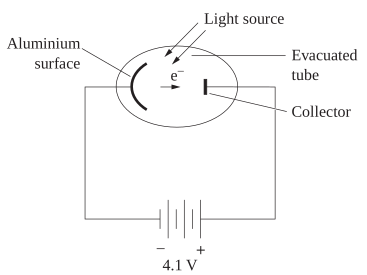
  2. An experiment was conducted using a photoelectric cell as shown in the diagram.

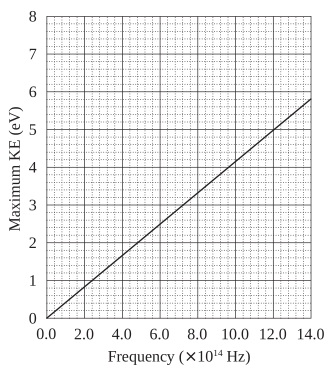
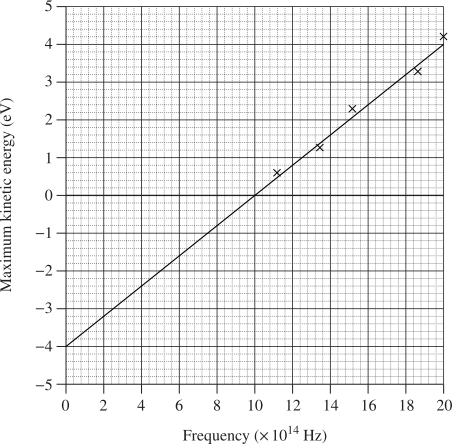
The graph plots the maximum kinetic energy of the emitted photoelectrons against radiation frequency for the aluminium surface.

The experiment is planned to be repeated using a voltage of 0.0 V.

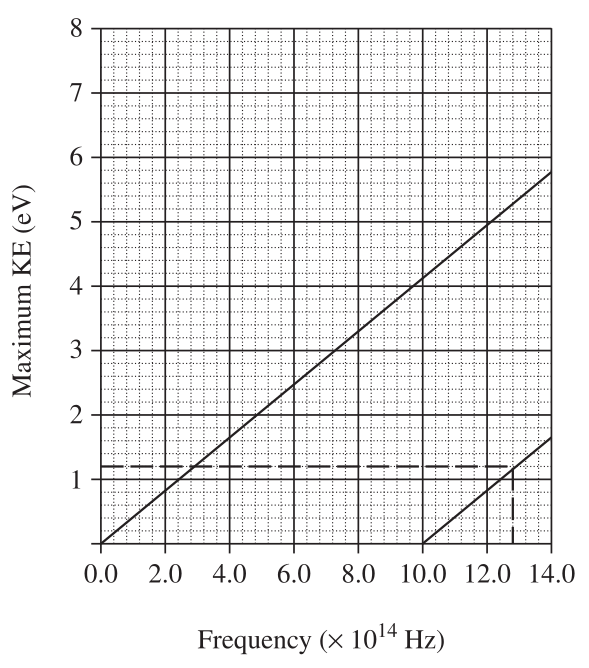
Draw a line on the graph to show the predicted results of the planned experiment, and determine the radiation frequency which would produce photoelectrons with a maximum kinetic energy of 1.2 eV using a voltage of 0.0 V.  (3 marks)

Show Answers Only

`text(See Worked Solutions)`

Show Worked Solution
a.   `c` `= f lambda`
    `= hf`
    `= (hc)/lambda`
    `= (6.626 xx 10^(-34) Js xx 3 xx 10^8 ms^(-1))/(415 xx 10^(-9)m)`
    `= 4.79 xx 10^(-19) J`


b.  

`text(To find intercept)`

`4.1 text(V)` `= 4.1 xx 1.602 xx 10^(-19)\ text(J)` `text(of energy required to be)`
`text(supplied by the photon.)`
  `= 6.56 xx 10^(-19)\ text(J)`  
`hf` `= 6.56 xx 10^(-19)\ text(J)`  
`f` `= (6.56 xx 10^(-19))/(6.626 xx 10^(-34))`  
  `= 9.9 xx 10^14`  

`text(Gradient = same as A1)`

`text{From graph maximum KE(eV)}` `= 1.2\ text(eV)`
`text(Frequency)` `= 12.8\ text(Hz)`
  `= 12.8 xx 10^14\ text(Hz)`

Filed Under: Uncategorized Tagged With: Band 4, Band 5, smc-3698-40-Find freq/lambda, smc-3698-60-Experiments

PHYSICS, M7 2022 HSC 14 MC

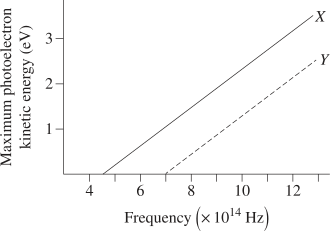
Line `X` shows the results of an experiment carried out to investigate the photoelectric effect.


What change to this experiment would produce the results shown by line `Y` ?

  1. Increasing the frequency of the radiation
  2. Using a metal that has a greater work function
  3. Decreasing the intensity of the incident radiation
  4. Decreasing the maximum energy of photoelectrons
Show Answers Only

`B`

Show Worked Solution
  • The work function of the metals is given by the respective y-intercepts of lines `X` and `Y`. 
  • As line `Y` has a y-intercept with greater magnitude, it can be produced by using a metal with a greater work function.

`=>B`

Filed Under: Light: Quantum Model Tagged With: Band 4, smc-3698-10-Photoelectric Effect, smc-3698-60-Experiments

PHYSICS, M7 2019 HSC 23

A student investigated the photoelectric effect. The frequency of light incident on a metal surface was varied and the corresponding maximum kinetic energy of the photoelectrons was measured.

The following results were obtained.
 

\begin{array}{|l|c|c|c|c|c|}
\hline \rule{0pt}{2.5ex}\textit{Frequency}\ \left(\times 10^{14} Hz\right) \rule[-1ex]{0pt}{0pt}& 11.2 & 13.5 & 15.2 & 18.6 & 20.0 \\
\hline \rule{0pt}{2.5ex}\textit{Maximum kinetic energy}\ (eV) \rule[-1ex]{0pt}{0pt}& 0.6 & 1.3 & 2.3 & 3.3 & 4.2 \\
\hline
\end{array}

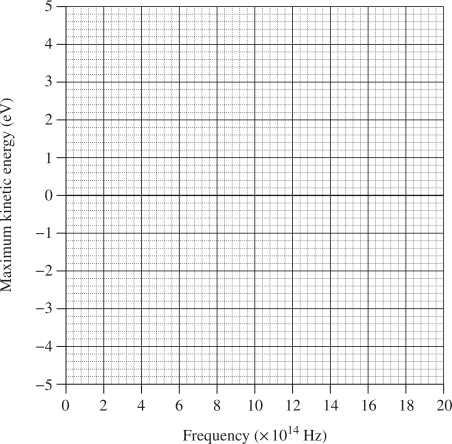
Plot the results on the axes below and hence determine the work function of the metal in electron volts.   (3 marks)
 

--- 3 WORK AREA LINES (style=lined) ---
Show Answers Only

Work function = 4 eV

Show Worked Solution

The metal has a work function of 4 eV (this is the negative of the \(y\)-intercept).

Filed Under: Light: Quantum Model Tagged With: Band 4, smc-3698-10-Photoelectric Effect, smc-3698-60-Experiments

PHYSICS, M7 2020 HSC 3 MC

What was the basis for Maxwell's prediction of the velocity of electromagnetic waves?

  1. Experiments using magnetic fields to accelerate particles
  2. Experiments using light and mirrors to establish the finite speed of light
  3. Equations showing how oscillating electric and magnetic fields propagate
  4. Equations showing how electromagnetic waves are affected by gravitational fields
Show Answers Only

`C`

Show Worked Solution
  • Maxwell used equations to show interactions between electric and magnetic fields.

`=>C`

Filed Under: Electromagnetic Spectrum, Light: Quantum Model Tagged With: Band 3, smc-3698-60-Experiments

PHYSICS, M7 2021 HSC 33

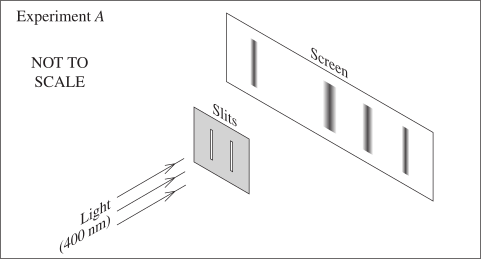
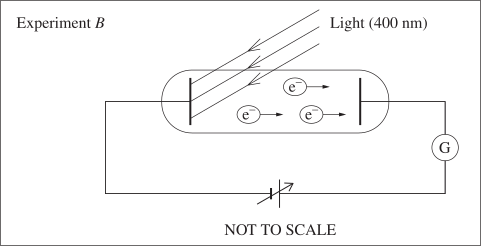
Two experiments are performed with identical light sources having a wavelength of 400 nm.

In experiment \(A\), the light is incident on a pair of narrow slits  5.0 × 10\(^{-5}\) m  apart, producing a pattern on a screen located 3.0 m behind the slits.
 

In experiment \(B\), the light is incident on different metal samples inside an evacuated tube as shown. The kinetic energy of any emitted photoelectrons can be measured.
 

Some results from experiment \(B\) are shown.
 

\begin{array}{|l|l|c|}
\hline
\rule{0pt}{1.5ex}\textit{Metal sample}\rule[-0.5ex]{0pt}{0pt}& \textit{Work function} \ \text{(J)} & \textit{Photoelectrons observed?} \\
\hline
\rule{0pt}{2.5ex}\text{Nickel}\rule[-1ex]{0pt}{0pt}&8.25 \times 10^{-19}&\text{No}\\
\hline
\rule{0pt}{2.5ex}\text{Calcium}\rule[-1ex]{0pt}{0pt}& 4.60 \times 10^{-19}&\text{Yes}\\
\hline
\end{array}

How do the results from Experiment \(A\) and Experiment \(B\) support TWO different models of light? In your answer, include a quantitative analysis of each experiment.   (9 marks)

--- 22 WORK AREA LINES (style=lined) ---
Show Answers Only
  • Experiment A supports the wave model of light as it demonstrates light undergoing diffraction as well as constructive and destructive interference, which are wave properties.
  • When light is incident upon the slits, it diffracts and causes the slit to act as a source of wavefronts. When light from the slits arrives at the screen, bright bands are produced when light waves arrive in phase and undergo constructive interference.
  • Dark bands are produced when light waves arrive at the screen out of phase and undergo destructive interference.
  • The spacing between adjacent bright bands can be calculated using  \(d \sin \theta=m \lambda\):
  •    \(5 \times 10^{-5} \sin \theta=1 \times 400 \times 10^{-9}\ \ \Rightarrow\ \ \theta=0.46^{\circ}\)
  •    \(s=3 \times \tan (0.46^{\circ})=0.024 \ \text{m}\)
  •  Experiment B supports Einstein’s particle, or photon model of light. This model can calculate the photon energy of incident light and explain why photons are emitted from calcium but not nickel:
  •    \(f=\dfrac{c}{\lambda}=\dfrac{3.00 \times 10^8}{400 \times 10^{-9}}=7.50 \times 10^{14} Hz\)
  •    \(E=h f=6.626 \times 10^{-34} \times 7.50 \times 10^{14}=4.97 \times 10^{-19} J\)
  • This energy is greater than the work function of calcium, explaining why one photon has enough energy to liberate a photoelectron from the calcium sample. However, this energy is less than the work function of nickel, explaining why no photoelectrons were observed from the nickel sample.
  • These observations support the particle model of light. Applying the particle model, the kinetic energy of photoelectrons emitted from calcium can be calculated:
  •    \(K_{\max }=h f-\phi=4.97 \times 10^{-19}-4.60 \times 10^{-19}=3.70 \times 10^{-20} \ \text{J}\)
Show Worked Solution
  • Experiment A supports the wave model of light as it demonstrates light undergoing diffraction as well as constructive and destructive interference, which are wave properties.
  • When light is incident upon the slits, it diffracts and causes the slit to act as a source of wavefronts. When light from the slits arrives at the screen, bright bands are produced when light waves arrive in phase and undergo constructive interference.
  • Dark bands are produced when light waves arrive at the screen out of phase and undergo destructive interference.
  • The spacing between adjacent bright bands can be calculated using  \(d \sin \theta=m \lambda\):
  •    \(5 \times 10^{-5} \sin \theta=1 \times 400 \times 10^{-9}\ \ \Rightarrow\ \ \theta=0.46^{\circ}\)
  •    \(s=3 \times \tan (0.46^{\circ})=0.024 \ \text{m}\)
  •  Experiment B supports Einstein’s particle, or photon model of light. This model can calculate the photon energy of incident light and explain why photons are emitted from calcium but not nickel:
  •    \(f=\dfrac{c}{\lambda}=\dfrac{3.00 \times 10^8}{400 \times 10^{-9}}=7.50 \times 10^{14} Hz\)
  •    \(E=h f=6.626 \times 10^{-34} \times 7.50 \times 10^{14}=4.97 \times 10^{-19} J\)
  • This energy is greater than the work function of calcium, explaining why one photon has enough energy to liberate a photoelectron from the calcium sample. However, this energy is less than the work function of nickel, explaining why no photoelectrons were observed from the nickel sample.
  • These observations support the particle model of light. Applying the particle model, the kinetic energy of photoelectrons emitted from calcium can be calculated:
  •    \(K_{\max }=h f-\phi=4.97 \times 10^{-19}-4.60 \times 10^{-19}=3.70 \times 10^{-20} \ \text{J}\)

♦ Mean mark 52%.

Filed Under: Light: Quantum Model, Light: Wave Model Tagged With: Band 4, Band 5, Band 6, smc-3697-20-Young, smc-3697-30-Double Slit Calcs, smc-3698-60-Experiments, smc-3698-80-Wave/Particle models

Copyright © 2014–2025 SmarterEd.com.au · Log in