SmarterEd

Aussie Maths & Science Teachers: Save your time with SmarterEd

  • Login
  • Get Help
  • About

PHYSICS, M8 2024 HSC 24

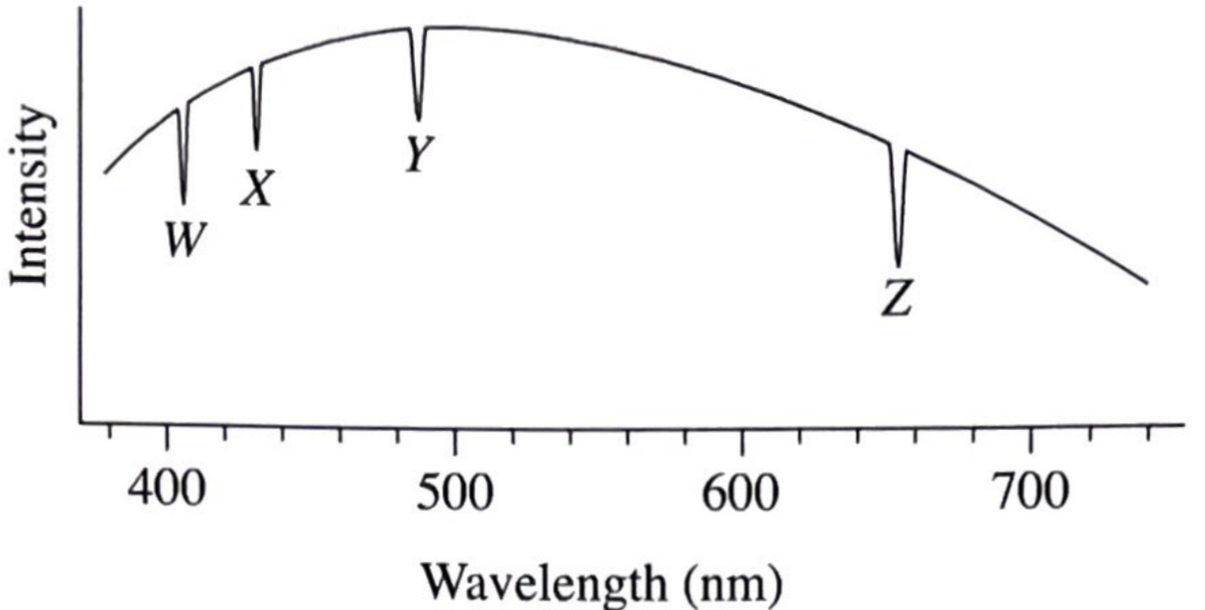
An absorption spectrum resulting from the passage of visible light from a star's surface through its hydrogen atmosphere is shown. Absorption lines are labelled \(W\) to \(Z\) in the diagram.
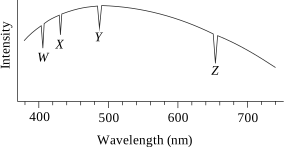
 

  1. Determine the surface temperature of the star.   (2 marks)

    --- 4 WORK AREA LINES (style=lined) ---

  2. Absorption line \(W\) originates from an electron transition between the second and sixth energy levels. Use  \(\dfrac{1}{\lambda}=R\left(\dfrac{1}{n_{ f }^2}-\dfrac{1}{n_{ i }^2}\right)\)  to calculate the frequency of light absorbed to produce absorption line \(W\).   (3 marks)

    --- 8 WORK AREA LINES (style=lined) ---

  3. Explain the physical processes that produce an absorption spectrum.   (3 marks)

    --- 8 WORK AREA LINES (style=lined) ---
Show Answers Only

a.    \(5796\ \text{K}\)

b.    \(7.31 \times 10^{14}\ \text{Hz}\)

c.    An absorption spectra is produced when:

  • A continuous spectrum of light  from a black body such as a star passes through cooler and lower density gas in the outer atmosphere of the star.
  • As the light passes through the gas, electrons in the atoms that make up the cooler gas clouds absorb distinct wavelengths/energy levels of light equal to the difference in energy levels between the electron shells where \(E_i-E_f=hf=\dfrac{hc}{\lambda}\). 
  • As the electrons in the atoms fall back into their ground state, they emit the photon of light that they absorb and the photon is then scattered out of the continuous spectrum.
  • The light that remains is then passed through a prism to separate the wavelengths and record the intensities. The black or darkened lines in the absorption spectra is the result of the scattered wavelengths of light. 
Show Worked Solution

a.    Determined temperature using the peak wavelength:

\(T=\dfrac{b}{\lambda_{\text{max}}}=\dfrac{2.898 \times 10^{-3}}{500 \times 10^{-9}}=5796\ \text{K}\)
 

b.     \(\dfrac{1}{\lambda}\) \(=R\left(\dfrac{1}{n_f^2}-\dfrac{1}{n_i^2}\right)\)
    \(=1.097 \times 10^7 \times \left(\dfrac{1}{2^2}-\dfrac{1}{6^2}\right)\)
    \(=2.438 \times 10^6\ \text{m}^{-1}\)
  \(\lambda\) \(=\dfrac{1}{2.438 \times 10^6}=410.2\ \text{nm}\)


\(\therefore f=\dfrac{c}{\lambda} = \dfrac{3 \times 10^8}{410.2 \times 10^{-9}} = 7.31 \times 10^{14}\ \text{Hz}\)
 

c.    Absorption spectra:

  • Produced when a continuous spectrum of light  from a black body such as a star passes through cooler and lower density gas in the outer atmosphere of the star.
  • As the light passes through the gas, electrons in the atoms that make up the cooler gas clouds absorb distinct wavelengths/energy levels of light equal to the difference in energy levels between the electron shells where \(E_i-E_f=hf=\dfrac{hc}{\lambda}\). 
  • As the electrons in the atoms fall back into their ground state, they emit the photon of light that they absorb and the photon is then scattered out of the continuous spectrum.
  • The light that remains is then passed through a prism to separate the wavelengths and record the intensities. The black or darkened lines in the absorption spectra is the result of the scattered wavelengths of light. 
♦ Mean mark (c) 51%.

Filed Under: Light: Quantum Model, Origins of Elements, Quantum Mechanical Nature of the Atom Tagged With: Band 4, Band 5, smc-3698-50-Blackbodies, smc-3698-70-Planck, smc-3700-20-Spectra, smc-3702-20-Electron Transitions

PHYSICS, M7 2023 HSC 23c

The James Webb Space Telescope observed an exoplanet emitting a peak wavelength of 1.14 \(\times\) 10\(^{-5}\) m.

Calculate the temperature of the exoplanet.  (2 marks)

--- 4 WORK AREA LINES (style=lined) ---
Show Answers Only

\(T= 254\) \( \text{K}\)

Show Worked Solution

\(T=\dfrac{b}{\lambda_{\text{max}}}=\dfrac{2.898\times 10^{-3}}{1.14 \times 10^{-5}}= 254\) \( \text{K}\)

Filed Under: Light: Quantum Model Tagged With: Band 3, smc-3698-50-Blackbodies

PHYSICS, M7 2023 HSC 9 MC

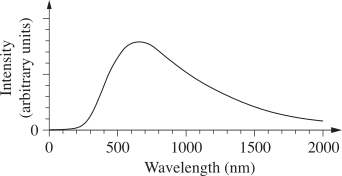
The graph shows the relationship between radiation intensity and wavelength for a black body at 4500 K.
 

Which statement describes the expected difference in the graph for a black body at 4000 K?

  1. Intensity at all wavelengths will be less.
  2. Intensity at all wavelengths will be greater.
  3. The peak intensity will occur at a higher frequency.
  4. The peak intensity will occur at a shorter wavelength.
Show Answers Only

\(A\)

Show Worked Solution
  • The total power output of a black body diminishes with decreasing temperature, resulting in lower intensity across all wavelengths for the 4000 K curve.

\(\Rightarrow A\)

Filed Under: Light: Quantum Model Tagged With: Band 4, smc-3698-50-Blackbodies, smc-3698-70-Planck

PHYSICS, M7 EQ-Bank 14 MC

The graph shows the electromagnetic radiation emitted from a black body cavity.
 

What is the best estimate of the temperature of this black body?

  1. `5.9 × 10^(3) \ text{K}`
  2. `7.2 × 10^(3) \ text{K}`
  3. `1.7 × 10^(5) \ text{K}`
  4. `5.9 × 10^(6) \ text{K}`
Show Answers Only

`A`

Show Worked Solution
  • The peak wavelength of this black body is approximately 490 nm.
`lambda_(max)` `=(b)/(T)`  
`T` `=(2.898 xx10^(-3))/(490 xx10^(-9))=5.91 xx10^3  text{K}`   

 
`=>A`

Filed Under: Light: Quantum Model Tagged With: Band 4, smc-3698-50-Blackbodies

PHYSICS, M7 2018 HSC 2 MC

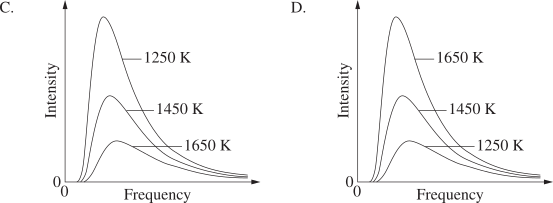
Which graph is consistent with predictions resulting from Planck's hypothesis regarding radiation from hot objects?


Show Answers Only

`B`

Show Worked Solution
  • Planck’s hypothesis is consistent with Wein’s Law,  `lambda_(max)=(b)/(T)`, or  `lambda_(max) prop (1)/(T)`.
  • So, hotter objects have a greater peak wavelength.

`=>B`

Filed Under: Light: Quantum Model Tagged With: Band 4, smc-3698-50-Blackbodies

PHYSICS, M7 2022 HSC 9 MC

The radiation emitted by a black body has a peak wavelength of  `5.8 xx10^(-7) \ text{m}`.

What is its temperature?

  1. `3000 \ text{K}`
  2. `4500 \ text{K}`
  3. `5000 \ text{K}`
  4. `5500 \ text{K}`
Show Answers Only

`C`

Show Worked Solution
`lambda_(max)` `=(b)/(T)`  
`T` `=(b)/(lambda_(max))=(2.898 xx10^(-3))/(5.8 xx10^(-7))~~5000  text{K}`  

 
`=>C`

Filed Under: Light: Quantum Model Tagged With: Band 3, smc-3698-50-Blackbodies

PHYSICS, M7 2019 HSC 6 MC

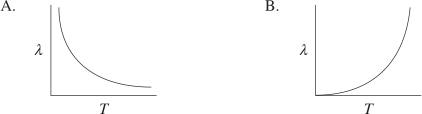
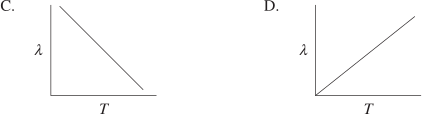
Which graph correctly shows the relationship between the surface temperature of a black body `(T)` and the wavelength `(λ)` at which the maximum intensity of light is emitted?
 

Show Answers Only

`A`

Show Worked Solution
  • Since  `lambda_(max) = (b)/(T), \ \ lambda prop (1)/(T)`  (Wien’s Displacement Law)

`=>A`

Filed Under: Light: Quantum Model Tagged With: Band 4, smc-3698-50-Blackbodies

PHYSICS, M7 2020 HSC 26

  1. Describe the difference between the spectra of the light produced by a gas discharge tube and by an incandescent lamp.   (2 marks)

--- 4 WORK AREA LINES (style=lined) ---

  1. The graph shows the curves predicted by two different models, `X` and `Y`, for the electromagnetic radiation emitted by an object at a temperature of 5000 K.
     

    Identify an assumption of EACH model which determines the shape of its curve.   (2 marks)

--- 4 WORK AREA LINES (style=lined) ---

  1. The diagram shows the radiation curve for a black body radiator at a temperature of 5000 K.


    On the same diagram, sketch a curve for a black body radiator at a temperature of 4000 K and explain the differences between the curves.   (4 marks)

    --- 6 WORK AREA LINES (style=lined) ---

Show Answers Only

a.   The spectra of light produced by a gas discharge tube will consist of lines only at a few discrete wavelengths.

The spectra of light produced by an incandescent lamp will be a continuous spectrum.

b.   Model `X` black bodies absorb and emit energy continuously.

Model `Y` assumes that black bodies absorb and emit energy in discrete quantities.

c.

  • Using `lambda_(max)=(b)/(T)\ \ =>\ \ lambda prop (1)/(T)`
  • Therefore, the 4000 K curve will have a peak wavelength greater than the 5000 K curve.
  • The area under the curve and the intensity at all wavelengths will be less for the 4000 K curve, as the total power output of a black body decreases as its temperature decreases.
Show Worked Solution

a.    Differences:

  • The spectra of light produced by a gas discharge tube will consist of lines only at a few discrete wavelengths.
  • The spectra of light produced by an incandescent lamp will be a continuous spectrum.

♦ Mean mark (a) 39%.

b.    Assumptions of EACH model:

  • Model `X` black bodies absorb and emit energy continuously.
  • Model `Y` assumes that black bodies absorb and emit energy in discrete quantities.

♦ Mean mark (b) 44%.

c.

  • Using `lambda_(max)=(b)/(T)\ \ =>\ \ lambda prop (1)/(T)`
  • Therefore, the 4000 K curve will have a peak wavelength greater than the 5000 K curve.
  • The area under the curve and the intensity at all wavelengths will be less for the 4000 K curve, as the total power output of a black body decreases as its temperature decreases.

Filed Under: Electromagnetic Spectrum, Light: Quantum Model, Light: Wave Model, Origins of Elements Tagged With: Band 4, Band 5, smc-3696-10-Spectroscopy, smc-3698-50-Blackbodies, smc-3698-80-Wave/Particle models, smc-3700-20-Spectra

PHYSICS, M7 2020 HSC 22

A capsule travelling at 12 900 m s ¯1 enters Earth's atmosphere, causing it to rapidly slow down to 400 m s ¯1.

  1. During this re-entry, the capsule reaches a temperature of 3200 K.
  2. What is the peak wavelength of the light emitted by the capsule? (2 marks)

--- 4 WORK AREA LINES (style=lined) ---
  1. Outline TWO limitations of applying special relativity to the analysis of the motion of the capsule.  (3 marks)

--- 6 WORK AREA LINES (style=lined) ---

Show Answers Only

a.   `lambda_(max)=9xx10^(-7)` m

b.   Limitations:

  • The speed of the capsule is not close to the speed of light and so the effects of special relativity are insignificant.
  • The capsule is decelerating and so it is in a non-inertial frame of reference, therefore special relativity is not applicable.
Show Worked Solution
a.    `lambda_(max)` `=(b)/(T)`
    `=(2.898 xx10^(-3))/(3200)`
    `=9.056xx10^(-7)  text{m}`
    `=9xx10^(-7)  text{m}`


b.   Limitations:

  • The speed of the capsule is not close to the speed of light and so the effects of special relativity are insignificant.
  • The capsule is decelerating and so it is in a non-inertial frame of reference, therefore special relativity is not applicable.

♦ Mean mark (b) 42%.

Filed Under: Light and Special Relativity, Light: Quantum Model Tagged With: Band 4, Band 5, smc-3698-50-Blackbodies, smc-3699-40-Einstein's Postulates

PHYSICS, M7 2021 HSC 11 MC

What is the peak wavelength of electromagnetic radiation emitted by a person with a body temperature of 37°C (310 K)?

  1. `9.3 × 10^(-6)\ `m
  2. `7.8 × 10^(-5)\ `m
  3. `9.3 × 10^(-3)\ `m
  4. `7.8 × 10^(-2)\ `m
Show Answers Only

`A`

Show Worked Solution

`lambda=(b)/(T)=(2.898 xx10^(-3))/(310)=9.3 xx10^(-6)`

 `=>A`

Filed Under: Light: Quantum Model Tagged With: Band 4, smc-3698-50-Blackbodies

Copyright © 2014–2025 SmarterEd.com.au · Log in