SmarterEd

Aussie Maths & Science Teachers: Save your time with SmarterEd

  • Login
  • Get Help
  • About

PHYSICS, M7 2024 HSC 26

Muons are unstable particles produced when cosmic rays strike atoms high in the atmosphere. The muons travel downward, perpendicular to Earth's surface, at almost the speed of light.

Classical physics predicts that these muons will decay before they have time to reach Earth's surface.

Explain qualitatively why these muons can reach Earth's surface, regardless of whether their motion is considered from either the muon's frame of reference or the Earth's frame of reference.   (3 marks)

--- 8 WORK AREA LINES (style=lined) ---

Show Answers Only

  • The muon’s are able to reach the Earth’s surface due to Einstein’s special theory of relativity in relation to length contraction and time dilation.

Muon’s frame of reference:

  • The distance to the Earth’s surface is contracted according to  \(l=l_o\sqrt{1-\frac{v^2}{c^2}}\). Muons see the Earth’s surface move towards them at speeds close to \(c\).
  • Since the muons have to travel a shorter distance than the proper length, they will have time to reach the Earth’s surface before they decay. 

Earth’s frame of reference:

  • The time that it takes the muon to decay will be dilated according to  \(t=\dfrac{t_o}{\sqrt{1-\frac{v^2}{c^2}}}\)  as the muon’s are moving close to the speed of light.
  • Therefore, the muons have a longer half-life and lifespan than predicted by classical physics and will be able to reach the Earth’s surface before they decay.
  • In this way, muons can reach the surface of the Earth from either frame of reference. 

Show Worked Solution

  • The muon’s are able to reach the Earth’s surface due to Einstein’s special theory of relativity in relation to length contraction and time dilation.

Muon’s frame of reference:

  • The distance to the Earth’s surface is contracted according to  \(l=l_o\sqrt{1-\frac{v^2}{c^2}}\). Muons see the Earth’s surface move towards them at speeds close to \(c\).
  • Since the muons have to travel a shorter distance than the proper length, they will have time to reach the Earth’s surface before they decay.

Earth’s frame of reference:

  • The time that it takes the muon to decay will be dilated according to  \(t=\dfrac{t_o}{\sqrt{1-\frac{v^2}{c^2}}}\)  as the muon’s are moving close to the speed of light.
  • Therefore, the muons have a longer half-life and lifespan than predicted by classical physics and will be able to reach the Earth’s surface before they decay.
  • In this way, muons can reach the surface of the Earth from either frame of reference. 
♦ Mean mark 46%.

Filed Under: Light and Special Relativity Tagged With: Band 5, smc-3699-10-Time Dilation, smc-3699-20-Length Contraction, smc-3699-40-Einstein's Postulates

PHYSICS, M7 2019 VCE 11

What is the second postulate of Einstein's theory of special relativity regarding the speed of light? Explain how the second postulate differs from the concept of the speed of light in classical physics.   (3 marks)

--- 6 WORK AREA LINES (style=lined) ---

Show Answers Only
  • Einstein’s second postulate states that the speed of light \((c)\) is constant and independent of the motion of the source and motion of the observer.
  • The speed of light in classical physics was dependant on relative motion between the source and observer leading to different measurements for \((c)\),
  • For example, if the source and observer were approaching one another then the speed would be greater than \(3 \times 10^8\ \text{ms}^{-1}\) and if the source and observer were moving away from one another the speed would be less than \(3 \times 10^8\ \text{ms}^{-1}\).
Show Worked Solution
  • Einstein’s second postulate states that the speed of light \((c)\) is constant and independent of the motion of the source and motion of the observer.
  • The speed of light in classical physics was dependant on relative motion between the source and observer leading to different measurements for \((c)\),
  • For example, if the source and observer were approaching one another then the speed would be greater than \(3 \times 10^8\ \text{ms}^{-1}\) and if the source and observer were moving away from one another the speed would be less than \(3 \times 10^8\ \text{ms}^{-1}\).
♦ Mean mark 40%.
COMMENT: Many students failed to properly explain the classical predictions for c.

Filed Under: Light and Special Relativity Tagged With: Band 5, smc-3699-40-Einstein's Postulates

PHYSICS, M7 2021 VCE 20 MC

One of Einstein's postulates for special relativity is that the laws of physics are the same in all inertial frames of reference.

Which one of the following best describes a property of an inertial frame of reference?

  1. It is travelling at a constant speed.
  2. It is travelling at a speed much slower than \(c\).
  3. Its movement is consistent with the expansion of the universe.
  4. No observer in the frame can detect any acceleration of the frame.
Show Answers Only

\(D\)

Show Worked Solution
  • An inertial frame of reference is one where there is no acceleration acting on the bodies.
  • Therefore, no observer will be able to detect any acceleration.

\(\Rightarrow D\)

♦ Mean mark 49%.

Filed Under: Light and Special Relativity Tagged With: Band 5, smc-3699-40-Einstein's Postulates

PHYSICS, M7 2022 VCE 18 MC

Which one of the following is an example of an inertial frame of reference?

  1. a bus travelling at constant velocity
  2. an express train that is accelerating
  3. a car turning a corner at a constant speed
  4. a roller-coaster speeding up while heading down a slope
Show Answers Only

\(A\)

Show Worked Solution
  • \(A\) is the only frame of reference where no acceleration is imposed on the object.
  • It is therefore an inertial frame of reference.

\(\Rightarrow A\)

Filed Under: Light and Special Relativity Tagged With: Band 3, smc-3699-40-Einstein's Postulates

PHYSICS, M7 2023 HSC 19 MC

The diagram represents the distribution of positive charges in identical wires when no current is flowing.
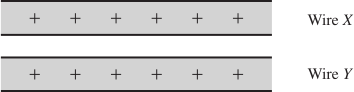


Equal currents then flow in each wire, but in opposite directions. These currents are considered conventionally as the flow of positive charge.

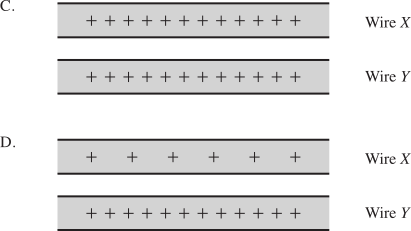
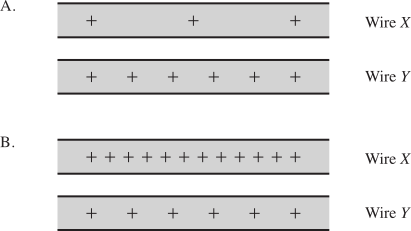
Which diagram represents the charge distribution in the wires, from the frame of reference of a positive charge in wire \(Y\) ?


Show Answers Only

\(B\)

Show Worked Solution
  • The currents flowing through Wire \(Y\) are all travelling in the same direction and at the same speed, thus they are all within the same inertial frame of reference and will not experience any relativistic effects when viewed from the frame of reference of a positive charge in \(Y\).
  • Therefore, the separation of the charges in \(Y\) from the frame of reference of \(Y\) will not change.
  • As the positive charges in \(X\) are moving in the opposite direction to the positive charges in \(Y\), from the frame of reference of a positive charge in \(Y\), length contraction will be observed in \(X\).
  • Therefore, the separation of the positive charges in \(X\) from the frame of reference of \(Y\) will be shorter so the charges appear closer together.

\(\Rightarrow B\)

♦ Mean mark 44%.

Filed Under: Light and Special Relativity Tagged With: Band 5, smc-3699-20-Length Contraction, smc-3699-40-Einstein's Postulates

PHYSICS, M7 EQ-Bank 16 MC

In 1972 , four caesium clocks were flown twice around the world on commercial jet flights, once eastward and once westward. The travelling clocks were compared with reference clocks at the US Naval Observatory and the results were compared with predictions from Einstein's theory of special relativity.
 

Which of the following is correct about the observed results in relation to Einstein's theory?

  1. Both of the results are inconclusive.
  2. Both of the results support the theory.
  3. One of the results supports the theory and the other is inconclusive.
  4. One of the results supports the theory and the other rejects the theory.
Show Answers Only

`B`

Show Worked Solution
  • The tolerance range for the eastward journey is –63 to –17 nanoseconds. 
  • The tolerance range for the westward journey is 254 to 296 nanoseconds. 
  • Therefore, both of the results fall within the range predicted by Einstein’s theory of special relativity.

`=>B`

Filed Under: Light and Special Relativity Tagged With: Band 5, smc-3699-10-Time Dilation, smc-3699-40-Einstein's Postulates

PHYSICS, M7 2015 HSC 14 MC

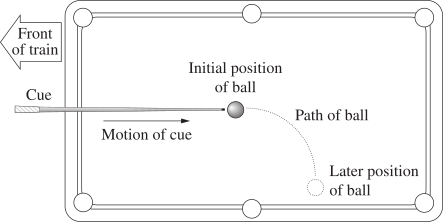
A passenger is playing billiards on a train that is travelling forwards on a level track. The ball takes the path shown when hit by the cue.
 

What can be inferred about the motion of the train?

  1. It is turning left.
  2. It is speeding up.
  3. It is turning right.
  4. It is slowing down.
Show Answers Only

`C`

Show Worked Solution
  • The ball will travel on a straight path relative to the ground (Newton’s First Law).
  • Looking from the back of the pool table, facing the direction of the front of the train, the ball moves left.
  • The pool table (and hence the train) must be moving towards the right relative to the ground.

`=>C`

Filed Under: Light and Special Relativity Tagged With: Band 4, smc-3699-40-Einstein's Postulates

PHYSICS, M7 2016 HSC 6 MC

In a thought experiment, a jet is travelling at 0.5 `c` relative to the ground, towards a train that is travelling at 0.1 `c` relative to the ground, as shown.

 

What is the speed of the light emitted from the train's headlight, as measured by a pilot in the jet?

  1. 0.1 `c`
  2. 0.4 `c`
  3. 0.6 `c`
  4. 1.0 `c`
Show Answers Only

`D`

Show Worked Solution
  • The speed of light is constant at 1.0 `c` for all observers.

`=>D`

Filed Under: Light and Special Relativity Tagged With: Band 4, smc-3699-40-Einstein's Postulates

PHYSICS, M7 2017 HSC 2 MC

Which of the following is an inertial frame of reference?

  1. A rocket during launch
  2. A train travelling at a constant velocity
  3. A car turning a corner at a constant speed
  4. A lift slowing down as it approaches the ground floor
Show Answers Only

`B`

Show Worked Solution
  • An inertial frame of reference is one which is not accelerating.

`=>B`

Filed Under: Light and Special Relativity Tagged With: Band 3, smc-3699-40-Einstein's Postulates

PHYSICS, M7 2018 HSC 19 MC

A mass was hanging from the roof of a bus that was travelling forward on a horizontal road at a constant velocity.
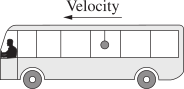
 

The string holding the mass was cut. At the same instant, the bus driver applied the brakes, causing the bus to slow down at a rate of `3\ text{m s}^(-2)`.

To an observer outside the bus, the mass follows a parabolic trajectory.

Which statement correctly describes the resulting motion of the mass observed from within the frame of reference of the moving bus?

  1. The mass travelled in a straight line vertically downwards.
  2. The mass travelled in a straight line downwards and towards the front of the bus.
  3. The mass travelled in a parabolic path downwards and towards the back of the bus.
  4. The mass travelled in a parabolic path downwards and towards the front of the bus.
Show Answers Only

`B`

Show Worked Solution
  • From the perspective of an observer on the bus, the ball has both a downwards acceleration due to gravity and a relative forwards acceleration due to the slowdown of the bus.
  • Since the mass has an initial velocity of zero (relative to the observer on the bus), the mass will travel in a straight line in the direction of this acceleration.

`=>B`


♦♦ Mean mark 39%.

Filed Under: Light and Special Relativity Tagged With: Band 5, smc-3699-40-Einstein's Postulates

PHYSICS, M7 2018 HSC 15 MC

The diagram shows a simplified model of the Michelson-Morley experiment. It can be assumed that distances `L_1` and `L_2` are equal without affecting the outcome.
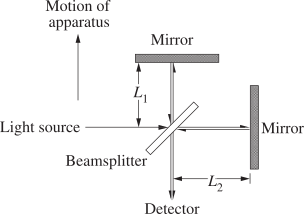


The times taken for the light to travel in both directions along the lengths `L_1` and `L_2` are `t_1` and `t_2` respectively.

What was Michelson attempting to demonstrate in this experiment?

  1. The relativistic contraction of `L_1` would cause `t_1` to be less than `t_2`.
  2. The ether is carried through space with Earth, which would cause `t_1` to be equal to `t_2`.
  3. The times `t_1` and `t_2` would be the same because the velocity of the apparatus was much less than the speed of light.
  4. The motion of the apparatus resulting from Earth's orbital motion around the sun would cause `t_1` to be greater than `t_2`.
Show Answers Only

`D`

Show Worked Solution
  • Michelson was attempting to show that due to the relative motion of Earth through the aether, there would be a difference in travel times for lengths parallel and perpendicular to the direction of Earth’s travel.

`=>D`

Filed Under: Light and Special Relativity Tagged With: Band 4, smc-3699-40-Einstein's Postulates

PHYSICS, M7 2020 HSC 22

A capsule travelling at 12 900 m s ¯1 enters Earth's atmosphere, causing it to rapidly slow down to 400 m s ¯1.

  1. During this re-entry, the capsule reaches a temperature of 3200 K.
  2. What is the peak wavelength of the light emitted by the capsule? (2 marks)

--- 4 WORK AREA LINES (style=lined) ---

  1. Outline TWO limitations of applying special relativity to the analysis of the motion of the capsule.  (3 marks)

--- 6 WORK AREA LINES (style=lined) ---

Show Answers Only

a.   `lambda_(max)=9xx10^(-7)` m

b.   Limitations:

  • The speed of the capsule is not close to the speed of light and so the effects of special relativity are insignificant.
  • The capsule is decelerating and so it is in a non-inertial frame of reference, therefore special relativity is not applicable.
Show Worked Solution
a.    `lambda_(max)` `=(b)/(T)`
    `=(2.898 xx10^(-3))/(3200)`
    `=9.056xx10^(-7)  text{m}`
    `=9xx10^(-7)  text{m}`


b.   Limitations:

  • The speed of the capsule is not close to the speed of light and so the effects of special relativity are insignificant.
  • The capsule is decelerating and so it is in a non-inertial frame of reference, therefore special relativity is not applicable.

♦ Mean mark (b) 42%.

Filed Under: Light and Special Relativity, Light: Quantum Model Tagged With: Band 4, Band 5, smc-3698-50-Blackbodies, smc-3699-40-Einstein's Postulates

PHYSICS, M7 2021 HSC 4 MC

An astronaut is travelling towards Earth in a spaceship at 0.8c. At regular intervals, a radio pulse is sent from the spaceship to an observer on Earth.

Which quantity would the astronaut and the observer measure to be the same?

  1. Length of the spaceship
  2. Speed of the radio pulses
  3. Momentum of the astronaut
  4. Time interval between the radio pulses
Show Answers Only

`B`

Show Worked Solution
  • Speed of radio waves (light) is equal in all frames of reference. All other quantities depend on the observer.

`=>B`

Filed Under: Light and Special Relativity Tagged With: Band 4, smc-3699-40-Einstein's Postulates

Copyright © 2014–2025 SmarterEd.com.au · Log in