SmarterEd

Aussie Maths & Science Teachers: Save your time with SmarterEd

  • Login
  • Get Help
  • About

PHYSICS, M8 2024 HSC 24

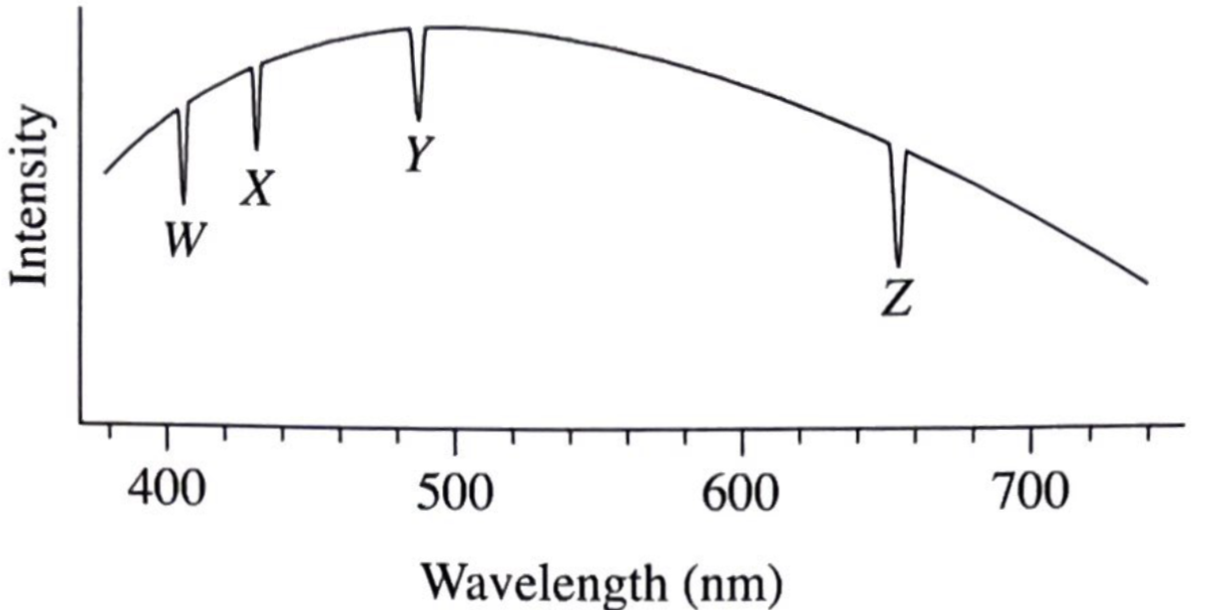
An absorption spectrum resulting from the passage of visible light from a star's surface through its hydrogen atmosphere is shown. Absorption lines are labelled \(W\) to \(Z\) in the diagram.
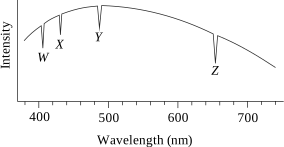
 

  1. Determine the surface temperature of the star.   (2 marks)

    --- 4 WORK AREA LINES (style=lined) ---

  2. Absorption line \(W\) originates from an electron transition between the second and sixth energy levels. Use  \(\dfrac{1}{\lambda}=R\left(\dfrac{1}{n_{ f }^2}-\dfrac{1}{n_{ i }^2}\right)\)  to calculate the frequency of light absorbed to produce absorption line \(W\).   (3 marks)

    --- 8 WORK AREA LINES (style=lined) ---

  3. Explain the physical processes that produce an absorption spectrum.   (3 marks)

    --- 8 WORK AREA LINES (style=lined) ---
Show Answers Only

a.    \(5796\ \text{K}\)

b.    \(7.31 \times 10^{14}\ \text{Hz}\)

c.    An absorption spectra is produced when:

  • A continuous spectrum of light  from a black body such as a star passes through cooler and lower density gas in the outer atmosphere of the star.
  • As the light passes through the gas, electrons in the atoms that make up the cooler gas clouds absorb distinct wavelengths/energy levels of light equal to the difference in energy levels between the electron shells where \(E_i-E_f=hf=\dfrac{hc}{\lambda}\). 
  • As the electrons in the atoms fall back into their ground state, they emit the photon of light that they absorb and the photon is then scattered out of the continuous spectrum.
  • The light that remains is then passed through a prism to separate the wavelengths and record the intensities. The black or darkened lines in the absorption spectra is the result of the scattered wavelengths of light. 
Show Worked Solution

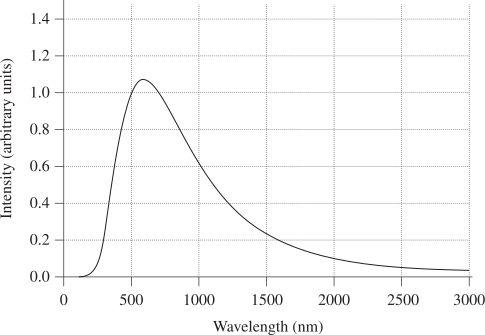
a.    Determined temperature using the peak wavelength:

\(T=\dfrac{b}{\lambda_{\text{max}}}=\dfrac{2.898 \times 10^{-3}}{500 \times 10^{-9}}=5796\ \text{K}\)
 

b.     \(\dfrac{1}{\lambda}\) \(=R\left(\dfrac{1}{n_f^2}-\dfrac{1}{n_i^2}\right)\)
    \(=1.097 \times 10^7 \times \left(\dfrac{1}{2^2}-\dfrac{1}{6^2}\right)\)
    \(=2.438 \times 10^6\ \text{m}^{-1}\)
  \(\lambda\) \(=\dfrac{1}{2.438 \times 10^6}=410.2\ \text{nm}\)


\(\therefore f=\dfrac{c}{\lambda} = \dfrac{3 \times 10^8}{410.2 \times 10^{-9}} = 7.31 \times 10^{14}\ \text{Hz}\)
 

c.    Absorption spectra:

  • Produced when a continuous spectrum of light  from a black body such as a star passes through cooler and lower density gas in the outer atmosphere of the star.
  • As the light passes through the gas, electrons in the atoms that make up the cooler gas clouds absorb distinct wavelengths/energy levels of light equal to the difference in energy levels between the electron shells where \(E_i-E_f=hf=\dfrac{hc}{\lambda}\). 
  • As the electrons in the atoms fall back into their ground state, they emit the photon of light that they absorb and the photon is then scattered out of the continuous spectrum.
  • The light that remains is then passed through a prism to separate the wavelengths and record the intensities. The black or darkened lines in the absorption spectra is the result of the scattered wavelengths of light. 
♦ Mean mark (c) 51%.

Filed Under: Light: Quantum Model, Origins of Elements, Quantum Mechanical Nature of the Atom Tagged With: Band 4, Band 5, smc-3698-50-Blackbodies, smc-3698-70-Planck, smc-3700-20-Spectra, smc-3702-20-Electron Transitions

PHYSICS, M8 2024 HSC 22

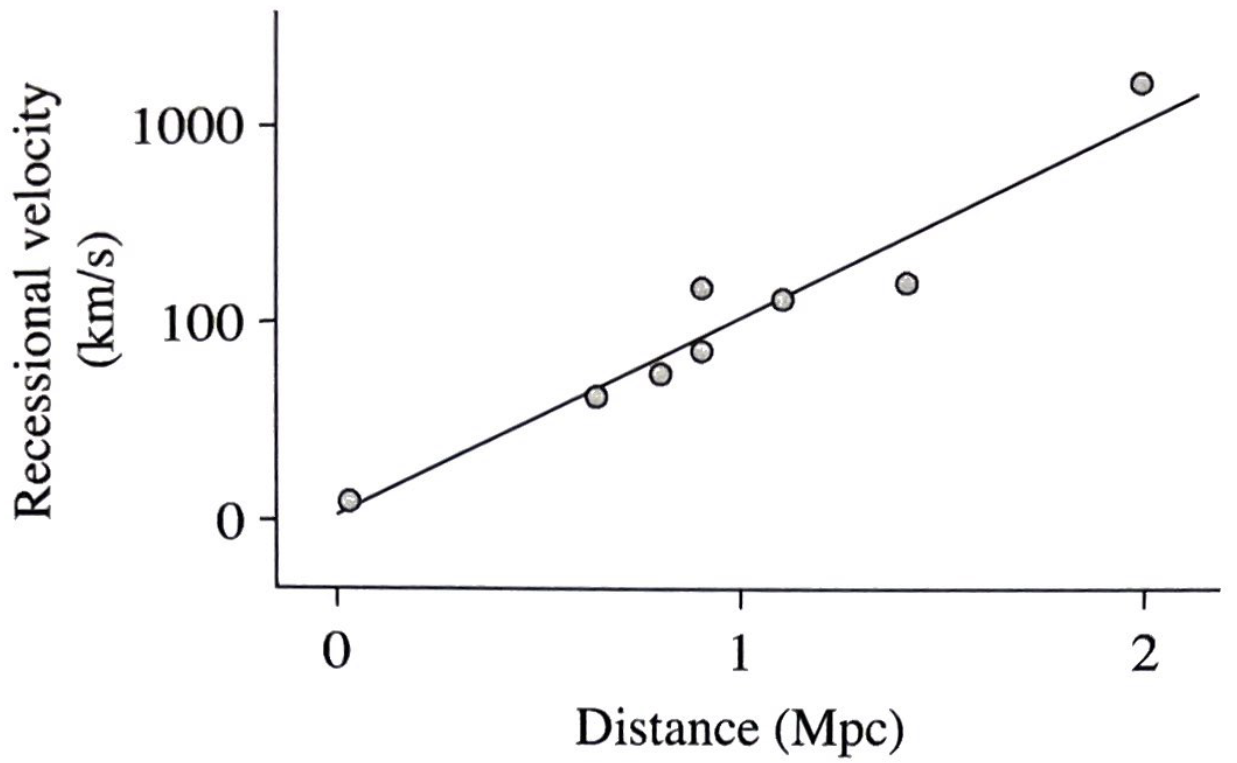
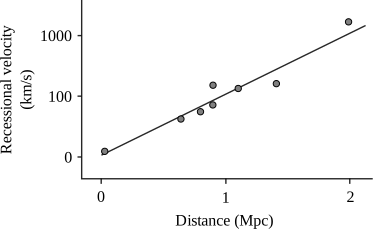
The following graph, based on the data gathered by Hubble, shows the relationship between the recessional velocity of galaxies and their distance from Earth.


  1. Describe the significance of the graph to our understanding of the universe.   (2 marks)

    --- 4 WORK AREA LINES (style=lined) ---

  2. How were the recessional velocities of galaxies determined?  (3 marks)

    --- 6 WORK AREA LINES (style=lined) ---

Show Answers Only

a.   Recessional velocity vs distance from Earth graph:

  • The graph shows that the further away galaxies are from Earth, the faster these galaxies are moving away from Earth.
  • This relationships depicts Hubble’s law:  \(v=H_0 D\). 
  • This graph provides evidence that the universe is constantly expanding as predicted by the big bang theory.
     

b.   Determining recessional velocities:

  • The recessional velocities of the galaxies were determined by analysing their absorption spectras.
  • Light waves that are moving away from the Earth will appear to be stretched (wavelength increased) according to the doppler effect.
  • The absorption spectra of galaxies were compared with the spectra of the same elements on Earth, revealing that the galaxies’ spectra were redshifted.
  • The greater the extent of the red shift in the spectra, the greater the recessional velocity of the galaxy. 

Show Worked Solution

a.   Recessional velocity vs distance from Earth graph:

  • The graph shows that the further away galaxies are from Earth, the faster these galaxies are moving away from Earth.
  • This relationships depicts Hubble’s law:  \(v=H_0 D\). 
  • This graph provides evidence that the universe is constantly expanding as predicted by the big bang theory.
     

b.   Determining recessional velocities:

  • The recessional velocities of the galaxies were determined by analysing their absorption spectras.
  • Light waves that are moving away from the Earth will appear to be stretched (wavelength increased) according to the doppler effect.
  • The absorption spectra of galaxies were compared with the spectra of the same elements on Earth, revealing that the galaxies’ spectra were redshifted.
  • The greater the extent of the red shift in the spectra, the greater the recessional velocity of the galaxy. 
♦ Mean mark (b) 49%.

Filed Under: Electromagnetic Spectrum, Origins of Elements Tagged With: Band 4, Band 5, smc-3696-10-Spectroscopy, smc-3700-20-Spectra, smc-3700-30-Hubble

PHYSICS, M8 2023 HSC 27b

The diagram represents one hydrogen emission line from the spectrum of a star.

Explain the changes to this spectral line that would be observed as a result of the star’s rotational velocity. Modify the diagram to support your answer.   (4 marks)

--- 8 WORK AREA LINES (style=lined) ---

Show Answers Only

  • When a star rotates, one side of the star is moving towards the Earth and one side of the star is moving away from the Earth.
  • As a result of the Doppler Effect, the wavelengths of the light moving towards the earth are shortened and so are blueshifted while the wavelengths of the light moving away from the earth and lengthened and so are red shifted. 
  • The light from the centre of the star is not moving towards or away from the Earth so it is not shifted in any direction.
  • As a result of the simultaneous blue and red shifting of the 656 nm absorption line, the spectral line will become broader as seen in the modified diagram below.

Show Worked Solution

  • When a star rotates, one side of the star is moving towards the Earth and one side of the star is moving away from the Earth.
  • As a result of the Doppler Effect, the wavelengths of the light moving towards the earth are shortened and so are blueshifted while the wavelengths of the light moving away from the earth and lengthened and so are red shifted. 
  • The light from the centre of the star is not moving towards or away from the Earth so it is not shifted in any direction.
  • As a result of the simultaneous blue and red shifting of the 656 nm absorption line, the spectral line will become broader as seen in the modified diagram below.

♦ Mean mark 55%.

Filed Under: Origins of Elements Tagged With: Band 5, smc-3700-20-Spectra

PHYSICS, M8 2023 HSC 27a

Explain how the composition and temperature of a star can be determined from its spectrum.   (4 marks)

--- 10 WORK AREA LINES (style=lined) ---

Show Answers Only

Chemical composition:

  • Each element has a unique emission spectra.
  • When the continuous spectra of a star passes through its cooler and lower density atmosphere, the electrons in the elements within the atmosphere are excited by specific wavelengths of light. When the electrons return to ground state, the light is scattered leaving absorption lines in the continuous spectra (absorption spectra).
  • Therefore by analysing the absorption lines and comparing it to known emission spectra, the chemical composition of the star can be determined.
  • Additionally, the relative intensity of the absorption lines corresponds to the relative abundance of the elements.

Temperature:

  • The surface temperature of a star can be determined from its black body radiation spectra. 
  • The sun’s spectra can be approximated to that of a black body curve. Wein’s Law  \(\lambda_{\text{max}}=\dfrac{b}{T}\)  can be used to calculate the surface temperature of the star.
  • Thus by determining the peak wavelength in the star’s spectrum, the surface temperature can be accurately calculated.

Show Worked Solution

Chemical composition:

  • Each element has a unique emission spectra.
  • When the continuous spectra of a star passes through its cooler and lower density atmosphere, the electrons in the elements within the atmosphere are excited by specific wavelengths of light. When the electrons return to ground state, the light is scattered leaving absorption lines in the continuous spectra (absorption spectra).
  • Therefore by analysing the absorption lines and comparing it to known emission spectra, the chemical composition of the star can be determined.
  • Additionally, the relative intensity of the absorption lines corresponds to the relative abundance of the elements.

Temperature:

  • The surface temperature of a star can be determined from its black body radiation spectra. 
  • The sun’s spectra can be approximated to that of a black body curve. Wein’s Law  \(\lambda_{\text{max}}=\dfrac{b}{T}\)  can be used to calculate the surface temperature of the star.
  • Thus by determining the peak wavelength in the star’s spectrum, the surface temperature can be accurately calculated.

Filed Under: Origins of Elements Tagged With: Band 4, smc-3700-20-Spectra

PHYSICS, M8 EQ-Bank 25

Compare the features of emission and absorption spectra in terms of how they are produced.   (4 marks)

Show Answers Only
  • Emission and absorption spectra are both produced by the transition of electrons between energy levels in an atom.
  • Emission spectra involve a series of coloured lines corresponding to “emitted” light of discrete wavelengths on a black background. Absorption spectra differ by presenting a continuous spectrum with some specific wavelengths appearing with lower intensities (having been “absorbed”). In this way, the emission and absorption spectra of a specific element or compound appear as negatives of each other.
  • Emission spectra are produced when electrons are in higher energy shells in which they are unstable and fall back to lower, more stable levels. They emit a photon of light with energy equal to the difference in energy between the two shells. These photons correspond to emission lines.
  • Absorption spectra are produced when a continuous spectrum is passed through a cool gas. Certain wavelengths of light with energies corresponding to a difference in energy levels are absorbed by the electron and it jumps to a higher energy level. This results in a dark line.
Show Worked Solution
  • Emission and absorption spectra are both produced by the transition of electrons between energy levels in an atom.
  • Emission spectra involve a series of coloured lines corresponding to “emitted” light of discrete wavelengths on a black background. Absorption spectra differ by presenting a continuous spectrum with some specific wavelengths appearing with lower intensities (having been “absorbed”). In this way, the emission and absorption spectra of a specific element or compound appear as negatives of each other.
  • Emission spectra are produced when electrons are in higher energy shells in which they are unstable and fall back to lower, more stable levels. They emit a photon of light with energy equal to the difference in energy between the two shells. These photons correspond to emission lines.
  • Absorption spectra are produced when a continuous spectrum is passed through a cool gas. Certain wavelengths of light with energies corresponding to a difference in energy levels are absorbed by the electron and it jumps to a higher energy level. This results in a dark line.

Filed Under: Origins of Elements Tagged With: Band 4, smc-3700-20-Spectra

PHYSICS, M8 2016 HSC 33c

Describe how the spectrum of a star can be used to determine its chemical composition and surface temperature.   (4 marks)

--- 8 WORK AREA LINES (style=lined) ---

Show Answers Only
  • Compounds in the atmosphere of stars absorb specific frequencies of light allowing the elements and molecules to be identified.
  • The resulting absorption spectrum is unique and can be used to accurately describe the chemical composition and each chemical’s relative proportion in the star’s atmosphere.
  • The presence of molecules, neutral atoms or ionised atoms in a star are determined by its temperature.
  • These can also be detected in the absorption spectrum and after adjusting for any Doppler effect, can allow the star’s temperature to be calculated.
Show Worked Solution
  • Compounds in the atmosphere of stars absorb specific frequencies of light allowing the elements and molecules to be identified.
  • The resulting absorption spectrum is unique and can be used to accurately describe the chemical composition and each chemical’s relative proportion in the star’s atmosphere.
  • The presence of molecules, neutral atoms or ionised atoms in a star are determined by its temperature.
  • These can also be detected in the absorption spectrum and after adjusting for any Doppler effect, can allow the star’s temperature to be calculated.

♦ Mean mark 49%.

Filed Under: Origins of Elements Tagged With: Band 5, smc-3700-20-Spectra

PHYSICS, M8 2017 HSC 33bii

Describe a process which can be used to obtain the spectrum of an individual star.   (3 marks)

--- 6 WORK AREA LINES (style=lined) ---
Show Answers Only
  • Place a diffraction grating over the opening of a telescope.
  • The photographic image produced will show multiple spectra.
  • Each spectrum will represent an individual star in the field of view.

Other possible answers may include:

  • Optic fibres are attached to a platen. This should target where starlight falls within a defined field of view.
  • The starlight should then be passed through a spectroscope via the optic fibre for individual stars.
Show Worked Solution
  • Place a diffraction grating over the opening of a telescope.
  • The photographic image produced will show multiple spectra.
  • Each spectrum will represent an individual star in the field of view.

Other possible answers may include:

  • Optic fibres are attached to a platen. This should target where starlight falls within a defined field of view.
  • The starlight should then be passed through a spectroscope via the optic fibre for individual stars.

♦♦ Mean mark 38%.

Filed Under: Origins of Elements Tagged With: Band 5, smc-3700-20-Spectra

PHYSICS M8 2022 HSC 2 MC

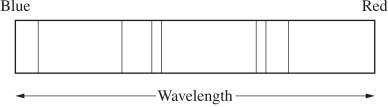
The absorption lines in a star's spectrum are shown.
 

What feature of the star is directly responsible for these absorption lines?

  1. Size
  2. Colour
  3. Distance from Earth
  4. Chemical composition
Show Answers Only

`D`

Show Worked Solution
  • Elements and compounds in the stars’ atmosphere will absorb specific wavelengths of light which correspond to these absorption lines.
  • Chemical composition is responsible.

`=>D`

Filed Under: Origins of Elements Tagged With: Band 3, smc-3700-20-Spectra

PHYSICS, M7 2020 HSC 26

  1. Describe the difference between the spectra of the light produced by a gas discharge tube and by an incandescent lamp.   (2 marks)

--- 4 WORK AREA LINES (style=lined) ---

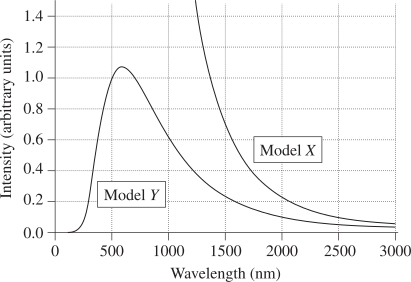
  1. The graph shows the curves predicted by two different models, `X` and `Y`, for the electromagnetic radiation emitted by an object at a temperature of 5000 K.
     

    Identify an assumption of EACH model which determines the shape of its curve.   (2 marks)

--- 4 WORK AREA LINES (style=lined) ---
  1. The diagram shows the radiation curve for a black body radiator at a temperature of 5000 K.


    On the same diagram, sketch a curve for a black body radiator at a temperature of 4000 K and explain the differences between the curves.   (4 marks)

    --- 6 WORK AREA LINES (style=lined) ---
Show Answers Only

a.   The spectra of light produced by a gas discharge tube will consist of lines only at a few discrete wavelengths.

The spectra of light produced by an incandescent lamp will be a continuous spectrum.

b.   Model `X` black bodies absorb and emit energy continuously.

Model `Y` assumes that black bodies absorb and emit energy in discrete quantities.

c.

  • Using `lambda_(max)=(b)/(T)\ \ =>\ \ lambda prop (1)/(T)`
  • Therefore, the 4000 K curve will have a peak wavelength greater than the 5000 K curve.
  • The area under the curve and the intensity at all wavelengths will be less for the 4000 K curve, as the total power output of a black body decreases as its temperature decreases.
Show Worked Solution

a.    Differences:

  • The spectra of light produced by a gas discharge tube will consist of lines only at a few discrete wavelengths.
  • The spectra of light produced by an incandescent lamp will be a continuous spectrum.

♦ Mean mark (a) 39%.

b.    Assumptions of EACH model:

  • Model `X` black bodies absorb and emit energy continuously.
  • Model `Y` assumes that black bodies absorb and emit energy in discrete quantities.

♦ Mean mark (b) 44%.

c.

  • Using `lambda_(max)=(b)/(T)\ \ =>\ \ lambda prop (1)/(T)`
  • Therefore, the 4000 K curve will have a peak wavelength greater than the 5000 K curve.
  • The area under the curve and the intensity at all wavelengths will be less for the 4000 K curve, as the total power output of a black body decreases as its temperature decreases.

Filed Under: Electromagnetic Spectrum, Light: Quantum Model, Light: Wave Model, Origins of Elements Tagged With: Band 4, Band 5, smc-3696-10-Spectroscopy, smc-3698-50-Blackbodies, smc-3698-80-Wave/Particle models, smc-3700-20-Spectra

PHYSICS, M7 2021 HSC 5 MC

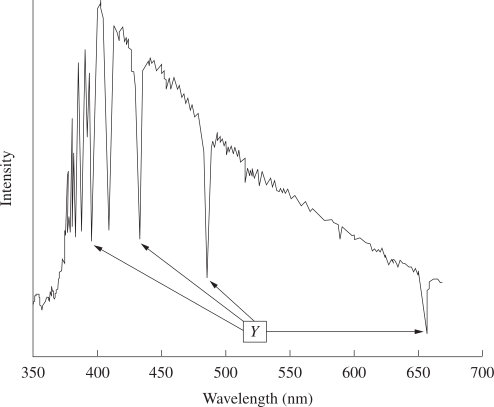
The spectrum of an object is shown.
 

Which row of the table correctly identifies the most likely source of the spectrum and the features labelled \(Y\)?

\begin{align*}
\begin{array}{l}
\rule{0pt}{1.5ex} \ \rule[-0.5ex]{0pt}{0pt}& \\
\rule{0pt}{2.5ex}\textbf{A.}\rule[-1ex]{0pt}{0pt}\\
\rule{0pt}{2.5ex}\textbf{B.}\rule[-1ex]{0pt}{0pt}\\
\rule{0pt}{2.5ex}\textbf{C.}\rule[-1ex]{0pt}{0pt}\\
\rule{0pt}{2.5ex}\textbf{D.}\rule[-1ex]{0pt}{0pt}\\
\end{array}
\begin{array}{|l|l|}
\hline
\rule{0pt}{1.5ex}\text{Source of spectrum}\rule[-0.5ex]{0pt}{0pt}& \textit{Features labelled \(Y\)} \\
\hline
\rule{0pt}{2.5ex}\text{Star}\rule[-1ex]{0pt}{0pt}&\text{Absorption lines}\\
\hline
\rule{0pt}{2.5ex}\text{Discharge tube}\rule[-1ex]{0pt}{0pt}& \text{Absorption lines}\\
\hline
\rule{0pt}{2.5ex}\text{Star}\rule[-1ex]{0pt}{0pt}& \text{Emission lines} \\
\hline
\rule{0pt}{2.5ex}\text{Discharge tube}\rule[-1ex]{0pt}{0pt}& \text{Emission lines} \\
\hline
\end{array}
\end{align*}

Show Answers Only

\(A\)

Show Worked Solution
  • Overall shape resembles a blackbody curve so the source of the spectrum is a star. The wavelengths of lower intensity are absorption lines.

\(\Rightarrow A\)

Filed Under: Electromagnetic Spectrum, Origins of Elements Tagged With: Band 4, smc-3696-10-Spectroscopy, smc-3696-30-Stars, smc-3700-20-Spectra

Copyright © 2014–2025 SmarterEd.com.au · Log in