SmarterEd

Aussie Maths & Science Teachers: Save your time with SmarterEd

  • Login
  • Get Help
  • About

PHYSICS, M8 2024 HSC 22

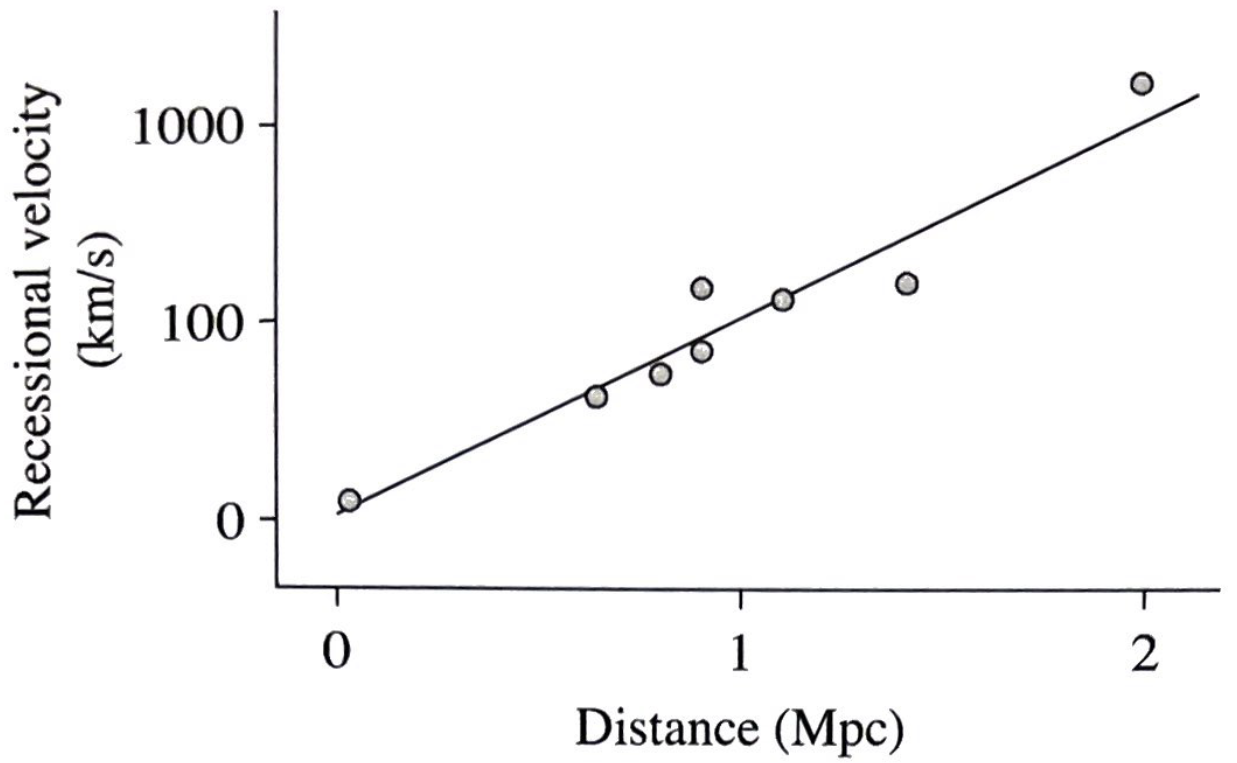
The following graph, based on the data gathered by Hubble, shows the relationship between the recessional velocity of galaxies and their distance from Earth.


  1. Describe the significance of the graph to our understanding of the universe.   (2 marks)

    --- 4 WORK AREA LINES (style=lined) ---

  2. How were the recessional velocities of galaxies determined?  (3 marks)

    --- 6 WORK AREA LINES (style=lined) ---
Show Answers Only

a.   Recessional velocity vs distance from Earth graph:

  • The graph shows that the further away galaxies are from Earth, the faster these galaxies are moving away from Earth.
  • This relationships depicts Hubble’s law:  \(v=H_0 D\). 
  • This graph provides evidence that the universe is constantly expanding as predicted by the big bang theory.
     

b.   Determining recessional velocities:

  • The recessional velocities of the galaxies were determined by analysing their absorption spectras.
  • Light waves that are moving away from the Earth will appear to be stretched (wavelength increased) according to the doppler effect.
  • The absorption spectra of galaxies were compared with the spectra of the same elements on Earth, revealing that the galaxies’ spectra were redshifted.
  • The greater the extent of the red shift in the spectra, the greater the recessional velocity of the galaxy. 

Show Worked Solution

a.   Recessional velocity vs distance from Earth graph:

  • The graph shows that the further away galaxies are from Earth, the faster these galaxies are moving away from Earth.
  • This relationships depicts Hubble’s law:  \(v=H_0 D\). 
  • This graph provides evidence that the universe is constantly expanding as predicted by the big bang theory.
     

b.   Determining recessional velocities:

  • The recessional velocities of the galaxies were determined by analysing their absorption spectras.
  • Light waves that are moving away from the Earth will appear to be stretched (wavelength increased) according to the doppler effect.
  • The absorption spectra of galaxies were compared with the spectra of the same elements on Earth, revealing that the galaxies’ spectra were redshifted.
  • The greater the extent of the red shift in the spectra, the greater the recessional velocity of the galaxy. 
♦ Mean mark (b) 49%.

Filed Under: Electromagnetic Spectrum, Origins of Elements Tagged With: Band 4, Band 5, smc-3696-10-Spectroscopy, smc-3700-20-Spectra, smc-3700-30-Hubble

PHYSICS, M8 2023 HSC 20 MC

In 1995 , observational evidence showed that Hubble's description of the expansion of the universe was inaccurate.

It was discovered that the expansion of the universe was accelerating. This discovery was based on observations of light from galaxies whose distances from Earth could be accurately measured, and were significantly more distant than any observed by Hubble.

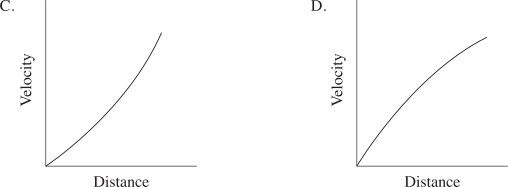
Which graph relating velocities of galaxies to their distances from Earth is consistent with an accelerating rate of expansion of the universe?


Show Answers Only

\(D\)

Show Worked Solution
  • Light from the most distant galaxies has taken the longest time to reach the Earth and so distance can also be regarded as a measure of time.
  • The light from these galaxies was around when the acceleration of the universe was smaller than it is today.
  • Hence, it is expected that the gradient of the graph at large distances from Earth will be flatter as the acceleration of the universe was smaller.
  • Light coming from galaxies closer to the Earth is younger and so the closer the distance a galaxy is from Earth, the steeper the curve. 
  • The difference in velocities between galaxies closer to the Earth is greater due to the accelerating rate of the universe.

\(\Rightarrow D\)

♦♦♦ Mean mark 11%.

Filed Under: Origins of Elements Tagged With: Band 6, smc-3700-30-Hubble

PHYSICS, M8 2019 HSC 8 MC

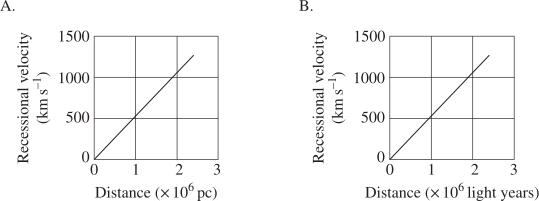
A typical galaxy has a diameter of 100 000 light years (∼30 000 pc).

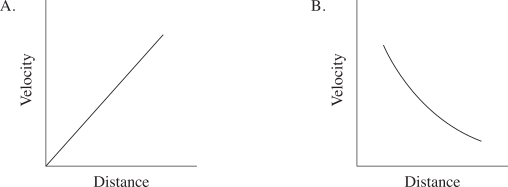
Which graph is consistent with Hubble's measurements of the recessional velocity of galaxies?


Show Answers Only

`A`

Show Worked Solution

By elimination:

  • Hubble found that the recessional velocity of a galaxy was directly proportional to its distance (linear graph) → Eliminate C and D
  • Hubble measured distance using parsecs → Eliminate B

`=>A`


♦ Mean mark 25%.

Filed Under: Origins of Elements Tagged With: Band 6, smc-3700-30-Hubble

PHYSICS, M8 2021 HSC 32

Two students perform an investigation with a piece of elastic laid out straight on a table. The elastic is fixed at one end and has three markings at regular intervals. The distances from each marking to the fixed end, `d_1, d_2` and `d_3`, are measured as shown.
 

A student pulls the elastic to extend it, and the new values of `d_1, d_2` and `d_3` are measured. The student observes that each value has doubled.

How well do the observations from this investigation model the evidence that led to Hubble's discovery of the expansion of the universe? Justify your answer.   (5 marks)

--- 10 WORK AREA LINES (style=lined) ---

Show Answers Only
  • Hubble observed that galaxies further away from Earth are receding at a faster rate that is proportional to their distance from Earth.
  • From this he discovered that space is expanding.
  • The investigation successfully models this as markings further away from the fixed end moved by a larger amount as the elastic expands.
  • This increase is proportional to a marking’s distance from the fixed end and links to the greater recessional velocity of more distant galaxies.

Limitations:

  • The elastic only expands in one direction whereas Hubble’s evidence demonstrated that the universe is expanding in three dimensions.
  • The investigation measures the change in the position of markings whereas Hubble measured speed of galaxies.
  • The markings themselves stretch. Hubble didn’t find that the galaxies themselves were spreading out.
Show Worked Solution
  • Hubble observed that galaxies further away from Earth are receding at a faster rate that is proportional to their distance from Earth.
  • From this he discovered that space is expanding.
  • The investigation successfully models this as markings further away from the fixed end moved by a larger amount as the elastic expands.
  • This increase is proportional to a marking’s distance from the fixed end and links to the greater recessional velocity of more distant galaxies.

Limitations:

  • The elastic only expands in one direction whereas Hubble’s evidence demonstrated that the universe is expanding in three dimensions.
  • The investigation measures the change in the position of markings whereas Hubble measured speed of galaxies.
  • The markings themselves stretch. Hubble didn’t find that the galaxies themselves were spreading out.

♦ Mean mark 51%.

Filed Under: Origins of Elements Tagged With: Band 5, smc-3700-30-Hubble

Copyright © 2014–2025 SmarterEd.com.au · Log in