SmarterEd

Aussie Maths & Science Teachers: Save your time with SmarterEd

  • Login
  • Get Help
  • About

PHYSICS, M8 2022 VCE 9

A star is transforming energy at a rate of 2.90 × 10\(^{25}\) W.

Explain the type of transformation involved and what effect, if any, the transformation would have on the mass of the star. No calculations are required.  (2 marks)

--- 6 WORK AREA LINES (style=lined) ---
Show Answers Only
  • The transformation involved is the transformation of mass to energy using Einstein’s mass-energy equivalence formula, \(E=mc^2\)
  • The process undertaken is called nuclear fusion and commonly occurs in the form of the proton-proton chain or CNO cycle.
  • This transformation would decrease the mass of the star as energy is produced and radiates away from the star.
Show Worked Solution
  • The transformation involved is the transformation of mass to energy using Einstein’s mass-energy equivalence formula, \(E=mc^2\)
  • The process undertaken is called nuclear fusion and commonly occurs in the form of the proton-proton chain or CNO cycle.
  • This transformation would decrease the mass of the star as energy is produced and radiates away from the star.
♦ Mean mark 47%.

Filed Under: Origins of Elements Tagged With: Band 5, smc-3700-40-Nuclear Reactions in Stars

PHYSICS, M8 EQ-Bank 23

Describe TWO processes by which stars produce energy.   (4 marks)

--- 8 WORK AREA LINES (style=lined) ---

Show Answers Only
  • At the most basic level, stars produce energy through the process of nuclear fusion.
  • In less massive, lower temperature stars (like our Sun), the proton-proton chain reaction generates energy through nuclear fusion via the fusion of four hydrogen atoms to one helium atom. 
  • In more massive, hotter stars, the CNO cycle is the dominant means by which energy is produced. This process involves carbon, nitrogen and oxygen acting as catalysts for the similar nuclear fusion of four hydrogen atoms into one helium atom and high energy gamma ray photons.
Show Worked Solution
  • At the most basic level, stars produce energy through the process of nuclear fusion.
  • In less massive, lower temperature stars (like our Sun), the proton-proton chain reaction generates energy through nuclear fusion via the fusion of four hydrogen atoms to one helium atom. 
  • In more massive, hotter stars, the CNO cycle is the dominant means by which energy is produced. This process involves carbon, nitrogen and oxygen acting as catalysts for the similar nuclear fusion of four hydrogen atoms into one helium atom and high energy gamma ray photons.

Filed Under: Origins of Elements Tagged With: Band 4, smc-3700-40-Nuclear Reactions in Stars

PHYSICS M8 2022 HSC 21

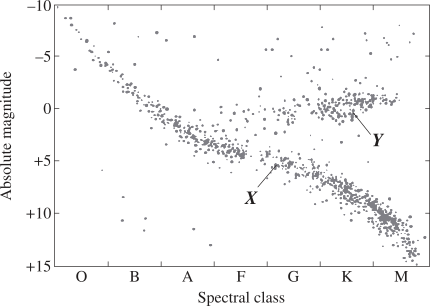
The positions of two stars, `X` and `Y`, are shown in the Hertzsprung-Russell diagram.
 

  1. Compare qualitatively the surface temperature and luminosity of `X` and `Y`.   (2 marks)

    --- 4 WORK AREA LINES (style=lined) ---

  1. Identify the elements undergoing fusion in the core of each star, `X` and `Y`.   (2 marks)

    --- 4 WORK AREA LINES (style=lined) ---

Show Answers Only

a.   Surface Temperature:

  • The surface temperature of `X` is greater than the surface temperature of `Y.`

Luminosity:

  • The luminosity of `Y` is greater than the luminosity of `X.`

b.   Elements undergoing fusion:

  • `X` is a main sequence star so in its core hydrogen is being fused into helium.
  • `Y` is a red giant so in its core helium is being fused into carbon.
Show Worked Solution

a.   Surface Temperature:

  • The surface temperature of `X` is greater than the surface temperature of `Y.`

Luminosity:

  • The luminosity of `Y` is greater than the luminosity of `X.`

b.   Elements undergoing fusion:

  • `X` is a main sequence star so in its core hydrogen is being fused into helium.
  • `Y` is a red giant so in its core helium is being fused into carbon.

Filed Under: Origins of Elements Tagged With: Band 3, Band 4, smc-3700-10-H-R Diagrams, smc-3700-40-Nuclear Reactions in Stars

PHYSICS, M8 2021 HSC 6 MC

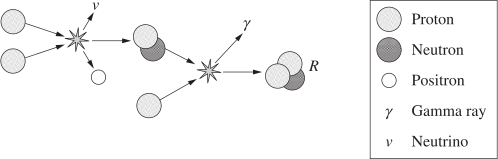
The diagram shows part of a nuclear fusion process that occurs in stars.
 

What is the isotope labelled \(R\) ?

  1. \(\ce{H-2}\)
  2. \(\ce{He-2}\)
  3. \(\ce{H-3}\)
  4. \(\ce{He-3}\)
Show Answers Only

`D`

Show Worked Solution
  • The atom has two protons (Helium) and one neutron giving it a mass number of three.

\(\Rightarrow D\)

Filed Under: Origins of Elements Tagged With: Band 4, smc-3700-40-Nuclear Reactions in Stars

Copyright © 2014–2025 SmarterEd.com.au · Log in