SmarterEd

Aussie Maths & Science Teachers: Save your time with SmarterEd

  • Login
  • Get Help
  • About

PHYSICS, M8 2020 VCE 13 MC

Matter is converted to energy by nuclear fusion in stars.

If the star Alpha Centauri converts mass to energy at the rate of 6.6 × 10\(^9\) kg s\(^{-1}\), then the power generated is closest to

  1. \(2.0 \times 10^{18}\ \text{W}\)
  2. \(2.0 \times 10^{18}\ \text{J}\)
  3. \(6.0 \times 10^{26}\ \text{W}\)
  4. \(6.0 \times 10^{26}\ \text{J}\)
Show Answers Only

\(C\)

Show Worked Solution
  • The energy produced by the star each second is the power generated by the star.
  • \(E=mc^2=6.6 \times 10^9 \times (3 \times 10^8)^2=6 \times 10^{26}\ \text{Js}^{-1}=6 \times 10^{26}\ \text{W}\)

\(\Rightarrow C\)

Mean mark 56%.

Filed Under: Origins of Elements Tagged With: Band 4, smc-3700-60-Mass-Energy Equivalence

PHYSICS, M8 EQ-Bank 22

Einstein's equation `E = mc^(2)`  is one of the most important equations in the history of physics.

Justify this statement.   (7 marks)

--- 14 WORK AREA LINES (style=lined) ---

Show Answers Only

Position Statement

  • Einstein’s equation `E=mc^2` is among physics’ most important equations because it reveals mass-energy equivalence and explains fundamental processes from atomic to cosmic scales.

Nuclear Applications

  • The equation explains energy from nuclear fission and fusion processes. It shows how tiny amounts of matter convert to enormous energy in nuclear reactions.
  • The mass defect in atoms directly relates to binding energy through `E=mc^2` and this principle drives nuclear reactors that power cities and nuclear weapons.
  • These applications are responsible for revolutionising both energy production and global politics.

Cosmic and Particle Physics

  • Stars produce energy by converting mass to energy through fusion reactions. The Sun converts 4 million tonnes of mass to energy every second using this principle
  • Particle accelerators create new particles by converting kinetic energy into mass. This allows scientists to study fundamental matter structure and discover new particles.
  • Furthermore, mass dilation near light speed also follows from this mass-energy relationship.

Reinforcement

  • While other equations like Newton’s gravity law are important, they lack the broad applicability of `E=mc^2`.
  • No other single equation explains phenomena from subatomic particles to stellar processes.
  • The equation unified our understanding of matter and energy as different forms of the same thing.
  • This justifies calling `E=mc^2` one of history’s most important physics equations.
Show Worked Solution

Position Statement

  • Einstein’s equation `E=mc^2` is among physics’ most important equations because it reveals mass-energy equivalence and explains fundamental processes from atomic to cosmic scales.

Nuclear Applications

  • The equation explains energy from nuclear fission and fusion processes. It shows how tiny amounts of matter convert to enormous energy in nuclear reactions.
  • The mass defect in atoms directly relates to binding energy through `E=mc^2` and this principle drives nuclear reactors that power cities and nuclear weapons.
  • These applications are responsible for revolutionising both energy production and global politics.

Cosmic and Particle Physics

  • Stars produce energy by converting mass to energy through fusion reactions. The Sun converts 4 million tonnes of mass to energy every second using this principle
  • Particle accelerators create new particles by converting kinetic energy into mass. This allows scientists to study fundamental matter structure and discover new particles.
  • Furthermore, mass dilation near light speed also follows from this mass-energy relationship.

Reinforcement

  • While other equations like Newton’s gravity law are important, they lack the broad applicability of `E=mc^2`.
  • No other single equation explains phenomena from subatomic particles to stellar processes.
  • The equation unified our understanding of matter and energy as different forms of the same thing.
  • This justifies calling `E=mc^2` one of history’s most important physics equations.

Filed Under: Light and Special Relativity, Origins of Elements, Properties of the Nucleus Tagged With: Band 3, Band 4, Band 5, smc-3699-80-E = mc^2, smc-3700-60-Mass-Energy Equivalence, smc-3703-20-Conservation of Mass-Energy

PHYSICS, M8 2015 HSC 33d

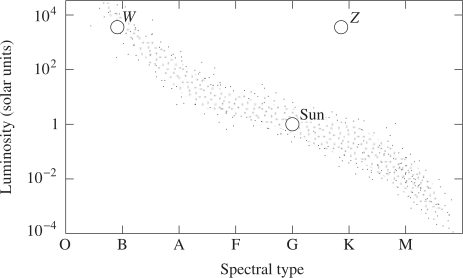
The position of the Sun, star `W` and star `Z` are shown on the H-R diagram.
 

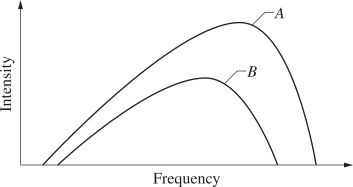
The curves `A` and `B` show intensity versus frequency for star `W` and the Sun, measured from the same distance.
 

  1. Identify which curve (`A` or `B`) represents star `W` and justify your choice.   (2 marks)

--- 4 WORK AREA LINES (style=lined) ---

  1. Account for differences between stars `W` and `Z` that can be deduced from the H-R diagram.   (3 marks)

--- 6 WORK AREA LINES (style=lined) ---

Show Answers Only

i.    Curve A represents star `W`:

  • `W` is hotter so will emit more energy overall, and peak frequency will be higher.

ii.   Differences displayed in H-R graph:

  • Star `W` lies in the main sequence and is therefore fusing hydrogen to helium, most likely via CNO cycle as it is a large dense star.
  • Star `Z` is past main sequence and is therefore fusing larger elements.
  • Since star `Z` is cooler than `W` (refer to its H-R diagram location ) but has similar luminosity, we can deduce it is much larger than `W`.

Other possible answers could include:

  • Differences in fuel source, size and temperature of the stars.
Show Worked Solution

i.    Curve A represents star `W`:

  • `W` is hotter so will emit more energy overall, and peak frequency will be higher.

ii.   Differences displayed in H-R graph:

  • Star `W` lies in the main sequence and is therefore fusing hydrogen to helium, most likely via CNO cycle as it is a large dense star.
  • Star `Z` is past main sequence and is therefore fusing larger elements.
  • Since star `Z` is cooler than `W` (refer to its H-R diagram location ) but has similar luminosity, we can deduce it is much larger than `W`.

Other possible answers could include:

  • Differences in fuel source, size and temperature of the stars.

Filed Under: Origins of Elements Tagged With: Band 3, Band 4, smc-3700-10-H-R Diagrams, smc-3700-60-Mass-Energy Equivalence

Copyright © 2014–2025 SmarterEd.com.au · Log in