SmarterEd

Aussie Maths & Science Teachers: Save your time with SmarterEd

  • Login
  • Get Help
  • About

PHYSICS, M8 2024 HSC 24

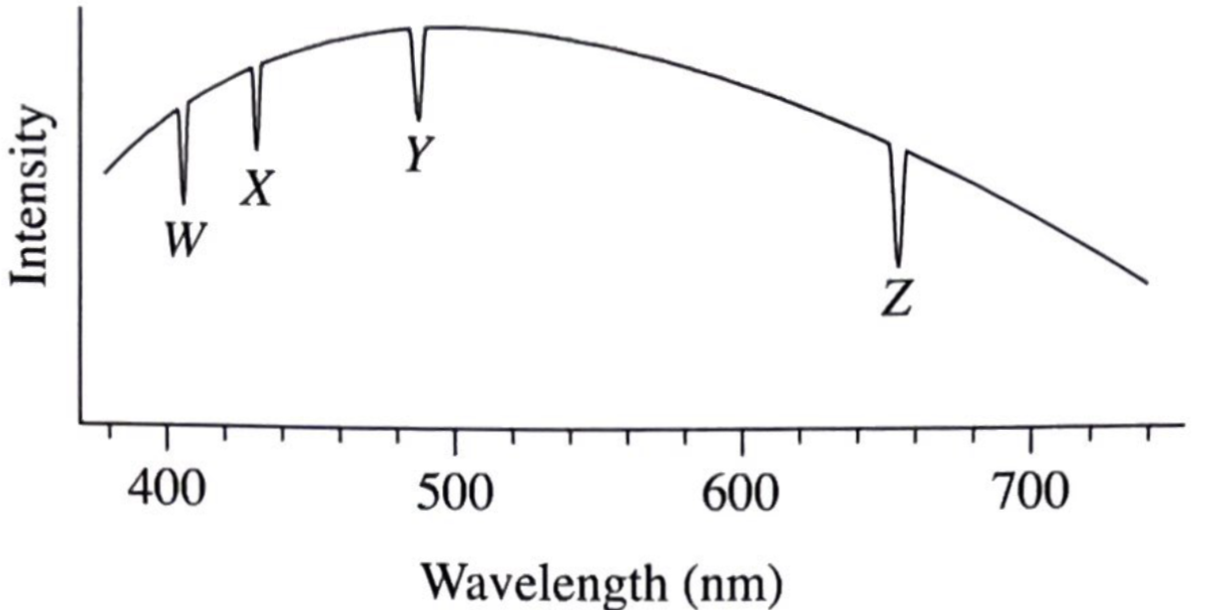
An absorption spectrum resulting from the passage of visible light from a star's surface through its hydrogen atmosphere is shown. Absorption lines are labelled \(W\) to \(Z\) in the diagram.
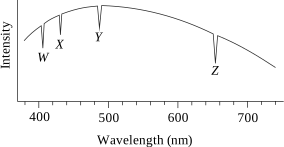
 

  1. Determine the surface temperature of the star.   (2 marks)

    --- 4 WORK AREA LINES (style=lined) ---

  2. Absorption line \(W\) originates from an electron transition between the second and sixth energy levels. Use  \(\dfrac{1}{\lambda}=R\left(\dfrac{1}{n_{ f }^2}-\dfrac{1}{n_{ i }^2}\right)\)  to calculate the frequency of light absorbed to produce absorption line \(W\).   (3 marks)

    --- 8 WORK AREA LINES (style=lined) ---

  3. Explain the physical processes that produce an absorption spectrum.   (3 marks)

    --- 8 WORK AREA LINES (style=lined) ---
Show Answers Only

a.    \(5796\ \text{K}\)

b.    \(7.31 \times 10^{14}\ \text{Hz}\)

c.    An absorption spectra is produced when:

  • A continuous spectrum of light  from a black body such as a star passes through cooler and lower density gas in the outer atmosphere of the star.
  • As the light passes through the gas, electrons in the atoms that make up the cooler gas clouds absorb distinct wavelengths/energy levels of light equal to the difference in energy levels between the electron shells where \(E_i-E_f=hf=\dfrac{hc}{\lambda}\). 
  • As the electrons in the atoms fall back into their ground state, they emit the photon of light that they absorb and the photon is then scattered out of the continuous spectrum.
  • The light that remains is then passed through a prism to separate the wavelengths and record the intensities. The black or darkened lines in the absorption spectra is the result of the scattered wavelengths of light. 
Show Worked Solution

a.    Determined temperature using the peak wavelength:

\(T=\dfrac{b}{\lambda_{\text{max}}}=\dfrac{2.898 \times 10^{-3}}{500 \times 10^{-9}}=5796\ \text{K}\)
 

b.     \(\dfrac{1}{\lambda}\) \(=R\left(\dfrac{1}{n_f^2}-\dfrac{1}{n_i^2}\right)\)
    \(=1.097 \times 10^7 \times \left(\dfrac{1}{2^2}-\dfrac{1}{6^2}\right)\)
    \(=2.438 \times 10^6\ \text{m}^{-1}\)
  \(\lambda\) \(=\dfrac{1}{2.438 \times 10^6}=410.2\ \text{nm}\)


\(\therefore f=\dfrac{c}{\lambda} = \dfrac{3 \times 10^8}{410.2 \times 10^{-9}} = 7.31 \times 10^{14}\ \text{Hz}\)
 

c.    Absorption spectra:

  • Produced when a continuous spectrum of light  from a black body such as a star passes through cooler and lower density gas in the outer atmosphere of the star.
  • As the light passes through the gas, electrons in the atoms that make up the cooler gas clouds absorb distinct wavelengths/energy levels of light equal to the difference in energy levels between the electron shells where \(E_i-E_f=hf=\dfrac{hc}{\lambda}\). 
  • As the electrons in the atoms fall back into their ground state, they emit the photon of light that they absorb and the photon is then scattered out of the continuous spectrum.
  • The light that remains is then passed through a prism to separate the wavelengths and record the intensities. The black or darkened lines in the absorption spectra is the result of the scattered wavelengths of light. 
♦ Mean mark (c) 51%.

Filed Under: Light: Quantum Model, Origins of Elements, Quantum Mechanical Nature of the Atom Tagged With: Band 4, Band 5, smc-3698-50-Blackbodies, smc-3698-70-Planck, smc-3700-20-Spectra, smc-3702-20-Electron Transitions

PHYSICS, M8 2019 VCE 18

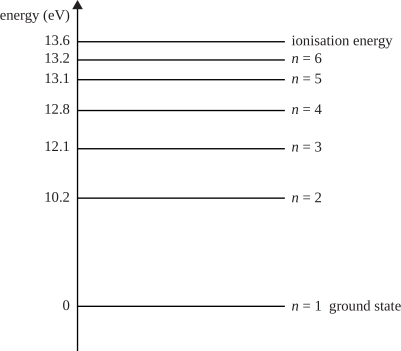
The energy level diagram for a hydrogen atom is shown below.
 

  1. A hydrogen atom in the ground state is excited to the \(n=4\) state.
  2. Explain how the hydrogen atom could be excited to the \(n=4\) state in one step.   (2 marks)

    --- 4 WORK AREA LINES (style=lined) ---

  1. List the possible photon energies that could be emitted as the atom goes from the \(n=4\) state to the \(n=2\) state.   (3 marks) 

    --- 4 WORK AREA LINES (style=lined) ---

Show Answers Only

a.   Ground state to \(n=4\) state:

  • The hydrogen atom would need to absorb exactly 12.8 eV of energy.
  • The energy source could be either an incident photon or electron.

b.    From \(n=4\) to \(n=3\ \ \Rightarrow \ 0.7\ \text{eV}\)

From \(n=3\) to \(n=2\ \ \Rightarrow \ 1.9\ \text{eV}\)

From \(n=4\) to \(n=2\ \ \Rightarrow \ 2.6\ \text{eV}\)

Show Worked Solution

a.   Ground state to \(n=4\) state:

  • The hydrogen atom would need to absorb exactly 12.8 eV of energy.
  • The energy source could be either an incident photon or electron.

b.    From \(n=4\) to \(n=3\ \ \Rightarrow \ 0.7\ \text{eV}\)

From \(n=3\) to \(n=2\ \ \Rightarrow \ 1.9\ \text{eV}\)

From \(n=4\) to \(n=2\ \ \Rightarrow \ 2.6\ \text{eV}\)

Filed Under: Quantum Mechanical Nature of the Atom Tagged With: Band 4, smc-3702-10-Bohr's Model, smc-3702-20-Electron Transitions

PHYSICS, M8 2020 VCE 17

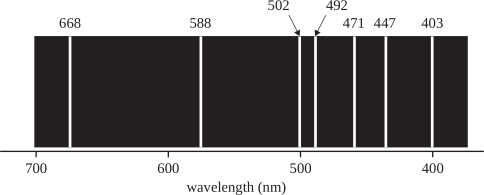
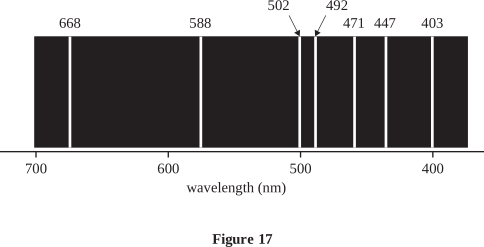
The diagram shows the emission spectrum for helium gas.
 

  1. Which spectral line indicates the photon with the lowest energy?  (1 mark)

--- 1 WORK AREA LINES (style=lined) ---

  1. Calculate the frequency of the photon emitted at the 588 nm line. Show your working.  (2 marks)

--- 6 WORK AREA LINES (style=lined) ---

  1. Explain why only certain wavelengths and, therefore, certain energies are present in the helium spectrum.  (2 marks)

--- 4 WORK AREA LINES (style=lined) ---

Show Answers Only

a.    \(668\ \text{nm}\)

b.    \(5.1 \times 10^{14}\ \text{Hz}\)

c.   Wavelengths of \(\ce{He}\) spectrum:

  • Electrons in the helium atom exist within electron shells.
  • Electrons in each shell have a fixed amount of energy. 
  • The electrons can absorb certain amounts of energy and move up into the next energy shell which is equal to the difference in energy between the shells.
  • When electrons fall back to their original energy state, they emit a photon with energy equal to the difference in energy between the shells.
  • As these are always fixed energy levels, only certain wavelengths and energies are emitted and therefore present in the helium spectrum.

Show Worked Solution

a.    \(E=\dfrac{hc}{\lambda}\),  therefore \(E \propto \dfrac{1}{\lambda}\)

  • The photon with the lowest energy will have the highest wavelength.
  • Lowest energy spectral line = 668 nm

b.    Convert: 588 nm = 588 × 10\(^{-9}\) m

\(f=\dfrac{c}{\lambda}=\dfrac{3 \times 10^8}{588 \times 10^{-9}}=5.1 \times 10^{14}\ \text{Hz}\)
 

c.   Wavelengths of \(\ce{He}\) spectrum:

  • Electrons in the helium atom exist within electron shells.
  • Electrons in each shell have a fixed amount of energy. 
  • The electrons can absorb certain amounts of energy and move up into the next energy shell which is equal to the difference in energy between the shells.
  • When electrons fall back to their original energy state, they emit a photon with energy equal to the difference in energy between the shells.
  • As these are always fixed energy levels, only certain wavelengths and energies are emitted and therefore present in the helium spectrum.
♦♦ Mean mark (c) 34%.

Filed Under: Quantum Mechanical Nature of the Atom Tagged With: Band 4, Band 5, smc-3702-20-Electron Transitions, smc-3702-30-Photon Energy

PHYSICS, M8 2021 VCE 19

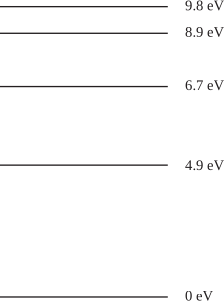
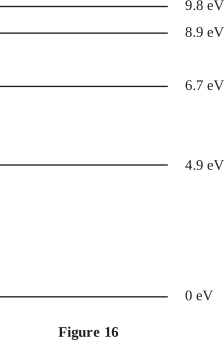
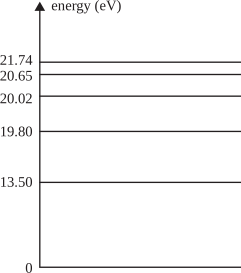
A simplified diagram of some of the energy levels of an atom is shown in the diagram.
 

  1. Identify the transition on the energy level diagram that would result in the emission of a 565 nm photon. Show your working.   (2 marks)

--- 6 WORK AREA LINES (style=lined) ---

  1. A sample of the atoms is excited into the 9.8 eV state and a line spectrum is observed as the states decay. Assume that all possible transitions occur.

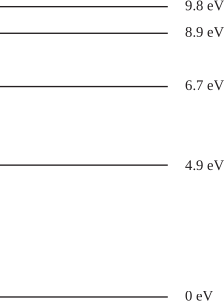
    What is the total number of lines in the spectrum? Explain your answer. You may use the diagram below to support your answer.   (2 marks)
     

--- 6 WORK AREA LINES (style=lined) ---

Show Answers Only

a.    The energy transition from 8.9 eV to 6.7 eV.

b.    9 spectral lines.

Show Worked Solution

a.    \(E=hf=\dfrac{hc}{\lambda}=\dfrac{6.626 \times 10^{-34} \times 3 \times 10^8}{565 \times 10^{-9}}=3.52 \times 10^{-19}\ \text{J}\)

\(\text{Convert to eV}\ =\dfrac{3.52 \times 10^{-19}}{1.602 \times 10^{-19}}=2.2\ \text{eV}\)

  • The energy transition from 8.9 eV to 6.7 eV will result in the emission of a 565 nm photon.
  • Note: This could have also been shown on the diagram as a downwards arrow from 8.9 eV to 6.7 eV.
     
♦ Mean mark (a) 50%.

b.    Decay from the 9.8 eV state:

  • Each photon emitted that has its own unique energy will result in a spectrum line.
  • There are 4 possible transitions from 9.8 eV, 3 from 8.9 eV, 2 from 6.7 eV and 1 from 4.9 eV, resulting in 10 different transitions.
  • However, the transition from 9.8 eV to 4.9 eV and 4.9 eV to 0 eV will produce a photon of the same energy, hence they will have the same spectral line. 
  • Therefore, there will be 9 lines in the spectrum.
♦♦ Mean mark (b) 31%.

Filed Under: Quantum Mechanical Nature of the Atom Tagged With: Band 5, smc-3702-20-Electron Transitions, smc-3702-30-Photon Energy

PHYSICS, M8 2022 VCE 15

The diagram shows some of the energy levels of excited neon atoms. These energy levels are not drawn to scale.
 

  1. Show that the energy transition required for an emitted photon of wavelength 640 nm is 1.94 eV.   (1 mark)

--- 4 WORK AREA LINES (style=lined) ---

  1. On the diagram, draw an arrow to show the transition that would emit the photon described in part a.   (1 mark)

--- 0 WORK AREA LINES (style=blank) ---

Show Answers Only

a.    \(E=hf=\dfrac{hc}{\lambda}=\dfrac{6.626 \times 10^{-34} \times 3 \times 10^8}{640 \times 10^{-9}}=3.106 \times 10^{-19}\ \text{J}\)

\(\text{Convert to electron volts} =\dfrac{3.106 \times 10^{-19}}{1.602 \times 10^{-19}}=1.94\ \text{eV}\)
 

b.   
       

Show Worked Solution

a.    \(E=hf=\dfrac{hc}{\lambda}=\dfrac{6.626 \times 10^{-34} \times 3 \times 10^8}{640 \times 10^{-9}}=3.106 \times 10^{-19}\ \text{J}\)

\(\text{Convert to electron volts} =\dfrac{3.106 \times 10^{-19}}{1.602 \times 10^{-19}}=1.94\ \text{eV}\)
 

b.
       

Filed Under: Quantum Mechanical Nature of the Atom Tagged With: Band 4, smc-3702-20-Electron Transitions, smc-3702-30-Photon Energy

PHYSICS, M8 2023 VCE 16

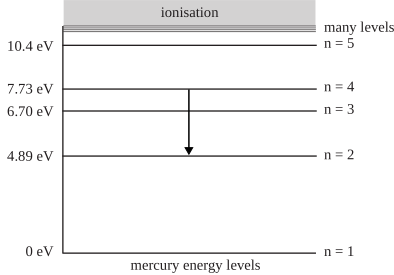
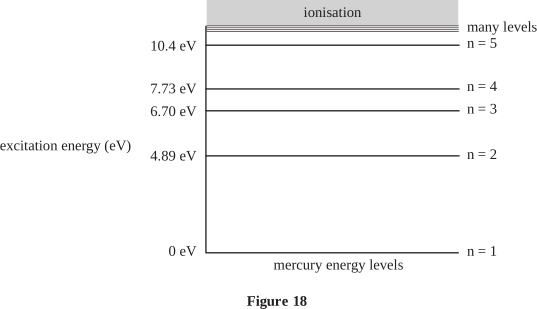
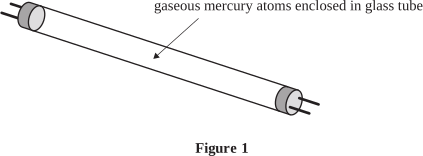
Fluorescent lights, when operating, contain gaseous mercury atoms, as shown in Figure 1.
 

Analysis of the light produced by fluorescent lights shows a number of emission spectral lines, including a prominent line representing a wavelength of 436.6 nm.

  1. Calculate the energy of the photons represented by the emission spectral line representing a wavelength of 436.6 nm.   (2 marks)

--- 4 WORK AREA LINES (style=lined) ---

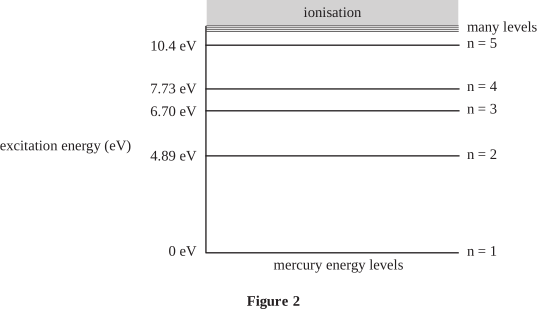
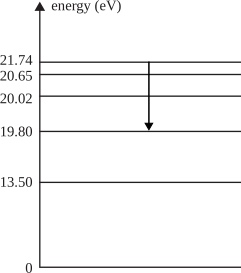
Figure 2 shows the lowest five energy levels for mercury.
 

  1. On the energy level diagram in Figure 2, draw an arrow showing the energy level transition that corresponds to the production of the spectral line representing a wavelength of 436.6 nm.   (1 mark)

    --- 0 WORK AREA LINES (style=lined) ---

Show Answers Only

a.    \(E=2.84\ \text{eV}\)

b.    
       

Show Worked Solution

a.    \(E=\dfrac{hc}{\lambda}=\dfrac{6.626 \times 10^{-34} \times 3 \times 10^8}{436.6 \times 10^{-9}}=4.549 \times 10^{-19}\ \text{J}\)

\(\text{Convert to eV:}\)

\(E= \dfrac{4.549 \times 10^{-19}}{1.602 \times 10^{-19}} = 2.84\ \text{eV}\)
 

b.    

Filed Under: Quantum Mechanical Nature of the Atom Tagged With: Band 4, smc-3702-20-Electron Transitions, smc-3702-30-Photon Energy

PHYSICS, M8 EQ-Bank 24

The table shows the quantum numbers of the four lowest states of the hydrogen atom, together with the energies of those states.

\begin{array}{|c|c|}
\hline \rule{0pt}{2.5ex}\textit{Quantum number,} \ n \rule[-1ex]{0pt}{0pt}& \quad \textit{Energy}\ \text{(joules)} \quad  \\
\hline \rule{0pt}{2.5ex}1 \text { (ground state) } \rule[-1ex]{0pt}{0pt}& 0 \\
\hline \rule{0pt}{2.5ex}2 \rule[-1ex]{0pt}{0pt}& 1.63 \times 10^{-18} \\
\hline \rule{0pt}{2.5ex}3 \rule[-1ex]{0pt}{0pt}& 1.94 \times 10^{-18} \\
\hline \rule{0pt}{2.5ex}4 \rule[-1ex]{0pt}{0pt}& 2.04 \times 10^{-18} \\
\hline
\end{array}

Using appropriate calculations, explain a quantum transition that will absorb a photon of wavelength 102 nm?   (3 marks)

Show Answers Only

See Worked Solutions

Show Worked Solution

Calculating the energy of the photon:

\(E\) \(=h f\)  
  \(=\dfrac{h c}{\lambda}\)  
  \(=\dfrac{\left(6.626 \times 10^{-34}\right)\left(3 \times 10^8\right)}{1.02 \times 10^{-7}}\)  
  \(=1.949 \times 10^{-18} \  \text{J}\)  
     
  •  When a photon with wavelength 102 nm strikes an electron in the ground state of the hydrogen atom, it will transfer its energy to the electron causing it to occupy a shell with greater energy. 
  • The electron absorbing the photon will therefore transition between shells one (ground state) and three, which is approximately the energy difference between these levels as shown in the table.

Filed Under: Quantum Mechanical Nature of the Atom Tagged With: Band 5, smc-3702-20-Electron Transitions, smc-3702-30-Photon Energy

PHYSICS, M8 2016 HSC 34bii

Calculate the initial energy level of an electron in a hydrogen atom if it emitted `4.089 × 10^{-19}` J on transition to the `n` = 2 level.   (3 marks)

--- 6 WORK AREA LINES (style=lined) ---

Show Answers Only

`n_i = 4`

Show Worked Solution

`E/(hc) = 1/lambda`

`E/(hc)` `=R(1/((n_f)^2)-1/((n_i)^2))=R(1/(2^2)-1/((n_i)^2))`  
`1/(n_i)^2` `=1/4-(E)/(Rhc)`  
  `=1/4-(4.089 xx 10^{-19})/(1.097 xx 10^7 xx 6.626 xx 10^(-34) xx 3 xx 10^8)`  
  `=0.06248`  

  
`n_i=sqrt(1/0.06248) = 4`

Filed Under: Quantum Mechanical Nature of the Atom Tagged With: Band 4, smc-3702-20-Electron Transitions

PHYSICS, M8 2017 HSC 34c

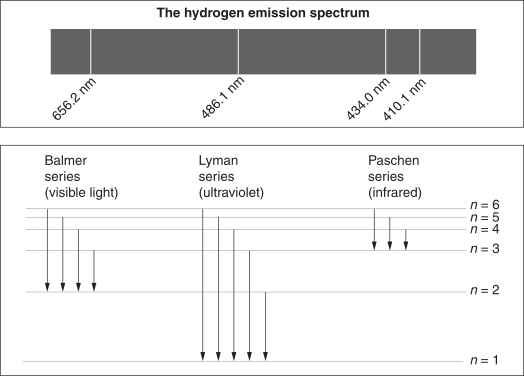
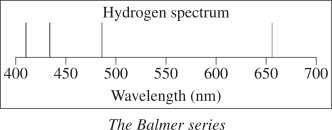
The diagrams show features of the hydrogen emission spectrum.
 

With reference to Bohr's postulates, explain how the line at 434.0 nm in the hydrogen emission spectrum is produced. Support your answer with calculations.   (4 marks)

--- 9 WORK AREA LINES (style=lined) ---

Show Answers Only
  • Bohr’s postulates state that an electron orbits an atom’s nucleus at fixed energy levels.
  • If an electron jumps from a higher energy level to a lower energy level, it will emit a photon that contains an exact amount of energy.
  • The Rydberg equation can be used to calculate a photon’s wavelength.
  • The blue light is part of the visible Balmer series and therefore `n_f=2`.
  • Using `n_f=2`, `lambda` = 434.0 nm: 
`1/lambda` `=R(1/((n_f)^2)-1/((n_i)^2))`  
  `=R(1/(2^2)-1/((n_i)^2))`  
`1/(n_i)^2` `=1/4-1/(lambdaR)`  
`(n_i)^2` `=1/(1/4-1/(1.097 xx 10^7 xx 434 xx 10^9))`  
`n_i` `=5`  
     
  •  The equation shows that a 434 nm wavelength for the emitted photon corresponds to a jump from the 5th energy level to the 2nd energy level.
Show Worked Solution
  • Bohr’s postulates state that an electron orbits an atom’s nucleus at fixed energy levels.
  • If an electron jumps from a higher energy level to a lower energy level, it will emit a photon that contains an exact amount of energy.
  • The Rydberg equation can be used to calculate a photon’s wavelength.
  • The blue light is part of the visible Balmer series and therefore `n_f=2`.
  • Using `n_f=2`, `lambda` = 434.0 nm: 
`1/lambda` `=R(1/((n_f)^2)-1/((n_i)^2))`  
  `=R(1/(2^2)-1/((n_i)^2))`  
`1/(n_i)^2` `=1/4-1/(lambdaR)`  
`(n_i)^2` `=1/(1/4-1/(1.097 xx 10^7 xx 434 xx 10^9))`  
`n_i` `=5`  
     
  •  The equation shows that a 434 nm wavelength for the emitted photon corresponds to a jump from the 5th energy level to the 2nd energy level.

Mean mark 56%.

Filed Under: Quantum Mechanical Nature of the Atom Tagged With: Band 4, smc-3702-10-Bohr's Model, smc-3702-20-Electron Transitions

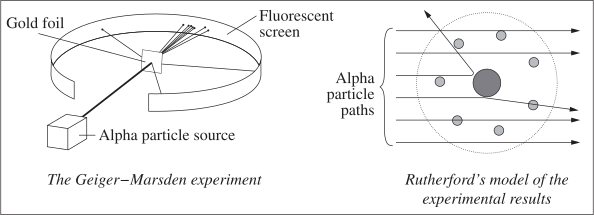
PHYSICS M8 2022 HSC 31

Following the Geiger-Marsden experiment, Rutherford proposed a model of the atom.


Bohr modified this model to explain the spectrum of hydrogen observed in experiments.


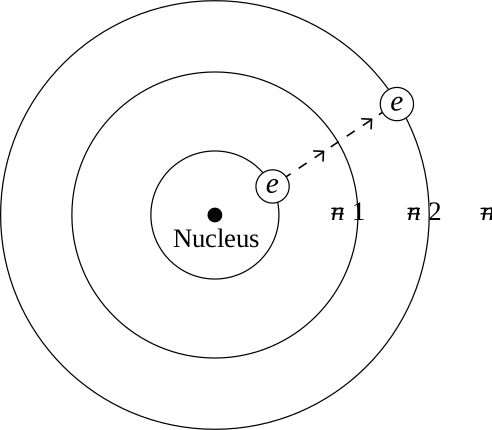
The Bohr-Rutherford model of the atom consists of electrons in energy levels around a positive nucleus.

How do features of this model account for all the experimental evidence above? Support your answer with a sample calculation and a diagram, and refer to energy, forces and photons.   (9 marks)

--- 18 WORK AREA LINES (style=lined) ---
Show Answers Only

The Geiger-Marsden experiment, which involved firing alpha particles at a thin sheet of gold foil produced results which can be explained by the Bohr-Rutherford model:

  • The majority of fired alpha particles passed through the gold foil undeflected. Rutherford concluded from this that the atom had a small, central nucleus.
  • Some alpha particles were deflected and some of these were deflected at very large angles. Rutherford concluded from this that the nucleus was dense and positively charged exerting a repulsive electromagnetic force on the fired alpha particles.
  • The model accounts for Rutherford’s conclusions, placing electrons in orbits around a small positive nucleus. 

Rutherford’s model alone could not explain the emission spectra of elements such as hydrogen. Bohr’s contribution to the Bohr-Rutherford model amended this:


  • Bohr proposed that electrons orbited the atomic nucleus in quantised orbits at fixed energies. He proposed that electrons could move from a higher energy orbit (eg. n=1) to a lower energy orbit (n=3) by emitting a photon with energy  `E=hf`  equal to the energy difference between the two orbits.
  • Additionally, he proposed that electrons could move from a lower energy orbit to a higher energy orbit by absorbing a photon with energy  `E=hf`  equal to the energy difference between the two orbits. 
  • This is able to account for the given emission spectra of hydrogen, where emission lines correspond to electron transitions from higher energy orbits to the second energy orbit which produce photons within the spectrum of visible light. 

Using Rydberg’s equation it is possible to predict the emission lines of hydrogen, using an electron moving from the sixth to the second Bohr energy orbit as an example: 

`(1)/(lambda)` `=R((1)/(n_(f)^(2))-(1)/(n_(i)^(2)))`  
  `=(1.097 xx10^7)((1)/(2^(2))-(1)/(6^(2)))`  
  `=(2 xx1.097 xx10^7)/(9)`  
  `=2.438 xx10^6`  
`lambda` `=410  text{nm}`  
     
  •  This value corresponds to the leftmost line on the given spectrum, reflecting how Bohr’s model can account for the emission spectra of hydrogen.
Show Worked Solution

The Geiger-Marsden experiment, which involved firing alpha particles at a thin sheet of gold foil produced results which can be explained by the Bohr-Rutherford model:

  • The majority of fired alpha particles passed through the gold foil undeflected. Rutherford concluded from this that the atom had a small, central nucleus.
  • Some alpha particles were deflected and some of these were deflected at very large angles. Rutherford concluded from this that the nucleus was dense and positively charged exerting a repulsive electromagnetic force on the fired alpha particles.
  • The model accounts for Rutherford’s conclusions, placing electrons in orbits around a small positive nucleus. 

Rutherford’s model alone could not explain the emission spectra of elements such as hydrogen. Bohr’s contribution to the Bohr-Rutherford model amended this:


  • Bohr proposed that electrons orbited the atomic nucleus in quantised orbits at fixed energies. He proposed that electrons could move from a higher energy orbit (eg. n=1) to a lower energy orbit (n=3) by emitting a photon with energy  `E=hf`  equal to the energy difference between the two orbits.
  • Additionally, he proposed that electrons could move from a lower energy orbit to a higher energy orbit by absorbing a photon with energy  `E=hf`  equal to the energy difference between the two orbits. 
  • This is able to account for the given emission spectra of hydrogen, where emission lines correspond to electron transitions from higher energy orbits to the second energy orbit which produce photons within the spectrum of visible light. 

Using Rydberg’s equation it is possible to predict the emission lines of hydrogen, using an electron moving from the sixth to the second Bohr energy orbit as an example: 

`(1)/(lambda)` `=R((1)/(n_(f)^(2))-(1)/(n_(i)^(2)))`  
  `=(1.097 xx10^7)((1)/(2^(2))-(1)/(6^(2)))`  
  `=(2 xx1.097 xx10^7)/(9)`  
  `=2.438 xx10^6`  
`lambda` `=410  text{nm}`  
     
  •  This value corresponds to the leftmost line on the given spectrum, reflecting how Bohr’s model can account for the emission spectra of hydrogen.

♦ Mean mark 51%.

Filed Under: Quantum Mechanical Nature of the Atom, Structure of the Atom Tagged With: Band 4, Band 5, Band 6, smc-3701-40-Rutherford, smc-3702-10-Bohr's Model, smc-3702-20-Electron Transitions

PHYSICS, M8 2020 HSC 21

  1. Calculate the wavelength of light emitted by an electron moving from energy level 3 to 2 in a Bohr model hydrogen atom.   (2 marks)

--- 7 WORK AREA LINES (style=lined) ---
  1. Describe the behaviour of electrons in the Bohr model of the atom with reference to the law of conservation of energy.   (3 marks)

--- 7 WORK AREA LINES (style=lined) ---
Show Answers Only

a.   `6.563 xx10^(-7) text{m}`

b.   Behaviour of electrons in the Bohr model:

  • Bohr’s model describes electrons orbiting the atomic nucleus in discrete energy levels.
  • When these electrons absorb a photon they gain energy and move from lower to higher energy levels.
  • When they move from higher to lower energy levels, they emit energy in the form of a photon.
  • This is consistent with the law of conservation of energy as the energy of absorbed or emitted photons is equal to the difference in energy of the discrete levels between which electrons move.
Show Worked Solution
a.
`(1)/(lambda)` `=R((1)/(n_(f^(2)))-(1)/(n_(i^(2))))`
    `=1.097 xx10^(7)((1)/(2^(2))-(1)/(3^(2)))`
    `=1.524 xx10^(6)`
  `lambda` `=6.563 xx10^(-7) text{m}`


b.   Behaviour of electrons in the Bohr model:

  • Bohr’s model describes electrons orbiting the atomic nucleus in discrete energy levels.
  • When these electrons absorb a photon they gain energy and move from lower to higher energy levels.
  • When they move from higher to lower energy levels, they emit energy in the form of a photon.
  • This is consistent with the law of conservation of energy as the energy of absorbed or emitted photons is equal to the difference in energy of the discrete levels between which electrons move.

Filed Under: Quantum Mechanical Nature of the Atom Tagged With: Band 4, smc-3702-10-Bohr's Model, smc-3702-20-Electron Transitions

PHYSICS, M8 2021 HSC 13 MC

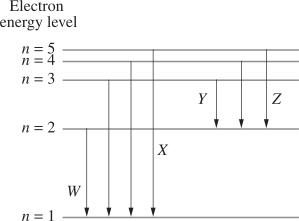
The diagram shows electron transitions in a Bohr-model hydrogen atom.
 

Which transition would produce the shortest wavelength of light?

  1. `W`
  2. `X`
  3. `Y`
  4. `Z`
Show Answers Only

`B`

Show Worked Solution

`E=hf=(hc)/(lambda)`

  • Energy is inversely proportional to wavelength → the shortest wavelength is given by the highest energy transition.

`=>B`

Filed Under: Quantum Mechanical Nature of the Atom Tagged With: Band 4, smc-3702-20-Electron Transitions

Copyright © 2014–2025 SmarterEd.com.au · Log in