SmarterEd

Aussie Maths & Science Teachers: Save your time with SmarterEd

  • Login
  • Get Help
  • About

ENGINEERING, CS 2023 HSC 22a

Previously, children's playground structures were constructed from 'treated pine' logs. The logs were treated with a copper chromium arsenate (CCA) solution which resisted fungi, insect attack and decay.

  1. Outline why new materials are being used to replace CCA treated logs in children's playground structures.   (2 marks)

    --- 4 WORK AREA LINES (style=lined) ---

  2. Justify a suitable material to use for a playground structure which will be exposed to the weather at all times.   (3 marks)

    --- 6 WORK AREA LINES (style=lined) ---

Show Answers Only

i.     CCA materials contain arsenic.

  • Arsenic is a carcinogen/poison and not considered suitable for use in children’s playground structures.
  • Other modern plastic materials also have superior characteristics for playground use including better resistance to insect attack and improved traction. 

ii.   Compact Laminate is suitable material.

  • It is made of softwood and phenolic binder provides excellent stability over time and good abrasion resistance.

Other possible answers include:

  • Finished hardwood: resistant to corrosion and degradation in bright sunlight while also being very tough and wear resistant.
  • UV stabilised High Density Polyethylene: Provides bright colours, formability of complex shapes and low maintenance.
  • Stainless Steel: Provides good corrosion resistance, strength and wear resistance.
  • UV Stabilised ABS: Strong and light with excellent water resistance.

Show Worked Solution

i.   CCA materials contain arsenic.

  • Arsenic is a carcinogen/poison and not considered suitable for use in children’s playground structures.
  • Other modern plastic materials also have superior characteristics for playground use including better resistance to insect attack and improved traction.  

ii.   Compact Laminate is suitable material.

  • It is made of softwood and phenolic binder provides excellent stability over time and good abrasion resistance.

Other possible answers include:

  • Finished hardwood: resistant to corrosion and degradation in bright sunlight while also being very tough and wear resistant.
  • UV stabilised High Density Polyethylene: Provides bright colours, formability of complex shapes and low maintenance.
  • Stainless Steel: Provides good corrosion resistance, strength and wear resistance.
  • UV Stabilised ABS: Strong and light with excellent water resistance.

Filed Under: Engineering Materials Tagged With: Band 4, smc-3715-60-Laminates, smc-3715-68-Other materials/composites

ENGINEERING, CS 2016 HSC 21b

Manufacturers of student travel cards use a PVC based polymer.

Justify why a PVC based polymer is a suitable material for this application.   (3 marks)

--- 6 WORK AREA LINES (style=lined) ---
Show Answers Only

Answers could include any three of the following:

  • Low cost per unit due to suitability for mass production.
  • Easy to manufacture with image and chip viable inclusions.
  • Colour can be easily added in a range of finishes.
  • Light weight, waterproof and durable.
  • Rigid but still flexible products achievable, as PVC polymer is durable at room temperature when plasticised.
Show Worked Solution

Answers could include any three of the following:

  • Low cost per unit due to suitability for mass production.
  • Easy to manufacture with image and chip viable inclusions.
  • Colour can be easily added in a range of finishes.
  • Light weight, waterproof and durable.
  • Rigid but still flexible products achievable, as PVC polymer is durable at room temperature when plasticised.

Filed Under: Engineering Materials Tagged With: Band 4, smc-3715-60-Laminates

ENGINEERING, CS 2019 HSC 21b

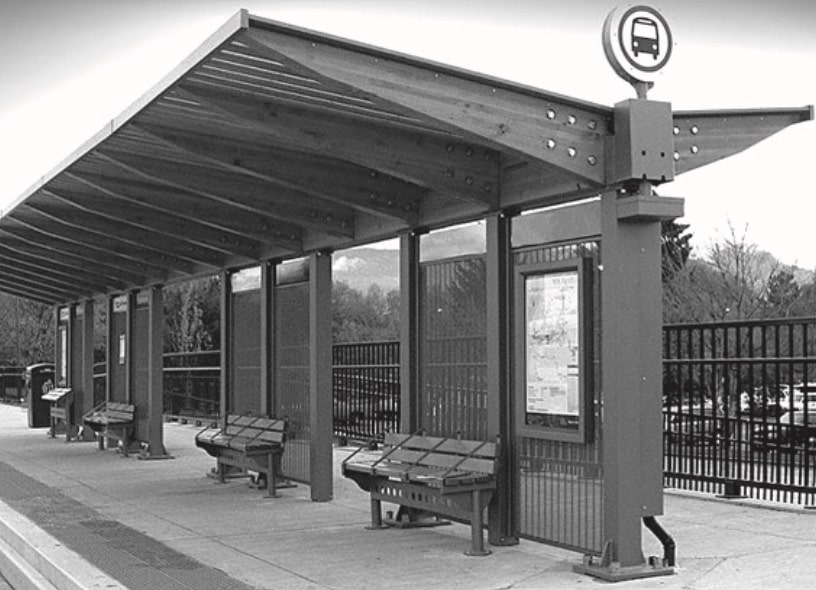
A bus shelter is shown.


A laminated timber beam is used as part of the roof construction for this bus shelter.

Apart from cost and aesthetics, justify why laminated timber would be selected for this structure.   (2 marks)

--- 6 WORK AREA LINES (style=lined) ---
Show Answers Only
  • Laminated timber can create a stronger and more rigid beam by eliminating knots and imperfections.
  • It is fire resistant.
  • Compared to steel, laminate has a superior strength to weight ratio.
Show Worked Solution
  • Laminated timber can create a stronger and more rigid beam by eliminating knots and imperfections.
  • It is fire resistant.
  • Compared to steel, laminate has a superior strength to weight ratio.

♦♦ Mean mark (b) 33%.

Filed Under: Engineering Materials Tagged With: Band 5, smc-3715-60-Laminates

ENGINEERING, CS 2018 HSC 24a

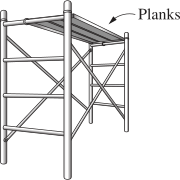
The diagram shows a scaffold supporting planks. The planks can be made from laminated timber, aluminium alloy or galvanised steel.
 

Outline an in-service advantage of each of these materials when used as a scaffold plank.   (3 marks)

--- 7 WORK AREA LINES (style=lined) ---

Show Answers Only

Answers could include one advantage from each material type below:

Laminated timber plank

  • Easily cut on-site to accommodate a non-standard opening.
  • Non-conductive.

Aluminium scaffold plank

  • Low density
  • Light weight makes aluminium planks easy to manoeuver on-site.

Galvanised steel planks

  • Can absorb energy through impact without shattering or fracturing (high impact resistance).
  • Appropriate for applications where the scaffold is likely to be exposed to falling loads eg concrete block laying, bricklaying, concreting and demolition work.
Show Worked Solution

Answers could include one advantage from each material type below:

Laminated timber plank

  • Easily cut on-site to accommodate a non-standard opening.
  • Non-conductive.

Aluminium scaffold plank

  • Low density
  • Light weight makes aluminium planks easy to manoeuver on-site.

Galvanised steel planks

  • Can absorb energy through impact without shattering or fracturing (high impact resistance).
  • Appropriate for applications where the scaffold is likely to be exposed to falling loads eg concrete block laying, bricklaying, concreting and demolition work.

Filed Under: Engineering Materials, Materials Tagged With: Band 4, smc-3715-60-Laminates, smc-3719-80-Compare properties

ENGINEERING, CS 2019 HSC 16 MC

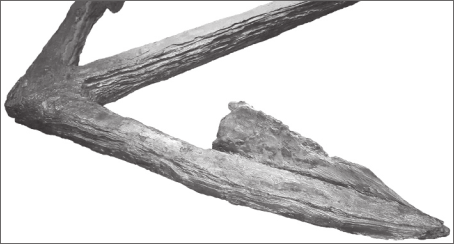
The image shows part of a large anchor recovered from waters off Western Australia. The anchor's approximate date of manufacture was 1790 .
 

This anchor is most likely made from

  1. cast iron.
  2. cast steel.
  3. wrought iron.
  4. laminated silicon steel.
Show Answers Only

`C`

Show Worked Solution

By Elimination:

  • In 1790 mild steel and silicon steel did not exist (eliminate `B` and `D`).
  • Since it is less brittle, wrought iron would have been used as anchors are subjected to sudden impacts against rocks (eliminate `A`).

`=>C`


Mean mark 52%.

Filed Under: Historical and Societal Influences, Historical and Societal Influences, Materials Tagged With: Band 5, smc-3713-30-Historical materials, smc-3715-60-Laminates, smc-3717-30-Historical materials, smc-3719-10-Manufacturing - Ferrous

ENGINEERING, CS 2022 HSC 23a

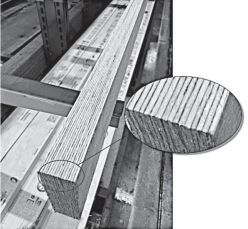
The image shows a laminated veneer lumber (LVL) beam that is used to span long distances in buildings.
 

Give reasons for using LVL instead of a steel beam as the supporting member in a building.   (2 marks)

--- 4 WORK AREA LINES (style=lined) ---

Show Answers Only

Possible reasons include:

  • LVL has higher strength to weight ratio
  • Easier to attach to other timber framing members
  • Uses timber otherwise thrown away as waste
  • Can use defective timber as surrounding layers will support defects
  • Cheaper
  • Easier to colour
Show Worked Solution

Possible reasons include:

  • LVL has higher strength to weight ratio
  • Easier to attach to other timber framing members
  • Uses timber otherwise thrown away as waste
  • Can use defective timber as surrounding layers will support defects
  • Cheaper
  • Easier to colour

Filed Under: Engineering Materials Tagged With: Band 3, smc-3715-60-Laminates

Copyright © 2014–2025 SmarterEd.com.au · Log in