SmarterEd

Aussie Maths & Science Teachers: Save your time with SmarterEd

  • Login
  • Get Help
  • About

ENGINEERING, CS 2024 HSC 21d

An orthogonal drawing of a strap brace tensioner is shown.
 

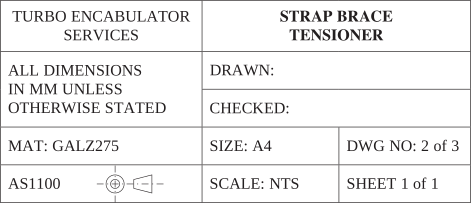
With reference to the orthogonal drawing and modified title block, complete the table.   (3 marks)

--- 0 WORK AREA LINES (style=lined) ---

\begin{array} {|l|l|}
\hline
\rule{0pt}{2.5ex} \text{What does 'M' stand for in} \quad \quad & \text{What is the allowable range for the} \quad \\
\text{M5 \(\times\) 0.8?}  & \text {R\(2.5 \pm 0.5\) dimension?} \\
\\
\\
\text{........................................................} & \text{........................................................}\rule[-1ex]{0pt}{0pt}\\
\hline
\rule{0pt}{2.5ex} \text{Which dimension is not to AS1100?} & \text{What does the 0.8 refer to in the} \quad \\
\text{}  & \text {expression M5 \(\times 0.8\) ?} \\
\\
\\
\text{........................................................} & \text{........................................................}\rule[-1ex]{0pt}{0pt}\\
\hline
\rule{0pt}{2.5ex} \text{Name the tensioner material} & \text{What is the unit of measurement} \quad \\
\text{}  & \text {used in this drawing} \\
\\
\\
\text{........................................................} & \text{........................................................}\rule[-1ex]{0pt}{0pt}\\
\hline
\rule{0pt}{2.5ex} \text{What is the name of the curve} & \text{State ONE radial dimension} \quad \\
\text{indicated by the letter 'A'?}  & \text {} \\
\\
\\
\text{........................................................} & \text{........................................................}\rule[-1ex]{0pt}{0pt}\\
\hline
\rule{0pt}{2.5ex} \text{What is the angle of projection?} & \text{Which line type is missing from the} \quad \\
\text{}  & \text {SIDE VIEW?} \\
\\
\\
\text{........................................................} & \text{........................................................}\rule[-1ex]{0pt}{0pt}\\
\hline
\end{array}
Show Answers Only

\begin{array} {|l|l|}
\hline
\rule{0pt}{2.5ex} \text{What does ‘M’ stand for in} \quad \quad & \text{What is the allowable range for the} \quad \\
\text{M5 \(\times\) 0.8?}  & \text {R\(2.5 \pm 0.5\) dimension?} \\
\\
\text{Metric} & \text{From 2 mm to 3 mm (or 1 mm)}\rule[-1ex]{0pt}{0pt}\\
\hline
\rule{0pt}{2.5ex} \text{Which dimension is not to AS1100?} & \text{What does the 0.8 refer to in the} \quad \\
\text{}  & \text {expression M5 \(\times 0.8\) ?} \\
\\
\text{2.5 mm} & \text{Pitch of thread}\rule[-1ex]{0pt}{0pt}\\
\hline
\rule{0pt}{2.5ex} \text{Name the tensioner material} & \text{What is the unit of measurement} \quad \\
\text{}  & \text {used in this drawing} \\
\\
\text{Galvanised Steel (GALZ275)} & \text{Millimetres (mm)}\rule[-1ex]{0pt}{0pt}\\
\hline
\rule{0pt}{2.5ex} \text{What is the name of the curve} & \text{State ONE radial dimension} \quad \\
\text{indicated by the letter ‘A’?}  & \text {} \\
\\
\text{Fillet} & \text{R18 or R2.5}\rule[-1ex]{0pt}{0pt}\\
\hline
\rule{0pt}{2.5ex} \text{What is the angle of projection?} & \text{Which line type is missing from the} \quad \\
\text{}  & \text {SIDE VIEW?} \\
\\
\text{3rd} & \text{Hidden detail}\rule[-1ex]{0pt}{0pt}\\
\hline
\end{array}
Show Worked Solution

\begin{array} {|l|l|}
\hline
\rule{0pt}{2.5ex} \text{What does ‘M’ stand for in} \quad \quad & \text{What is the allowable range for the} \quad \\
\text{M5 \(\times\) 0.8?}  & \text {R\(2.5 \pm 0.5\) dimension?} \\
\\
\text{Metric} & \text{From 2 mm to 3 mm (or 1 mm)}\rule[-1ex]{0pt}{0pt}\\
\hline
\rule{0pt}{2.5ex} \text{Which dimension is not to AS1100?} & \text{What does the 0.8 refer to in the} \quad \\
\text{}  & \text {expression M5 \(\times 0.8\) ?} \\
\\
\text{2.5 mm} & \text{Pitch of thread}\rule[-1ex]{0pt}{0pt}\\
\hline
\rule{0pt}{2.5ex} \text{Name the tensioner material} & \text{What is the unit of measurement} \quad \\
\text{}  & \text {used in this drawing} \\
\\
\text{Galvanised Steel (GALZ275)} & \text{Millimetres (mm)}\rule[-1ex]{0pt}{0pt}\\
\hline
\rule{0pt}{2.5ex} \text{What is the name of the curve} & \text{State ONE radial dimension} \quad \\
\text{indicated by the letter ‘A’?}  & \text {} \\
\\
\text{Fillet} & \text{R18 or R2.5}\rule[-1ex]{0pt}{0pt}\\
\hline
\rule{0pt}{2.5ex} \text{What is the angle of projection?} & \text{Which line type is missing from the} \quad \\
\text{}  & \text {SIDE VIEW?} \\
\\
\text{3rd} & \text{Hidden detail}\rule[-1ex]{0pt}{0pt}\\
\hline
\end{array}

Filed Under: Communication Tagged With: Band 4, smc-3716-10-AS 1100, smc-3716-15-Orthogonal drawings

ENGINEERING, CS 2017 HSC 12 MC

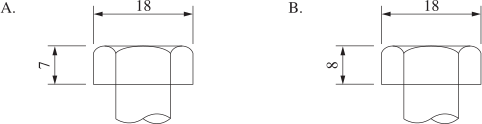
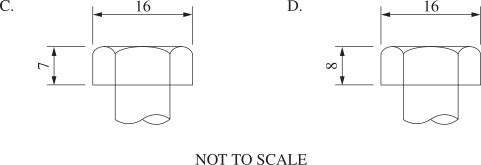
Which drawing shows the correct AS 1100 standard representation of a Ø10 non-structural bolt head?
 

Show Answers Only

`A`

Show Worked Solution
  • The thickness of a bolt head is equal to 0.7 times the diameter, and the width of a bolt head (across peaks) is equal to 1.8 times the diameter.

`=>A`


♦♦♦ Mean mark 26%.

Filed Under: Communication Tagged With: Band 6, smc-3716-10-AS 1100

ENGINEERING, CS 2016 HSC 23a

This diagram shows the cross-section of a highway pavement drawn using AS 1100 drawing standards.
 

Explain the benefits of using AS 1100 drawing standards in the preparation of engineering drawings such as the one above.   (3 marks)

--- 6 WORK AREA LINES (style=lined) ---

Show Answers Only

Benefits of using AS 1100 standards

  • Communication between manufacturers and designers is of higher quality, more accurate and involves fewer ambiguities.
  • AS 1100 is based on international standards so drawings can be easily shared between countries.
  • One project can be assigned multiple designers.
  • Cost effective as interpretation errors are minimised.
Show Worked Solution

Benefits of using AS 1100 standards

  • Communication between manufacturers and designers is of higher quality, more accurate and involves fewer ambiguities.
  • AS 1100 is based on international standards so drawings can be easily shared between countries.
  • One project can be assigned multiple designers.
  • Cost effective as interpretation errors are minimised.

Filed Under: Communication, Communication Tagged With: Band 4, smc-3716-10-AS 1100, smc-3721-40-AS 1100

ENGINEERING, PPT 2018 HSC 4 MC

A line specified in AS 1100 is shown.
 

Which feature is this line typically used to indicate?

  1. Centre-line
  2. Cutting plane
  3. Hidden feature
  4. Fictitious outline
Show Answers Only

`B`

Show Worked Solution
  • Although similar to a centre line, cutting planes can be identified by the thick dark ends.

`=>B`


♦♦♦ Mean mark 21%.

Filed Under: Communication, Communication Tagged With: Band 6, smc-3716-10-AS 1100, smc-3721-40-AS 1100

ENGINEERING, CS 2019 HSC 4 MC

A general purpose bolt drawn to AS 1100 drawing standards is shown.
 

What is the diameter of the bolt?

  1. 8.75 mm
  2. 10.00 mm
  3. 14.00 mm
  4. 18.00 mm
Show Answers Only

`B`

Show Worked Solution
  • The width of the head of a bolt is 0.7 × the diameter, therefore the diameter is 10 mm.

`=>B`


♦ Mean mark 50%.

Filed Under: Communication, Communication, Communication Tagged With: Band 5, smc-3716-10-AS 1100, smc-3721-40-AS 1100, smc-3726-40-AS 1100

ENGINEERING, CS 2022 HSC 7 MC

What is the thickness of a standard nut that fits a M20 × 2 bolt?

  1. 10 mm
  2. 16 mm
  3. 18 mm
  4. 20 mm
Show Answers Only

`B`

Show Worked Solution
  • AS1100 standards state the width of a nut is 0.8 x the diameter of the bolt.
  • 0.8 × 20 = 16 mm

`=>B`


Mean mark 52%.

Filed Under: Communication Tagged With: Band 5, smc-3716-10-AS 1100

ENGINEERING, CS 2020 HSC 24d

An exploded view of a yoke and turnbuckle is shown.
 

Complete the assembled front view in the space below. Apply AS 1100 drawing standards. Do NOT show hidden detail. Do NOT add dimensions.  (3 marks)
 

--- 0 WORK AREA LINES (style=lined) ---

Show Answers Only

Notes:

  • Thread must be properly drawn to the correct length
  • Nut dimensions must be correct according to AS1100
  • Question states no hidden detail or dimensions are to be shown
  • Centrelines must still be shown
  • Ensure the drawing is completed from the correct viewing direction
Show Worked Solution

Notes:

  • Thread must be properly drawn to the correct length
  • Nut dimensions must be correct according to AS1100
  • Question states no hidden detail or dimensions are to be shown
  • Centrelines must still be shown
  • Ensure the drawing is completed from the correct viewing direction

Filed Under: Communication Tagged With: Band 4, smc-3716-10-AS 1100, smc-3716-15-Orthogonal drawings

Copyright © 2014–2025 SmarterEd.com.au · Log in