SmarterEd

Aussie Maths & Science Teachers: Save your time with SmarterEd

  • Login
  • Get Help
  • About

ENGINEERING, AE 2025 HSC 24b

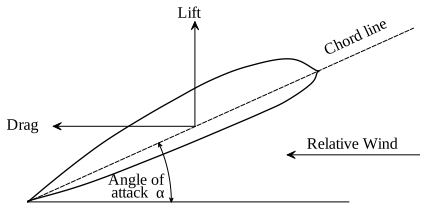
Describe what may cause an aircraft to stall in flight.   (2 marks)

--- 5 WORK AREA LINES (style=lined) ---

Show Answers Only
  • A stall occurs when the angle of attack becomes excessive. The airflow over the upper surface of the aerofoil separates and becomes turbulent rather than remaining smooth and laminar.
  • This disrupted airflow causes a sudden and significant loss of lift. Without sufficient lift to overcome the aircraft’s weight, the aircraft cannot maintain altitude and begins to descend.
Show Worked Solution
  • A stall occurs when the angle of attack becomes excessive. The airflow over the upper surface of the aerofoil separates and becomes turbulent rather than remaining smooth and laminar.
  • This disrupted airflow causes a sudden and significant loss of lift. Without sufficient lift to overcome the aircraft’s weight, the aircraft cannot maintain altitude and begins to descend
Filed Under: Mechanics and Hydraulics Tagged With: Band 4, smc-3724-10-Lift/Drag, smc-3724-30-Angle of attack

ENGINEERING, AE 2025 HSC 9 MC

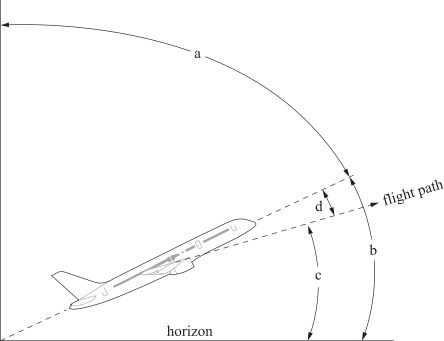
The diagram shows an aircraft in ascent.
 

Which letter indicates the angle of attack of the aircraft?

  1. \(\text{a}\)
  2. \(\text{b}\)
  3. \(\text{c}\)
  4. \(\text{d}\)
Show Answers Only

\(D\)

Show Worked Solution
  • The angle of attack is the angle between the chord line of the wing and the oncoming airflow (relative airflow).
  • In the diagram, \(\text{d}\) is the angle between the chord line/flight path and the relative airflow direction — this is the angle of attack.
  • Angle \(\text{a}\) is the angle of ascent — measured between the flight path and the horizon.
  • Angles \(\text{b}\) and \(\text{c}\) relate to the flight path and vertical — neither represent the angle of attack.

\(\Rightarrow D\)


♦♦ Mean mark 35%.

Filed Under: Mechanics and Hydraulics Tagged With: Band 5, smc-3724-30-Angle of attack

ENGINEERING, AE 2018 HSC 25b

Explain how the angle of attack of an aircraft in flight influences the lift generated by the wings. Use a labelled sketch to support your answer.   (3 marks) 

--- 6 WORK AREA LINES (style=lined) ---

--- 6 WORK AREA LINES (style=blank) ---

Show Answers Only
  • When the angle of attack is zero,there is no lift, but drag is still encountered.
  • The lower the angle of attack, the weaker these forces will become.
  • The higher the angle of attack, the higher the lift and drag forces become.
  • With increased angle of attack, upper surface separation point of air flow transfers to the trailing edge from the leading edge.
  • When the critical angle of attack is reached, the wing’s maximum coefficient of lift is produced and upper surface flow is increasingly disconnected.
  • If you pass the critical angle of attack (around 10° to 20°) the lift from the airfoil will drop to zero and the aircraft will stall.
     

Show Worked Solution
  • When the angle of attack is zero,there is no lift, but drag is still encountered.
  • The lower the angle of attack, the weaker these forces will become.
  • The higher the angle of attack, the higher the lift and drag forces become.
  • With increased angle of attack, upper surface separation point of air flow transfers to the trailing edge from the leading edge.
  • When the critical angle of attack is reached, the wing’s maximum coefficient of lift is produced and upper surface flow is increasingly disconnected.
  • If you pass the critical angle of attack (around 10° to 20°) the lift from the airfoil will drop to zero and the aircraft will stall.


Mean mark 51%.

Filed Under: Mechanics and Hydraulics Tagged With: Band 5, smc-3724-30-Angle of attack

ENGINEERING, AE 2022 HSC 24c

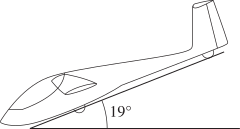
An image of a glider is shown.

The glider is currently on a descent at an angle of 19 degrees. The total lift force is 6250 N.

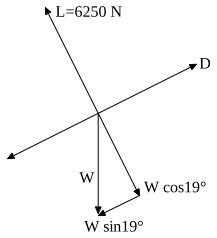
  1. Draw a free-body diagram, indicating all forces acting on the glider.   (1 mark)   

--- 4 WORK AREA LINES (style=blank) ---

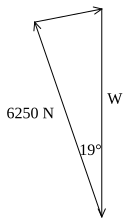
  1. If the mass of the pilot is 95 kg, calculate the mass of the glider.   (3 marks)

--- 6 WORK AREA LINES (style=blank) ---

  1. Calculate the lift-to-drag ratio.   (2 marks)

--- 4 WORK AREA LINES (style=blank) ---

Show Answers Only

i.   Free-body diagram

ii.  Mass of the glider

`text{cos}19°` `=6250/W`  
`W` `=6250/(\text{cos}19°)=6610.13N`  

 
`m=6610.13/10=661.01\ text{kg}`

`:. m_text{glider} =661.01-95=566.01\ text{kg}`
 

iii.    `(text{Lift})/(text{Drag})` `=(Wcos19°)/(Wsin19°)=1/(tan19°)`

 
`:.\ text{Lift : Drag}\ = 2.9 : 1`

Show Worked Solution

i.   Free-body diagram


♦ Mean mark (i) 49%.

ii.  Mass of the glider

`text{cos}19°` `=6250/W`  
`W` `=6250/(\text{cos}19°)=6610.13N`  

 
`m=6610.13/10=661.01\ text{kg}`

`:. m_text{glider} =661.01-95=566.01\ text{kg}`


♦ Mean mark (ii) 46%.
iii.    `(text{Lift})/(text{Drag})` `=(Wcos19°)/(Wsin19°)=1/(tan19°)`

 
`:.\ text{Lift : Drag}\ = 2.9 : 1`


♦♦ Mean mark (iii) 37%.

Filed Under: Mechanics and Hydraulics Tagged With: Band 5, smc-3724-10-Lift/Drag, smc-3724-20-Key forces, smc-3724-30-Angle of attack

ENGINEERING, AE 2022 HSC 10 MC

Which of the following identifies two causes of parasitic drag?

  1. Aircraft lift, angle of attack
  2. Aircraft lift, material of aircraft skin
  3. The movement of air over the wing, angle of attack
  4. The movement of air over the wing, material of aircraft skin
Show Answers Only

`D`

Show Worked Solution
  • Parasitic drag is all drag that is caused by the shape, construction-type and material of an aircraft.

`=>D`


♦♦ Mean mark 37%.

Filed Under: Mechanics and Hydraulics Tagged With: Band 5, smc-3724-10-Lift/Drag, smc-3724-30-Angle of attack

ENGINEERING, AE 2020 HSC 7 MC

Which of the following best describes how an unpowered aircraft will glide, in a controlled descent, when the lift-to-drag ratio is high?

  1. Long distance at a steep glide angle
  2. Short distance at a steep glide angle
  3. Long distance at a shallow glide angle
  4. Short distance at a shallow glide angle
Show Answers Only

`C`

Show Worked Solution
  • High lift to drag ratio means the aircraft will travel a long distance (low drag) at a shallow angle (high lift).

`=>C`

Filed Under: Mechanics and Hydraulics Tagged With: Band 4, smc-3724-10-Lift/Drag, smc-3724-30-Angle of attack

Copyright © 2014–2026 SmarterEd.com.au · Log in