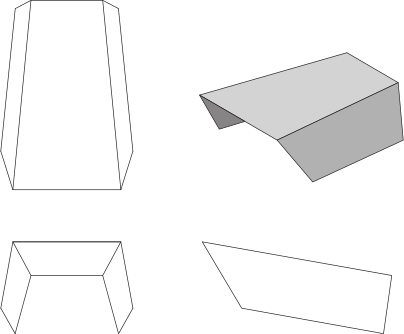
A transitional piece for an aircraft cooling duct is shown.
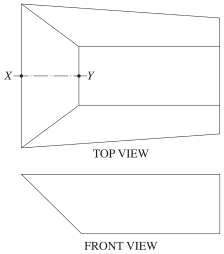
Construct a half-pattern development of the transitional piece using the seam indicated \(X–Y\) as the starting position. (6 marks)
--- 20 WORK AREA LINES (style=lined) ---

Show Answers Only
Show Worked Solution
Construction steps:
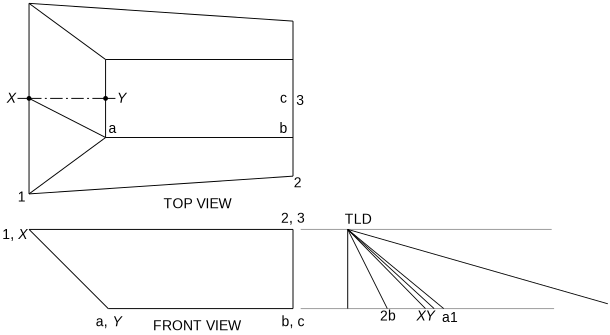
- Label the half piece in the top and front views: \(X\) and \(Y\) on the seam (top and bottom), \(1\) and \(a\) at the left corners (top and bottom), \(2\) and \(b\) at the right corners (top and bottom), and \(3\) and \(c\) on the centre line at the right end (top and bottom).
- Identify the faces of the half pattern: the sloping front face \(X–Y–a–1\) (flat, shown as an edge in the front view), the side face \(1–a–b–2\) (not flat, because \(1–2\) and \(a–b\) are not parallel, so it is divided into triangles along the diagonal \(1–b\)), and the vertical end face \(2–b–c–3\). The top and bottom are open.
- Lines already shown true length: \(X–1\), \(1–2\), \(2–3\), \(Y–a\), \(a–b\) and \(b–c\) (in the top view), and \(c–3\) (vertical, in the front view).
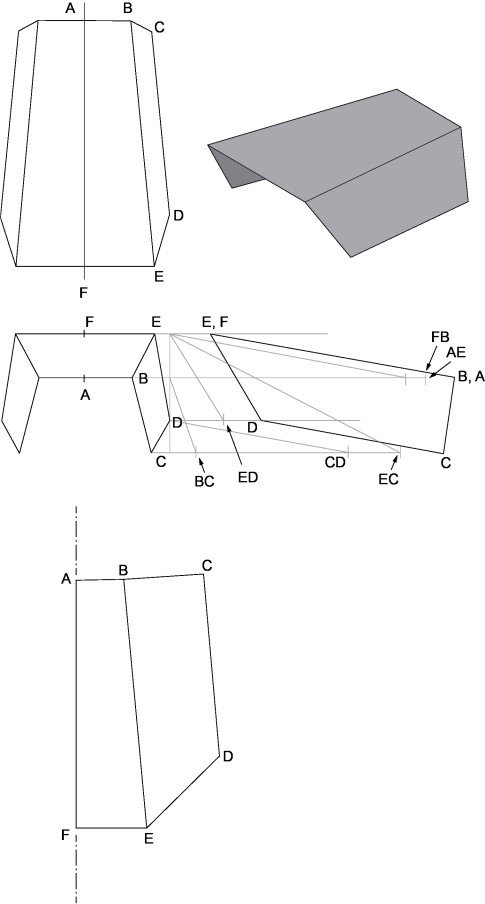
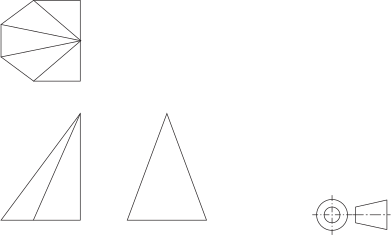
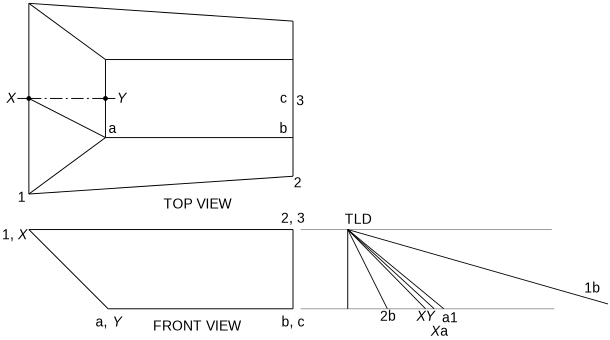
- Find the true length of \(X–Y\), \(X–a\), \(a–1\), \(1–b\) and \(2–b\) using a true length diagram (TLD): the vertical height from the front view as the height and the plan length from the top view as the base. The hypotenuse is the true length.
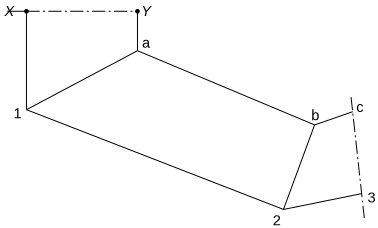
- Starting from seam \(X–Y\), build up the pattern triangle by triangle using compass arcs of the true lengths: \(X–Y–a\) and \(X–a–1\) (front face), then \(1–a–b\) and \(1–b–2\) (side face). The end face \(2–b–c–3\) is flat and vertical, so its true shape is a trapezoid with right angles at \(c\) and \(3\): attach it along edge \(2–b\), with \(b–c\) and \(2–3\) perpendicular to the seam \(c–3\).
- Draw the outline with object lines, show the fold lines \(1–a\) and \(2–b\), show the seams \(X–Y\) and \(c–3\) as chain lines, and label all points.