SmarterEd

Aussie Maths & Science Teachers: Save your time with SmarterEd

  • Login
  • Get Help
  • About

CHEMISTRY, M1 EQ-Bank 14

Compare and explain the reactivity of Group 1 (alkali metals) and Group 2 (alkaline earth metals) with water. In your answer, link your explanation to electron configuration, atomic radius, and ionisation energy.   (6 marks)

--- 15 WORK AREA LINES (style=lined) ---

Show Answers Only
  • Group 1 metals (e.g. \(\ce{Li, Na, K}\)) react vigorously with water to form a hydroxide and hydrogen gas.
  • Group 2 metals (e.g. \(\ce{Mg, Ca}\)) also react with water but much less vigorously, especially at the top of the group. For example, magnesium reacts only slowly with cold water.
  • Electron configuration: Group 1 metals have one valence electron, while Group 2 metals have two valence electrons. Losing one electron requires less energy than losing two, making Group 1 metals more reactive.
  • Atomic radius and ionisation energy: Down both groups, the atomic radius increases, shielding increases, and ionisation energy decreases. This means reactivity with water increases down the group.
  • Therefore: Reactivity increases down both groups, but Group 1 metals show higher reactivity with water compared with Group 2 metals in the same period.
Show Worked Solution
  • Group 1 metals (e.g. \(\ce{Li, Na, K}\)) react vigorously with water to form a hydroxide and hydrogen gas.
  • Group 2 metals (e.g. \(\ce{Mg, Ca}\)) also react with water but much less vigorously, especially at the top of the group. For example, magnesium reacts only slowly with cold water.
  • Electron configuration: Group 1 metals have one valence electron, while Group 2 metals have two valence electrons. Losing one electron requires less energy than losing two, making Group 1 metals more reactive.
  • Atomic radius and ionisation energy: Down both groups, the atomic radius increases, shielding increases, and ionisation energy decreases. This means reactivity with water increases down the group.
  • Therefore: Reactivity increases down both groups, but Group 1 metals show higher reactivity with water compared with Group 2 metals in the same period.

Filed Under: Periodicity Tagged With: Band 5, Band 6, smc-4257-10-Atomic Radii, smc-4257-30-Ionisation Energy, smc-4257-40-Reactivity

CHEMISTRY, M1 EQ-Bank 6 MC

Which of the following elements reacts most vigorously with water?

  1. Lithium 
  2. Sodium 
  3. Potassium 
  4. Calcium 
Show Answers Only

\(C\)

Show Worked Solution
  • Reactivity increases down Group 1 (alkali metals), so \(\ce{K}\) is more reactive than \(\ce{Li}\) and \(\ce{Na}\).
  • Potassium reacts violently with water, producing enough heat to ignite the hydrogen gas with a lilac flame.
  • Calcium reacts more slowly than potassium despite being a reactive metal as Potassium’s outer electron is further from the nucleus, making it easier to lose and more reactive.

\(\Rightarrow C\)

Filed Under: Periodicity Tagged With: Band 4, smc-4257-40-Reactivity

CHEMISTRY, M1 EQ-Bank 11

Explain the relationship between electronegativity and atomic radius with non-metal reactivity down Group 17 (the halogens) of the Periodic Table.   (4 marks)

--- 8 WORK AREA LINES (style=lined) ---

Show Answers Only
  • Atomic radius increases down Group 17 because each element gains more electron shells.
  • This leads to weaker nuclear attraction for incoming electrons, due to greater distance from the nucleus and increased shielding by inner shells.
  • As a result, electronegativity decreases down the group, and consequently decreasing reactivity down Group 17
  • For instance, fluorine (small radius, high electronegativity) is most reactive while in contrast, iodine (large radius, low electronegativity) is least reactive.
  • Therefore, smaller atoms with higher electronegativity are more reactive non-metals.
Show Worked Solution
  • Atomic radius increases down Group 17 because each element gains more electron shells.
  • This leads to weaker nuclear attraction for incoming electrons, due to greater distance from the nucleus and increased shielding by inner shells.
  • As a result, electronegativity decreases down the group, and consequently decreasing reactivity down Group 17
  • For instance, fluorine (small radius, high electronegativity) is most reactive while in contrast, iodine (large radius, low electronegativity) is least reactive.
  • Therefore, smaller atoms with higher electronegativity are more reactive non-metals.

Filed Under: Periodicity Tagged With: Band 4, Band 5, smc-4257-10-Atomic Radii, smc-4257-20-Electronegativity, smc-4257-40-Reactivity

CHEMISTRY, M1 EQ-Bank 6

Explain the trend in reactivity with water of the elements in Group 2 as you move down the group.   (2 marks)

--- 5 WORK AREA LINES (style=lined) ---

Show Answers Only
  • The reactivity of Group 2 elements with water increases as you move down the group due to decreasing ionization energies and increasing atomic radii.
  • Lower ionization energies and larger atomic radii make it easier for these metals to lose electrons and react with water, forming hydroxides and hydrogen gas. 
  • For instance, magnesium reacts slowly with hot water, while barium reacts vigorously even at room temperature, illustrating this trend.
Show Worked Solution
  • The reactivity of Group 2 elements with water increases as you move down the group due to decreasing ionization energies and increasing atomic radii.
  • Lower ionization energies and larger atomic radii make it easier for these metals to lose electrons and react with water, forming hydroxides and hydrogen gas. 
  • For instance, magnesium reacts slowly with hot water, while barium reacts vigorously even at room temperature, illustrating this trend.

Filed Under: Periodicity Tagged With: Band 4, smc-4257-40-Reactivity

CHEMISTRY, M1 2010 HSC 35d

Experimental evidence from emission line spectra of gaseous atoms has highlighted both the merits and the limitations of Bohr's atomic model. 

Discuss Bohr's atomic model with reference to this evidence.  (5 marks)

Show Answers Only


Show Worked Solution
  • The Bohr model of the atom describes the orbit of electrons around the nucleus at fixed radii and energy.
  • The emission line spectrum of hydrogen was seen to support the Bohr model as discrete lines were observed which could be assigned to electronic transitions between fixed energy levels.
  • However when the emission line spectrum for sodium was recorded there were more spectral lines than could be explained by the Bohr model. Line splitting or doublets were observed.
  • The line splitting or doublets result from electrons having differing angular momenta, residing in sub-shells, which was not considered in the Bohr model.

Filed Under: Periodicity Tagged With: Band 4, Band 5, smc-4257-40-Reactivity

CHEMISTRY, M1 2013 HSC 6 MC

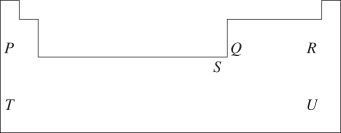
A representation of the Periodic Table is shown. The positions of six different elements, \(P, Q, R, S, T\) and \(U\) are given.
 

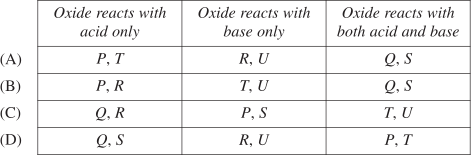
Which row of the following table shows the correct acid and base reactivities of the oxides of these elements?
 

Show Answers Only

`A`

Show Worked Solution
  • Acidic Oxides: are often the oxides of non-metals and form acidic solutions
  • Basic Oxides: are usually formed by reacting oxygen with metals, they participate with acids in neutralisation rections
  • Neutral Oxides: react with neither acids or bases and do not lead to either acidic or basic solutions
  • Amphoteric Oxides: exhibit both acidic and basic properties, they can chemically react as either an acid or base

`=>A`

Filed Under: Periodicity Tagged With: Band 3, smc-4257-40-Reactivity

Copyright © 2014–2025 SmarterEd.com.au · Log in