SmarterEd

Aussie Maths & Science Teachers: Save your time with SmarterEd

  • Login
  • Get Help
  • About

CHEMISTRY, M1 EQ-Bank 17

The following table gives some information about two covalent molecule substances

\begin{array} {|c|c|c|}
\hline \text{Compound} & \text{Molecular formula} & \text{Boiling Point } (^{\circ}C) \\
\hline \text{Water} & \ce{H2O} & 100 \\
\hline \text{Hydrogen sulfide} & \ce{H2S} & -60 \\
\hline \end{array}

  1. Draw Lewis dot diagrams for each molecule.   (2 marks)

    --- 4 WORK AREA LINES (style=blank) ---

  1. Identify the shape and polarity of each molecule.   (4 marks)

    --- 2 WORK AREA LINES (style=lined) ---

  1. Explain why there is a difference in the boiling points of these molecules.   (3 marks)

    --- 6 WORK AREA LINES (style=lined) ---

Show Answers Only

a.   
             

b.   Water: Bent and Polar

Hydrogen Sulfide: Bent and polar 

c.   Even though both molecular are polar:

  • Water has strong hydrogen bonding between molecules because \(\ce{H}\) is bonded to highly electronegative \(\ce{O}\) with lone pairs. These hydrogen bonds require large amounts of energy to break, giving water a high boiling point.
  • Hydrogen sulfide cannot form hydrogen bonds because \(\ce{S}\) is not electronegative enough. The only intermolecular forces are weak dipole–dipole and dispersion forces. Thus less energy is required to overcome the intermolecular forces and so \(\ce{H2S}\) a lower boiling point.
Show Worked Solution

a.   
             

b.   Water: Bent and Polar

Hydrogen Sulfide: Bent and polar
 

c.   Even though both molecular are polar:

  • Water has strong hydrogen bonding between molecules because \(\ce{H}\) is bonded to highly electronegative \(\ce{O}\) with lone pairs. These hydrogen bonds require large amounts of energy to break, giving water a high boiling point.
  • Hydrogen sulfide cannot form hydrogen bonds because \(\ce{S}\) is not electronegative enough. The only intermolecular forces are weak dipole–dipole and dispersion forces. Thus less energy is required to overcome the intermolecular forces and so \(\ce{H2S}\) a lower boiling point.

Filed Under: Bonding Tagged With: Band 4, Band 5, smc-4258-30-Lewis Dot, smc-4258-40-Inter/Intramolecular Bonding, smc-4258-50-Chemical structure

CHEMISTRY, M1 EQ-Bank 12

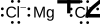
  1. Draw a Lewis electron dot diagram for each of the following compounds:
  2. i. \(\ce{CO2}\)   (1 mark)
  3. ii. \(\ce{MgCl2}\)   (1 mark)
  1. Using the two substances in (a) as examples, compare the bonding in ionic compounds with the bonding in covalent molecular compounds.   (3 marks)

--- 5 WORK AREA LINES (style=lined) ---

  1. The boiling point of \(\ce{CO2}\) is –78°C, while the boiling point of \(\ce{MgCl2}\) is 1412\(^{\circ}\)C. Account for the difference in boiling points between these two substances.   (3 marks)

--- 5 WORK AREA LINES (style=lined) ---

Show Answers Only

a.i.  

 a.ii.  


b.   Bonding in ionic compounds vs covalent molecular compounds:

  • Ionic compounds are solids at STP and consist of positively and negatively charged ions held together in a lattice by strong electrostatic forces. 
  • In magnesium chloride, doubly charged magnesium cations are surrounded by chloride anions in a ratio of 1:2.
  • Covalent molecular compounds are groups of atoms in which one or more pairs of electrons are shared between atoms.
  • In carbon dioxide, carbon forms double covalent bonds with two oxygen atoms, sharing its valence electrons. Carbon dioxide molecules are bound together only by relatively weak dispersion forces and therefore exist as a gas at STP.

c.   Differences in boiling points:

  • \(\ce{CO2}\) molecules are held together by weak dispersion forces between neutral molecules. These forces require little energy to overcome, resulting in a very low boiling point –78°C.
  • \(\ce{MgCl2}\) has a giant ionic lattice. Strong electrostatic forces between \(\ce{Mg^2+}\) and \(\ce{Cl^-}\) ions extend throughout the solid. Large amounts of energy are required to break these ionic bonds, giving it a very high boiling point at 1412°C.
  • Therefore, the huge difference in boiling points is due to weak intermolecular forces in covalent molecular substances compared with strong ionic bonds in ionic compounds.
Show Worked Solution

a.i.  


 a.ii.  


b.   Bonding in ionic compounds vs covalent molecular compounds:

  • Ionic compounds are solids at STP and consist of positively and negatively charged ions held together in a lattice by strong electrostatic forces. 
  • In magnesium chloride, doubly charged magnesium cations are surrounded by chloride anions in a ratio of 1:2.
  • Covalent molecular compounds are groups of atoms in which one or more pairs of electrons are shared between atoms.
  • In carbon dioxide, carbon forms double covalent bonds with two oxygen atoms, sharing its valence electrons. Carbon dioxide molecules are bound together only by relatively weak dispersion forces and therefore exist as a gas at STP.

c.   Differences in boiling points:

  • \(\ce{CO2}\) molecules are held together by weak dispersion forces between neutral molecules. These forces require little energy to overcome, resulting in a very low boiling point –78°C.
  • \(\ce{MgCl2}\) has a giant ionic lattice. Strong electrostatic forces between \(\ce{Mg^2+}\) and \(\ce{Cl^-}\) ions extend throughout the solid. Large amounts of energy are required to break these ionic bonds, giving it a very high boiling point at 1412°C.
  • Therefore, the huge difference in boiling points is due to weak intermolecular forces in covalent molecular substances compared with strong ionic bonds in ionic compounds.

Filed Under: Bonding Tagged With: Band 4, Band 5, Band 6, smc-4258-30-Lewis Dot, smc-4258-40-Inter/Intramolecular Bonding

CHEMISTRY, M1 EQ-Bank 1 MC

The Lewis electron dot diagram of ammonia \(\ce{NH3}\) is shown:
 

Which of the following is correct for this molecule?

\begin{align*}
\begin{array}{l}
\rule{0pt}{2.5ex} \ \rule[-1ex]{0pt}{0pt}& \\
\rule{0pt}{2.5ex}\textbf{A.}\rule[-1ex]{0pt}{0pt}\\
\rule{0pt}{2.5ex}\textbf{B.}\rule[-1ex]{0pt}{0pt}\\
\rule{0pt}{2.5ex}\textbf{C.}\rule[-1ex]{0pt}{0pt}\\
\rule{0pt}{2.5ex}\textbf{D.}\rule[-1ex]{0pt}{0pt}\\
\end{array}
\begin{array}{|c|c|}
\hline
\rule{0pt}{2.5ex}\text{Molecule polarity}\rule[-1ex]{0pt}{0pt}& \text{Molecular shape} \\
\hline
\rule{0pt}{2.5ex}\text{Non-polar}\rule[-1ex]{0pt}{0pt}&\text{Trigonal Planar}\\
\hline
\rule{0pt}{2.5ex}\text{Non-polar}\rule[-1ex]{0pt}{0pt}& \text{Tetrahedral}\\
\hline
\rule{0pt}{2.5ex}\text{Polar}\rule[-1ex]{0pt}{0pt}& \text{Tetrahedral} \\
\hline
\rule{0pt}{2.5ex}\text{Polar}\rule[-1ex]{0pt}{0pt}& \text{Pyramidal} \\
\hline
\end{array}
\end{align*}

Show Answers Only

\(D\)

Show Worked Solution
  • \(\ce{NH3}\) has 3 bonding pairs and 1 lone pair of electrons around nitrogen.
  • According to VSEPR theory, this gives a pyramidal molecular shape (not planar or tetrahedral as a whole).
  • The bonds between nitrogen and hydrogen are polar covalent bonds. The arrangement causes the whole molecule to be polar.

\(\Rightarrow D\)

Filed Under: Bonding Tagged With: Band 5, smc-4258-30-Lewis Dot, smc-4258-50-Chemical structure

CHEMISTRY, M1 EQ-Bank 11

  1. Draw Lewis dot diagrams for both water AND methane.   (2 marks)

--- 2 WORK AREA LINES (style=blank) ---

  1. Methane has a boiling point of –161.5°C, while water has a melting point of 0°C and a boiling point of 100°C.
  2. Account for the differences in these physical properties for these TWO common substances in our atmosphere.   (2 marks)

--- 4 WORK AREA LINES (style=lined) ---

Show Answers Only

a.   Methane \((\ce{CH4})\)       Water \((\ce{H2O})\)

 
  • All electrons must be shown as dots, not crosses, circles, etc.
  • No lines should be present to represent covalent bonds. 

b.   Differences in the physical properties of methane and water:

  • Can be explained by the differences in their molecular structures and intermolecular forces.
  • Methane \(\ce{(CH4)}\) is a nonpolar molecule with weak dispersion forces between its molecules. These weak forces result in a very low boiling point of -161.5°C.
  • Water \(\ce{(H2O)}\), on the other hand, is a polar molecule that forms strong hydrogen bonds between its molecules. These strong intermolecular forces require more energy to be broken and result in much higher melting and boiling points (0°C and 100°C, respectively).
Show Worked Solution

a.   Methane \((\ce{CH4})\)       Water \((\ce{H2O})\)

 
  • All electrons must be shown as dots, not crosses, circles, etc.
  • No lines should be present to represent covalent bonds. 

b.   Differences in the physical properties of methane and water:

  • Can be explained by the differences in their molecular structures and intermolecular forces.
  • Methane \(\ce{(CH4)}\) is a nonpolar molecule with weak dispersion forces between its molecules. These weak forces result in a very low boiling point of -161.5°C.
  • Water \(\ce{(H2O)}\), on the other hand, is a polar molecule that forms strong hydrogen bonds between its molecules. These strong intermolecular forces require more energy to be broken and result in much higher melting and boiling points (0°C and 100°C, respectively).

Filed Under: Bonding Tagged With: Band 4, Band 5, smc-4258-30-Lewis Dot, smc-4258-40-Inter/Intramolecular Bonding

CHEMISTRY, M1 EQ-Bank 4

Draw Lewis electron dot structures for the following ionic molecular compounds

  1. Sodium chloride  \((\ce{NaCl})\)   (1 mark)

    --- 4 WORK AREA LINES (style=lined) ---

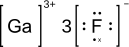
  2. Aluminium fluoride \((\ce{GaF3})\)   (1 mark)

    --- 4 WORK AREA LINES (style=lined) ---

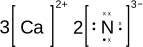
  3. Calcium nitride  \((\ce{Ca3N2})\)   (2 marks)

    --- 4 WORK AREA LINES (style=lined) ---

Show Answers Only

a.    Sodium chloride  \((\ce{NaCl}\)


b.  Aluminium Fluoride \((\ce{GaF3}\)

c.  Calcium nitride   \((\ce{Ca3N2}\)

Show Worked Solution

a.    Sodium chloride  \((\ce{NaCl}\)


b.  Aluminium Fluoride \((\ce{GaF3}\)

c.  Calcium nitride   \((\ce{Ca3N2}\)

Filed Under: Bonding Tagged With: Band 3, Band 4, Band 5, smc-4258-30-Lewis Dot

CHEMISTRY, M1 EQ-Bank 3

Draw Lewis electron dot structures for the following covalent molecular compounds

  1. Ammonia   (2 marks)

    --- 4 WORK AREA LINES (style=lined) ---

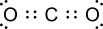
  2. Carbon dioxide   (2 marks)

    --- 4 WORK AREA LINES (style=lined) ---

Show Answers Only

a.    Ammonia \( (\ce{CH3})\)


b.   Carbon dioxide \( (\ce{CO2}) \)

Show Worked Solution

a.    Ammonia \( (\ce{CH3})\)


b.   Carbon dioxide \( (\ce{CO2}) \)
 

Filed Under: Bonding Tagged With: Band 4, Band 5, smc-4258-30-Lewis Dot

CHEMISTRY, M1 EQ-Bank 2

Draw Lewis electron dot structures for

  1. a nitrogen molecule \( (\ce{N2})\)   (1 mark)

    --- 3 WORK AREA LINES (style=lined) ---

  2. an oxygen molecule \( (\ce{O2}) \)  (1 mark)

    --- 3 WORK AREA LINES (style=lined) ---

Show Answers Only

a.    
       

b.     
        

Show Worked Solution

a.    
     

b.     
     

Filed Under: Bonding Tagged With: Band 3, Band 4, smc-4258-30-Lewis Dot

CHEMISTRY, M1 2008 HSC 18a

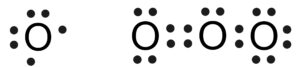
Draw Lewis electron dot structures for oxygen \( (\ce{O})\) and ozone \( (\ce{O3}) \).   (2 marks)

Show Answers Only

            Oxygen \((\ce{O})\)         Ozone \((\ce{O3}) \)

Show Worked Solution

            Oxygen \((\ce{O})\)         Ozone \((\ce{O3}) \)

Filed Under: Bonding Tagged With: Band 3, smc-4258-30-Lewis Dot, smc-4258-50-Chemical structure

CHEMISTRY, M1 2012 HSC 37dii

Write the electronic configuration of \(\ce{Fe^2+}\) and \(\ce{Fe^3+}\).  (2 marks)

Show Answers Only


Show Worked Solution

Method 1

\(\ce{Fe^2+: [Ar] \text{3d}^6 }\)

\(\ce{Fe^3+: [Ar] \text{3d}^5 }\)
 

Method 2

\(\ce{Fe^2+: 1s^2 2s^2 2p^2 2p^6 3s^2 3p^6 4s^2 3d^6}\)

\(\ce{Fe^3+: 1s^2 2s^2 2p^2 2p^6 3s^2 3p^6 4s^2 3d^5}\)

Filed Under: Bonding Tagged With: Band 4, smc-4258-30-Lewis Dot

Copyright © 2014–2025 SmarterEd.com.au · Log in