SmarterEd

Aussie Maths & Science Teachers: Save your time with SmarterEd

  • Login
  • Get Help
  • About

CHEMISTRY, M1 EQ-Bank 3 MC

Hydrogen bonding occurs between molecules of which of the following substances?

  1. Carbon dioxide
  2. Hydrogen fluoride
  3. Methane
  4. Hydrogen iodide
Show Answers Only

\(B\)

Show Worked Solution
  • Hydrogen bonding requires \(\ce{H}\) covalently bonded to \(\ce{N}\), \(\ce{O}\), or \(\ce{F}\).
  • Only hydrogen fluoride \(\ce{(HF)}\) meets these conditions.

\(\Rightarrow B\)

Filed Under: Bonding Tagged With: Band 4, smc-4258-40-Inter/Intramolecular Bonding

CHEMISTRY, M1 EQ-Bank 17

The following table gives some information about two covalent molecule substances

\begin{array} {|c|c|c|}
\hline \text{Compound} & \text{Molecular formula} & \text{Boiling Point } (^{\circ}C) \\
\hline \text{Water} & \ce{H2O} & 100 \\
\hline \text{Hydrogen sulfide} & \ce{H2S} & -60 \\
\hline \end{array}

  1. Draw Lewis dot diagrams for each molecule.   (2 marks)

    --- 4 WORK AREA LINES (style=blank) ---

  1. Identify the shape and polarity of each molecule.   (4 marks)

    --- 2 WORK AREA LINES (style=lined) ---

  1. Explain why there is a difference in the boiling points of these molecules.   (3 marks)

    --- 6 WORK AREA LINES (style=lined) ---

Show Answers Only

a.   
             

b.   Water: Bent and Polar

Hydrogen Sulfide: Bent and polar 

c.   Even though both molecular are polar:

  • Water has strong hydrogen bonding between molecules because \(\ce{H}\) is bonded to highly electronegative \(\ce{O}\) with lone pairs. These hydrogen bonds require large amounts of energy to break, giving water a high boiling point.
  • Hydrogen sulfide cannot form hydrogen bonds because \(\ce{S}\) is not electronegative enough. The only intermolecular forces are weak dipole–dipole and dispersion forces. Thus less energy is required to overcome the intermolecular forces and so \(\ce{H2S}\) a lower boiling point.
Show Worked Solution

a.   
             

b.   Water: Bent and Polar

Hydrogen Sulfide: Bent and polar
 

c.   Even though both molecular are polar:

  • Water has strong hydrogen bonding between molecules because \(\ce{H}\) is bonded to highly electronegative \(\ce{O}\) with lone pairs. These hydrogen bonds require large amounts of energy to break, giving water a high boiling point.
  • Hydrogen sulfide cannot form hydrogen bonds because \(\ce{S}\) is not electronegative enough. The only intermolecular forces are weak dipole–dipole and dispersion forces. Thus less energy is required to overcome the intermolecular forces and so \(\ce{H2S}\) a lower boiling point.

Filed Under: Bonding Tagged With: Band 4, Band 5, smc-4258-30-Lewis Dot, smc-4258-40-Inter/Intramolecular Bonding, smc-4258-50-Chemical structure

CHEMISTRY, M1 EQ-Bank 15

Explain the characteristics of the two oxides given below.   (4 marks)

\begin{array} {|c|c|c|}
\hline \text{Compound} & \text{Melting Point } (^{\circ}C) & \text{Conductivity when molten} \\
\hline \ce{XO} & 2850 &  \text{good} \\
\hline \ce{YO} & -183 & \text{poor} \\
\hline \end{array}

--- 8 WORK AREA LINES (style=lined) ---

Show Answers Only

\(\ce{XO}\) is an ionic oxide.

  • Its melting point is high because there are strong electrostatic forces of attraction between the oppositely charged ions throughout the giant ionic lattice that must be overcome to melt the solid.
  • When molten, the ions are free to move and can transfer charge, so conductivity is good.

\(\ce{YO}\) is a covalent molecular oxide.

  • The molecules are held together only by weak dispersion forces. These are easily overcome, giving it a very low melting point.
  • There are no mobile charged particles present in the liquid, so it does not conduct electricity.
Show Worked Solution

\(\ce{XO}\) is an ionic oxide.

  • Its melting point is high because there are strong electrostatic forces of attraction between the oppositely charged ions throughout the giant ionic lattice that must be overcome to melt the solid.
  • When molten, the ions are free to move and can transfer charge, so conductivity is good.

\(\ce{YO}\) is a covalent molecular oxide.

  • The molecules are held together only by weak dispersion forces. These are easily overcome, giving it a very low melting point.
  • There are no mobile charged particles present in the liquid, so it does not conduct electricity.

Filed Under: Bonding Tagged With: Band 5, smc-4258-40-Inter/Intramolecular Bonding

CHEMISTRY, M1 EQ-Bank 14

Copper and copper \(\text{(II)}\) oxide both conduct electricity in the molten state. However, copper also conducts electricity in the solid state, whereas copper \(\text{(II)}\) oxide does not.

Explain the electrical conductivity of copper and copper \(\text{(II)}\) oxide in terms of their structure and bonding.   (4 marks)

--- 8 WORK AREA LINES (style=lined) ---

Show Answers Only

Copper \(\text{(II)}\):

  • Copper is a metal with a giant metallic lattice structure. In both the solid and molten states, copper atoms are arranged in a lattice surrounded by a “sea of delocalised valence electrons”.
  • These delocalised electrons are free to move and carry charge, so copper conducts electricity in the solid state as well as when molten.

Copper \(\text{(II)}\) oxide :

  • Copper \(\text{(II)}\) oxide is an ionic compound composed of \(\ce{Cu^2+}\) cations and \(\ce{O^2-}\) anions arranged in a giant ionic lattice.
  • In the solid state, the ions are held in fixed positions by strong electrostatic forces and cannot move, so \(\ce{CuO}\) does not conduct electricity.
  • In the molten state, the ionic lattice breaks apart and the ions become mobile, allowing them to act as charge carriers, so molten \(\ce{CuO}\) does conduct electricity.
Show Worked Solution

Copper \(\text{(II)}\):

  • Copper is a metal with a giant metallic lattice structure.
  • In both the solid and molten states, copper atoms are arranged in a lattice surrounded by a “sea of delocalised valence electrons”.
  • These delocalised electrons are free to move and carry charge, so copper conducts electricity in the solid state as well as when molten.

Copper \(\text{(II)}\) oxide :

  • Copper \(\text{(II)}\) oxide is an ionic compound composed of \(\ce{Cu^2+}\) cations and \(\ce{O^2-}\) anions arranged in a giant ionic lattice.
  • In the solid state, the ions are held in fixed positions by strong electrostatic forces and cannot move, so \(\ce{CuO}\) does not conduct electricity.
  • In the molten state, the ionic lattice breaks apart and the ions become mobile, allowing them to act as charge carriers, so molten \(\ce{CuO}\) does conduct electricity.

Filed Under: Bonding Tagged With: Band 6, smc-4258-40-Inter/Intramolecular Bonding, smc-4258-50-Chemical structure

CHEMISTRY, M1 EQ-Bank 12

  1. Draw a Lewis electron dot diagram for each of the following compounds:
  2. i. \(\ce{CO2}\)   (1 mark)
  3. ii. \(\ce{MgCl2}\)   (1 mark)
  1. Using the two substances in (a) as examples, compare the bonding in ionic compounds with the bonding in covalent molecular compounds.   (3 marks)

--- 5 WORK AREA LINES (style=lined) ---

  1. The boiling point of \(\ce{CO2}\) is –78°C, while the boiling point of \(\ce{MgCl2}\) is 1412\(^{\circ}\)C. Account for the difference in boiling points between these two substances.   (3 marks)

--- 5 WORK AREA LINES (style=lined) ---

Show Answers Only

a.i.  

 a.ii.  


b.   Bonding in ionic compounds vs covalent molecular compounds:

  • Ionic compounds are solids at STP and consist of positively and negatively charged ions held together in a lattice by strong electrostatic forces. 
  • In magnesium chloride, doubly charged magnesium cations are surrounded by chloride anions in a ratio of 1:2.
  • Covalent molecular compounds are groups of atoms in which one or more pairs of electrons are shared between atoms.
  • In carbon dioxide, carbon forms double covalent bonds with two oxygen atoms, sharing its valence electrons. Carbon dioxide molecules are bound together only by relatively weak dispersion forces and therefore exist as a gas at STP.

c.   Differences in boiling points:

  • \(\ce{CO2}\) molecules are held together by weak dispersion forces between neutral molecules. These forces require little energy to overcome, resulting in a very low boiling point –78°C.
  • \(\ce{MgCl2}\) has a giant ionic lattice. Strong electrostatic forces between \(\ce{Mg^2+}\) and \(\ce{Cl^-}\) ions extend throughout the solid. Large amounts of energy are required to break these ionic bonds, giving it a very high boiling point at 1412°C.
  • Therefore, the huge difference in boiling points is due to weak intermolecular forces in covalent molecular substances compared with strong ionic bonds in ionic compounds.
Show Worked Solution

a.i.  


 a.ii.  


b.   Bonding in ionic compounds vs covalent molecular compounds:

  • Ionic compounds are solids at STP and consist of positively and negatively charged ions held together in a lattice by strong electrostatic forces. 
  • In magnesium chloride, doubly charged magnesium cations are surrounded by chloride anions in a ratio of 1:2.
  • Covalent molecular compounds are groups of atoms in which one or more pairs of electrons are shared between atoms.
  • In carbon dioxide, carbon forms double covalent bonds with two oxygen atoms, sharing its valence electrons. Carbon dioxide molecules are bound together only by relatively weak dispersion forces and therefore exist as a gas at STP.

c.   Differences in boiling points:

  • \(\ce{CO2}\) molecules are held together by weak dispersion forces between neutral molecules. These forces require little energy to overcome, resulting in a very low boiling point –78°C.
  • \(\ce{MgCl2}\) has a giant ionic lattice. Strong electrostatic forces between \(\ce{Mg^2+}\) and \(\ce{Cl^-}\) ions extend throughout the solid. Large amounts of energy are required to break these ionic bonds, giving it a very high boiling point at 1412°C.
  • Therefore, the huge difference in boiling points is due to weak intermolecular forces in covalent molecular substances compared with strong ionic bonds in ionic compounds.

Filed Under: Bonding Tagged With: Band 4, Band 5, Band 6, smc-4258-30-Lewis Dot, smc-4258-40-Inter/Intramolecular Bonding

CHEMISTRY, M1 EQ-Bank 11

  1. Draw Lewis dot diagrams for both water AND methane.   (2 marks)

--- 2 WORK AREA LINES (style=blank) ---

  1. Methane has a boiling point of –161.5°C, while water has a melting point of 0°C and a boiling point of 100°C.
  2. Account for the differences in these physical properties for these TWO common substances in our atmosphere.   (2 marks)

--- 4 WORK AREA LINES (style=lined) ---

Show Answers Only

a.   Methane \((\ce{CH4})\)       Water \((\ce{H2O})\)

 
  • All electrons must be shown as dots, not crosses, circles, etc.
  • No lines should be present to represent covalent bonds. 

b.   Differences in the physical properties of methane and water:

  • Can be explained by the differences in their molecular structures and intermolecular forces.
  • Methane \(\ce{(CH4)}\) is a nonpolar molecule with weak dispersion forces between its molecules. These weak forces result in a very low boiling point of -161.5°C.
  • Water \(\ce{(H2O)}\), on the other hand, is a polar molecule that forms strong hydrogen bonds between its molecules. These strong intermolecular forces require more energy to be broken and result in much higher melting and boiling points (0°C and 100°C, respectively).
Show Worked Solution

a.   Methane \((\ce{CH4})\)       Water \((\ce{H2O})\)

 
  • All electrons must be shown as dots, not crosses, circles, etc.
  • No lines should be present to represent covalent bonds. 

b.   Differences in the physical properties of methane and water:

  • Can be explained by the differences in their molecular structures and intermolecular forces.
  • Methane \(\ce{(CH4)}\) is a nonpolar molecule with weak dispersion forces between its molecules. These weak forces result in a very low boiling point of -161.5°C.
  • Water \(\ce{(H2O)}\), on the other hand, is a polar molecule that forms strong hydrogen bonds between its molecules. These strong intermolecular forces require more energy to be broken and result in much higher melting and boiling points (0°C and 100°C, respectively).

Filed Under: Bonding Tagged With: Band 4, Band 5, smc-4258-30-Lewis Dot, smc-4258-40-Inter/Intramolecular Bonding

CHEMISTRY, M1 EQ-Bank 10

Explain why ethanol \(\ce{(C2H5OH)}\) is a liquid at room temperature whereas ethane \(\ce{(C2H6)}\) is a gas.    (3 marks)

--- 6 WORK AREA LINES (style=lined) ---

Show Answers Only
  • Ethanol \(\ce{(C2H5OH)}\) is a polar molecule with an \(\ce{(-OH)}\) group that can form hydrogen bonds.
  • Hydrogen bonds are strong intermolecular forces that require more energy to break, resulting in ethanol being a liquid at room temperature.
  • Ethane \(\ce{(C2H6)}\), however, is a nonpolar molecule. The only intermolecular forces present in ethane are dispersion forces (also known as London dispersion forces), which are much weaker than hydrogen bonds.
  • As a result, ethane remains a gas at room temperature because less energy is required to separate its molecules.
  • The significant difference in the strength of intermolecular forces (hydrogen bonding in ethanol vs. dispersion forces in ethane) explains why ethanol is a liquid and ethane is a gas at room temperature.
Show Worked Solution
  • Ethanol \(\ce{(C2H5OH)}\) is a polar molecule with an \(\ce{(-OH)}\) group that can form hydrogen bonds.
  • Hydrogen bonds are strong intermolecular forces that require more energy to break, resulting in ethanol being a liquid at room temperature.
  • Ethane \(\ce{(C2H6)}\), however, is a nonpolar molecule. The only intermolecular forces present in ethane are dispersion forces (also known as London dispersion forces), which are much weaker than hydrogen bonds.
  • As a result, ethane remains a gas at room temperature because less energy is required to separate its molecules.
  • The significant difference in the strength of intermolecular forces (hydrogen bonding in ethanol vs. dispersion forces in ethane) explains why ethanol is a liquid and ethane is a gas at room temperature.

Filed Under: Bonding Tagged With: Band 5, smc-4258-40-Inter/Intramolecular Bonding

CHEMISTRY, M1 EQ-Bank 8

Explain why the boiling points of hydrogen halides \(\ce{(HF, HCl, HBr}\), and \(\ce{HI)}\) increase from \(\ce{HF}\) to \(\ce{HI}\).

Include in your answer the types of intermolecular forces involved and how molecular mass affects these boiling points.   (3 marks)

--- 6 WORK AREA LINES (style=lined) ---

Show Answers Only
  • \(\ce{HF}\) exhibits hydrogen bonding while \(\ce{HCl, HBr}\), and \(\ce{HI}\) experience dipole-dipole interactions and dispersion forces.
  • As molecular mass increases from \(\ce{HCl}\) to \(\ce{HI}\), the number of electrons increases, enhancing the dispersion forces.
  • Despite \(\ce{HF}\) having hydrogen bonds, the significantly greater molecular mass of \(\ce{HI}\) results in stronger dispersion forces that lead to a higher boiling point.
Show Worked Solution
  • \(\ce{HF}\) exhibits hydrogen bonding while \(\ce{HCl, HBr}\), and \(\ce{HI}\) experience dipole-dipole interactions and dispersion forces.
  • As molecular mass increases from \(\ce{HCl}\) to \(\ce{HI}\), the number of electrons increases, enhancing the dispersion forces.
  • Despite \(\ce{HF}\) having hydrogen bonds, the significantly greater molecular mass of \(\ce{HI}\) results in stronger dispersion forces that lead to a higher boiling point.

Filed Under: Bonding Tagged With: Band 6, smc-4258-40-Inter/Intramolecular Bonding

CHEMISTRY, M1 EQ-Bank 1

Describe three differences between covalent and ionic bonds, with reference to relevant compounds.  (3 marks)

--- 7 WORK AREA LINES (style=lined) ---

Show Answers Only
  • Ionic bonding occurs when atoms donate electrons to one another, forming positive and negative ions. 
  • Positive and negatively charged ions then attract to form ionic bonds. eg. \(\ce{Na^{+} + Cl^{-} \Rightarrow NaCl} \)
  • Covalent bonds occur when atoms share electrons, such as \(\ce{H2O}\).
  • Covalent bonds are much weaker than ionic bonds.
  • Covalent bonds tend to form between non-metals.
Show Worked Solution
  • Ionic bonding occurs when atoms donate electrons to one another, forming positive and negative ions. 
  • Positive and negatively charged ions then attract to form ionic bonds. eg. \(\ce{Na^{+} + Cl^{-} \Rightarrow NaCl} \)
  • Covalent bonds occur when atoms share electrons, such as \(\ce{H2O}\).
  • Covalent bonds are much weaker than ionic bonds.
  • Covalent bonds tend to form between non-metals.

Filed Under: Bonding Tagged With: Band 4, smc-4258-40-Inter/Intramolecular Bonding

CHEMISTRY, M1 2016 HSC 5 MC

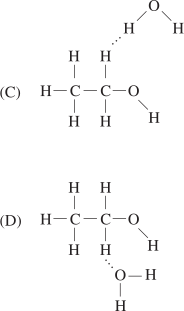
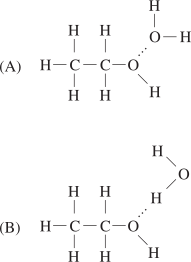
Which of the following diagrams best represents the bonding between molecules of water and ethanol?


Show Answers Only

`B`

Show Worked Solution
  • Ethanol, \(\ce{C2H5OH}\) has a polar \(\ce{OH}\) group. The partially negative oxygen atom is attracted to the partially positive hydrogen atom in the water molecule.
  • This forms a hydrogen bond.

`=>B`

Filed Under: Bonding Tagged With: Band 4, smc-4258-40-Inter/Intramolecular Bonding, smc-4258-50-Chemical structure

CHEMISTRY, M1 2011 HSC 9 MC

What property of \(\ce{O3}\) makes it more soluble in water than \(\ce{O2}\) in water?

  1. \(\ce{O3}\) is a polar molecule.
  2. \(\ce{O3}\) has a resonance structure.
  3. \(\ce{O3}\) is a highly reactive molecule.
  4. \(\ce{O3}\) has a coordinate covalent bond.
Show Answers Only

`A`

Show Worked Solution
  • Solubility in water is directly correlated to the polarity of a molecule. The more polar a molecule is the more it will dissolve in water.
  • Thus if \(\ce{O3}\) is more soluble in water than \(\ce{O2}\), it must be polar while \(\ce{O2}\) is relatively nonpolar.

`=>A`

Filed Under: Bonding Tagged With: Band 4, smc-4258-40-Inter/Intramolecular Bonding

Copyright © 2014–2025 SmarterEd.com.au · Log in