SmarterEd

Aussie Maths & Science Teachers: Save your time with SmarterEd

  • Login
  • Get Help
  • About

CHEMISTRY, M2 EQ-Bank 10

  1. A student is asked to prepare 500.0 mL of a 0.150 mol L\(^{-1}\) standard solution of oxalic acid \(\ce{(C2H2O4.2H2O)}\), and then to perform a dilution to produce 250.0 mL of a 0.0300 mol L\(^{-1}\) solution. Outline and explain each step in this process, including the calculations involved and choice of equipment.   (5 marks)

--- 12 WORK AREA LINES (style=lined) ---

  1. Justify the procedure in part (a.) by explaining two measures taken to ensure the accuracy of the standard solution and diluted solution produced.   (2 marks)

--- 4 WORK AREA LINES (style=lined) ---

Show Answers Only

a.    Calculate the mass of oxalic acid:

\(MM\ce{(C2H2O4.2H2O)}= 2(12.01) + 2(1.008) + 4(16.00) + 4(1.008) +2(16.00) = 126.068\ \text{g mol}^{-1}\)

\(n\ce{(C2H2O4.2H2O)} = c \times V = 0.150 \times 0.5 = 0.075\ \text{mol}\)

\(m\ce{(C2H2O4.2H2O)} = 0.075 \times 126.068 = 9.455\ \text{g}\)

  • Measure 9.455 g of oxalic acid using an electronic balance.

Prepare the standard solution:

  • Transfer the oxalic acid to a 500.0 mL volumetric flask using a funnel and rinse any remaining crystals from the weighing container into the flask with a small amount of distilled water.
  • Fill the volumetric flask with distilled water to about 80% full and swirl to dissolve the oxalic acid completely and carefully add more distilled water with a pipette until the bottom of the meniscus rests on the 500.0 mL mark to ensure precise volume.
  • Stopper the flask and invert several times to ensure a homogeneous solution.

Perform the dilution:

\(V_1=\dfrac{c_2V_2}{c_1} = \dfrac{0.03 \times 250}{0.15} = 50\ \text{mL}\)

  • Use a pipette to transfer 50.0 mL of the 0.150 mol L\(^{-1}\) solution into a 250.0 mL volumetric flask.
  • Dilute with distilled water up to the 250.0 mL mark in the flask to achieve a concentration of 0.0300 mol L\(^{-1}\).

b.    Answers could include two of the following:

  • A volumetric flask is used for both the standard solution and the diluted solution, as it provides precise measurements for the final solution volume. This accuracy is essential for ensuring the concentration is exactly as calculated.
  • The primary solute is weighed on an electronic balance to the nearest 0.01 g or better, minimising any error in the amount of solute added to the solution. 
  • The pipette provides precise measurements crucial for accurate dilutions.
  • Using oxalic acid as the primary standard for the investigation. Primary standard’s have high molar masses and are anhydrous (don’t absorb water). This ensures the substance is pure and the electronic balance can accurately weigh the sample.
Show Worked Solution

a.    Calculate the mass of oxalic acid:

\(MM\ce{(C2H2O4.2H2O)}= 2(12.01) + 2(1.008) + 4(16.00) + 4(1.008) +2(16.00) = 126.068\ \text{g mol}^{-1}\)

\(n\ce{(C2H2O4.2H2O)} = c \times V = 0.150 \times 0.5 = 0.075\ \text{mol}\)

\(m\ce{(C2H2O4.2H2O)} = 0.075 \times 126.068 = 9.455\ \text{g}\)

  • Measure 9.455 g of oxalic acid using an electronic balance.

Prepare the standard solution:

  • Transfer the oxalic acid to a 500.0 mL volumetric flask using a funnel and rinse any remaining crystals from the weighing container into the flask with a small amount of distilled water.
  • Fill the volumetric flask with distilled water to about 80% full and swirl to dissolve the oxalic acid completely and carefully add more distilled water with a pipette until the bottom of the meniscus rests on the 500.0 mL mark to ensure precise volume.
  • Stopper the flask and invert several times to ensure a homogeneous solution.

Perform the dilution:

\(V_1=\dfrac{c_2V_2}{c_1} = \dfrac{0.03 \times 250}{0.15} = 50\ \text{mL}\)

  • Use a pipette to transfer 50.0 mL of the 0.150 mol L\(^{-1}\) solution into a 250.0 mL volumetric flask.
  • Dilute with distilled water up to the 250.0 mL mark in the flask to achieve a concentration of 0.0300 mol L\(^{-1}\).

b.    Answers could include two of the following:

  • A volumetric flask is used for both the standard solution and the diluted solution, as it provides precise measurements for the final solution volume. This accuracy is essential for ensuring the concentration is exactly as calculated.
  • The primary solute is weighed on an electronic balance to the nearest 0.01 g or better, minimising any error in the amount of solute added to the solution. 
  • The pipette provides precise measurements crucial for accurate dilutions.
  • Using oxalic acid as the primary standard for the investigation. Primary standard’s have high molar masses and are anhydrous (don’t absorb water). This ensures the substance is pure and the electronic balance can accurately weigh the sample.

Filed Under: Concentration and Molarity Tagged With: Band 5, Band 6, smc-4261-20-Concentration Calculations, smc-4261-60-Dilutions, smc-4261-70-Standard Solutions, smc-4261-90-Practical Investigation

CHEMISTRY, M2 EQ-Bank 6 MC

A chemist is given 200.0 mL of a 1.2 M solution of sodium sulfate and is asked to dilute it to form 50.0 mL of a 0.30 M sodium sulfate solution.

Which of the following options regarding the dilution is correct?

\begin{align*}
\begin{array}{l}
\rule{0pt}{2.5ex}\ & \\
\rule[-1ex]{0pt}{0pt} \ & \\
\rule{0pt}{2.5ex}\textbf{A.}\rule[-1ex]{0pt}{0pt}\\
\rule{0pt}{2.5ex}\textbf{B.}\rule[-1ex]{0pt}{0pt}\\
\rule{0pt}{2.5ex}\textbf{C.}\rule[-1ex]{0pt}{0pt}\\
\rule{0pt}{2.5ex}\textbf{D.}\rule[-1ex]{0pt}{0pt}\\
\end{array}
\begin{array}{|c|c|}
\hline
\rule{0pt}{2.5ex} \textbf{Volume of 1.2 M solution needed } & \textbf{Glassware to make} \\
\textbf{to dilute solution (mL)} \rule[-1ex]{0pt}{0pt}& \textbf{accurately known solution} \\
\hline
\rule{0pt}{2.5ex} 12.5 \rule[-1ex]{0pt}{0pt}& \text{beaker, measuring cylinder} \\
\hline
\rule{0pt}{2.5ex} 75 \rule[-1ex]{0pt}{0pt}& \text{beaker, measuring cylinder} \\
\hline
\rule{0pt}{2.5ex} 12.5 \rule[-1ex]{0pt}{0pt}& \text{volumetric flask, pipette} \\
\hline
\rule{0pt}{2.5ex} 75 \rule[-1ex]{0pt}{0pt}& \text{volumetric flask, pipette} \\
\hline
\end{array}
\end{align*}

Show Answers Only

\(C\)

Show Worked Solution
  • Using the dilution formula, \(c_1V_1=c_2V_2\)
  •    \(V_1 = \dfrac{c_2V_2}{c_1} = \dfrac{0.3 \times 50}{1.2} = 12.5\ \text{mL}\)
  • To prepare an accurately diluted solution, a volumetric flask and a pipette should be used, as these provide precise measurements. 

\(\Rightarrow C\)

Filed Under: Concentration and Molarity Tagged With: Band 4, smc-4261-60-Dilutions, smc-4261-70-Standard Solutions, smc-4261-90-Practical Investigation

CHEMISTRY, M2 EQ-Bank 4

A student is required to dilute 150.00 mL solution of 3.00 mol L\(^{-1}\) hydrochloric acid to produce 250.00 mL of 0.54 mol L\(^{-1}\) hydrochloric acid. 

Explain how the student should perform this dilution in a school laboratory. Include relevant calculations in your answer AND explain how the student should prepare any equipment they would use.   (4 marks)

--- 8 WORK AREA LINES (style=lined) ---

Show Answers Only
  • The student should wash a 250 mL volumetric flask with distilled water only, if any hydrochloric acid was in the flask it would increase the final concentration to an unknown value.
  • A 50 mL volumetric pipette should be rinsed with distilled water to remove impurities then rinsed with the 3.00 M HCl solution to be diluted, as if any water was left in the pipette it would dilute the acid by an unknown factor.
  • The initial and final concentrations and volumes are related by the dilution equation:
  •    \(C_1 V_1 = C_2 V_2 \), where
  •    \( C_1 = 3.00 \, \text{M} \) (initial concentration)
  •    \( V_1 \) = volume to be pipetted
  •    \( C_2 = 0.54 \, \text{M} \) (final concentration)
  •    \( V_2 = 250.00 \, \text{mL} \) (final volume)
  • Rearrange to solve for \( V_1 \):
  •    \( V_1 = \dfrac{C_2 V_2}{C_1}  = \dfrac{0.54 \times 250.00}{3.00}= \dfrac{125.00}{3.00} = 45 \, \text{mL} \)
  • Thus, the student would pipette 45 mL of the 3.00 M acid and deliver it to the 250 mL volumetric flask, making it up to the 250 mL line with distilled water. This would produce a 0.50 M dilution.
Show Worked Solution
  • The student should wash a 250 mL volumetric flask with distilled water only, if any hydrochloric acid was in the flask it would increase the final concentration to an unknown value.
  • A 50 mL volumetric pipette should be rinsed with distilled water to remove impurities then rinsed with the 3.00 M HCl solution to be diluted, as if any water was left in the pipette it would dilute the acid by an unknown factor.
  • The initial and final concentrations and volumes are related by the dilution equation:
  •    \(C_1 V_1 = C_2 V_2 \), where
  •    \( C_1 = 3.00 \, \text{M} \) (initial concentration)
  •    \( V_1 \) = volume to be pipetted
  •    \( C_2 = 0.54 \, \text{M} \) (final concentration)
  •    \( V_2 = 250.00 \, \text{mL} \) (final volume)
  • Rearrange to solve for \( V_1 \):
  •    \( V_1 = \dfrac{C_2 V_2}{C_1}  = \dfrac{0.54 \times 250.00}{3.00}= \dfrac{125.00}{3.00} = 45 \, \text{mL} \)
  • Thus, the student would pipette 45 mL of the 3.00 M acid and deliver it to the 250 mL volumetric flask, making it up to the 250 mL line with distilled water. This would produce a 0.50 M dilution.

Filed Under: Concentration and Molarity Tagged With: Band 4, Band 5, smc-4261-60-Dilutions, smc-4261-90-Practical Investigation

CHEMISTRY, M2 EQ-Bank 3

A student is required to dilute 100.00 mL solution of 2.00 mol L\(^{-1}\) hydrochloric acid to produce 200.00 mL of 0.20 mol L\(^{-1}\) hydrochloric acid. 

Explain how the student should perform this dilution in a school laboratory. Include relevant calculations in your answer AND explain how the student should prepare any equipment they would use.    (4 marks)

--- 8 WORK AREA LINES (style=lined) ---

Show Answers Only
  • The student should wash a 200 mL volumetric flask with distilled water only, as if any hydrochloric acid was in the flask it would increase the final concentration to an unknown value.
  • A 20 mL volumetric pipette should be rinsed with distilled water to remove impurities then rinsed with the 2.00 M HCl solution to be diluted, as if any water was left in the pipette it would dilute the acid by an unknown factor.
  • The initial and final concentrations and volumes are related by the dilution equation:
  •    \( C_1 V_1 = C_2 V_2 \), where 
  •    \( C_1 = 2.00 \, \text{M} \) (initial concentration)
  •    \( V_1 \) = volume to be pipetted
  •    \( C_2 = 0.20 \, \text{M} \) (final concentration)
  •    \( V_2 = 200.00 \, \text{mL} \) (final volume)
  • Solve for \( V_1 \):
  •    \( V_1 = \dfrac{C_2 V_2}{C_1} = \dfrac{0.20 \times 200.00}{2.00} = \dfrac{40.00}{2.00} = 20.00 \ \text{mL} \)
  • Thus, the student would pipette 20.00 mL of the 2.00 M acid and deliver it to the 200 mL volumetric flask, making it up to the 200 mL line with distilled water. This would produce a 0.200 M or \(1:10\) dilution.
Show Worked Solution
  • The student should wash a 200 mL volumetric flask with distilled water only, as if any hydrochloric acid was in the flask it would increase the final concentration to an unknown value.
  • A 20 mL volumetric pipette should be rinsed with distilled water to remove impurities then rinsed with the 2.00 M HCl solution to be diluted, as if any water was left in the pipette it would dilute the acid by an unknown factor.
  • The initial and final concentrations and volumes are related by the dilution equation:
  •    \( C_1 V_1 = C_2 V_2 \), where 
  •    \( C_1 = 2.00 \, \text{M} \) (initial concentration)
  •    \( V_1 \) = volume to be pipetted
  •    \( C_2 = 0.20 \, \text{M} \) (final concentration)
  •    \( V_2 = 200.00 \, \text{mL} \) (final volume)
  • Solve for \( V_1 \):
  •    \( V_1 = \dfrac{C_2 V_2}{C_1} = \dfrac{0.20 \times 200.00}{2.00} = \dfrac{40.00}{2.00} = 20.00 \ \text{mL} \)
  • Thus, the student would pipette 20.00 mL of the 2.00 M acid and deliver it to the 200 mL volumetric flask, making it up to the 200 mL line with distilled water. This would produce a 0.200 M or \(1:10\) dilution.

Filed Under: Concentration and Molarity Tagged With: Band 4, Band 5, smc-4261-60-Dilutions, smc-4261-90-Practical Investigation

CHEMISTRY, M2 2013 HSC 28

A student attempted to determine the concentration of a hydrochloric acid solution. The following steps were performed.

Step 1. A conical flask was rinsed with water.

Step 2. A 25.0 mL pipette was rinsed with water.

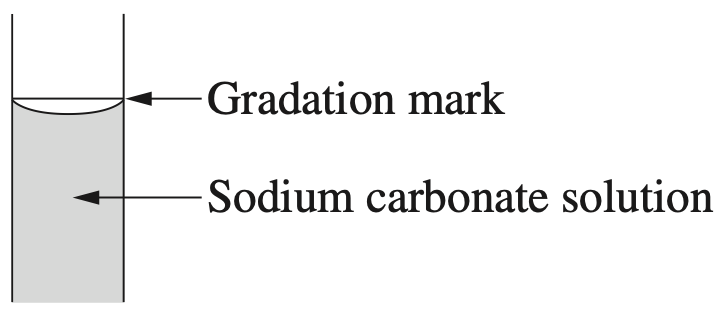
Step 3. The student filled the pipette with a standard sodium carbonate solution to the level shown in the diagram.

Step 4. The standard sodium carbonate solution in the pipette was transferred to the conical flask. The student ensured that all of the sodium carbonate solution was transferred to the conical flask by blowing through the pipette. Three drops of an appropriate indicator were added to the conical flask.

Step 5. A burette was rinsed with the hydrochloric acid solution and then filled with the acid. The student then carried out a titration to determine the concentration of the hydrochloric acid solution.

In steps 2,3 and 4 above the student did not follow acceptable procedures.

  1. Identify the mistake the student made in step 4 and propose a change that would improve the validity of the result.  (2 marks)
  2. Explain the effect of the mistakes made in steps 2 and 3 on the calculation of the concentration of the hydrochloric acid solution.  (3 marks)
Show Answers Only

a.   Mistake: blowing through the pipette

  • Proposed change: student should have touched the end of the pipette to the surface of flask to draw out the liquid.

b.   Mistake (step 2): rinsing the pipette with water

  • This would decrease the number of moles of \(\ce{Na2CO3}\) it contains.

Mistake (step 3): not filling to the gradation mark

  • By not filling to the mark, the pipette would contain fewer moles of \(\ce{Na2CO3}\).
  • Hence, a lower volume of the \(\ce{HCl}\) would be added from the burette, but the student would think that there were more moles of \(\ce{HCl}\) in this volume.
  • As a result, the calculated concentration of the acid solution would be higher than the actual concentration.
Show Worked Solution

a.   Mistake: blowing through the pipette

  • Proposed change: student should have touched the end of the pipette to the surface of flask to draw out the liquid.

b.   Mistake (step 2): rinsing the pipette with water

  • This would decrease the number of moles of \(\ce{Na2CO3}\) it contains.

Mistake (step 3): not filling to the gradation mark

  • By not filling to the mark, the pipette would contain fewer moles of \(\ce{Na2CO3}\).
  • Hence, a lower volume of the \(\ce{HCl}\) would be added from the burette, but the student would think that there were more moles of \(\ce{HCl}\) in this volume.
  • As a result, the calculated concentration of the acid solution would be higher than the actual concentration.
♦ Mean mark (b) 54%.

Filed Under: Concentration and Molarity Tagged With: Band 4, Band 5, smc-4261-90-Practical Investigation

Copyright © 2014–2025 SmarterEd.com.au · Log in