SmarterEd

Aussie Maths & Science Teachers: Save your time with SmarterEd

  • Login
  • Get Help
  • About

CHEMISTRY, M3 EQ-Bank 11

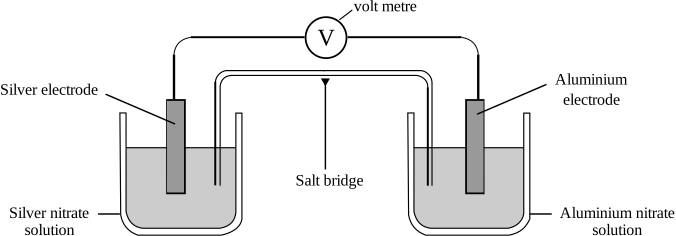
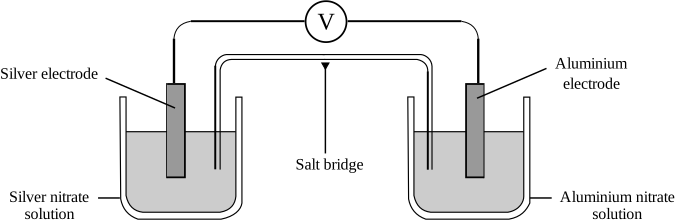
A student set up two half-cells: one with an aluminium nitrate solution and an aluminium metal electrode, and the other with silver nitrate solution and a silver metal electrode. The two solutions were connected by a salt bridge soaked in potassium nitrate, and the electrodes were linked to a volt-meter using electrical wires.

  1. Draw a labelled diagram of the student's setup.   (3 marks)

--- 10 WORK AREA LINES (style=blank) ---

  1. Complete the following table.   (3 marks)

    --- 0 WORK AREA LINES (style=lined) ---

\begin{array} {|c|c|}
\hline
\rule{0pt}{2.5ex} \text{anode half equation} \rule[-1ex]{0pt}{0pt} & \qquad \qquad\qquad \qquad \qquad \\
\hline
\rule{0pt}{2.5ex} \text{cathode half equation} \rule[-1ex]{0pt}{0pt} & \\
\hline
\rule{0pt}{2.5ex} \text{net ionic equation} \rule[-1ex]{0pt}{0pt} &  \\
\hline
\end{array}

  1. Determine the theoretical cell potential of the students galvanic cell.   (2 marks)

--- 4 WORK AREA LINES (style=lined) ---

Show Answers Only

a.   
       

b.   

\begin{array} {|c|c|}
\hline
\rule{0pt}{2.5ex} \text{anode half equation} \rule[-1ex]{0pt}{0pt} & \ce{Al(s) -> Al^{3+}(aq) + 3e^-}\\
\hline
\rule{0pt}{2.5ex} \text{cathode half equation} \rule[-1ex]{0pt}{0pt} & \ce{Ag+(aq) + e^- -> Ag(s)} \\
\hline
\rule{0pt}{2.5ex} \text{net ionic equation} \rule[-1ex]{0pt}{0pt} & \ce{Al(s) + Ag+(aq) -> Al^{3+}(aq) + Ag(s)} \\
\hline
\end{array}

 
c.    
\(E^{\circ}_{\text{cell}}=E^{\circ}_{\text{cathode}}-E^{\circ}_{\text{anode}}=0.8-(-1.68)=2.48\ \text{V}\)
Show Worked Solution

a.  


b.   

\begin{array} {|c|c|}
\hline
\rule{0pt}{2.5ex} \text{anode half equation} \rule[-1ex]{0pt}{0pt} & \ce{Al(s) -> Al^{3+}(aq) + 3e^-}\\
\hline
\rule{0pt}{2.5ex} \text{cathode half equation} \rule[-1ex]{0pt}{0pt} & \ce{Ag+(aq) + e^- -> Ag(s)} \\
\hline
\rule{0pt}{2.5ex} \text{net ionic equation} \rule[-1ex]{0pt}{0pt} & \ce{Al(s) + Ag+(aq) -> Al^{3+}(aq) + Ag(s)} \\
\hline
\end{array}


c.    \(E^{\circ}_{\text{cell}}=E^{\circ}_{\text{cathode}}-E^{\circ}_{\text{anode}}=0.8-(-1.68)=2.48\ \text{V}\)
Filed Under: Predicting Reactions of Metals Tagged With: Band 4, smc-4264-25-Redox, smc-4264-40-Cell Potentials, smc-4264-45-Galvanic Cells

CHEMISTRY, M3 EQ-Bank 5 MC

Which statement is correct for the following reaction?

\(\ce{Zn(s) + Cu^{2+}(aq) -> Zn^{2+}(aq) + Cu(s)}\)

  1. \(\ce{Zn}\) is the oxidising agent because it undergoes reduction.
  2. \(\ce{Zn}\) is the reducing agent because it undergoes oxidation.
  3. \(\ce{Cu^{2+}}\) is the reducing agent because it undergoes oxidation.
  4. \(\ce{Cu^{2+}}\) is the oxidising agent because it undergoes oxidation.
Show Answers Only

\(B\)

Show Worked Solution
  • Oxidation is the process in which a substance loses electrons.
  • Reduction is the process in which substance gains electrons.
  • The oxidising agent is reduced and the reducing agent is oxidised.
  • Zinc undergoes oxidation as it loses electrons, \(\ce{Zn(s) -> Zn^{2+}(aq) + 2e^-}\).
  • Zinc is also the reducing agent as it causes Copper to undergo reduction.

\(\Rightarrow B\)

Filed Under: Predicting Reactions of Metals Tagged With: Band 4, smc-4264-25-Redox

CHEMISTRY, M3 EQ-Bank 8

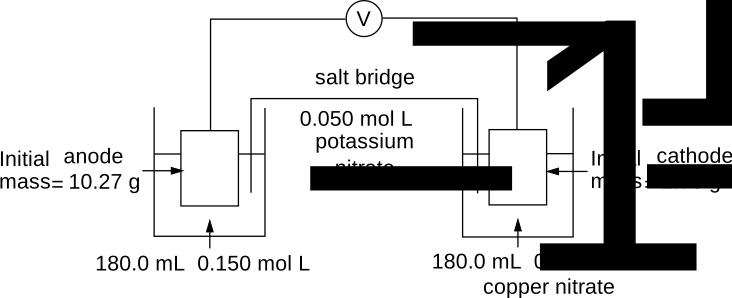
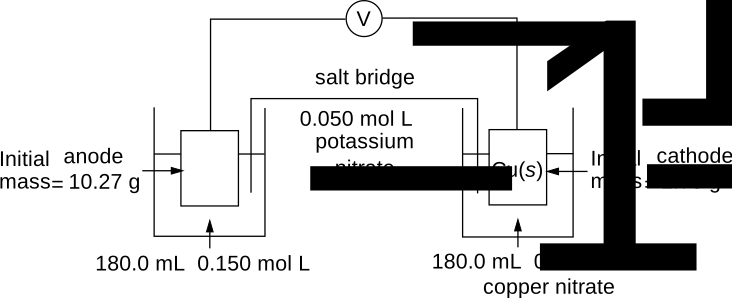
A galvanic cell has been set up as illustrated in the diagram below.

  1. The standard potential for this reaction is 0.78 V. Use half equations to determine the unknown electrode.   (2 marks)

--- 4 WORK AREA LINES (style=blank) ---

  1. The unknown solution is light green in colour. Explain what will happen to the colour of the unknown solution as the reaction proceeds.   (2 marks)

--- 4 WORK AREA LINES (style=lined) ---

  1. After some time, a solid deposit formed on the copper electrode was removed and dried. The mass of the deposit was 0.150 g. Determine the final concentration of the copper nitrate solution.   (3 marks)

--- 6 WORK AREA LINES (style=lined) ---

Show Answers Only

a.    \(\ce{Fe(s) -> Fe^{2+} + 2e^-}\)

b.    As the reaction progresses:

  • The solution will darken, taking on a more intense green colour.
  • This change occurs because nickel undergoes oxidation to form \(\ce{Fe^{2+}}\) ions, which are released into the solution, thereby increasing its colour intensity.

c.    \(0.137\ \text{mol L}^{-1}\)

Show Worked Solution
a.     \(E^{\circ}_{\text{cell}}\) \(=E^{\circ}_{\text{cathode}}-E^{\circ}_{\text{anode}}\)
  \(0.78\) \(=0.34-E^{\circ}_{\text{anode}}\)
  \(E^{\circ}_{\text{anode}}\) \(=0.34-0.78\)
  \(E^{\circ}_{\text{anode}}\) \(=-0.44\)
     
  • \(\ce{Fe^{2+} + 2e^- -> Fe(s)} \qquad -0.44\ \text{V}\)
  • \(\ce{Fe^{2+}}\) is undergoing oxidation. The correct half equation is: \(\ce{Fe(s) -> Fe^{2+} + 2e^-}\)
     

b.    As the reaction progresses:

  • The solution will darken, taking on a more intense green colour.
  • This change occurs because nickel undergoes oxidation to form \(\ce{Fe^{2+}}\) ions, which are released into the solution, thereby increasing its colour intensity.
     

c.    Moles of solid copper formed on electrode: \(\dfrac{m}{MM}=\dfrac{0.175}{63.55}=2.36 \times 10^{-3}\ \text{mol}\)

Moles of copper taken out of solution: \(2.36 \times 10^{-3}\ \text{mol}\)

Moles of copper remaining in solution: \((0.15 \times 0.18)-2.36 \times 10^{-3}= 0.0246\ \text{mol}\)

Final concentration: \(c=\dfrac{n}{V}=\dfrac{0.0246}{0.18}=0.137\ \text{mol L}^{-1}\)

Filed Under: Predicting Reactions of Metals Tagged With: Band 4, Band 5, Band 6, smc-4264-25-Redox, smc-4264-40-Cell Potentials

CHEMISTRY M3 2013 VCE 6 MC

Which one of the following reactions is a redox reaction?

  1. \(\ce{2Al(s) + 3Cl2(g)\rightarrow 2AlCl3(s)}\)
  2. \(\ce{Pb^{2+}(aq) + 2Cl^{-}(aq)\rightarrow PbCl2(s)}\)
  3. \(\ce{NaOH(aq) + HCl(aq)\rightarrow NaCl(aq) + H2O(l)}\)
  4. \(\ce{CH3OH(l) + HCOOH(l)\rightarrow HCOOCH3(l) + H2O(l)}\)
Show Answers Only

\(A\)

Show Worked Solution
  • In option \(A\), the oxidation number of \(\ce{Al}\) increases from 0 to +3, while the oxidation number of \(\ce{Cl}\) decreases from 0 to – 1.
  • Other reactions are: precipitation (option \(B\)), neutralisation (option \(C\)) and condensation (option \(D\)).

\(\Rightarrow A\)

♦ Mean mark 55%.

Filed Under: Predicting Reactions of Metals Tagged With: Band 5, smc-4264-25-Redox

CHEMISTRY, M3 2014 VCE 10 MC

Which one of the reactions of hydrochloric acid below is a redox reaction?

  1. \(\ce{2HCl(aq) + Fe(s)\rightarrow H2(g) + FeCl2(aq)}\)
  2. \(\ce{2HCl(aq) + Na2S(s)\rightarrow H2S(g) + 2NaCl(aq)}\)
  3. \(\ce{2HCl(aq) + MgO(s)\rightarrow MgCl2(aq) + H2O(l)}\)
  4. \(\ce{2HCl(aq) + K2CO3(s)\rightarrow CO2(g) + 2KCl(aq) + H2O(l)}\)
Show Answers Only

\(A\)

Show Worked Solution
  • \(\ce{HCl}\) is the common reactant in all options.
  • Therefore, redox reaction will see the oxidation number of \(\ce{H}\) or \(\ce{Cl}\) change.
  • In option \(A\), the oxidation number of \(\ce{H}\) decreases from +1 to 0, while the oxidation number of \(\ce{Fe}\) increases from 0 to +2.

\(\Rightarrow A\)

Filed Under: Predicting Reactions of Metals Tagged With: Band 4, smc-4264-25-Redox

CHEMISTRY, M3 2016 VCE 3 MC

Hydrogen peroxide solutions are commercially available and have a range of uses. The active ingredient, hydrogen peroxide, \(\ce{H2O2}\), undergoes decomposition in the presence of a suitable catalyst according to the reaction

\(\ce{2H2O2(l)\rightarrow 2H2O(l) + O2(g)}\)

In this reaction, oxygen

  1. only undergoes oxidation.
  2. only undergoes reduction.
  3. undergoes both oxidation and reduction.
  4. undergoes neither oxidation nor reduction.
Show Answers Only

\(C\)

Show Worked Solution
  • The oxidation number of oxygen has decreased from –1 to –2 when \(\ce{H2O2}\) has been reduced to \(\ce{H2O}\).
  • Also, the oxidation number of oxygen has increased from –1 to 0 when \(\ce{H2O2}\) has been oxidised to \(\ce{O2}\).

\(\Rightarrow C\)

♦ Mean mark 53%.

Filed Under: Predicting Reactions of Metals Tagged With: Band 5, smc-4264-25-Redox

CHEMISTRY, M3 2022 VCE 14 MC

The discharge reaction in a vanadium redox battery is represented by the following equation.

\(\ce{VO2+(aq) + 2H+(aq) + V^2+(aq) \rightarrow V^3+(aq) + VO^2+(aq) + H2O(l)}\)

When the vanadium redox battery is recharging

  1. \(\ce{H+}\) is the reducing agent.
  2. \(\ce{H2O}\) is the oxidising agent.
  3. \(\ce{VO^{2+}}\) is the reducing agent.
  4. \(\ce{VO2+}\) is the oxidising agent.
Show Answers Only

\(C\)

Show Worked Solution
  • Recharging equation:
  •    \(\ce{V^3+(aq) + VO^2+(aq) + H2O(l) \rightarrow VO2+(aq) + 2H+(aq) + V^2+(aq) }\)
  • Only atom that changes oxidation numbers is \(\ce{V}\) (eliminate A and B)
  • \(\ce{VO2+}\) is a product of the recharging equation and cannot be the oxidising agent (eliminate D)
  • \(\ce{VO^{2+}}\) is oxidised to \(\ce{VO2+}\) with the oxidation number of \(\ce{V}\) increasing from +4 to +5, making \(\ce{VO^{2+}}\) the reducing agent.

\(\Rightarrow C\)

♦ Mean mark 53%.

Filed Under: Predicting Reactions of Metals Tagged With: Band 5, smc-4264-25-Redox

CHEMISTRY, M3 2012 HSC 13-14 MC

Use the information provided to answer Questions 13 and 14.

\begin{array} {|l|}
\hline \text{This equation represents a common redox reaction.} \\ \ \ \ \ce{Cr2O7^{2-}(aq) + 14H+(aq) + 6Fe^{2+}(aq) \rightarrow 2Cr^{3+}(aq) + 6Fe^{3+}(aq) + 7H2O(l)} \\
\hline \end{array}

Question 13

What is the oxidising agent in the reaction?

  1. \(\ce{H^+}\)
  2. \(\ce{Cr^3+}\)
  3. \(\ce{Fe^2+}\)
  4. \(\ce{Cr2O7^2-}\)

 
Question 14

What is the value of \(\ce{E}_{\text {cell }}^{\ominus}\) for the reaction?

  1. 0.59 V
  2. 0.92 V
  3. 1.90 V
  4. 2.13 V
Show Answers Only

\(\text{Question 13:}\ D\)

\(\text{Question 14:}\ A\)

Show Worked Solution

Question 13

  • The oxidising agent is the chemical that undergoes reduction. The chromium changes its oxidation number from \(+6\) to \(+3\) indication reduction.
  • Thus it is the dichromate ion which undergoes reduction.

\(\Rightarrow D\)
 

Question 14

From the list of standard potentials:

  • The reduction voltage of dichromate ions is 1.36 \(\text{V}\) 
  • The oxidation of \(\ce{Fe^2+}\) ions is -0.77 \(\text{V}\) 
  •    \(1.36 + -0.77= 0.59\ \text{V}\) 

\(\Rightarrow A\)

Filed Under: Predicting Reactions of Metals Tagged With: Band 4, Band 5, smc-4264-25-Redox

CHEMISTRY, M3 2015 HSC 7 MC

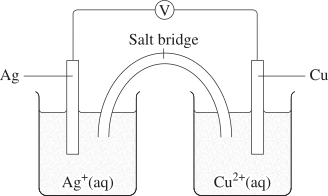
A diagram of a simple cell is shown.

Which of the following occurs when the cell is in operation?

  1. Silver ions are formed in solution.
  2. The copper electrode loses electrons.
  3. Electrons travel through the electrolyte.
  4. The copper electrode increases in mass.
Show Answers Only

\(B\)

Show Worked Solution
  • Copper is a more active metal than silver.
  • Thus the copper electrode will be the anode and the silver electrode will be the cathode, and in REDOX reactions, electrons flow from the anode to the cathode.
  • Hence the copper electrode will lose electrons.

\(\Rightarrow B\)

Filed Under: Predicting Reactions of Metals Tagged With: Band 4, smc-4264-25-Redox

CHEMISTRY, M3 2015 HSC 4 MC

What happens to \(\ce{Fe^2+} \) in the following reaction?

\( \ce{Sn^4+} + \ce{Fe^2+} \rightarrow \ce{Sn^3+} + \ce{Fe^3+} \)

  1. It undergoes oxidation and gains electrons.
  2. It undergoes reduction and gains electrons.
  3. It undergoes oxidation and loses electrons.
  4. It undergoes reduction and loses electrons.
Show Answers Only

\(C\)

Show Worked Solution
  • The increase from \(2^+\) to \(3^+\) indicates oxidation.
  • During oxidation, the species loses electrons.

\(\Rightarrow C\)

Filed Under: Predicting Reactions of Metals Tagged With: Band 4, smc-4264-25-Redox

CHEMISTRY, M3 2017 HSC 11 MC

Consider the following redox reaction.

\( \ce{2K2Cr2O7}(aq) + \ce{2H2O}(l) + \ce{3S}(s) \rightarrow \ce{2Cr2O3}(aq) + \ce{4KOH}(aq) + \ce{3SO2}(g) \)

Which species is being oxidised?

  1. \( \ce{Cr^6+}\)
  2.  \( \ce{K^+} \)
  3. \( \ce{O^2-} \)
  4. \( \ce{S} \)
Show Answers Only

\(D\)

Show Worked Solution
  • Sulfer has an oxidation number of 0 on the left hand side of the equation.
  • Let \(x\) equal the oxidation number of sulfur within \(\ce{3SO2}(g) \).
\(x+2 \times -2\) \(=0\)  
\(x-4\) \(=0\)  
\(x\) \(=4\)  


  • The increase in oxidation number shows the species, \( \ce{S} \), has undergone oxidation.

\(\Rightarrow D\)

Filed Under: Predicting Reactions of Metals Tagged With: Band 5, smc-4264-25-Redox, smc-4264-30-Oxidation Numbers

Copyright © 2014–2025 SmarterEd.com.au · Log in