SmarterEd

Aussie Maths & Science Teachers: Save your time with SmarterEd

  • Login
  • Get Help
  • About

CHEMISTRY, M3 EQ-Bank 11

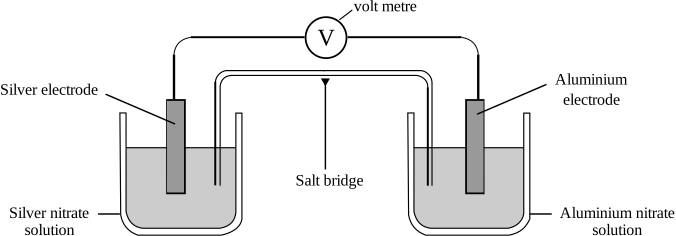
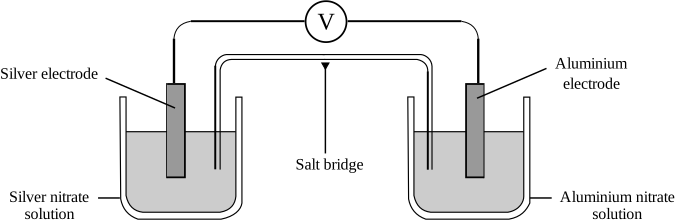
A student set up two half-cells: one with an aluminium nitrate solution and an aluminium metal electrode, and the other with silver nitrate solution and a silver metal electrode. The two solutions were connected by a salt bridge soaked in potassium nitrate, and the electrodes were linked to a volt-meter using electrical wires.

  1. Draw a labelled diagram of the student's setup.   (3 marks)

--- 10 WORK AREA LINES (style=blank) ---

  1. Complete the following table.   (3 marks)

    --- 0 WORK AREA LINES (style=lined) ---

\begin{array} {|c|c|}
\hline
\rule{0pt}{2.5ex} \text{anode half equation} \rule[-1ex]{0pt}{0pt} & \qquad \qquad\qquad \qquad \qquad \\
\hline
\rule{0pt}{2.5ex} \text{cathode half equation} \rule[-1ex]{0pt}{0pt} & \\
\hline
\rule{0pt}{2.5ex} \text{net ionic equation} \rule[-1ex]{0pt}{0pt} &  \\
\hline
\end{array}

  1. Determine the theoretical cell potential of the students galvanic cell.   (2 marks)

--- 4 WORK AREA LINES (style=lined) ---

Show Answers Only

a.   
       

b.   

\begin{array} {|c|c|}
\hline
\rule{0pt}{2.5ex} \text{anode half equation} \rule[-1ex]{0pt}{0pt} & \ce{Al(s) -> Al^{3+}(aq) + 3e^-}\\
\hline
\rule{0pt}{2.5ex} \text{cathode half equation} \rule[-1ex]{0pt}{0pt} & \ce{Ag+(aq) + e^- -> Ag(s)} \\
\hline
\rule{0pt}{2.5ex} \text{net ionic equation} \rule[-1ex]{0pt}{0pt} & \ce{Al(s) + Ag+(aq) -> Al^{3+}(aq) + Ag(s)} \\
\hline
\end{array}

 
c.    
\(E^{\circ}_{\text{cell}}=E^{\circ}_{\text{cathode}}-E^{\circ}_{\text{anode}}=0.8-(-1.68)=2.48\ \text{V}\)
Show Worked Solution

a.  


b.   

\begin{array} {|c|c|}
\hline
\rule{0pt}{2.5ex} \text{anode half equation} \rule[-1ex]{0pt}{0pt} & \ce{Al(s) -> Al^{3+}(aq) + 3e^-}\\
\hline
\rule{0pt}{2.5ex} \text{cathode half equation} \rule[-1ex]{0pt}{0pt} & \ce{Ag+(aq) + e^- -> Ag(s)} \\
\hline
\rule{0pt}{2.5ex} \text{net ionic equation} \rule[-1ex]{0pt}{0pt} & \ce{Al(s) + Ag+(aq) -> Al^{3+}(aq) + Ag(s)} \\
\hline
\end{array}


c.    \(E^{\circ}_{\text{cell}}=E^{\circ}_{\text{cathode}}-E^{\circ}_{\text{anode}}=0.8-(-1.68)=2.48\ \text{V}\)
Filed Under: Predicting Reactions of Metals Tagged With: Band 4, smc-4264-25-Redox, smc-4264-40-Cell Potentials, smc-4264-45-Galvanic Cells

CHEMISTRY, M3 EQ-Bank 10

A student conducted an experiment to measure the voltage generated by using various combinations of metals in an electrolyte solution.


  1. Complete the table below.   (2 marks)

    --- 0 WORK AREA LINES (style=lined) ---

\begin{array} {|c|c|c|c|}
\hline
\rule{0pt}{2.5ex} \textbf{Experiment} \rule[-1ex]{0pt}{0pt} & \textbf{Half cell A} & \textbf{Half cell B} & \textbf{Cell Potential (V)}\\
\hline
\rule{0pt}{2.5ex} \textbf{1} \rule[-1ex]{0pt}{0pt} & \ce{Zn(s) | Zn^{2+}(aq)} & \ce{Pb(s) | Pb^{2+}(aq)} &  \\
\hline
\rule{0pt}{2.5ex} \textbf{2} \rule[-1ex]{0pt}{0pt} & \ce{Cu(s) | Cu^{2+}(aq)} & \ce{Pb(s) | Pb^{2+}(aq)} &  \\
\hline
\end{array}

  1. Explain whether the Zinc electrode is the anode or the cathode.   (2 marks)

--- 3 WORK AREA LINES (style=lined) ---

  1. Write the net ionic equation for Experiment 2.   (2 marks)

--- 3 WORK AREA LINES (style=lined) ---

Show Answers Only

a.  Cell potential of Experiment 1:

\(\ce{Zn(s) -> Zn^{2+} + 2e^-} \quad V=0.76\ \text{V}\)

\(\ce{Pb^{2+} + 2e^- -> Pb(s)} \quad V=-0.13\ \text{V}\)

\(E^{\circ}_{\text{cell}}=0.76 + -0.13 =0.63\ \text{V}\)
 

Cell potential of Experiment 2:

\(\ce{Pb(s) -> Pb^{2+} + 2e^-} \quad V=0.13\ \text{V}\)

\(\ce{Cu^{2+} + 2e^- -> Cu(s)} \quad V=0.34\ \text{V}\)

\(E^{\circ}_{\text{cell}}=0.13 + 0.34 =0.47\ \text{V}\)
 

b.    Zinc electrode is the anode.

  • Zinc is a more reactive metal than lead and therefore will undergo oxidation while lead undergoes reduction.
  • Since oxidation occurs at the anode, the zinc electrode will be the anode in this cell.

 
c.    
\(\ce{Pb(s) + Cu^{2+}(aq) -> Pb^{2+}(aq) + Cu(s)}\)

Show Worked Solution

a.  Cell potential of experiment 1:

\(\ce{Zn(s) -> Zn^{2+} + 2e^-} \quad V=0.76\ \text{V}\)

\(\ce{Pb^{2+} + 2e^- -> Pb(s)} \quad V=-0.13\ \text{V}\)

\(E^{\circ}_{\text{cell}}=0.76 + -0.13 =0.63\ \text{V}\)
 

Cell potential of experiment 2:

\(\ce{Pb(s) -> Pb^{2+} + 2e^-} \quad V=0.13\ \text{V}\)

\(\ce{Cu^{2+} + 2e^- -> Cu(s)} \quad V=0.34\ \text{V}\)

\(E^{\circ}_{\text{cell}}=0.13 + 0.34 =0.47\ \text{V}\)
 

b.    Zinc electrode is the anode.

  • Zinc is a more reactive metal than lead and therefore will undergo oxidation while lead undergoes reduction.
  • Since oxidation occurs at the anode, the zinc electrode will be the anode in this cell.

 
c.    
\(\ce{Pb(s) + Cu^{2+}(aq) -> Pb^{2+}(aq) + Cu(s)}\)

Filed Under: Predicting Reactions of Metals Tagged With: Band 4, Band 5, smc-4264-40-Cell Potentials, smc-4264-45-Galvanic Cells

CHEMISTRY, M3 EQ-Bank 4 MC

Which set of oxidation and reduction reactions would result in a spontaneous process?

\begin{align*}
\begin{array}{l}
\ & \\
\textbf{A.}\\
\textbf{B.}\\
\textbf{C.}\\
\textbf{D.}\\
\end{array}
\begin{array}{|c|c|}
\hline
\textit{Oxidation} & \textit{Reduction} \\
\hline
\ce{Mg(s) -> Mg^{2+}(aq) + 2e^-} & \ce{Cu^{2+}(aq) +2e^- -> Cu(s)} \\
\hline
\ce{Ag(s) -> Ag^+(aq) + e^-} & \ce{Fe^{3+}(aq) +e^- -> fe^{2+}} \\
\hline
\ce{Cu(s) -> Cu^{2+}(aq) + 2e^-} & \ce{Zn^{2+}(aq) +2e^- -> Zn(s)} \\
\hline
\ce{Pb^{2+}(aq) +2e^- -> Pb(s)} & \ce{Cu(s) -> Cu^{2+}(aq) + 2e^-} \\
\hline
\end{array}
\end{align*}

Show Answers Only

\(A\)

Show Worked Solution
  • For a redox reaction to be spontaneous, the cell potential must be a positive number.
  • Option A:  \(E^{\circ}_{\text{cell}} = 0.34-(-2.36) = 2.70\ \text{V}\)  → Spontaneous
  • Options B and C: both have negative cell potentials and will therefore be non-spontaneous.
  • Option D: has the reduction and oxidation equations around the wrong way, going against the natural direction for a spontaneous reaction.

\(\Rightarrow A\)

Filed Under: Predicting Reactions of Metals Tagged With: Band 5, smc-4264-40-Cell Potentials

CHEMISTRY, M3 EQ-Bank 8

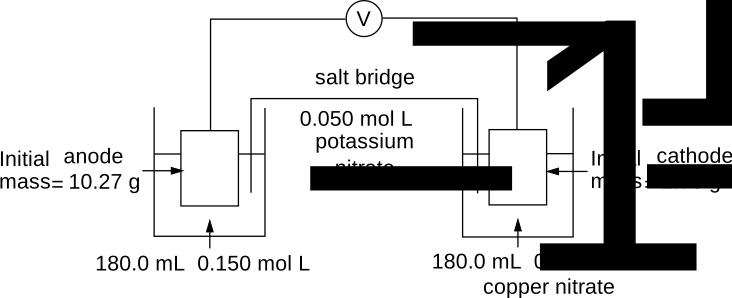
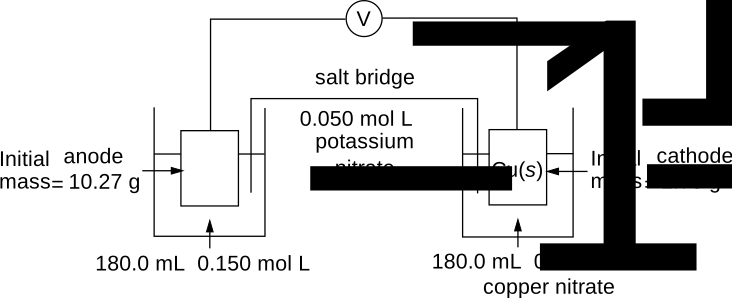
A galvanic cell has been set up as illustrated in the diagram below.

  1. The standard potential for this reaction is 0.78 V. Use half equations to determine the unknown electrode.   (2 marks)

--- 4 WORK AREA LINES (style=blank) ---

  1. The unknown solution is light green in colour. Explain what will happen to the colour of the unknown solution as the reaction proceeds.   (2 marks)

--- 4 WORK AREA LINES (style=lined) ---

  1. After some time, a solid deposit formed on the copper electrode was removed and dried. The mass of the deposit was 0.150 g. Determine the final concentration of the copper nitrate solution.   (3 marks)

--- 6 WORK AREA LINES (style=lined) ---

Show Answers Only

a.    \(\ce{Fe(s) -> Fe^{2+} + 2e^-}\)

b.    As the reaction progresses:

  • The solution will darken, taking on a more intense green colour.
  • This change occurs because nickel undergoes oxidation to form \(\ce{Fe^{2+}}\) ions, which are released into the solution, thereby increasing its colour intensity.

c.    \(0.137\ \text{mol L}^{-1}\)

Show Worked Solution
a.     \(E^{\circ}_{\text{cell}}\) \(=E^{\circ}_{\text{cathode}}-E^{\circ}_{\text{anode}}\)
  \(0.78\) \(=0.34-E^{\circ}_{\text{anode}}\)
  \(E^{\circ}_{\text{anode}}\) \(=0.34-0.78\)
  \(E^{\circ}_{\text{anode}}\) \(=-0.44\)
     
  • \(\ce{Fe^{2+} + 2e^- -> Fe(s)} \qquad -0.44\ \text{V}\)
  • \(\ce{Fe^{2+}}\) is undergoing oxidation. The correct half equation is: \(\ce{Fe(s) -> Fe^{2+} + 2e^-}\)
     

b.    As the reaction progresses:

  • The solution will darken, taking on a more intense green colour.
  • This change occurs because nickel undergoes oxidation to form \(\ce{Fe^{2+}}\) ions, which are released into the solution, thereby increasing its colour intensity.
     

c.    Moles of solid copper formed on electrode: \(\dfrac{m}{MM}=\dfrac{0.175}{63.55}=2.36 \times 10^{-3}\ \text{mol}\)

Moles of copper taken out of solution: \(2.36 \times 10^{-3}\ \text{mol}\)

Moles of copper remaining in solution: \((0.15 \times 0.18)-2.36 \times 10^{-3}= 0.0246\ \text{mol}\)

Final concentration: \(c=\dfrac{n}{V}=\dfrac{0.0246}{0.18}=0.137\ \text{mol L}^{-1}\)

Filed Under: Predicting Reactions of Metals Tagged With: Band 4, Band 5, Band 6, smc-4264-25-Redox, smc-4264-40-Cell Potentials

CHEMISTRY, M3 EQ-Bank 3 MC

A student set up a galvanic cell using two half-cells: \(\ce{Cu(s)/Cu^{2+}}\) and \(\ce{Zn(s)/Zn^{2+}}\). Assuming standard conditions, what is the maximum potential difference (emf) the student would expect to measure between the two half-cells?

  1. \(0.34\ \text{V}\)
  2. \(0.76\ \text{V}\)
  3. \(1.10\ \text{V}\)
  4. \(1.56\ \text{V}\)
Show Answers Only

\(C\)

Show Worked Solution
  • To find the maximum potential difference, we need to use the standard reduction potentials \(E^{\circ}\) of the half-reactions:
  • Standard reduction potential for \(\ce{Cu^{2+} + 2e^- -> Cu(s)}\) is \(+0.34\ \text{V}\)
  • Standard reduction potential for \(\ce{Zn^{2+} + 2e^- -> Zn(s)}\) is \(-0.76\ \text{V}\)
  •    \(E^{\circ}_{\text{cell}}=E^{\circ}_{\text{cathode}}-E^{\circ}_{\text{anode}}=0.34-(-0.76)=1.10\ \text{V}\)

\(\Rightarrow C\)

Filed Under: Predicting Reactions of Metals Tagged With: Band 4, smc-4264-40-Cell Potentials

CHEMISTRY, M3 2016 HSC 16 MC

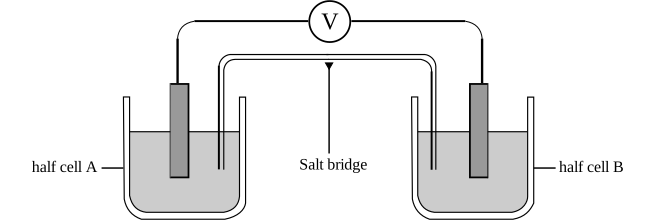
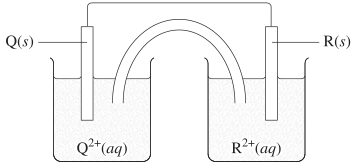
An electrochemical cell has the following structure.
 

This particular cell can be represented as:

\( \ce{Q}  |  \ce{Q^2+}  ||  \ce{R^2+}  |  \ce{R} \)

Which of the following cells would produce the highest cell potential at standard conditions?

  1. \( \ce{Mg}  |  \ce{Mg^2+}  ||  \ce{Fe^2+}  |  \ce{Fe} \)
  2. \( \ce{Al}  |  \ce{Al^3+}  ||  \ce{Cu^2+}  |  \ce{Cu} \)
  3. \( \ce{Zn}  |  \ce{Zn^2+}  ||  \ce{Pb^2+}  |  \ce{Pb} \)
  4. \( \ce{Ni}  |  \ce{Ni^2+}  ||  \ce{Ag^+}  |  \ce{Ag} \)
Show Answers Only

\(B\)

Show Worked Solution

Calculate the cell potential of each option:

A. cell potential \(= -2.36 + 0.44 = -1.92\)

B. cell potential \(= -1.68 +-0.3= -1.98\)

C. cell potential \(= -0.76 + 0.1= -0.66\)

D. cell potential \(= -0.24 +-0.8 = -1.04\)

\(\Rightarrow B\)

Filed Under: Predicting Reactions of Metals Tagged With: Band 5, smc-4264-40-Cell Potentials

Copyright © 2014–2025 SmarterEd.com.au · Log in