SmarterEd

Aussie Maths & Science Teachers: Save your time with SmarterEd

  • Login
  • Get Help
  • About

CHEMISTRY, M3 EQ-Bank 6 MC

How does increasing the surface area of a reactant, such as using a powdered solid instead of a solid block, affect the rate of a reaction?

  1. It allows more particles to be exposed to the reactant, increasing collision frequency.
  2. It decreases the energy required for successful collisions between particles.
  3. It decreases the temperature of the system, making the reaction faster.
  4. It increases the number of particles that remain unreacted at the end.
Show Answers Only

\(A\)

Show Worked Solution
  • Increasing the surface area of a reactant (e.g., using powdered solids) exposes more of the particles to the other reactants, resulting in a greater number of collisions per unit of time.
  • Since collision frequency is a key factor in the rate of reaction, having more available particles in contact increases the likelihood of successful collisions, which speeds up the reaction.

\(\Rightarrow A\)

Filed Under: Rates of Reactions Tagged With: Band 4, smc-4265-10-Collision theory, smc-4265-35-Surface area

CHEMISTRY, M3 EQ-Bank 4 MC

There could be a risk of explosion in a coal mine due to the presence of fine coal dust particles, so strict safety precautions are followed in these environments.
Which of the following statements best explains this risk?

  1. The activation energy for the reaction of fine particles is much lower than for large particles.
  2. The surface area of the coal dust particles is very large, which makes combustion reactions occur more rapidly.
  3. It is very easy to heat the fine coal dust particles to their ignition temperature.
  4. When coal is ground into fine particles, the energy profile diagram for the combustion reaction is altered.
Show Answers Only

\(B\)

Show Worked Solution
  • Fine coal dust particles have a much greater surface area compared to larger pieces of coal.
  • This increased surface area allows for more particles to be exposed to oxygen, leading to a faster and more intense combustion reaction. When ignited, the reaction can happen very quickly, which increases the risk of an explosion.
  • This is why environments with fine particles, like coal mines, must adhere to strict safety precautions to prevent such dangerous reactions.

\(\Rightarrow B\)

Filed Under: Rates of Reactions Tagged With: Band 4, smc-4265-35-Surface area

CHEMISTRY, M3 EQ-Bank 10

A student conducted a series of  investigations where 8.50 g of sodium carbonate was reacted with excess nitric acid \(\ce{(HNO3)}\) at a temperature of 25°C and 100 kPa. The volume of carbon dioxide gas produced was measured at regular intervals during each investigation. In experiment A, sodium carbonate was provided as large crystals, and in experiment B, it was supplied in powdered form.

Both reactions produced 1.988 L of \(\ce{CO2(g)}\) however experiment B finished reacting before experiment A finished reacting.

  1. Explain why experiment B had a faster rate of reaction than experiment A.   (1 mark)

--- 2 WORK AREA LINES (style=blank) ---

  1. Using the volume of \(\ce{CO2(g)}\) produced, calculate the maximum mass of carbon dioxide produced in the reaction.   (3 marks)

--- 2 WORK AREA LINES (style=blank) ---

  1. Explain why both experiments produced in the same volume of carbon dioxide.   (1 mark)

--- 2 WORK AREA LINES (style=blank) ---

Show Answers Only

a.   Experiment B faster than experiment A:

  • In experiment B, the surface area of the sodium carbonate was greater than in experiment A due to it being in a powdered form.
  • Thus, there are a greater number of collisions able to occur in experiment B, leading to a greater number of successful collisions.
  • Overall this allows the rate of reaction of experiment B to be greater than that of experiment A.

b.    \(3.52\ \text{g}\)

c.   Reasons why same volume \(\ce{CO2}\) produced:

  • Both experiments used the same amount of sodium carbonate reacting with excess hydrochloric acid.
  • The maximum amount of carbon dioxide produced is dependent on how much sodium carbonate reacted.
  • As the initial mass of sodium carbonate is the same in both reaction and both reactions went until completion, the volume of carbon dioxide will be the same despite the different rates of reaction between experiment A and B.
Show Worked Solution

a.   Experiment B faster than experiment A:

  • In experiment B, the surface area of the sodium carbonate was greater than in experiment A due to it being in a powdered form.
  • Thus, there are a greater number of collisions able to occur in experiment B, leading to a greater number of successful collisions.
  • Overall this allows the rate of reaction of experiment B to be greater than that of experiment A.

b.   The maximum volume of carbon dioxide produced is 1.988 L.

  • At SLC (standard laboratory conditions), the 1 mole of gas takes up 24.79 L.
  • \(\ce{n(CO2(g))}= \dfrac{1.988}{24.79} = 0.08\ \text{mol}\)
  • \(\ce{m(CO2(g))} = n \times MM = 0.08 \times 44.01 =3.52\ \text{g}\)

c.   Reasons why same volume \(\ce{CO2}\) produced:

  • Both experiments used the same amount of sodium carbonate reacting with excess hydrochloric acid.
  • The maximum amount of carbon dioxide produced is dependent on how much sodium carbonate reacted.
  • As the initial mass of sodium carbonate is the same in both reaction and both reactions went until completion, the volume of carbon dioxide will be the same despite the different rates of reaction between experiment A and B.

Filed Under: Rates of Reactions Tagged With: Band 3, Band 5, smc-4265-35-Surface area

CHEMISTRY, M3 EQ-Bank 9

Consider the statement:

The effectiveness of a metal catalyst is not dependent upon its surface area.

Explain if this statement correct, giving reasons for your answer.   (2 marks)

--- 5 WORK AREA LINES (style=lined) ---

Show Answers Only
  • The statement is incorrect.
  • Metal catalysts are solid and reactions occur on the catalyst surface.
  • It follows that the larger the surface, the more effective the catalyst (i.e. its “effectiveness” is dependent on the surface area).
Show Worked Solution
  • The statement is incorrect.
  • Metal catalysts are solid and reactions occur on the catalyst surface.
  • It follows that the larger the surface, the more effective the catalyst (i.e. its “effectiveness” is dependent on the surface area).

Filed Under: Rates of Reactions Tagged With: Band 4, smc-4265-35-Surface area, smc-4265-50-Catalysts

CHEMISTRY, M3 EQ-Bank 1 MC

According to Collision Theory, to increase the rate of a reaction, which of the following must occur? 

  1. A decrease in temperature
  2. An increase in the concentration of a reactant
  3. An increase in the surface area of a reactant
  4. An increase in the frequency of successful collisions
Show Answers Only

\(D\)

Show Worked Solution
  • Options A and C will increase the rate of a reaction but neither “must” occur for the rate of a reaction to increase.
  • The frequency of successful collisions defines the rate of reaction.

\(\Rightarrow D\)

Filed Under: Rates of Reactions Tagged With: Band 3, smc-4265-10-Collision theory, smc-4265-30-Temperature, smc-4265-35-Surface area, smc-4265-40-Concentration

CHEMISTRY, M3 EQ-Bank 4

Explain how using a reagent in powdered form versus a crystal form would influence the rate of a chemical reaction.   (2 marks)

--- 5 WORK AREA LINES (style=lined) ---

Show Answers Only
  • Using a reactant in powdered form increases its surface area.
  • This increases the area in which reactant particles can make contact with each other, leading to more frequent and effective particle collisions that exceed activation energy \(\ce{(E_{a})}\) which increases the reaction rate.
Show Worked Solution
  • Using a reactant in powdered form increases its surface area.
  • This increases the area in which reactant particles can make contact with each other, leading to more frequent and effective particle collisions that exceed activation energy \(\ce{(E_{a})}\) which increases the reaction rate.

Filed Under: Rates of Reactions Tagged With: Band 4, smc-4265-35-Surface area

CHEMISTRY, M3 2013 VCE 14-15 MC

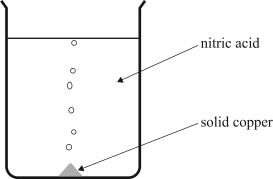
\(\ce{Cu(s) + 4HNO3(aq)\rightarrow Cu(NO3)2(aq) + 2NO2(g) + 2H2O(l)}\)
 

Question 14

Which one of the following will not increase the rate of the above reaction?

  1. decreasing the size of the solid copper particles
  2. increasing the temperature of \(\ce{HNO3}\) by 20 °C
  3. increasing the concentration of \(\ce{HNO3}\)
  4. allowing \(\ce{NO2}\) gas to escape

 
Question 15

In the above reaction, the number of successful collisions per second is a small fraction of the total number of collisions.

The major reason for this is that

  1. the nitric acid is ionised in solution.
  2. some reactant particles have too much kinetic energy.
  3. the kinetic energy of the particles is reduced when they collide with the container’s walls.
  4. not all reactant particles have the minimum kinetic energy required to initiate the reaction.
Show Answers Only

\(\text{Question 14:}\ D\)

\(\text{Question 15:}\ D\)

Show Worked Solution

Question 14

  • Options \(A, B\) and \(C\) will all increase the rate of the given chemical reaction.

\(\Rightarrow D\)
 

Question 15

  • Successful collisions occur only if the particles involved have at least the minimum kinetic energy required and the correct orientation.

\(\Rightarrow D\)

Filed Under: Rates of Reactions Tagged With: Band 3, Band 4, smc-4265-10-Collision theory, smc-4265-30-Temperature, smc-4265-35-Surface area, smc-4265-40-Concentration

Copyright © 2014–2025 SmarterEd.com.au · Log in