SmarterEd

Aussie Maths & Science Teachers: Save your time with SmarterEd

  • Login
  • Get Help
  • About

CHEMISTRY, M3 EQ-Bank 14

A student conducted an experiment to investigate how the concentration of hydrochloric acid affects the rate of its reaction with magnesium ribbon. They measured the volume of hydrogen gas produced at regular intervals in reactions using 1.0 M, 2.0 M, and 3.0 M hydrochloric acid, keeping other variables constant.

  1. Explain how the concentration of hydrochloric acid influences the rate of reaction with magnesium, using collision theory.   (2 marks)

--- 4 WORK AREA LINES (style=blank) ---

  1. Describe how the student could modify the experiment to investigate the effect of temperature on the reaction rate.   (2 marks)

--- 4 WORK AREA LINES (style=blank) ---

  1. Identify and explain one advantage of a student using digital technologies such as a gas pressure sensor to collect or analyse data from the experiment.   (2 marks)

--- 4 WORK AREA LINES (style=blank) ---
Show Answers Only

a.   \(\ce{[HCl]}\) influence on the rate of reaction:

  • As the concentration increases, the number of acid particles in a given volume also increases.
  • This leads to more frequent collisions between hydrochloric acid molecules and the magnesium surface.
  • As a result, a higher concentration of hydrochloric acid increases the chance of successful collisions, which increases the reaction rate and causes hydrogen gas to be produced more quickly.

b.   Experiment modifications:

  • To investigate the effect of temperature on the reaction rate, the student could modify the experiment by conducting the reaction at different temperatures while keeping the concentration of hydrochloric acid constant.
  • They could use a water bath or hot plate to control the temperature for each trial. For example, the student could perform the reaction at 20°C, 30°C, and 40°C, then measure and compare the volume of hydrogen gas produced over time at each temperature.

c.   Advantage of digital technologies:

  • Using a gas pressure sensor in the experiment allows for continuous and precise data collection without human intervention.
  • This reduces the chances of human error when measuring the volume of gas produced manually at intervals, leading to more accurate and reliable results.
  • Additionally, the sensor can automatically record data over time, providing detailed information about the reaction rate that can be easily analysed using digital tools such as graphing software.
Show Worked Solution

a.   \(\ce{[HCl]}\) influence on the rate of reaction:

  • As the concentration increases, the number of acid particles in a given volume also increases.
  • This leads to more frequent collisions between hydrochloric acid molecules and the magnesium surface.
  • As a result, a higher concentration of hydrochloric acid increases the chance of successful collisions, which increases the reaction rate and causes hydrogen gas to be produced more quickly.

b.   Experiment modifications:

  • To investigate the effect of temperature on the reaction rate, the student could modify the experiment by conducting the reaction at different temperatures while keeping the concentration of hydrochloric acid constant.
  • They could use a water bath or hot plate to control the temperature for each trial. For example, the student could perform the reaction at 20°C, 30°C, and 40°C, then measure and compare the volume of hydrogen gas produced over time at each temperature.

c.   Advantage of digital technologies:

  • Using a gas pressure sensor in the experiment allows for continuous and precise data collection without human intervention.
  • This reduces the chances of human error when measuring the volume of gas produced manually at intervals, leading to more accurate and reliable results.
  • Additionally, the sensor can automatically record data over time, providing detailed information about the reaction rate that can be easily analysed using digital tools such as graphing software.

Filed Under: Rates of Reactions Tagged With: Band 4, Band 5, smc-4265-10-Collision theory, smc-4265-30-Temperature, smc-4265-40-Concentration

CHEMISTRY, M3 EQ-Bank 13

A certain chemical reaction begins with a high reaction rate but over time this rate of reaction slows until the reaction is complete.

Explain this statement using collision theory.   (3 marks)

--- 4 WORK AREA LINES (style=blank) ---

Show Answers Only
  • At the start of the reaction, there is a high concentration of reactant molecules, which increases the frequency of collisions between them. According to collision theory, more frequent and effective collisions lead to a higher reaction rate.
  • As the reaction progresses, the concentration of reactants decreases, leading to fewer collisions. With fewer successful collisions occurring over time, the reaction rate slows down.
  • Eventually, when most or all of the reactants are used up, the reaction reaches completion, and the rate drops to zero.
Show Worked Solution
  • At the start of the reaction, there is a high concentration of reactant molecules, which increases the frequency of collisions between them. According to collision theory, more frequent and effective collisions lead to a higher reaction rate.
  • As the reaction progresses, the concentration of reactants decreases, leading to fewer collisions. With fewer successful collisions occurring over time, the reaction rate slows down.
  • Eventually, when most or all of the reactants are used up, the reaction reaches completion, and the rate drops to zero.

Filed Under: Rates of Reactions Tagged With: Band 5, smc-4265-10-Collision theory, smc-4265-40-Concentration

CHEMISTRY, M3 EQ-Bank 1 MC

According to Collision Theory, to increase the rate of a reaction, which of the following must occur? 

  1. A decrease in temperature
  2. An increase in the concentration of a reactant
  3. An increase in the surface area of a reactant
  4. An increase in the frequency of successful collisions
Show Answers Only

\(D\)

Show Worked Solution
  • Options A and C will increase the rate of a reaction but neither “must” occur for the rate of a reaction to increase.
  • The frequency of successful collisions defines the rate of reaction.

\(\Rightarrow D\)

Filed Under: Rates of Reactions Tagged With: Band 3, smc-4265-10-Collision theory, smc-4265-30-Temperature, smc-4265-35-Surface area, smc-4265-40-Concentration

CHEMISTRY, M3 EQ-Bank 8

Collision Theory is a principle of chemistry that can be used to predict the rates of chemical reactions.

Explain how this theory works with reference to an increase in reactant concentration and a decrease in temperature.   (4 marks)

--- 8 WORK AREA LINES (style=lined) ---

Show Answers Only
  • Collision Theory states that for a chemical reaction to occur, reactant particles must collide. A reaction will then only proceed if:
    • Particles collide with sufficient energy \((\text{E}_\text{a}) \)
    • Particles collide with the proper orientation
  • All reactions have a certain amount of particles colliding and exceeding \(\ce{E_{a}}\) which defines the reaction rate. Increasing the rate is achieved through increasing the amount of successful collisions.

Increase in reactant concentration:

  • Increases the number of reactant particles.
  • This increases the number of collisions, which leads to more successful collisions and a higher reaction rate.

Decrease in temperature

  • Decreases the kinetic energy of colliding particles.
  • As the kinetic energy of particles is decreased, they are less likely to exceed the \(\ce{E_{a}}\) required for a successful collision and a lower reaction rate results.
Show Worked Solution
  • Collision Theory states that for a chemical reaction to occur, reactant particles must collide. A reaction will then only proceed if:
    • Particles collide with sufficient energy \((\text{E}_\text{a}) \)
    • Particles collide with the proper orientation
  • All reactions have a certain amount of particles colliding and exceeding \(\ce{E_{a}}\) which defines the reaction rate. Increasing the rate is achieved through increasing the amount of successful collisions.

Increase in reactant concentration:

  • Increases the number of reactant particles.
  • This increases the number of collisions, which leads to more successful collisions and a higher reaction rate.

Decrease in temperature

  • Decreases the kinetic energy of colliding particles.
  • As the kinetic energy of particles is decreased, they are less likely to exceed the \(\ce{E_{a}}\) required for a successful collision and a lower reaction rate results.

Filed Under: Rates of Reactions Tagged With: Band 4, smc-4265-30-Temperature, smc-4265-40-Concentration

CHEMISTRY, M3 EQ-Bank 3

Explain how increasing the concentration of a reactant would influence the rate of a chemical reaction.   (2 marks)

--- 5 WORK AREA LINES (style=lined) ---

Show Answers Only
  • Increasing reactant concentration will increase the reaction rate.
  • A higher concentration of reactants allows for a greater likelihood of collisions between particles, consequently increasing the number of successful collisions that exceed activation energy \(\ce{(E_{a})}\) which increases the reaction rate.
Show Worked Solution
  • Increasing reactant concentration will increase the reaction rate.
  • A higher concentration of reactants allows for a greater likelihood of collisions between particles, consequently increasing the number of successful collisions that exceed activation energy \(\ce{(E_{a})}\) which increases the reaction rate.

Filed Under: Rates of Reactions Tagged With: Band 4, smc-4265-40-Concentration

CHEMISTRY, M3 2013 VCE 14-15 MC

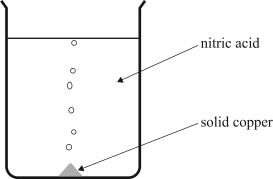
\(\ce{Cu(s) + 4HNO3(aq)\rightarrow Cu(NO3)2(aq) + 2NO2(g) + 2H2O(l)}\)
 

Question 14

Which one of the following will not increase the rate of the above reaction?

  1. decreasing the size of the solid copper particles
  2. increasing the temperature of \(\ce{HNO3}\) by 20 °C
  3. increasing the concentration of \(\ce{HNO3}\)
  4. allowing \(\ce{NO2}\) gas to escape

 
Question 15

In the above reaction, the number of successful collisions per second is a small fraction of the total number of collisions.

The major reason for this is that

  1. the nitric acid is ionised in solution.
  2. some reactant particles have too much kinetic energy.
  3. the kinetic energy of the particles is reduced when they collide with the container’s walls.
  4. not all reactant particles have the minimum kinetic energy required to initiate the reaction.
Show Answers Only

\(\text{Question 14:}\ D\)

\(\text{Question 15:}\ D\)

Show Worked Solution

Question 14

  • Options \(A, B\) and \(C\) will all increase the rate of the given chemical reaction.

\(\Rightarrow D\)
 

Question 15

  • Successful collisions occur only if the particles involved have at least the minimum kinetic energy required and the correct orientation.

\(\Rightarrow D\)

Filed Under: Rates of Reactions Tagged With: Band 3, Band 4, smc-4265-10-Collision theory, smc-4265-30-Temperature, smc-4265-35-Surface area, smc-4265-40-Concentration

Copyright © 2014–2025 SmarterEd.com.au · Log in