SmarterEd

Aussie Maths & Science Teachers: Save your time with SmarterEd

  • Login
  • Get Help
  • About

CHEMISTRY, M3 EQ-Bank 17

How does the presence of a catalyst influence the rate of a chemical reaction?   (2 marks)

--- 4 WORK AREA LINES (style=lined) ---

Show Answers Only
  • Catalysts are substances that increase the rate of a chemical reaction without being consumed in the process.
  • They work by providing an alternative reaction pathway with a lower activation energy, which is the energy required for the reaction to occur. Because of this, more reactant particles can successfully collide with enough energy to undergo the reaction at a given temperature.
  • As a result, the reaction occurs faster when a catalyst is present.

Show Worked Solution
  • Catalysts are substances that increase the rate of a chemical reaction without being consumed in the process.
  • They work by providing an alternative reaction pathway with a lower activation energy, which is the energy required for the reaction to occur. Because of this, more reactant particles can successfully collide with enough energy to undergo the reaction at a given temperature.
  • As a result, the reaction occurs faster when a catalyst is present.
Filed Under: Rates of Reactions Tagged With: Band 4, smc-4265-50-Catalysts

CHEMISTRY, M3 EQ-Bank 11

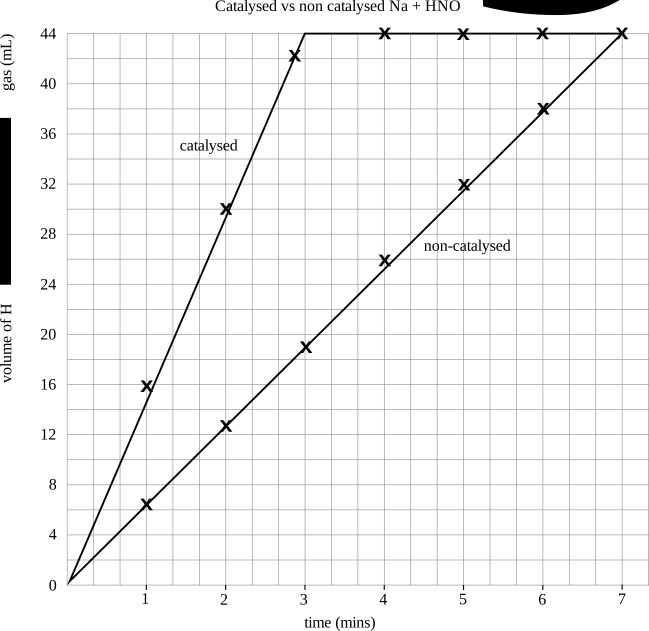
Brian measured the reaction rate of 0.5 g of sodium metal in 2.0 mol/L nitric acid. The volume of hydrogen gas produced per minute was recorded both without a catalyst and with copper as a catalyst.

\begin{array} {|c|c|c|}
\hline \text{Time (minutes)} & \text{Volume of hydrogen gas (mL)} & \text{Volume of hydrogen gas (mL)} \\ & \text{no catalyst} & \text{catalyst}  \\
\hline \text{0}  & 0 & 0  \\
\hline \text{1} & 16 & 7 \\
\hline \text{2} & 30 &  13\\
\hline \text{3} & 43 & 19 \\
\hline \text{4}  & 44 & 26 \\
\hline \text{5} & 44 &  32 \\
\hline \text{6} & 44 & 38 \\
\hline \text{7} & 44 &  44 \\
\hline \end{array}

  1. On the grid below, plot a line graph for the data in the table.   (3 marks)
     

  2. Write a conclusion for the experiment.   (2 marks)

    --- 3 WORK AREA LINES (style=blank) ---

Show Answers Only

a.    
       

b.   Experiment conclusion:

  • The rate of reaction was significantly faster when copper was used as a catalyst compared to when no catalyst was present.
  • This is because the copper catalyst provided an alternative reaction pathway with a lower activation energy, allowing the reactant particles to collide more frequently and effectively.

Show Worked Solution

a.   
     

b.   Experiment conclusion:

  • The rate of reaction was significantly faster when copper was used as a catalyst compared to when no catalyst was present.
  • This is because the copper catalyst provided an alternative reaction pathway with a lower activation energy, allowing the reactant particles to collide more frequently and effectively.

Filed Under: Rates of Reactions Tagged With: Band 3, Band 4, smc-4265-50-Catalysts

CHEMISTRY, M3 EQ-Bank 2 MC

Select the correct characteristic of a catalyst from the options below:

  1. A catalyst slows down the rate of reaction
  2. A catalyst doubles during a chemical reaction
  3. A catalyst is used up in a chemical reaction
  4. A catalyst speeds up the rate of reaction
Show Answers Only

\(D\)

Show Worked Solution
  • A catalyst speeds up the rate of a reaction by providing an alternative pathway with lower activation energy.
  • It remains chemically unchanged at the end of the reaction and is not consumed during the process.

\(\Rightarrow D\)

Filed Under: Rates of Reactions Tagged With: Band 3, smc-4265-50-Catalysts

CHEMISTRY, M3 EQ-Bank 9

Consider the statement:

The effectiveness of a metal catalyst is not dependent upon its surface area.

Explain if this statement correct, giving reasons for your answer.   (2 marks)

--- 5 WORK AREA LINES (style=lined) ---

Show Answers Only
  • The statement is incorrect.
  • Metal catalysts are solid and reactions occur on the catalyst surface.
  • It follows that the larger the surface, the more effective the catalyst (i.e. its “effectiveness” is dependent on the surface area).
Show Worked Solution
  • The statement is incorrect.
  • Metal catalysts are solid and reactions occur on the catalyst surface.
  • It follows that the larger the surface, the more effective the catalyst (i.e. its “effectiveness” is dependent on the surface area).

Filed Under: Rates of Reactions Tagged With: Band 4, smc-4265-35-Surface area, smc-4265-50-Catalysts

CHEMISTRY, M3 2013 VCE 11*

The following is a student’s summary of catalysts. It contains some correct and incorrect statements.

    1. A catalyst increases the rate of a reaction.
    2. All catalysts are solids.
    3. The mass of a catalyst is the same before and after the reaction.
    4. All catalysts align the reactant particles in an orientation that is favourable for a reaction to occur.
    5. A catalyst lowers the enthalpy change of a reaction, enabling more particles to have sufficient energy to successfully react.
  1. Identify two correct statements.   (1 mark)

    --- 1 WORK AREA LINES (style=lined) ---

  2. Evaluate the student’s summary by identifying two incorrect statements. In each case, explain why it is incorrect.   (4 marks)

    --- 8 WORK AREA LINES (style=lined) ---

Show Answers Only

a.    Statements 1 and 3 are correct.

b.    Answers could include two of the following:

Incorrect statement: All catalysts are solids

  • Catalysts can be solids, liquids, gases or within aqueous solutions.

Incorrect statement: All catalysts align the reactant particles in an orientation that is favourable for a reaction to occur.

  • Although solid catalysts orient reactant particles to favor reactions, liquid and gaseous catalysts do not arrange reactants in this manner.

Incorrect statement: A catalyst lowers the enthalpy change of a reaction, enabling more particles to have sufficient energy to successfully react.

  • A catalyst does not change the relative energy contents of reactants and products.
  • It does, however, lower the activation energy/increases the proportion of successful collisions/provides an alternative reaction pathway with the same overall \(\Delta H.\)
Show Worked Solution

a.    Statements 1 and 3 are correct.

b.    Answers could include two of the following:

Incorrect statement: All catalysts are solids

  • Catalysts can be solids, liquids, gases or within aqueous solutions.

Incorrect statement: All catalysts align the reactant particles in an orientation that is favourable for a reaction to occur.

  • Although solid catalysts orient reactant particles to favor reactions, liquid and gaseous catalysts do not arrange reactants in this manner.

Incorrect statement: A catalyst lowers the enthalpy change of a reaction, enabling more particles to have sufficient energy to successfully react.

  • A catalyst does not change the relative energy contents of reactants and products.
  • It does, however, lower the activation energy/increases the proportion of successful collisions/provides an alternative reaction pathway with the same overall \(\Delta H.\)
♦ Mean mark (b) 51%.

Filed Under: Energy Changes in Chemical Reactions, Rates of Reactions Tagged With: Band 4, Band 5, smc-4265-50-Catalysts, smc-4266-40-Role of catalysts

CHEMISTRY, M3 EQ-Bank 7

Explain the role of a catalyst in altering the rate of a reaction.   (2 marks)

--- 4 WORK AREA LINES (style=lined) ---

Show Answers Only
  • A catalyst increases the rate of a reaction by providing an alternate reaction pathway with a lower activation energy \((\text{E}_{a})\), and does not undergo any permanent chemical change in this process.
  • This means the threshold kinetic energy \((\text{E}_{a})\) for a successful collision between particles is lowered.
  • This leads to more successful collisions and an increase in reaction rate.
Show Worked Solution
  • A catalyst increases the rate of a reaction by providing an alternate reaction pathway with a lower activation energy \((\text{E}_{a})\), and does not undergo any permanent chemical change in this process.
  • This means the threshold kinetic energy \((\text{E}_{a})\) for a successful collision between particles is lowered.
  • This leads to more successful collisions and an increase in reaction rate.

Filed Under: Rates of Reactions Tagged With: Band 4, smc-4265-50-Catalysts

CHEMISTRY, M3 EQ-Bank 5

The following reaction is exothermic

\(\ce{N2(g) + 3H2(g) \rightarrow \ 2NH3(g)} \)

Lead \(\ce{(Pb)}\) can be used as a catalyst for this exothermic reaction. Describe what is meant by catalyst and how it influences this chemical reaction.   (3 marks)

--- 6 WORK AREA LINES (style=lined) ---

Show Answers Only
  • A catalyst increases the rate of a chemical reaction without undergoing any permanent chemical reaction itself.
  • The addition of \(\ce{Pb}\) in this reaction lowers the activation energy of a successful reaction.
  • More particles will exceed activation energy \(\ce{(E_{a})}\) when they collide with each other which increases the reaction rate.
Show Worked Solution
  • A catalyst increases the rate of a chemical reaction without undergoing any permanent chemical reaction itself.
  • The addition of \(\ce{Pb}\) in this reaction lowers the activation energy of a successful reaction.
  • More particles will exceed activation energy \(\ce{(E_{a})}\) when they collide with each other which increases the reaction rate.

Filed Under: Rates of Reactions Tagged With: Band 4, smc-4265-50-Catalysts

CHEMISTRY, M3 2012 HSC 3 MC

What effect does a catalyst have on a reaction?

  1. It increases the rate.
  2. It increases the yield.
  3. It increases the heat of reaction.
  4. It increases the activation energy.
Show Answers Only

\(A\)

Show Worked Solution
  • A catalyst is a substance that increases the rate of a chemical reaction without itself undergoing any permanent chemical change.

\(\Rightarrow A\)

Filed Under: Rates of Reactions Tagged With: Band 2, smc-4265-50-Catalysts

CHEMISTRY, M3 2017 VCE 1 MC

A catalyst

  1. slows the rate of reaction.
  2. ensures that a reaction is exothermic.
  3. moves the chemical equilibrium of a reaction in the forward direction.
  4. provides an alternative pathway for the reaction with a lower activation energy.
Show Answers Only

\(D\)

Show Worked Solution
  • A catalyst increases the rate of a chemical reaction by reducing the activation energy of the reaction. Thus, by collision theory, particles require less energy than normal to react to form products.

\(\Rightarrow D\)

Filed Under: Rates of Reactions Tagged With: Band 2, smc-4265-50-Catalysts

Copyright © 2014–2025 SmarterEd.com.au · Log in