SmarterEd

Aussie Maths & Science Teachers: Save your time with SmarterEd

  • Login
  • Get Help
  • About

CHEMISTRY, M4 EQ-Bank 1

Ethanol \(\ce{(C2H5OH)}\)) is a common hydrocarbon fuel used in alcohol burners. It combusts completely according to the following equation:

\(\ce{C2H5OH (l) + 3O2 (g) -> 2CO2 (g) + 3H2O (g)}\)

A student conducts an experiment to determine the heat energy released by ethanol during combustion.

They burn 0.25 g of ethanol in excess oxygen, capturing the heat released in a calorimeter containing 75.0 g of water. The water's temperature increases from 21.0 °C to 34.5 °C. Calculate the experimental molar heat of combustion \((\Delta H^{\circ}_{\text{comb}})\) for ethanol based on these results.   (3 marks)

--- 7 WORK AREA LINES (style=lined) ---
Show Answers Only

\(\Delta H^{\circ}_{\text{comb}}=-775.46\ \text{kJ/mol}\).

Show Worked Solution

Heat absorbed by the water \((q_{\text{water}})\):

\[q = m \cdot c \cdot \Delta T = 75.0\ \text{g} \cdot 4.18\ \text{J/g}^{\circ}\text{C} \cdot (34.5\ \text{°C}-21.0\ \text{°C}) = 4204.65\ \text{J} = 4.205\ \text{kJ}\]

Moles of ethanol burned:

\[\ce{MM(C2H5OH)} = 46.07\ \text{g/mol} \]

\[ \ce{n(C2H5OH)} = \frac{0.25\ \text{g}}{46.07\ \text{g/mol}} = 0.00542\ \text{mol} \]

Experimental molar heat of combustion:

\[ \Delta H^{\circ}_{\text{comb}} = \frac{4.205\ \text{kJ}}{0.00542\ \text{mol}} = -775.46\ \text{kJ/mol}\]

Filed Under: Energy Changes in Chemical Reactions Tagged With: Band 5, smc-4266-20-Heat of combustion

CHEMISTRY, M4 EQ-Bank 38v4

Methanol (\(\ce{CH3OH}\)) is a hydrocarbon fuel which combusts completely according to the following equation:

\[\ce{2CH3OH (l) + 3O2 (g) -> 2CO2 (g) + 4H2O (g)}\]

A chemist burns 0.40 g of methanol in excess oxygen during a calorimetry study, and the heat energy is used to heat 80.0 g of water. The initial temperature of the water in the calorimeter is 24.0 °C, which rises to a maximum of 52.0 °C after absorbing the energy from the combustion reaction. Based on these results, calculate the experimental molar heat of combustion (\(\Delta H^\circ_{\text{comb}}\)) for methanol.   (4 marks)

--- 7 WORK AREA LINES (style=blank) ---

Show Answers Only

The experimental molar heat of combustion (\(\Delta H^\circ_{\text{comb}}\)) for methanol is \( -770 \, \text{kJ/mol} \). (2 sig.fig.)

Show Worked Solution

Calculate the energy absorbed by the water:

\[q = mc\Delta T = (80.0 \, \text{g})(4.18 \, \text{J/g}^\circ\text{C})(52.0^\circ\text{C} – 24.0^\circ\text{C}) = 9363.2 \, \text{J}\]

Calculate the number of moles of methanol burned:

\[n = \frac{m}{M} = \frac{0.40 \, \text{g}}{32.042 \, \text{g/mol}} = 0.0125 \, \text{mol}\]

Calculate the molar heat of combustion:

\[\Delta H^\circ_{\text{comb}} = -\frac{q}{n} = -\frac{9363.2 \, \text{J}}{0.0125 \, \text{mol}} = -773056 \, \text{J/mol} = -770 \, \text{kJ/mol} \]

→ The experimental molar heat of combustion (\(\Delta H^\circ_{\text{comb}}\)) for methanol is \( -770 \, \text{kJ/mol} \). (2 sig.fig.)

Filed Under: Energy Changes in Chemical Reactions - draft Tagged With: Band 5, smc-4266-20-Heat of combustion

CHEMISTRY, M4 EQ-Bank 38v3

Propane (\(\ce{C3H8}\)) is a hydrocarbon fuel which combusts completely according to the following equation:

\[\ce{C3H8 (g) + 5O2 (g) -> 3CO2 (g) + 4H2O (g)}\]

A chemist burns 0.25 g of propane in excess oxygen during a calorimetry study, and the heat energy is used to heat 60.0 g of water. The initial temperature of the water in the calorimeter is 21.0 °C, which rises to a maximum of 42.0 °C after absorbing the energy from the combustion reaction. Based on these results, calculate the experimental molar heat of combustion (\(\Delta H^\circ_{\text{comb}}\)) for propane.   (4 marks)

--- 7 WORK AREA LINES (style=blank) ---

Show Answers Only

The experimental molar heat of combustion (\(\Delta H^\circ_{\text{comb}}\)) for propane is \( -930 \, \text{kJ/mol} \). (2 sig.fig.)

Show Worked Solution

Calculate the energy absorbed by the water:

\[q = mc\Delta T = (60.0 \, \text{g})(4.18 \, \text{J/g}^\circ\text{C})(42.0^\circ\text{C} – 21.0^\circ\text{C}) = 5266.8 \, \text{J}\]

Calculate the number of moles of propane burned:

\[n = \frac{m}{M} = \frac{0.25 \, \text{g}}{44.094 \, \text{g/mol}} = 0.00567 \, \text{mol}\]

Calculate the molar heat of combustion:

\[\Delta H^\circ_{\text{comb}} = -\frac{q}{n} = -\frac{5266.8 \, \text{J}}{0.00567 \, \text{mol}} = -928888.9 \, \text{J/mol} = -929 \, \text{kJ/mol}\]

→ The experimental molar heat of combustion (\(\Delta H^\circ_{\text{comb}}\)) for propane is \( -930 \, \text{kJ/mol} \). (2 sig.fig.)

Filed Under: Energy Changes in Chemical Reactions - draft Tagged With: Band 5, smc-4266-20-Heat of combustion

CHEMISTRY, M4 EQ-Bank 38v2

Methane (\(\ce{CH4}\)) is a hydrocarbon fuel which combusts completely according to the following equation:

\[\ce{CH4 (g) + 2O2 (g) -> CO2 (g) + 2H2O (g)}\]

A chemist burns 0.30 g of methane in excess oxygen during a calorimetry study, and the heat energy is used to heat 75.0 g of water. The initial temperature of the water in the calorimeter is 22.0 °C, which rises to a maximum of 36.5 °C after absorbing the energy from the combustion reaction. Based on these results, calculate the experimental molar heat of combustion (\(\Delta H^\circ_{\text{comb}}\)) for methane.    (4 marks)

--- 7 WORK AREA LINES (style=blank) ---

Show Answers Only

The experimental molar heat of combustion (\(\Delta H^\circ_{\text{comb}}\)) for methane is \( -240 \, \text{kJ/mol} \). (2 sig.fig)

Show Worked Solution

Calculate the energy absorbed by the water:

\[q = mc\Delta T = (75.0 \, \text{g})(4.18 \, \text{J/g}^\circ\text{C})(36.5^\circ\text{C} – 22.0^\circ\text{C}) = 4545.75 \, \text{J}\]

Calculate the number of moles of methane burned:

\[n = \frac{m}{M} = \frac{0.30 \, \text{g}}{16.042 \, \text{g/mol}} = 0.0187 \, \text{mol}\]

Calculate the molar heat of combustion:

\[\Delta H^\circ_{\text{comb}} = -\frac{q}{n} = -\frac{4545.75 \, \text{J}}{0.0187 \, \text{mol}} = -243088.24 \, \text{J/mol} = -240 \, \text{kJ/mol}\]

→ The experimental molar heat of combustion (\(\Delta H^\circ_{\text{comb}}\)) for methane is \( -240 \, \text{kJ/mol} \). (2 sig.fig)

Filed Under: Energy Changes in Chemical Reactions - draft Tagged With: Band 5, smc-4266-20-Heat of combustion

CHEMISTRY, M4 EQ-Bank 2

Ethanol \(\ce{(C2H5OH)}\) is a hydrocarbon fuel which combusts completely according to the following equation:

\[\ce{C2H5OH (l) + 3O2 (g) -> 2CO2 (g) + 3H2O (g)}\]

A chemist burns 0.50 g of ethanol in excess oxygen during a calorimetry study, and the heat energy is used to heat 100.0 g of water. The initial temperature of the water in the calorimeter is 20.0 °C, which rises to a maximum of 45.0 °C after absorbing the energy from the combustion reaction. Based on these results, calculate the experimental molar heat of combustion \((\Delta H^\circ_{\text{comb}})\) for ethanol.   (4 marks)

--- 7 WORK AREA LINES (style=blank) ---

Show Answers Only

\( -960 \, \text{kJ/mol  (2 sig.fig.)}\)

Show Worked Solution

Energy absorbed by the water:

\[q = mc\Delta T = (100.0 \, \text{g})(4.18 \, \text{J/g}^\circ\text{C})(45.0^\circ\text{C}-20.0^\circ\text{C}) = 10\,450 \, \text{J}\]

Number of moles of ethanol burned:

\[n\ce{(C2H5OH)} = \frac{m}{MM} = \frac{0.50 \, \text{g}}{46.068 \, \text{g/mol}} = 0.01085 \, \text{mol}\]

Experimental molar heat of combustion:

\[
\Delta H^\circ_{\text{comb}} = -\frac{q}{n} = -\frac{10\,450 \, \text{J}}{0.01085 \, \text{mol}} = -963\,133 \, \text{J/mol} = -960 \, \text{kJ/mol  (2 sig.fig.)}
\]

Filed Under: Energy Changes in Chemical Reactions Tagged With: Band 5, smc-4266-20-Heat of combustion

CHEMISTRY, M4 EQ-Bank 7 MC

The molar heat of combustion of pentan-1-ol \(\ce{(C5H12O)}\) is 2800 kJ mol\(^{-1}\). A quantity of pentan-1-ol was combusted, generating 108 kJ of heat.

What mass of pentan-1ol was combusted?

  1. 2.29 grams
  2. 2.86 grams
  3. 3.32 grams
  4. 3.40 grams
Show Answers Only

\(D\)

Show Worked Solution

\(\ce{MM(C5H12O = 5 \times 12.0 + 12 \times 1.008 + 16.0 = 88.096\ \text{g mol}^{-1}}\)

\(\ce{m(C5H12O\ \text{required}}\ = \dfrac{108}{2800} \times 88.096 = 3.397\ \text{g}\)

\(\Rightarrow D\)

Filed Under: Energy Changes in Chemical Reactions Tagged With: Band 4, smc-4266-20-Heat of combustion

CHEMISTRY, M4 2013 VCE 16*

\(\ce{C(s) + O2(g)\rightarrow CO2(g)}\) \(\quad \quad \Delta H = -393.5 \text{ kJ mol}^{-1}\)
\(\ce{2H(g) + O2(g)\rightarrow 2H2O(l)}\) \(\quad \quad \Delta H = -571.6 \text{ kJ mol}^{-1}\)

Given the information above, what is the enthalpy change for the following reaction?   (2 marks)

\(\ce{C(s) + 2H2O(l)\rightarrow CO2(g) + 2H2(g)}\)

--- 4 WORK AREA LINES (style=lined) ---

Show Answers Only

\(\Delta H = 178.1\ \text{kJ mol}^{-1}\)

Show Worked Solution

1st reaction is unchanged:

\(\ce{C(s) + O2(g)\rightarrow CO2(g)}\quad \Delta H = -393.5 \text{ kJ mol}^{-1}\)
 

Reverse 2nd reaction:

\(\ce{2H2O(l) \rightarrow 2H(g) + O2(g) }\quad \Delta H = +571.6 \text{ kJ mol}^{-1}\)
 

Combine both reactions:

\(\ce{C(s) + 2H2O(l)\rightarrow CO2(g) + 2H2(g)}\)

\(\Delta H = -393.5+571.6 = 178.1\ \text{kJ mol}^{-1}\)

Filed Under: Energy Changes in Chemical Reactions Tagged With: Band 3, smc-4266-20-Heat of combustion

CHEMISTRY, M4 2013 VCE 23*

Determine the enthalpy change when 40 g of \(\ce{NaOH}\) is dissolved in one litre of water, given the temperature of the solution is measure to have increased by 10.6 °C. Give your answer to the nearest kilojoule.   (2 marks)

--- 4 WORK AREA LINES (style=lined) ---

Show Answers Only

\(\Delta H = -44\ \text{kJ}\)

Show Worked Solution

\(\ce{m(1 litre H2O) = 1000\ \text{g}}\)

\(\Delta T = +10.6^{\circ}\text{C}\)

\(\text{Energy absorbed (water)}\) \(=4.18 \times 1000 \times 10.6\)  
  \(=4.43 \times 10^4\ \text{J}\)  
  \(=44\ \text{kJ (nearest kJ)}\)  

 
\(\therefore \Delta H = -44\ \text{kJ}\)

Filed Under: Energy Changes in Chemical Reactions Tagged With: Band 4, smc-4266-20-Heat of combustion

CHEMISTRY, M4 2016 VCE 10a*

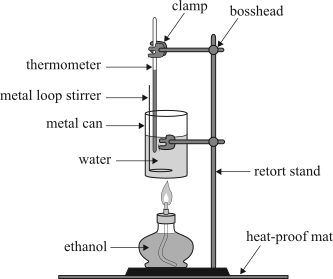
A senior Chemistry student created an experiment to calculate the molar heat of combustion of butane.

The experimental steps are as follows:

    1. Measure the initial mass of a butane canister
    2. Measure the mass of a metal can, add 250 mL of water and re-weigh.
    3. Set up the apparatus as in the diagram and measure the initial temperature of the water.
    4. Burn the butane gas for five minutes.
    5. Immediately measure the final temperature of the water.
    6. Measure the final mass of the butane canister when cool.
       

Results 

Quantity Measurement
mass of empty can 52.14 g
mass of can + water before combustion 303.37 g
mass of butane canister before heating 260.15 g
mass of butane canister after heating 259.79 g
initial temperature of water 22.1 °C
final temperature of water 32.7 °C


The balanced thermochemical equation for the complete combustion of butane is

\(\ce{2C4H10(g) + 13O2(g) \rightarrow 8CO2(g) + 10H2O(l)},\ \ \Delta H=-5748\ \text{kJ mol}^{-1}\)

  1. Calculate the amount of heat energy absorbed by the water when it was heated by burning the butane. Give your answer in kilojoules.   (2 marks)

    --- 4 WORK AREA LINES (style=lined) ---

  2. Calculate the experimental value of the molar heat of combustion of butane. Give your answer in kJ mol\(^{–1}\).   (2 marks)

    --- 4 WORK AREA LINES (style=lined) ---

  3. Use the known enthalpy change for butane to calculate the percentage energy loss to the environment.   (2 marks) 
  4. --- 3 WORK AREA LINES (style=lined) ---

Show Answers Only

i.    \(11.13\ \text{kJ}\)

ii.   \(-1.8 \times 10^{3}\ \text{kJ mol}^{-1} \)

iii.   \(37.4\% \)

Show Worked Solution

i.    \(\ce{m(water) = 303.37-52.14=251.23\ \text{g}}\)

\(\Delta T = 32.7-22.1=10.6^{\circ}\text{C}\)

\(\text{Energy absorbed}\) \(=4.18 \times 251.23 \times 10.6\)  
  \(=1.113 \times 10^{4}\ \text{J}\)  
  \(=11.13\ \text{kJ}\)  


ii.   \(\ce{m(C4H10 reacted) = 260.15-259.79=0.36\ \text{g}}\)

\(\ce{n(C4H10 reacted) = \dfrac{0.36}{\text{MM}} = \dfrac{0.36}{58.0} = 0.0062\ \text{mol}}\)

\(\text{Energy released (per mol}\ \ce{C4H10}\text{)} = \dfrac{11.13}{0.0062}=1.8 \times 10^{3}\ \text{mol}\)

\(\text{Experimental molar heat of combustion} = -1.8 \times 10^{3}\ \text{kJ mol}^{-1} \)
 

♦ Mean mark (ii) 42%.

iii.   \(\text{2 moles}\ \ce{C4H10},\ \Delta H = -5748\ \ \Rightarrow\ \ \text{1 mole}\ \ce{C4H10}, \Delta H = -2874\) 

\(\text{% Energy loss}\ = \dfrac{(2874-1.8 \times 10^{3})}{2874} \times 100 = 37.4\% \)

Filed Under: Energy Changes in Chemical Reactions Tagged With: Band 4, Band 5, smc-4266-20-Heat of combustion

CHEMISTRY, M4 2014 VCE 3a*

The combustion of ethanol is represented by the following equation.

\(\ce{C2H5OH(l) + 3O2(g)\rightarrow 2CO2(g) + 3H2O(l)}\ \ \ \ \ \ \Delta H=-1364\ \text{kJ mol}^{-1}\)

A spirit burner used 1.80 g of ethanol to raise the temperature of 100.0 g of water in a metal can from 25.0 °C to 40.0 °C.
 

Calculate the percentage of heat lost to the environment and to the apparatus.   (5 marks)

--- 8 WORK AREA LINES (style=lined) ---

Show Answers Only

\(\text{% heat lost}\ = 88.3\% \)

Show Worked Solution

\(\ce{n(CH3CH2OH) = \dfrac{1.80}{46.0} = 0.0391\ \text{mol}}\)

\(\Delta H \ce{(CH3CH2OH) =-1364\ \text{kJ mol}^{-1}}\)

\(\text{Energy released}\ = 0.0391\ \text{mol}\ \times 1364\ \text{kJ mol}^{-1} = 53.4\ \text{kJ}\)

\(\text{Energy absorbed by water}\ = 4.18 \times 100 \times 15.0 = 6.27\ \text{kJ}\)

\(\text{Energy not absorbed by water}\ = 53.4-6.27 = 47.13\ \text{kJ}\)

\(\text{% heat lost}\ = \dfrac{47.13}{53.4} \times 100 = 88.3\% \)

Filed Under: Energy Changes in Chemical Reactions Tagged With: Band 5, smc-4266-20-Heat of combustion

CHEMISTRY, M4 2022 VCE 15 MC

The molar heat of combustion of glucose, \(\ce{C6H12O6}\), in the cellular respiration equation is 2805 kJ mol\(^{-1}\) at standard laboratory conditions (SLC). The equation for cellular respiration is below.

\(\ce{C6H12O6(aq) + 6O2(g) \rightarrow 6CO2(g) + 6H2O(l)}\)

Which one of the following statements about cellular respiration is correct?

  1. Cellular respiration is an endothermic reaction.
  2. The products of cellular respiration are water and carbon monoxide.
  3. Cellular respiration is a redox reaction because \(\ce{C6H12O6}\) accepts electrons from oxygen.
  4. When one mole of oxygen is consumed in the reaction, 467.5 kJ of energy is released.
Show Answers Only

\(D\)

Show Worked Solution
  • Chemical equation for respiration:
  •    \(\ce{C6H12O6(aq) + 6O2(g) \rightarrow 6CO2(g) + 6H2O(l)}\)
  •    \(\Delta H = -2805\ \text{kJ mol}^{-1}\)
  • Exothermic redox reaction where \(\ce{C6H12O6}\) is oxidised (loses electrons).
  • 6 mol of \(\ce{O2}\) is required to produce 2805 kJ of energy.
  • 1 mol \(\ce{O2}\) = 2805 ÷ 6 = 467.5 kJ of energy.

\(\Rightarrow D\)

♦ Mean mark 47%.

Filed Under: Energy Changes in Chemical Reactions Tagged With: Band 5, smc-4266-20-Heat of combustion

CHEMISTRY, M4 2020 VCE 27 MC

The heat of combustion of ethanoic acid, \(\ce{C2H4O2}\), is –876 kJ mol\(^{-1}\) and the heat of combustion of methyl methanoate, \(\ce{C2H4O2}\), is –973 kJ mol\(^{-1}\). The auto-ignition temperature (the temperature at which a substance will combust in air without a source of ignition) of ethanoic acid is 485°C and the auto-ignition temperature of methyl methanoate is 449°C.

Which one of the following pairs is correct?
 

  \(\text{Compound with the lower}\)
\(\text{chemical energy per mole}\)
\(\text{Compound with the lower activation}\)
\(\text{energy of combustion per mole}\)
A.   \(\text{ethanoic acid}\) \(\text{methyl methanoate}\)
B. \(\text{ethanoic acid}\) \(\text{ethanoic acid}\)
C. \(\text{methyl methanoate}\) \(\text{methyl methanoate}\)
D. \(\text{methyl methanoate}\) \(\text{ethanoic acid}\)
Show Answers Only

\(A\)

Show Worked Solution
  • Ethanoic acid converts less chemical energy to heat energy per mole (–876 kJ vs –973 kJ) indicating a lower chemical energy per mole.
  • Methyl methanoate’s lower autoignition temperature (449°C vs 485°C) indicates that a lower activation energy for combustion is needed.

\(\Rightarrow A\)

♦ Mean mark 53%.

Filed Under: Energy Changes in Chemical Reactions Tagged With: Band 5, smc-4266-20-Heat of combustion

CHEMISTRY, M4 2020 VCE 22 MC

The combustion of which fuel provides the most energy per 100 g?

  1. pentane (\(\ce{MM}\) = 72 g mol\(^{-1}\)), which releases 49 097 MJ tonne\(^{-1}\)
  2. nitromethane (\(\ce{MM}\) = 61 g mol\(^{-1}\)), which releases 11.63 kJ g\(^{-1}\)
  3. butanol (\(\ce{MM}\) = 74 g mol\(^{-1}\)), which releases 2670 kJ mol\(^{-1}\)
  4. ethyne (\(\ce{MM}\) = 26 g mol\(^{-1}\)), which releases 1300 kJ mol\(^{-1}\)
Show Answers Only

\(D\)

Show Worked Solution

\(\text{Convert all options to kJ per 100 grams}\)

\(\text{A: Energy}\ = 100\ \text{g} \times 49\ 097 \times\ 10^{-6}\ \text{MJ g}^{-1} = 4.91\ \text{MJ}\ =4.91\ \times 10^{3}\ \text{kJ} \)

\(\text{B: Energy}\ = 100\ \text{g} \times 11.63\ \text{kJ g}^{-1} =1.16\ \times 10^{3}\ \text{kJ} \)

\(\text{C: Energy}\ = \dfrac{100}{74}\ \text{mol} \times 2670\ \text{kJ mol}^{-1} =3.73\ \times 10^{3}\ \text{kJ} \)

\(\text{D: Energy}\ = \dfrac{100}{26}\ \text{mol} \times 1300\ \text{kJ mol}^{-1} =5.0\ \times 10^{3}\ \text{kJ} \)

\(\Rightarrow D\)

♦ Mean mark 46%.

Filed Under: Energy Changes in Chemical Reactions Tagged With: Band 5, smc-4266-20-Heat of combustion

CHEMISTRY, M4 EQ-Bank 25

In an experiment, 1.40 g of pure sucrose, \(\ce{C12H22O11}\), underwent complete combustion, heating 350 mL of water from 19.6 °C to 35.8 °C.

\(\ce{MM(C12H22O11)}\) = 342 g mol\(^{−1}\)

Assuming there was no heat lost to the surroundings, calculate the experimental heat of combustion of pure sucrose, in joules per gram.   (2 marks)

--- 4 WORK AREA LINES (style=lined) ---

Show Answers Only

\(1.65 \times 10^{4}\ \text{J g}^{-1} \)

Show Worked Solution

\(\text{Energy absorbed} \ce{(H2O)}\ = mC \Delta T = 0.350 \times 4.18 \times 10^{3} \times (35.8-19.6) = 23\ 070.6\ \text{J} \)

\(\text{Energy (sucrose)}\ = \dfrac{23\ 070.6}{1.40} = 1.65 \times 10^{4}\ \text{J g}^{-1} \)

Filed Under: Energy Changes in Chemical Reactions Tagged With: Band 4, smc-4266-20-Heat of combustion, smc-4266-50-Calorimetry

CHEMISTRY, M4 2018 VCE 25 MC

The molar heat of combustion of pentan-1-ol, \(\ce{C5H11OH}\), is 3329 kJ mol\(^{–1}\).

\(\ce{MM(C5H11OH)}\) = 88.0 g mol\(^{–1}\)

The mass of \(\ce{C5H11OH}\), in tonnes, required to produce 10800 MJ of energy is closest to

  1. 0.0286
  2. 0.286
  3. 2.86
  4. 286
Show Answers Only

\(B\)

Show Worked Solution

\(10\ 800\ \text{MJ} = 10\ 800 \times 10^{3}\ \text{kJ}\)

\(\ce{n(C5H11OH) = \dfrac{10\ 800 \times 10^{3}}{3329} = 3.244 \times 10^{3}\ \text{mol}}\)

\(\ce{m(C5H11OH)}\)

\(= 3.244 \times 10^{3} \times 88.0 \)

 
  \(= 2.85 \times 10^{5}\ \text{g} \)  
  \(= 2.85 \times 10^{2}\ \text{kg}\)  
  \(= 0.285\ \text{tonnes}\)  

 
\(\Rightarrow B\)

Filed Under: Energy Changes in Chemical Reactions Tagged With: Band 4, smc-4266-20-Heat of combustion

CHEMISTRY, M4 2005 HSC 17

  1. The heat of combustion of ethanol is 1367 kJ mol\(^{-1}\). In a first-hand investigation to determine the heat of combustion of ethanol, the experimental value differed from the theoretical value.
  2. Identify a reason for this difference.   (1 mark)

    --- 2 WORK AREA LINES (style=lined) ---

  3. Calculate the theoretical mass of ethanol \(\ce{(C2H6O)}\) required to heat 200 mL of water from 21.0°C to 45.0°C.   (2 marks)

    --- 6 WORK AREA LINES (style=lined) ---

Show Answers Only

a.    Answers could include one of the following:

  • Heat loss into the surroundings from combustion process.
  • Specific examples of heat loss such as inefficient heating of water caused by proximity of the heat or not using a beaker lid.

b.    \(0.68\ \text{g} \)

Show Worked Solution

a.    Answers could include one of the following:

  • Heat loss into the surroundings from combustion process.
  • Specific examples of heat loss such as inefficient heating of water caused by proximity of the heat or not using a beaker lid.

b.    \(\Delta H = mC \Delta T = 0.200 \times 4.18 \times 10^{3} \times (45-21) = 20\ 064\ \text{J}\)

\(\ce{n(C2H6O)_{\text{req}} = \dfrac{20.064}{1367} = 0.014677\ \text{mol}} \)

\(\ce{MM(C2H6O) = 2 \times 12.01 + 6 \times 1.008 + 16 = 46.068\ \text{g mol}^{-1}} \)

\(\ce{m(C2H6O)_{\text{req}} = n \times MM = 0.014677 \times 46.068 = 0.68\ \text{g}} \)

Filed Under: Energy Changes in Chemical Reactions Tagged With: Band 3, Band 4, smc-4266-20-Heat of combustion

CHEMISTRY, M4 EQ-Bank 30

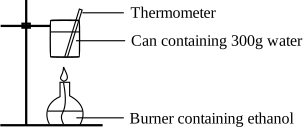
A student used the apparatus shown to determine the molar heat of combustion of ethanol.
 

The following results were obtained.

\begin{array} {|l|c|}
\hline
\rule{0pt}{2.5ex}\text{Initial mass of burner}\rule[-1ex]{0pt}{0pt} & \text{133.20 g} \\
\hline
\rule{0pt}{2.5ex}\text{Final mass of burner}\rule[-1ex]{0pt}{0pt} & \text{132.05 g}\\
\hline
\rule{0pt}{2.5ex}\text{Initial temperature of water}\rule[-1ex]{0pt}{0pt} & \text{25.0°C}\\
\hline
\rule{0pt}{2.5ex}\text{Final temperature of water}\rule[-1ex]{0pt}{0pt} & \text{45.5°C}\\
\hline
\end{array}

Calculate ethanol's molar heat of combustion from this data?   (3 marks)

Show Answers Only

\(1030\ \text{kJ mol}^{-1} \)

Show Worked Solution

\(\ce{Ethanol \ \Rightarrow \ C2H6O }\)

\(\ce{m(C2H6O) = 133.20-132.05=1.15\ \text{grams}}\)

\(\ce{MM(C2H6O) = 2 \times 12.01 + 6 \times 1.008 + 16 = 46.068\ \text{g mol}^{-1}} \)

\(\ce{n(C2H6O) = \dfrac{\text{m}}{\text{MM}} = \dfrac{1.15}{46.068} = 0.02496\ \text{mol}}\)

\(\Delta H = mC\Delta T = 0.300 \times 4.18 \times 10^{3} \times (45.5-25) = 25\ 707\ \text{J} = 25.707\ \text{kJ} \)

\(\ce{C2H6O \text{molar heat of combustion}}\)

\(=\dfrac{25.707}{0.02496}\)

\(=1030\ \text{kJ mol}^{-1} \)

Filed Under: Energy Changes in Chemical Reactions Tagged With: Band 4, smc-4266-20-Heat of combustion, smc-4266-50-Calorimetry

CHEMISTRY, M4 EQ-Bank 24

The table shows four fuels and their various properties.
 

\(\textit{Property}\) \(\textit{Petrol}\)  \(\textit{Kerosene}\) \(\textit{Hydrogen}\) \(\textit{Ethanol}\)
\(\text{Heat of combustion (kJ mol} ^{-1}) \) \(5460\) \(10\ 000\) \(285\) \(1370\)
\(\text{Boiling Point (°C)}\) \(126\) \(300\) \(-253\) \(78\)
\(\text{Density (g  mL}^{-1}) \) \(0.69\) \(0.78\) \(\text{n/a}\) \(0.78\)
\(\text{Average molar mass (g mol}^{-1}) \) \(114\) \(210\) \(2\) \(46\)

 
Showing your calculations, which fuel provides the greatest amount of energy per gram?  (2 marks)

Show Answers Only

Calculating each option:

\(\text{Energy (petrol)} = \dfrac{5460}{114} = 47.9\ \text{kJ/g} \)

\(\text{Energy (kerosene)} = \dfrac{10\ 000}{210} = 47.6\ \text{kJ/g} \)

\(\text{Energy (hydrogen)} = \dfrac{285}{2} = 142.5\ \text{kJ/g} \)

\(\text{Energy (ethanol)} = \dfrac{1370}{46} = 29.8\ \text{kJ/g} \)

\(\therefore\) Hydrogen provides the greatest energy per gram.

Show Worked Solution

Calculating each option:

\(\text{Energy (petrol)} = \dfrac{5460}{114} = 47.9\ \text{kJ/g} \)

\(\text{Energy (kerosene)} = \dfrac{10\ 000}{210} = 47.6\ \text{kJ/g} \)

\(\text{Energy (hydrogen)} = \dfrac{285}{2} = 142.5\ \text{kJ/g} \)

\(\text{Energy (ethanol)} = \dfrac{1370}{46} = 29.8\ \text{kJ/g} \)

\(\therefore\) Hydrogen provides the greatest energy per gram.

Filed Under: Energy Changes in Chemical Reactions Tagged With: Band 4, smc-4266-20-Heat of combustion

CHEMISTRY, M4 EQ-Bank 22

The molar heat of combustion of pentan-1-ol is 2800 kJ mol−1. A quantity of pentan-1-ol was combusted, generating 108 kJ of heat. \(MM=88.146\ \text{gmol}^{-1}\)

What mass of pentan-1-ol was combusted?   (2 marks)

Show Answers Only

3.40 grams

Show Worked Solution

\(\ce{Pentan-1-ol\ \Rightarrow C5H12O}\)

\(\ce{MM(C5H12O) = 12.01 \times 5 + 1.008 \times 12 + 16.00 = 88.146\ \text{g mol}^{-1}}\)

\(\ce{Moles combusted = \dfrac{108}{2800} = 0.03857\ \text{mol}}\)

\(\ce{m(C5H12O) = 0.03857 \times 88.146 = 3.40\ \text{g}}\)


Filed Under: Energy Changes in Chemical Reactions Tagged With: Band 4, smc-4266-20-Heat of combustion

CHEMISTRY, M4 2013 HSC 11 MC

The table shows the heat of combustion for four compounds.
 

\(\textit{Compound}\) \(\textit{Heat of combustion}\)
\( (\text{kJ mol}^{-1} )\) 
\(\ce{CO}\)  \(233\)
 \(\ce{CH4}\)  \(890\)
 \(\ce{C2H2}\)  \(1300\)
 \(\ce{C2H6}\)  \(1560\)

Which of these compounds would produce the greatest amount of energy if 1.00 g of each is burnt?

  1. \(\ce{CO}\)
  2. \(\ce{CH4}\)
  3. \(\ce{C2H2}\)
  4. \(\ce{C2H6}\)
Show Answers Only

\(B\)

Show Worked Solution
  • The smallest molecular mass it will result in the highest number of moles.
  • The highest number of moles gives the greatest amount of energy.
  • By comparing the molecular mass of each compound, the smallest is methane (\(\ce{CH4})\).

\(\Rightarrow B\)

Filed Under: Energy Changes in Chemical Reactions Tagged With: Band 4, smc-4266-20-Heat of combustion

CHEMISTRY, M4 2015 HSC 20 MC

The table shows the heat of combustion of four straight chain alkanols.

\begin{array} {|c|c|}
\hline \text{Number of C atoms in} & \text{Heat of combustion} \\ \text{straight chain alkanol} & \text{(kJ mol}^{-1})  \\
\hline 1  &  726 \\
\hline 3 & 2021  \\
\hline 5 &  3331 \\
\hline 7 & 4638  \\
\hline \end{array}

What is the mass of water that could be heated from 20°C to 45°C by the complete combustion of 1.0 g of heptan-1-ol \(\ce{(C7H16O)}\)? 

  1. 0.032 kg
  2. 0.044 kg
  3. 0.36 kg
  4. 0.38 kg
Show Answers Only

\(D\)

Show Worked Solution

Heptan-1-ol has seven \(\ce{C}\) atoms.

\(\ce{n(heptan-1-ol) = \dfrac{\text{m}}{\text{MM}} = \dfrac{1}{116.88} = 0.00856\ \text{mol}}\)

\(\ce{\Delta $H$ = 4638 \times 0.00856 = 39.7\ \text{kJ}}\)

♦ Mean mark 51%.
\(\ce{\Delta $H$}\) \(=mC \Delta H\)  
\(39.7 \times 10^3\) \(=m \times 4.18 \times 10^3(45-20) \)  
\(m\) \(=\dfrac{39.7 \times 10^3}{25 \times 4.18 \times 10^3}\)  
  \(=0.380\ \text{kg}\)  

 
\(\Rightarrow D\)

Filed Under: Energy Changes in Chemical Reactions Tagged With: Band 5, smc-4266-20-Heat of combustion

CHEMISTRY, M4 EQ-Bank 21

The heat of combustion of propan-1-ol is 2021 kJ mol−1. Combustion takes place according to the equation:

\(\ce{2C3H7OH(l) + 9O2(g) \rightarrow 6CO2(g) + 8H2O(l)}\)

What mass of water is formed when 1530 kJ of energy is released?   (2 marks)

--- 5 WORK AREA LINES (style=lined) ---

Show Answers Only

\(54.55\ \text{g}\)

Show Worked Solution
  • The stoichiometric ratio between propanol and water = 1 : 4
  • Moles of propane required if 1530 kJ of energy released:

\(\ce{n(C3H7OH) = \dfrac{1530}{2021} = 0.757\ \text{mol}}\)

\(\ce{n(H2O) = 4 \times 0.757 = 3.028\ \text{mol}}\)

\(\ce{MM(H2O) = 2 \times 1.008 + 16 = 18.016\ \text{g mol}^{-1}}\)

\(\ce{m(H2O) = 3.028 \times 18.016 = 54.55\ \text{g (2 d.p.)}}\)

Filed Under: Energy Changes in Chemical Reactions Tagged With: Band 4, smc-4266-20-Heat of combustion

CHEMISTRY, M4 2012 HSC 17 MC

The heat of combustion of propan-1-ol is 2021 kJ mol\(^{-1}\). Combustion takes place according to the equation:

\( \ce{2C3H7OH}(l)+ \ce{9O2}(g) \rightarrow \ce{6CO2}(g) + \ce{8H2O}(l)\)

What mass of water is formed when 1530 kJ of energy is released?

  1. 3.4 g
  2. 14 g
  3. 55 g
  4. 144 g
Show Answers Only

\(C\)

Show Worked Solution

\(\ce{n(C3H7OH)}=\dfrac{1530}{2021}=0.757\ \text{mol}\)

\(\ce{n(H2O)}=0.757 \times 4=3.03\ \text{mol}\)

\(\ce{m(H2O)}=3.03 \times 18.016=55\ \text{g}\)

\(\Rightarrow C\)

Filed Under: Energy Changes in Chemical Reactions Tagged With: Band 4, smc-4266-20-Heat of combustion

CHEMISTRY, M4 2009 HSC 20

  1. Calculate the mass of ethanol \(\ce{C2H6O}\) that must be burnt to increase the temperature of 210 g of water by 65°C, if exactly half of the heat released by this combustion is lost to the surroundings.
  2. The heat of combustion of ethanol is 1367 kJ mol −1.  (3 marks)

    --- 12 WORK AREA LINES (style=lined) ---

  3. What are TWO ways to limit heat loss from the apparatus when performing a first-hand investigation to determine and compare heat of combustion of different liquid alkanols?  (1 mark)

    --- 2 WORK AREA LINES (style=lined) ---

Show Answers Only

a.    3.85 grams

b.    Answers could include two of the following:

  • Use of an insulated vessel (Styrofoam cup)
  • Place the vessel as close as safely possible to the Bunsen’s flame.
  • Use a lid for the beaker
Show Worked Solution

a.    \(q=mC \Delta T = 210 \times 4.18 \times 65 = 57\ 057\ \text{J} = 57.057\ \text{kJ}\)

\(\ce{n(C2H5OH) = \dfrac{57.057}{1367} = 0.04174\ \text{mol}}\)

\(\ce{m(C2H5OH) = n \times MM = 0.04174 \times 46.068 = 1.923\ \text{g}}\)

Since half of the heat is lost to environmental surroundings.

\(\ce{m(C2H5OH)_{\text{init}} = 2 \times 1.923= 3.85\ \text{g}}\)
 

b.    Answers could include two of the following:

  • Use of an insulated vessel (Styrofoam cup)
  • Place the vessel as close as safely possible to the Bunsen’s flame.
  • Use a lid for the beaker

Filed Under: Energy Changes in Chemical Reactions Tagged With: Band 3, Band 4, smc-4266-20-Heat of combustion

CHEMISTRY, M4 2013 HSC 27

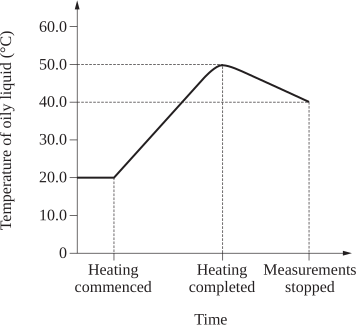
A 0.259 g sample of ethanol is burnt to raise the temperature of 120 g of an oily liquid, as shown in the graph. There is no loss of heat to the surroundings.
 

Using the information shown on the graph, calculate the specific heat capacity of the oily liquid. The heat of combustion of ethanol is 1367 kJ mol–1.   (4 marks)

--- 14 WORK AREA LINES (style=lined) ---

Show Answers Only

\(2.13 \times 10^{3}\ \text{J kg}^{-1}\text{K}^{-1}\)

Show Worked Solution

\(\ce{MM(C2H5OH) = 2 \times 12.01 + 6 \times 1.008 + 16 = 46.068}\)

\(\ce{n(C2H5OH) = \dfrac{\text{m}}{\text{MM}} = \dfrac{0.259}{46.068} = 5.622 \times 10^{-3}\ \text{mol}}\)

\(\text{Heat combustion}(q)\ = 1367 \times 5.622 \times 10^{-3} = 7.685\ \text{kJ} = 7685\ \text{J}\)

Mean mark 59%.
\(q\) \(=mc \Delta T\)  
\(c\) \(=\dfrac{q}{m \Delta T}\)  
  \(=\dfrac{7685}{0.120 \times (50-20)} \)  
  \(=2.13 \times 10^{3}\ \text{J kg}^{-1}\text{K}^{-1} \)  

Filed Under: Energy Changes in Chemical Reactions Tagged With: Band 4, smc-4266-20-Heat of combustion

Copyright © 2014–2025 SmarterEd.com.au · Log in