SmarterEd

Aussie Maths & Science Teachers: Save your time with SmarterEd

  • Login
  • Get Help
  • About

CHEMISTRY, M4 EQ-Bank 12

The energy profile diagram below shows the energy changes that occur during a specific chemical reaction in the absence of a catalyst.


  1. Draw the energy profile for this reaction with a catalyst on the diagram above.   (1 mark)

    --- 0 WORK AREA LINES (style=lined) ---

  2. Describe the impact of a catalyst on this reaction, using the diagram as a reference.   (2 marks)

--- 4 WORK AREA LINES (style=blank) ---

Show Answers Only

a.    
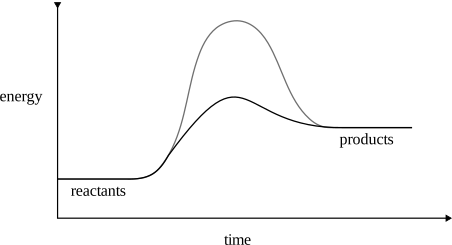
     

b.   Catalyst impact:

  • A catalyst offers an alternative pathway for the reaction to occur that requires less activation energy.
  • On the energy profile diagram, this would appear as a lower peak, indicating the reduction in the energy needed for the reaction to proceed.
Show Worked Solution

a.   


b.   Catalyst impact:

  • A catalyst offers an alternative pathway for the reaction to occur that requires less activation energy.
  • On the energy profile diagram, this would appear as a lower peak, indicating the reduction in the energy needed for the reaction to proceed.

Filed Under: Energy Changes in Chemical Reactions Tagged With: Band 4, smc-4266-30-Energy profiles, smc-4266-40-Role of catalysts

CHEMISTRY, M3 2013 VCE 11*

The following is a student’s summary of catalysts. It contains some correct and incorrect statements.

    1. A catalyst increases the rate of a reaction.
    2. All catalysts are solids.
    3. The mass of a catalyst is the same before and after the reaction.
    4. All catalysts align the reactant particles in an orientation that is favourable for a reaction to occur.
    5. A catalyst lowers the enthalpy change of a reaction, enabling more particles to have sufficient energy to successfully react.
  1. Identify two correct statements.   (1 mark)

    --- 1 WORK AREA LINES (style=lined) ---

  2. Evaluate the student’s summary by identifying two incorrect statements. In each case, explain why it is incorrect.   (4 marks)

    --- 8 WORK AREA LINES (style=lined) ---

Show Answers Only

a.    Statements 1 and 3 are correct.

b.    Answers could include two of the following:

Incorrect statement: All catalysts are solids

  • Catalysts can be solids, liquids, gases or within aqueous solutions.

Incorrect statement: All catalysts align the reactant particles in an orientation that is favourable for a reaction to occur.

  • Although solid catalysts orient reactant particles to favor reactions, liquid and gaseous catalysts do not arrange reactants in this manner.

Incorrect statement: A catalyst lowers the enthalpy change of a reaction, enabling more particles to have sufficient energy to successfully react.

  • A catalyst does not change the relative energy contents of reactants and products.
  • It does, however, lower the activation energy/increases the proportion of successful collisions/provides an alternative reaction pathway with the same overall \(\Delta H.\)
Show Worked Solution

a.    Statements 1 and 3 are correct.

b.    Answers could include two of the following:

Incorrect statement: All catalysts are solids

  • Catalysts can be solids, liquids, gases or within aqueous solutions.

Incorrect statement: All catalysts align the reactant particles in an orientation that is favourable for a reaction to occur.

  • Although solid catalysts orient reactant particles to favor reactions, liquid and gaseous catalysts do not arrange reactants in this manner.

Incorrect statement: A catalyst lowers the enthalpy change of a reaction, enabling more particles to have sufficient energy to successfully react.

  • A catalyst does not change the relative energy contents of reactants and products.
  • It does, however, lower the activation energy/increases the proportion of successful collisions/provides an alternative reaction pathway with the same overall \(\Delta H.\)
♦ Mean mark (b) 51%.

Filed Under: Energy Changes in Chemical Reactions, Rates of Reactions Tagged With: Band 4, Band 5, smc-4265-50-Catalysts, smc-4266-40-Role of catalysts

CHEMISTRY, M4 2021 VCE 24 MC

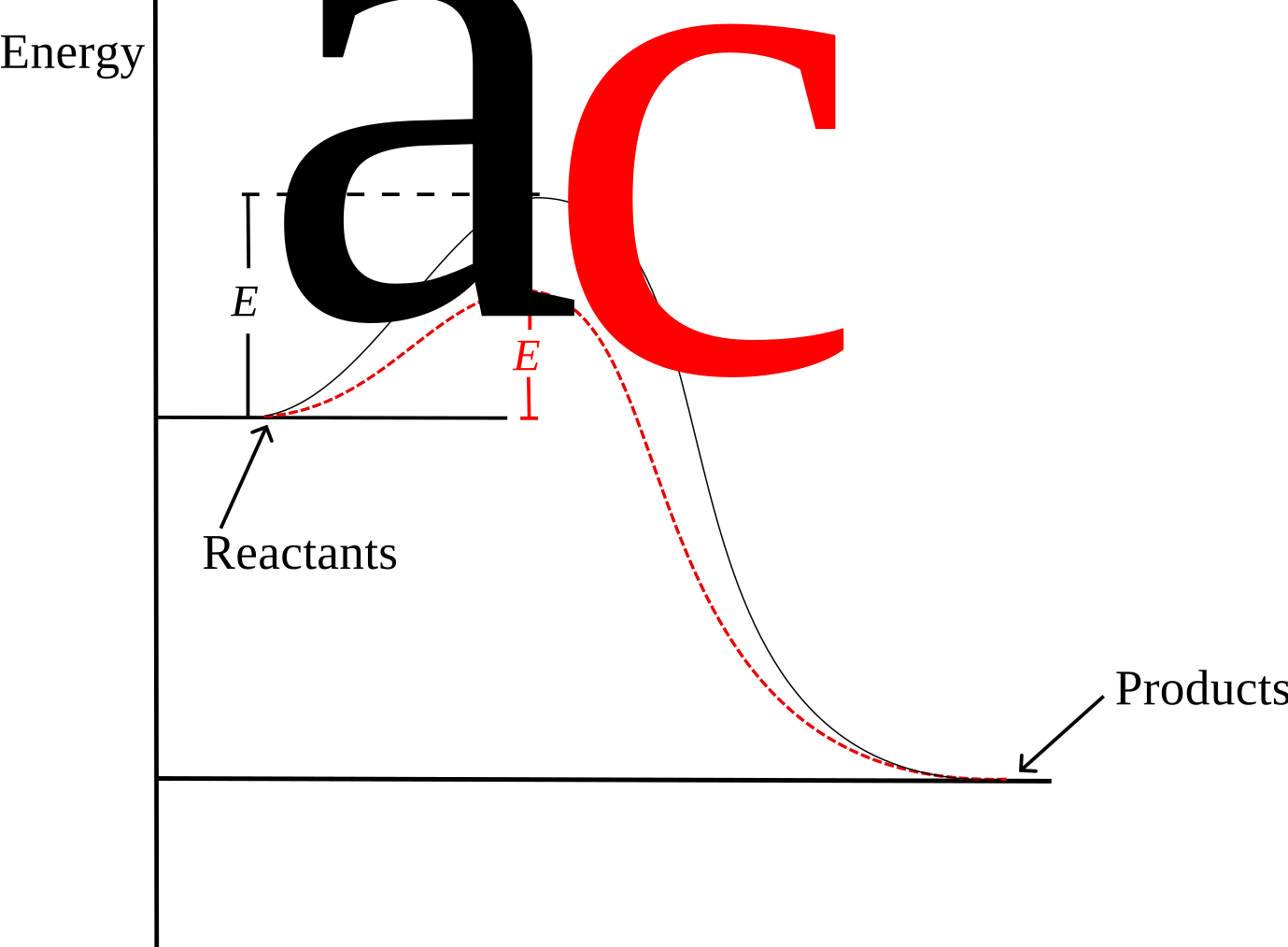
Which one of the following statements describes the effect that adding a catalyst will have on the energy profile diagram for an exothermic reaction?

  1. The energy of the products will remain the same.
  2. The shape of the energy profile diagram will remain the same.
  3. The peak of the energy profile will move to the left as the reaction rate increases.
  4. The activation energy will be lowered by the same proportion in the forward and reverse reactions.
Show Answers Only

\(A\)

Show Worked Solution

  • The energy content of both the products and reactants is the same in both reactions (\(\Delta H\) unchanged).
  • Although the activation energy of the forward and reverse reaction decreases by the same amount in the uncatalysed vs catalysed reactions, the proportions are different (i.e. the decrease is a higher proportion of the forward reaction’s activation energy).

\(\Rightarrow A\)

Filed Under: Energy Changes in Chemical Reactions Tagged With: Band 5, smc-4266-30-Energy profiles, smc-4266-40-Role of catalysts

CHEMISTRY, M4 EQ-Bank 10 MC

Which statement explains why catalysts are often used in chemical reactions?

  1. Catalysts increase the activation energies of reactions.
  2. Catalysts increase the rate of reactions.
  3. Catalysts increase the yield of products of reactions.
  4. Catalysts increase the purity of products of reactions.
Show Answers Only

\(B\)

Show Worked Solution
  • Catalysts increase the rate of reactions.

\(\Rightarrow B\)

Filed Under: Energy Changes in Chemical Reactions Tagged With: Band 3, smc-4266-40-Role of catalysts

Copyright © 2014–2025 SmarterEd.com.au · Log in