SmarterEd

Aussie Maths & Science Teachers: Save your time with SmarterEd

  • Login
  • Get Help
  • About

PHYSICS, M1 EQ-Bank 14

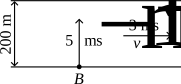
A boat is trying to cross a river that is 200 meters wide. The boat’s speed in still water is 5 m/s. The river flows eastward with a current of 3 m/s.

  1. If the boat heads straight north (perpendicular to the current), using a vector diagram. determine the magnitude and direction of its velocity relative to the ground?   (3 marks)

    --- 6 WORK AREA LINES (style=lined) ---

  1. How far downstream (east) will the boat have drifted by the time it reaches the opposite bank?   (1 mark)

    --- 2 WORK AREA LINES (style=lined) ---

  1. At what angle should the boat be aimed (relative to north) so that it reaches directly across from its starting point?   (2 marks)

    --- 4 WORK AREA LINES (style=lined) ---

Show Answers Only

a.    The velocity of the boat relative to the ground is 5.83 m/s N31\(^{\circ}\)E.

b.    \(120\ \text{m}\)

c.    The boat should head N36.9\(^{\circ}\)W.

Show Worked Solution

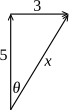
a.    Using the vector diagrams below

\(x=\sqrt{3^2+5^2} = 5.83\ \text{ms}^{-1}\)

\(\tan \theta= \dfrac{3}{5}\ \ \Rightarrow\ \ \theta=\tan^{-1}\left(\dfrac{3}{5}\right)=31^{\circ}\)

 \(\therefore\) The velocity of the boat relative to the ground is 5.83 m/s N31\(^{\circ}\)E.
 

b.    
         

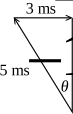
\(\tan 31^{\circ}\) \(=\dfrac{d}{200}\)  
\(d\) \(=200 \times \tan\,31^{\circ}=120\ \text{m}\)  

 
c.    
         

\(\sin \theta=\dfrac{3}{5}\ \ \Rightarrow\ \ \theta=\sin^{-1}\left(\dfrac{3}{5}\right)=36.9^{\circ}\)

 \(\therefore\) The boat should head N36.9\(^{\circ}\)W.
Filed Under: Motion on a Plane Tagged With: Band 3, Band 4, smc-4274-10-Vector addition, smc-4274-40-Relative motion

PHYSICS, M1 EQ-Bank 2 MC

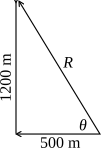
A cyclist rides 500 m to the west and then turns to travel 1200 m to the north. What is the cyclist's final displacement?

  1. 1700 m
  2. 1700 m bearing N 23\(^{\circ}\) W
  3. 1300 m bearing N 67\(^{\circ}\) W
  4. 1300 m bearing N 23\(^{\circ}\) W
Show Answers Only

\(D\)

Show Worked Solution

Using vector addition:

\(R=\sqrt{500^2+1200^2} = 1300\ \text{m}\)

\(\tan \theta\) \(=\dfrac{1200}{500}\)  
\(\theta\) \(=\tan^{-1}\left(\dfrac{1200}{500}\right)=67^{\circ}\)  

 
\(\Rightarrow D\)

Filed Under: Motion on a Plane Tagged With: Band 3, smc-4274-10-Vector addition

PHYSICS, M1 EQ-Bank 13

A motorboat was travelling 15 m/s relative to the water, heading due east according to its navigation system.

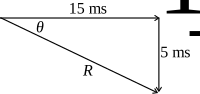
The boat then experiences a river current flowing south at 5 m/s relative to the shore. Using a vector diagram, determine the boat's resultant velocity relative to the shore.   (2 marks)

--- 6 WORK AREA LINES (style=lined) ---

Show Answers Only

15.8 ms\(^{-1}\) at S72\(^{\circ}\)E.

Show Worked Solution

Using vector addition as shown in the diagram above:

\(R=\sqrt{15^2+5^2} = 15.8\ \text{ms}^{-1}\)

\(\tan \theta\) \(=\dfrac{5}{15}\)  
\(\theta\) \(=\tan^{-1}\left(\dfrac{5}{15}\right)=18.4^{\circ}\)  

 
The resultant velocity is 15.8 ms\(^{-1}\) at S72\(^{\circ}\)E.

Filed Under: Motion on a Plane Tagged With: Band 4, smc-4274-10-Vector addition

PHYSICS, M1 EQ-Bank 12

An aircraft flies with a constant velocity of 95 ms\(^{-1}\) North. During the flight, a the plane experiences 2 different cross winds. 

  1. Determine the resultant velocity of the plane as seen from the ground when it experiences a wind blowing 40 ms\(^{-1}\) to the west.   (2 marks)

--- 5 WORK AREA LINES (style=lined) ---

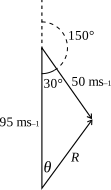
  1. Later in the flight when the plane is again travelling 95 ms\(^{-1}\) North, calculate its resultant velocity as seen from the ground when it experiences a cross wind of 50 ms\(^{-1}\) blowing towards a bearing of 150°T.   (4 marks)

--- 8 WORK AREA LINES (style=lined) ---

Show Answers Only

a.    \(103.1\ \text{ms}^{-1}\) at \(337^{\circ}\ \text{T}\)

b.    \(57.4\ \text{ms}^{-1}\) at \(026^{\circ}\ \text{T}\)

Show Worked Solution

a.   
       

Using vector addition:

\(R=\sqrt{40^2+95^2} = 103.1\ \text{ms}^{-1}\)

\(\tan \theta\) \(=\dfrac{40}{95}\)  
\(\theta\) \(=\tan^{-1}\left(\dfrac{40}{95}\right)=23^{\circ}\)  

 
Resultant velocity \(=103.1\ \text{ms}^{-1}\ \text{at}\ 337^{\circ}\ \text{T}\)
 

b. 
       

Using the cosine rule:

\(c=\sqrt{50^2+95^2-2 \times 50 \times 95 \times \cos 30} = 57.4261\ \text{ms}^{-1}\)
 

Determine the angle (using sine rule):

\(\dfrac{\sin \theta}{50}\) \(=\dfrac{\sin 30}{R}\)  
\(\sin \theta\) \(=\dfrac{50 \times \sin 30}{57.4261}\)  
\(\theta\) \(=\sin^{-1}\left(\dfrac{50 \times \sin 30}{57.4261}\right)=25.8^{\circ}\)   


Resultant velocity on the plane \(=57.4\ \text{ms}^{-1}\ \text{at}\ 26^{\circ}\ \text{T}\)

Filed Under: Motion on a Plane Tagged With: Band 4, Band 5, smc-4274-10-Vector addition

PHYSICS, M1 EQ-Bank 1 MC

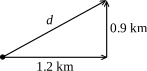
A hiker starts at Camp A and walks 1.2 km east. She then turns to face north and walks a further 0.9 km to arrive at Camp B.

The magnitude of the hiker’s overall displacement \((d)\) can be determined using which of the following expressions?

  1. \(\tan d = \dfrac{0.9\ \text{km}}{1.2\ \text{km}}\)
  2. \(d = 1.2\ \text{km} + 0.9\ \text{km}\)
  3. \(d = (1.2)^2\ \text{km} + (0.9)^2\ \text{km}\)
  4. \(d^2 = (1.2)^2\ \text{km} + (0.9)^2\ \text{km}\)
Show Answers Only

\(D\)

Show Worked Solution
  • By Pythagorean theorem:

\(d^2 = (1.2)^2\ \text{km} + (0.9)^2\ \text{km}\)

\(\Rightarrow D\)

Filed Under: Motion on a Plane Tagged With: Band 3, smc-4274-10-Vector addition, smc-4274-50-Vector diagrams

PHYSICS, M1 EQ-Bank 1

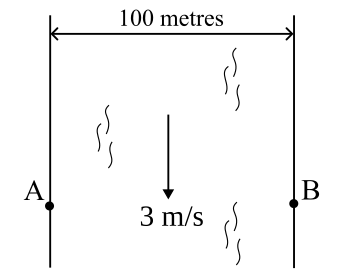
A physics student comes across a river which runs north to south and has a current of 3 ms\(^{-1}\) running south.

The student starts on the west side of the river at point A and paddles a kayak at 5 ms\(^{-1}\) directly across the river to finish at point B.

  1. Calculate the angle which he must position the boat to travel in a straight line across the river.   (2 mark)

    --- 5 WORK AREA LINES (style=blank) ---

  2. If the river is 100 metres wide, determine the time it takes for the student to cross the river.   (2 mark)

    --- 4 WORK AREA LINES (style=blank) ---

Show Answers Only

a.    \(36.9^{\circ}\)

b.    \(\text{25 seconds}\)

Show Worked Solution

a.   
       

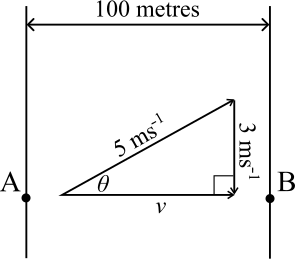
\(\sin \theta\) \(=\dfrac{3}{5}\)  
\(\theta\) \(=\sin^{-1}\Big(\dfrac{3}{5}\Big)=36.9^{\circ}\)  

 
The student must turn 36.9\(^{\circ}\) into the current as shown on the diagram.

 
b. 
   Using Pythagoras:

\(v=\sqrt{5^2-3^2}=4\ \text{ms}^{-1}\)

\(t=\dfrac{d}{s}=\dfrac{100}{4}=25\ \text{s}\)
 

\(\therefore\) It will take the student 25 seconds to travel from A to B.

Filed Under: Motion on a Plane Tagged With: Band 4, Band 5, smc-4274-10-Vector addition, smc-4274-50-Vector diagrams

PHYSICS, M1 EQ-Bank 10

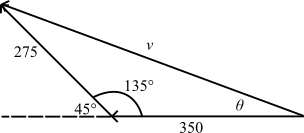
Determine the magnitude and direction of the resultant velocity vector for an airplane that is simultaneously moving with a velocity of 350\(^{-1}\) directly towards the west and 275 ms\(^{-1}\) towards the northwest.   (3 marks)

--- 7 WORK AREA LINES (style=lined) ---

Show Answers Only

578 ms\(^{-1}\), N70.3°W

Show Worked Solution

Add vectors to show resultant vector:

Using the cosine rule to find the magnitude of \(v\):

\(v\) \(=\sqrt{350^2+275^2-2 \times 350 \times 275 \times \cos 135°}\)  
  \(=578.1376\dots\ \text{ms}^{-1}\)  


Using the sign rule to find \(\theta\):

\(\dfrac{\sin \theta}{275}\) \(=\dfrac{\sin 135°}{578.1376}\)  
\(\sin \theta\) \(=\dfrac{\sin135° \times 275}{578.1376}\)  
\(\theta\) \(=\sin^{-1}\Big(\dfrac{\sin135° \times 275}{578.1376}\Big)\)  
  \(=19.7^{\circ}\)  


\(\therefore\) Resultant velocity of the aeroplane is 578 ms\(^{-1}\), N70.3°W.

Filed Under: Motion on a Plane Tagged With: Band 4, smc-4274-10-Vector addition

PHYSICS, M1 EQ-Bank 9

A car is travelling north and approaching an intersection at 50 kmh\(^{-1}\).

While maintaining a constant speed, the car turns left and continues east at 50 kmh\(^{-1}\). 

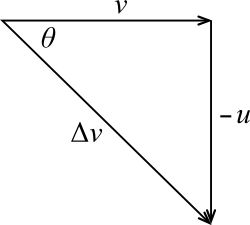
Using a vector diagram, calculate the change in velocity of the car.   (3 marks)

--- 7 WORK AREA LINES (style=lined) ---

Show Answers Only

\(\text{70.7 kmh}^{-1}, \text{S45°E} \)

Show Worked Solution

\(v= 50\ \text{kmh}^{-1}\ \text{east},\ \ u= 50\ \text{kmh}^{-1}\ \text{north.}\)

\(\Delta v= v-u = v+(-u),\ \ \text{where}\ -u= 50\ \text{kmh}^{-1}\ \text{south}\)
  

\(\Delta v=\sqrt{50^2 + 50^2}=\sqrt{5000}=70.7\ \text{kmh}^{-1}\)

\(\tan \theta \) \(=\dfrac{50}{50}\)  
\(\theta\) \(=\tan^{-1}\Big(\dfrac{50}{50}\Big)=45^{\circ}\)  


Change in velocity of the car = 70.7 \(\text{kmh}^{-1}\), S45\(^{\circ}\)E.

Filed Under: Motion on a Plane Tagged With: Band 4, smc-4274-10-Vector addition, smc-4274-50-Vector diagrams

PHYSICS, M1 EQ-Bank 6

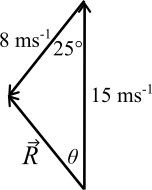
A boat is being rowed due north at a constant speed of 15 ms\(^{-1}\) when it encounters a current of 8 ms\(^{-1}\) going in the direction of S25°W.

Using vectors, determine the resultant velocity of the boat.   (3 marks)

--- 8 WORK AREA LINES (style=lined) ---

Show Answers Only

\(\overset{\rightarrow}R=8.455\ \text{ms}^{-1}\ \text{N}23.6^{\circ}\text{W}\)

Show Worked Solution

  • Using the cosine rule, the magnitude of \(\overset{\rightarrow}R\) is:
  •    \(\overset{\rightarrow}R=\sqrt{15^2+8^2-2 \times 15 \times 8 \times \cos25°}=8.455\ \text{ms}^{-1}\)
  • Using the sine rule, the direction of \(\overset{\rightarrow}R\) is:
\(\dfrac{\sin\theta}{8}\) \(=\dfrac{\sin25°}{8.455}\)  
\(\sin\theta\) \(=\dfrac{8\sin25°}{8.455}\)  
\(\theta\) \(=\sin^{-1}\Big{(}\dfrac{8\sin25°}{8.455}\Big{)}=23.6^{\circ}\)  

 
\(\therefore \overset{\rightarrow}R =8.455\ \text{ms}^{-1}\ \text{N}23.6^{\circ}\text{W}\)

Filed Under: Motion on a Plane Tagged With: Band 5, smc-4274-10-Vector addition, smc-4274-50-Vector diagrams

PHYSICS, M1 2018 VCE 5*

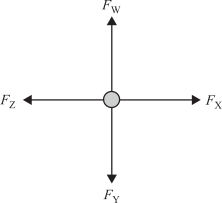
Four students are pulling on ropes in a four-person tug of war. The relative sizes of the forces acting on the various ropes are \(F_{ W }=200 \text{ N} , F_{ X }=240 \text{ N} , F_{ Y }=180 \text{ N}\) and \(F_{ Z }=210 \text{ N}\). The situation is shown in the diagram below.
 

What is the resultant force vector \((F_{\vec{R}})\) acting at the centre of the tug-of-war ropes?   (3 marks)

Show Answers Only

\(F_{\vec{R}}=36.1\ \text{N}, 33.7^{\circ}\) above the horizontal.

Show Worked Solution
  • By resolving the vertical vectors of \(F_{ W }=200 \text{ N}\) up and \(F_{ Y }=180 \text{ N}\) down, the net force in the vertical direction is \(F_v=20\ \text{N}\) up.
  • Similarly, the net force in the horizontal direction is \(F_h=30\ \text{N}\) to the right.
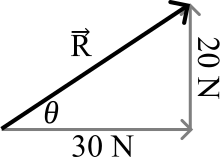
  • Thus the resultant vector \((F_{\vec{R}})\) can be calculated using the vector diagram below.

  • The magnitude of  \(F_{\vec{R}}=\sqrt{20^2+30^2}\)  and  \(\theta=\tan^{-1}\Big{(}\dfrac{20}{30}\Big{)}\)
  • Hence \(F_{\vec{R}}=36.1\ \text{N}, 33.7^{\circ}\) above the horizontal.

Filed Under: Motion on a Plane Tagged With: Band 4, smc-4274-10-Vector addition, smc-4274-20-Vector resolution

Copyright © 2014–2025 SmarterEd.com.au · Log in