SmarterEd

Aussie Maths & Science Teachers: Save your time with SmarterEd

  • Login
  • Get Help
  • About

PHYSICS, M2 EQ-Bank 11

A metal sphere is dropped near Earth’s surface and falls freely toward the ground. At the same time, a person pushes a box horizontally across a frictionless surface.

  1. Identify the type of force acting on each object.   (1 mark)

--- 2 WORK AREA LINES (style=lined) ---

  1. Compare the mechanisms through which these forces are produced.   (2 marks)

--- 5 WORK AREA LINES (style=lined) ---
Show Answers Only

a.   Force acting on the metal sphere is a field force (gravitational).

Force acting on the box is a contact force (applied force).
 

b.    Comparison of mechanisms:

  • The gravitational force acting on the metal sphere is a non-contact or field force, which means it is exerted through the gravitational field of the Earth without requiring any physical contact.
  • This force exists due to the mass of the Earth and the mass of the sphere, and it acts continuously as long as the sphere is within Earth’s gravitational field.
  • In contrast, the force applied to the box is a contact force that results from a direct physical interaction between the person’s hand and the surface of the box.
  • This force only exists while the two objects are in contact and depends on the muscular action of the person pushing.
Show Worked Solution

a.   Force acting on the metal sphere is a field force (gravitational).

Force acting on the box is a contact force (applied force).
 

b.    Comparison of mechanisms:

  • The gravitational force acting on the metal sphere is a non-contact or field force, which means it is exerted through the gravitational field of the Earth without requiring any physical contact.
  • This force exists due to the mass of the Earth and the mass of the sphere, and it acts continuously as long as the sphere is within Earth’s gravitational field.
  • In contrast, the force applied to the box is a contact force that results from a direct physical interaction between the person’s hand and the surface of the box.
  • This force only exists while the two objects are in contact and depends on the muscular action of the person pushing.

Filed Under: Forces Tagged With: Band 3, Band 4, smc-4275-10-Using Newton's laws

PHYSICS, M2 EQ-Bank 3 MC

Two balls are dropped vertically from a cliff. Ball \(\text{X}\) is dropped first. One second later, Ball \(\text{Y}\), which has half the mass of Ball \(\text{X}\), is also dropped from the same height. Assume air resistance is negligible and both balls are dropped from rest.

Which of the following is correct?

  1. Ball \(\text{X}\) will hit the ground with twice the speed of Ball \(\text{Y}\).
  2. Ball \(\text{Y}\) will accelerate slower because it has less mass.
  3. The balls will strike the ground more than one second apart.
  4. The distance between the balls increases while they are falling.
Show Answers Only

\(D\)

Show Worked Solution
  • Both balls will experience the same acceleration as they are both being acted on by gravity \((9.8\ \text{ms}^{-2})\).
  • The distance the balls fall during flight is given by  \(s= ut + \dfrac{1}{2}at^2 = \dfrac{1}{2}at^2\ \ (u = 0)\).

When  \(t=1:\)

Distance travelled by Ball \(\text{X} =\dfrac{1}{2} \times 9.8 \times 1= 4.9\ \text{m}\)

Distance travelled by Ball \(\text{Y = 0 m}\) (distance between balls = 4.9 m)
 

When  \(t=2:\)

Distance travelled by Ball \(\text{X} =\dfrac{1}{2} \times 9.8\times 4 = 19.6\ \text{m}\) 

Distance travelled by Ball \(\text{Y} =\dfrac{1}{2} \times 9.8 \times 1 = 4.9\ \text{m}\) (distance between the balls = 14.7 m)

  • Due to the factor of \(t^2\) in the distance equation, the distance between the balls will increase while they are falling.

\(\Rightarrow D\)

Filed Under: Forces Tagged With: Band 5, smc-4275-10-Using Newton's laws, smc-4275-30-Newton's 2nd Law

PHYSICS, M2 EQ-Bank 2

A block is being dragged along a flat surface with a horizontal force of 30 \(\text{N}\) being applied to it.

The mass of the block is 6 kilograms.

If the block is travelling at a constant velocity, determine the magnitude of the frictional forces acting on the block, giving reasons for your answer.   (2 marks)

--- 3 WORK AREA LINES (style=blank) ---

Show Answers Only
  • As the block is travelling at a constant velocity, the sum of all the forces acting on the block must add to 0. 
  • The frictional forces must be equal in magnitude and opposite to the applied force.
  • Therefore, the magnitude of the frictional forces is 30 \(\text{N}\).
Show Worked Solution
  • As the block is travelling at a constant velocity, the sum of all the forces acting on the block must add to 0. 
  • The frictional forces must be equal in magnitude and opposite to the applied force.
  • Therefore, the magnitude of the frictional forces is 30 \(\text{N}\).

Filed Under: Forces Tagged With: Band 3, smc-4275-10-Using Newton's laws, smc-4275-30-Newton's 2nd Law

PHYSICS, M2 2020 VCE 9-10 MC

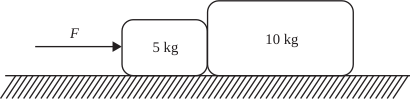
Two blocks of mass 5 kg and 10 kg are placed in contact on a frictionless horizontal surface, as shown in the diagram below. A constant horizontal force, \(F\), is applied to the 5 kg block.


Question 9

Which one of the following statements is correct?

  1. The net force on each block is the same.
  2. The acceleration experienced by the 5 kg block is twice the acceleration experienced by the 10 kg block.
  3. The magnitude of the net force on the 5 kg block is half the magnitude of the net force on the 10 kg block.
  4. The magnitude of the net force on the 5 kg block is twice the magnitude of the net force on the 10 kg block.

 
Question 10

If the force \(F\) has a magnitude of 250 N, what is the work done by the force in moving the blocks in a straight line for a distance of 20 m?

  1. \(5 \text{ kJ}\)
  2. \(25 \text{ kJ}\)
  3. \(50 \text{ kJ}\)
  4. \(500 \text{ kJ}\)
Show Answers Only

\(\text{Question 9:}\ C\)

\(\text{Question 10:}\ A\)

Show Worked Solution

\(\text{Question 9}\)

Using Newton’s second Law:  \(F=ma\ \ \Rightarrow\ \ a=\dfrac{F}{m}\).

  • The blocks will experience the same acceleration.
  • Both blocks will have the same force to mass ratio. Since the 5 kg block is half the mass of the 10 kg block, it will experience half the magnitude of the net force as the 10 kg block.

\(\Rightarrow C\)

♦ Mean mark 49%.

 
\(\text{Question 10}\)

\(W\) \(=F_{\parallel}s\)  
  \(=250 \times 20\)  
  \(=5000\ \text{J}\)  
  \(=5\ \text{kJ}\)  

 
\(\Rightarrow A\)

Filed Under: Forces Tagged With: Band 3, Band 5, smc-4275-10-Using Newton's laws, smc-4275-30-Newton's 2nd Law, smc-4276-40-Work done

PHYSICS, M2 2022 VCE 9 MC

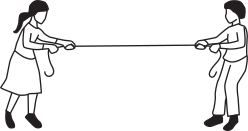
Two students pull on opposite ends of a rope, as shown in the diagram below. Each student pulls with a force of 400 N.
 

Which one of the following is closest to the magnitude of the force of the rope on each student?

  1. \(\text{0 N}\)
  2. \(\text{400 N}\)
  3. \(\text{600 N}\)
  4. \(\text{800 N}\)
Show Answers Only

\(B\)

Show Worked Solution
  • Newton’s 3rd Law states that every action has an equal and opposite reaction.
  • As each student exerts a force of 400 N on the rope, the rope will exert a force of 400 N on the student.

\(\Rightarrow B\)

♦ Mean mark 52%.

Filed Under: Forces Tagged With: Band 5, smc-4275-10-Using Newton's laws, smc-4275-20-Newtons 3rd Law

PHYSICS, M2 2012 HSC 11 MC

Which of the following is correct about the forces acting during a rocket launch?

  1. Equal and opposite forces act on the rocket. This enables it to continue to accelerate even in the vacuum of space.
  2. The engines exert an upward thrust on the rocket. This thrust exceeds the downward force of the engines on the air.
  3. The rocket engines exert a downward force on the gases being expelled. These gases exert an upward force on the engines.
  4. The expelled gases exert a force against the launch pad. The launch pad then exerts an equal and opposite force on the rocket causing it to accelerate.
Show Only

\(C\)

Show Worked Solution
  • By Newton’s third law of motion (for every action there is an equal and opposite reaction), option \(C\) is the correct answer.
  • Although \(D\) also uses Newton’s third law, it is incorrect as it is not the launch pad exerting a force on the rocket but rather the gases expelled from the rocket.

\( \Rightarrow C\)

♦ Mean mark 47%.

Filed Under: Forces Tagged With: Band 5, smc-4275-10-Using Newton's laws

PHYSICS, M5 2017 HSC 4 MC

An astronaut with a mass of 75 kg lands on Planet X where her weight is 630 N.

What is the acceleration due to gravity (in m s\(^{-2}\)) on Planet X ?

  1. 0.12
  2. 8.4
  3. 9.8
  4. 735
Show Answers Only

\(B\)

Show Worked Solution

\(\text{Using}\ \ F=mg:\)

\(g=\dfrac{F}{m}=\dfrac{630}{75}=8.4\  \text{m s}^{-2}\)

 \(\Rightarrow B\)

Filed Under: Forces, Motion in Gravitational Fields Tagged With: Band 2, smc-3692-15-Gravitational field strength, smc-4275-10-Using Newton's laws

PHYSICS, M5 2018 HSC 21

  1. Compare the force of gravity exerted on the moon by Earth with the force of gravity exerted on Earth by the moon.    (2 marks)

--- 3 WORK AREA LINES (style=lined) ---

  1. The acceleration due to gravity on the moon is `1.6 \ text{m s}^(-2)` and on Earth it is `9.8 \ text{m s}^(-2)`. Quantitatively compare the mass and weight of a 70 kg person on the moon and on Earth.   (2 marks)

--- 4 WORK AREA LINES (style=lined) ---

Show Answers Only

a.   Using Newton’s Third Law:

  • The force of gravity of the Earth on the moon is equal in magnitude and opposite in direction to the force of gravity exerted on Earth by the moon.
     

b.   Comparison of mass:

  • The mass of the person on both Earth and the moon is 70 kg.

Comparison of weight:

  • The weight of the person on Earth is given by  `W_e=mg=70 xx9.8=686\ text{N.}`
  • The weight of the person on the moon is given by  `W_m=mg=70xx1.6=112\ text{N.}`
  • The persons weight on Earth is greater than it is on the moon.
Show Worked Solution

a.   Using Newton’s Third Law:

  • The force of gravity of the Earth on the moon is equal in magnitude and opposite in direction to the force of gravity exerted on Earth by the moon.

♦♦ Mean mark (a) 33%.

b.   Comparison of mass:

  • The mass of the person on both Earth and the moon is 70 kg.

Comparison of weight:

  • The weight of the person on Earth is given by  `W_e=mg=70 xx9.8=686\ text{N.}`
  • The weight of the person on the moon is given by  `W_m=mg=70xx1.6=112\ text{N.}`
  • The persons weight on Earth is greater than it is on the moon.

Filed Under: Forces, Motion in Gravitational Fields Tagged With: Band 3, Band 5, smc-3692-10-Gravity between 2 objects, smc-4275-10-Using Newton's laws, smc-4275-30-Newton's 2nd Law

Copyright © 2014–2025 SmarterEd.com.au · Log in