SmarterEd

Aussie Maths & Science Teachers: Save your time with SmarterEd

  • Login
  • Get Help
  • About

PHYSICS, M2 EQ-Bank 10

A 20 kg crate is suspended in equilibrium by two cables as seen in the diagram below:


Determine the tension force \((T_2)\) in Cable 2.   (3 marks)

--- 6 WORK AREA LINES (style=lined) ---

Show Answers Only

\(17.2\ \text{N}\)

Show Worked Solution
  • The weight force of the crate, \(F_w=20 \times 9.8 = 19.6\ \text{N}\) and so the following vector diagram can be set up below.
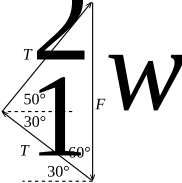
  • Using the \(\sin\) rule for finding the side length of a triangle, \(\dfrac{a}{\sin A}=\dfrac{b}{\sin B}\)
\(\dfrac{T_2}{\sin 60}\) \(=\dfrac{F_w}{\sin 80}\)  
\(T_2\) \(=\dfrac{19.6}{\sin 80} \times \sin 60\)  
  \(=17.2\ \text{N}\)  

Filed Under: Forces Tagged With: Band 5, smc-4275-40-Equilibrium systems

PHYSICS, M2 EQ-Bank 9

The diagram below shows a 20 kg mass suspended from two strings.


Using a force diagram, calculate the force \(F\) in each string acting on the mass.   (3 marks)
  

--- 8 WORK AREA LINES (style=lined) ---

Show Answers Only

\(196\ \text{N}\)

Show Worked Solution

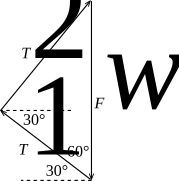
  • The weight force of the mass  \(F_w = mg = 20 \times 9.8 = 196\ \text{N}\).
  • As the force diagram is an equilateral triangle, the side length of all the sides of the triangle are equal.
  • Hence the magnitude of \(F_w = F = 196\ \text{N}\).
  • The force in each string is \(196\ \text{N}\).

Filed Under: Forces Tagged With: Band 4, smc-4275-40-Equilibrium systems

PHYSICS, M2 EQ-Bank 7

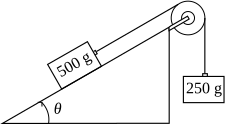
A 500 gram block is placed on a frictionless inclined plane and joined to a 250 gram block by a tensile frictionless wire, as shown in the diagram below.
 

Determine the angle of inclination at which the system remains in static equilibrium.   (2 marks)

--- 5 WORK AREA LINES (style=lined) ---

Show Answers Only

\(30^{\circ}\)

Show Worked Solution
  • For the system to be in static equilibrium, the force of the 500 g block, \((m_1)\), down the slope must be equal to the weight force of the 250 g block, \((m_2)\).
\(m_1g \times \sin \theta\) \(=m_2g\)  
\(\sin \theta\) \(=\dfrac{m_2}{m_1}\)  
\(\theta\) \(=\sin^{-1}\left(\dfrac{0.250}{0.5}\right) = 30^{\circ}\)  


  • The angle of inclination needs to be \(30^{\circ}\).

Filed Under: Forces Tagged With: Band 4, smc-4275-40-Equilibrium systems, smc-4275-50-Inclined Planes

PHYSICS, M2 EQ-Bank 6

A worker is using a pulley system to lift and lower a container at a construction site. The empty container has a mass of 5.0 kg, and when loaded with bricks, its mass increases to 18 kg.

The container is lowered vertically with a constant acceleration of 3.2 m/s\(^2\). Later, it is lifted back up at a constant speed of 2.8 m/s.

  1. Calculate the tension in the rope while the container is being lowered.   (2 marks)

    --- 4 WORK AREA LINES (style=lined) ---

  1. Calculate the tension in the rope while the container is being raised.   (1 mark)

    --- 2 WORK AREA LINES (style=lined) ---

Show Answers Only

a.    \(33\ \text{N}\)

b.    \(147\ \text{N}\)

Show Worked Solution

a.   Tension while container lowered:

  • Force due to gravity acts in the opposite direction to the tension force in the rope.
  • Total force on the system \(= F_g-T\)
\(ma\) \(=mg-T\)  
\(T\) \(=mg-ma\)  
  \(= 5 \times 9.8-5 \times 3.2\)  
  \(= 33\ \text{N}\)  

 
b.  
Tension while container raised:

Total force = \(0\ \text{N}\)  (raised at a constant speed)

\(mg-T\) \(=0\)  
\(\therefore T\) \(=mg = 15 \times 9.8 = 147\ \text{N}\)  

Filed Under: Forces Tagged With: Band 4, smc-4275-40-Equilibrium systems

PHYSICS, M2 EQ-Bank 5

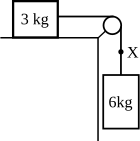
Consider the system below:
 

Two blocks are connected by a light, inextensible string that passes over a frictionless pulley, as shown in the diagram.

The 3.0 kg block rests on a smooth, horizontal surface, while the other 6.0 kg block hangs vertically off the edge of the table.

  1.  Calculate the acceleration of the entire system.   (3 marks)

--- 4 WORK AREA LINES (style=lined) ---

  1. Hence, determine the magnitude of the tension, \(T\), in the string at point \(X\).   (1 mark)

--- 2 WORK AREA LINES (style=lined) ---

Show Answers Only

a.    \(6.53\ \text{ms}^{-2}\)

b.    \(19.6\ \text{N}\)

Show Worked Solution

a.   \(F_{\text{net}} = 3\ \text{kg} \times a_{\text{system}} = T\)

\(F_{\text{net}} = 6\ \text{kg} \times a_{\text{system}} = 6\ \text{kg} \times 9.8-T\)   \((F_w-T)\)
 

Substitute the first equation into the second equation:

\(6\ \text{kg} \times a_{\text{system}}\) \(=6\ \text{kg} \times 9.8-(3\ \text{kg} \times a_{\text{system}})\)  
\(6\ \text{kg} \times a_{\text{system}} + 3\ \text{kg} \times a_{\text{system}}\) \(=58.8\ \text{N}\)  
\(a_{\text{system}} \times (6+3)\ \text{kg}\) \(=58.8\ \text{N}\)  
\(a_{\text{system}}\) \(=\dfrac{58.8\ \text{N}}{9\ \text{kg}}\)  
  \(=6.53\ \text{ms}^{-2}\)  


b.    \(T= 3\ \text{kg} \times a_{\text{system}} = 3 \times 6.53 = 19.59 = 19.6\ \text{N}\)

Filed Under: Forces Tagged With: Band 4, Band 6, smc-4275-40-Equilibrium systems

PHYSICS, M2 EQ-Bank 2 MC

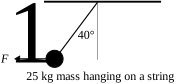
A 25 kg object is hanging from a string and is being pulled sideways by a force \((F_1)\), so that the string makes an angle of 40° with the vertical, as shown in the diagram.

Assuming the object remains stationary, determine the magnitude of the force \((F_1)\) pulling the object?
 

  1. 115 N
  2. 157 N
  3. 191 N
  4. 206 N
Show Answers Only

\(D\)

Show Worked Solution

\(\therefore \tan 40^{\circ}\) \(=\dfrac{F_1}{F_w}\)  
\(F_1\) \(=F_w \times \tan 40^{\circ}\)  
  \(= 25 \times 9.8 \times \tan 40^{\circ}\)  
  \(= 205.6\ \text{N}\)  

 
\(\Rightarrow D\)

Filed Under: Forces Tagged With: Band 4, smc-4275-40-Equilibrium systems

PHYSICS, M2 EQ-Bank 3

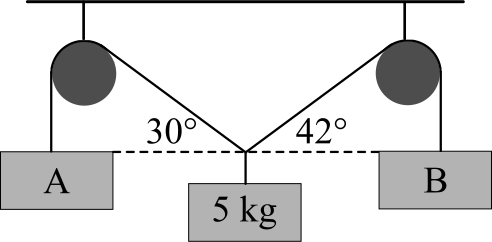
In the system diagram below, a 5-kilogram mass and masses \(A\) and \(B\) are held by high tensile frictionless wire in static equilibrium.
 

Using a vector diagram, calculate the masses of both \(A\) and \(B\).   (4 mark)

--- 8 WORK AREA LINES (style=blank) ---

Show Answers Only

\(\text{Mass}_A =3.91\ \text{kg}\)

\(\text{Mass}_B =4.55\ \text{kg}\)

Show Worked Solution

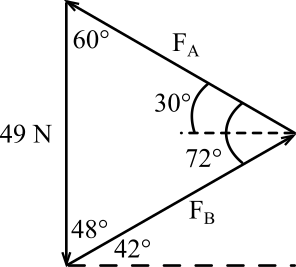
Using the sin rule both \(F_B\) and \(F_A\) can be calculated:

\(\dfrac{F_A}{\sin 48^{\circ}}\) \(=\dfrac{5 \times 9.8}{\sin 72^{\circ}}\)  
\(F_A\) \(=\dfrac{49\,\sin 48^{\circ}}{\sin 72^{\circ}}=38.3\ \text{N}\)  

 
\(\text{Mass}_A =\dfrac{F}{a}=\dfrac{38.3}{9.8}=3.91\ \text{kg}\)
 

\(\dfrac{F_B}{\sin 60^{\circ}}\) \(=\dfrac{49}{\sin 72^{\circ}}\)
\(F_B\) \(=\dfrac{49\, \sin 60^{\circ}}{\sin 72^{\circ}}=44.6\ \text{N}\)


\(\text{Mass}_B =\dfrac{F}{a}=\dfrac{44.6}{9.8}=4.55\ \text{kg}\)

Filed Under: Forces Tagged With: Band 4, Band 5, smc-4275-40-Equilibrium systems

PHYSICS, M2 EQ-Bank 1

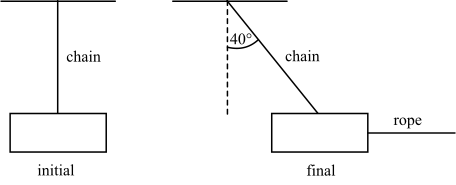
A concrete block with a weight of 1000 \(\text{N}\) is lifted with a pulley and chain system.

Initially the block is suspended by the chain as seen below. The block is then pulled to the side using a rope and makes an angle of 40° with the vertical as shown below. Ignore the masses of the chain and rope.
 

  1. State the tension in the chain initially.   (1 mark)

    --- 2 WORK AREA LINES (style=lined) ---

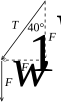
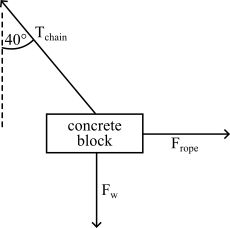
  2. Draw a free body diagram representing the forces acting on the concrete block in the final situation.   (2 marks)

    --- 3 WORK AREA LINES (style=lined) ---

  3. Determine the magnitude of the force being applied on the rope and the tension in the chain in the final situation.   (3 marks)

    --- 5 WORK AREA LINES (style=lined) ---

Show Answers Only

a.    \(1000\ \text{N up.}\)

b. 
             

c.   \(F_{\text{rope}}=839\ \text{N}\)

\(T_{\text{chain}}=1305.4\ \text{N}\)

Show Worked Solution

a.   Initial tension in chain:

  • Tension is equal and opposite to the weight force of 1000 \(\text{N}\) down.
  • Hence the tension in the chain is 1000 \(\text{N}\) up.

 
b. 


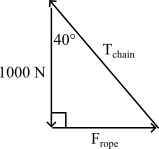
c. 
       

\(\tan 40^{\circ}\) \(=\dfrac{F_{\text{rope}}}{1000}\)  
\(F_{\text{rope}}\) \(=1000 \times \tan 40^{\circ}=839\ \text{N}\)  


\( \cos 40^{\circ}\) \(=\dfrac{1000}{T_{\text{chain}}}\)  
\(T_{\text{chain}}\) \(=\dfrac{1000}{\cos 40^{\circ}}=1305.4\ \text{N}\)  

Filed Under: Forces Tagged With: Band 4, smc-4275-40-Equilibrium systems

Copyright © 2014–2025 SmarterEd.com.au · Log in