SmarterEd

Aussie Maths & Science Teachers: Save your time with SmarterEd

  • Login
  • Get Help
  • About

PHYSICS, M2 EQ-Bank 7 MC

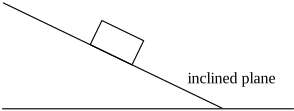
A 400 g block rests on a smooth inclined plane angled at 30° to the horizontal. In addition to the gravitational force, one other force acts on the block:

A tension force \((T)\) from a string pulling parallel to the incline and up the slope.
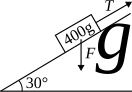
 

The block remains at rest. What must the tension force \((T)\) in the string be in order to maintain equilibrium?

  1. \(T=0.4 \times 9.8 \times \sin 30^{\circ}\)
  2. \(T=0.4 \times 9.8 \times \cos 30^{\circ}\)
  3. \(T=400 \times 9.8 \times \sin 30^{\circ}\)
  4. \(T=400 \times 9.8 \times \cos 30^{\circ}\)
Show Answers Only

\(A\)

Show Worked Solution
  • For the block to be in equilibrium the force acting down the slope must be equal to the tension force \((T)\) acting up the slope.
  • Convert grams to kg:  \(400\ \text{g}\ = \dfrac{400}{1000}\ \text{kg} = 0.4\ \text{kg} \)
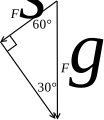
  • \(T=mg\ \sin\theta=0.4 \times 9.8 \times \sin 30^{\circ}\) (mass must be in kilograms)

\(\Rightarrow A\)

STRATEGY: It is crucial that \(F=mg\) force is the hypotenuse in the force diagram.
Filed Under: Forces Tagged With: Band 5, smc-4275-50-Inclined Planes

PHYSICS, M2 EQ-Bank 5 MC

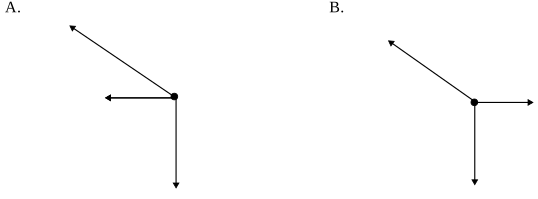
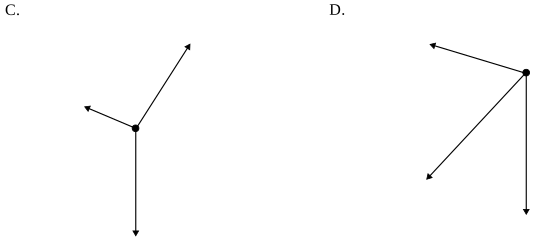
Which of the following free-body diagrams shows a block moving downhill at a constant speed?


Show Answers Only

\(C\)

Show Worked Solution
  • The three forces that act on an object when on an inclined plane are the normal force, weight force and frictional force.
  • For the block to be moving at a constant speed, the force down the plane (the component of the normal force parallel the plane) must be of equal magnitude to the frictional force which is displayed in \(C\).

\(\Rightarrow C\)

Filed Under: Forces Tagged With: Band 3, smc-4275-50-Inclined Planes

PHYSICS, M2 EQ-Bank 8

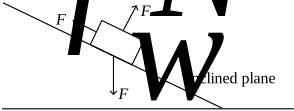
A box remains stationary on an inclined surface, as shown in the diagram.


  1. On the diagram, draw and label all the forces acting on the box using vector arrows.   (2 marks)

    --- 0 WORK AREA LINES (style=lined) ---

  2. The angle of the incline is gradually increased until the box just begins to slide. Explain why the box starts to accelerate down the slope at this point.   (2 marks)

--- 4 WORK AREA LINES (style=lined) ---

Show Answers Only

a.    


b.    As the angle of incline increases:

  • The magnitude of the force down the plane increases until it overcomes the static frictional force up the plane. In this way the magnitude of the net force will be down the slope of the plane.
  • As there is a net force acting down the slope of the plane, by Newtons second law \(F=ma\), the box will begin to accelerate down the slope.
Show Worked Solution

a.    


b.    As the angle of incline increases:

  • The magnitude of the force down the plane increases until it overcomes the static frictional force up the plane. In this way the magnitude of the net force will be down the slope of the plane.
  • As there is a net force acting down the slope of the plane, by Newtons second law \(F=ma\), the box will begin to accelerate down the slope.

Filed Under: Forces Tagged With: Band 3, smc-4275-50-Inclined Planes

PHYSICS, M2 EQ-Bank 4 MC

A 2 kg block is placed on a smooth inclined plane angled at 30\(^{\circ}\) to the horizontal. Assume friction is negligible.

What is the most likely motion of the block?

  1. The block will move down the incline with a constant acceleration.
  2. The block will move down the incline with increasing acceleration.
  3. The block will remain at rest.
  4. The block will move down the incline at a constant speed.
Show Answers Only

\(A\)

Show Worked Solution
  • The block will experience a constant force down the slope which can be calculated using \(F = mg\ \sin \theta\).
  • As the block is subject to a constant force, it will also experience a constant acceleration down the slope (Newton’s 2nd Law).

\(\Rightarrow A\)

Filed Under: Forces Tagged With: Band 3, smc-4275-30-Newton's 2nd Law, smc-4275-50-Inclined Planes

PHYSICS, M2 EQ-Bank 7

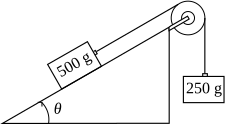
A 500 gram block is placed on a frictionless inclined plane and joined to a 250 gram block by a tensile frictionless wire, as shown in the diagram below.
 

Determine the angle of inclination at which the system remains in static equilibrium.   (2 marks)

--- 5 WORK AREA LINES (style=lined) ---

Show Answers Only

\(30^{\circ}\)

Show Worked Solution
  • For the system to be in static equilibrium, the force of the 500 g block, \((m_1)\), down the slope must be equal to the weight force of the 250 g block, \((m_2)\).
\(m_1g \times \sin \theta\) \(=m_2g\)  
\(\sin \theta\) \(=\dfrac{m_2}{m_1}\)  
\(\theta\) \(=\sin^{-1}\left(\dfrac{0.250}{0.5}\right) = 30^{\circ}\)  


  • The angle of inclination needs to be \(30^{\circ}\).

Filed Under: Forces Tagged With: Band 4, smc-4275-40-Equilibrium systems, smc-4275-50-Inclined Planes

PHYSICS, M2 EQ-Bank 4

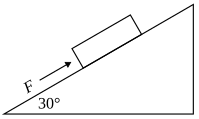
A 2 kg crate is being pushed up a rough incline that is angled at 30\(^{\circ}\) to the horizontal. The frictional force acting between the crate and the surface is 10 N.

  1. On the diagram provided, draw and label all the forces acting on the crate as it is pushed up the incline.   (3 marks)

    --- 4 WORK AREA LINES (style=blank) ---


  1. Calculate the magnitude of the applied force \(F\) required to accelerate the crate up the incline at 0.8 ms\(^{-2}\)   (2 marks)

--- 6 WORK AREA LINES (style=lined) ---

Show Answers Only

a.    
     

b.    \(F = 21.4\ \text{N}\)

Show Worked Solution

a.    
       

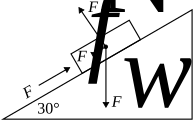
  • The frictional force acts down the slope in this scenario because frictional forces oppose the direction of motion.

b.    Weight force acting down slope \(= mg\sin \theta = 2 \times 9.8 \times \sin 30 = 9.8\ \text{N}\)

  • Total force down the slope \(=9.8 + 10 = 19.8\ \text{N}\)   (weight force down slope + frictional force)
\(F-19.8\) \(=ma_{\text{up slope}}\)  
\(F\) \(= 2 \times 0.8 +19.8\)  
  \(= 21.4\ \text{N}\)  

 
\(\therefore\) The force, \((F)\), acting up slope needs to be \(21.4\ \text{N}\).

Filed Under: Forces Tagged With: Band 4, Band 5, smc-4275-30-Newton's 2nd Law, smc-4275-50-Inclined Planes

Copyright © 2014–2025 SmarterEd.com.au · Log in