SmarterEd

Aussie Maths & Science Teachers: Save your time with SmarterEd

  • Login
  • Get Help
  • About

PHYSICS, M2 EQ-Bank 13 MC

A 75 kg mountain biker and bicycle of mass 15 kg descends a hill with a vertical drop of 40 m. Due to friction and air resistance, only 80% of the gravitational potential energy is converted to kinetic energy. If the biker starts from rest at the top of the hill, what is the biker's speed at the bottom of the hill?

  1. \(22\ \text{ms}^{-1}\)
  2. \(25\ \text{ms}^{-1}\)
  3. \(28\ \text{ms}^{-1}\)
  4. \(32\ \text{ms}^{-1}\)
Show Answers Only

\(B\)

Show Worked Solution
  • Total mass \((m) = 75 + 15 = 90\ \text{kg}\).
  • Initial gravitational potential energy:  \(U = mgh = 90 \times 9.8 \times 40 = 35\,280\ \text{J}\)
  • With 80% efficiency, the useful kinetic energy at the bottom is:
  •    \(E_k = 0.8 \times 35\,280 = 28\,224\ \text{J}\)
  • Using the kinetic energy equation:
  • \(E_k\) \(=\dfrac{1}{2}mv^2\)  
    \(28\,224\) \(=\dfrac{1}{2} \times 90 \times v^2\)  
    \(v\) \(=\sqrt{\dfrac{2 \times 28224}{90}}=25\ \text{ms}^{-1}\)  

     
    \(\Rightarrow B\)

Filed Under: Forces, Acceleration and Energy Tagged With: Band 4, smc-4276-10-Conservation of energy, smc-4276-60-Kinetic Energy

PHYSICS, M2 EQ-Bank 4

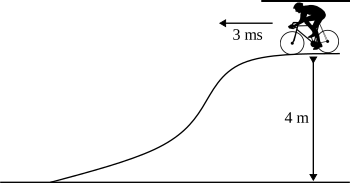
A 65 kg rider is on a 15 kg bicycle, moving across the top of a 4 metre high hill with a horizontal speed of 3 ms\(^{-1}\).
 

  1. The bicycle descends the hill, dropping a vertical distance of 4.0 meters before reaching level ground. Assuming no energy is lost to friction or air resistance, calculate the speed of the bicycle and rider at the bottom of the hill.   (3 marks)

--- 6 WORK AREA LINES (style=lined) ---

  1. At the bottom, the rider applies the brakes. The bike skids 15 metres across flat ground before coming to a stop. Calculate the magnitude of the frictional force acting on the bike during this motion.   (2 marks)

--- 5 WORK AREA LINES (style=lined) ---

Show Answers Only

a.    \(9.35\ \text{ms}^{-1}\)

b.    \(233\ \text{N}\)

Show Worked Solution

a.    By applying the Law of Conservation of Energy:

\(E_{\text{after}}\) \(=E_{\text{before}}\)  
\(\dfrac{1}{2}mv^2\) \(=\dfrac{1}{2}mu^2+mgh\)  
\(v^2\) \(=u^2 +2gh\)  
\(v\) \(=\sqrt{3^2+2 \times 9.8 \times 4}\)  
  \(=9.35\ \text{ms}^{-1}\)  


  • The velocity of the rider at the bottom of the hill is 9.35 ms\(^{-1}\).

b.    At the bottom of the hill:

  • Work done to slow rider = change in rider’s kinetic energy
\(W\) \(=\Delta KE\)  
\(Fs\) \(=\dfrac{1}{2}mv^2-\dfrac{1}{2}mu^2\)  
\(F \times 15\) \(=\dfrac{1}{2} \times 80 \times 0^2-\dfrac{1}{2} \times 80 \times 9.35^2\)  
\(F\) \(=-\dfrac{3496.9}{15}\)  
  \(=-233\ \text{N}\)  


  • The braking force acting on the bike is \(233\ \text{N}\).

Filed Under: Forces, Acceleration and Energy Tagged With: Band 4, Band 5, smc-4276-10-Conservation of energy, smc-4276-40-Work done, smc-4276-60-Kinetic Energy

PHYSICS, M2 EQ-Bank 3

A horizontal Atwood machine begins accelerating from rest along a horizontal track of length, \(L=4.00\ \text{m}\).

A block with a mass of 500 g takes 2.7 seconds to travel the full length of the track. A constant frictional force acts on the block, described by the equation \(F_f = \mu_k mg\)
  

  1. Determine the coefficient of kinetic friction between the 500 g block and the track.   (4 marks)

--- 8 WORK AREA LINES (style=lined) ---

  1. Find the kinetic energy of the 500 g block when it reaches the end of the track.   (2 marks)

--- 4 WORK AREA LINES (style=lined) ---

Show Answers Only

a.    \(0.154\)

b.    \(2.194\ \text{J}\)

Show Worked Solution

a.     Find system acceleration using  \(s=ut + \dfrac{1}{2}at^2\):

\(s\) \(=ut +\dfrac{1}{2}at^2\)  
\(4.00\) \(=0 + \dfrac{1}{2} \times a \times 2.7^2\)  
\(a\) \(=\dfrac{2 \times 4.00}{2.7^2}=1.097\ \text{ms}^{-2}\)  

 
\(\therefore\) Total system mass \((m_T)\) = 500 + 150=650\ \text{g} = 0.65\ \text{kg} \)
 

Find frictional force acting on the block:

\(F_{\text{net}}\) \(=F_{\text{applied}}-F_f\)  
\(0.65 \times 1.097\) \(= 0.15 \times 9.8-F_f\)  
\(F_f\) \(=1.47-0.713=0.757\ \text{N}\)  

 
\(\therefore \mu_k = \dfrac{F_f}{mg} = \dfrac{0.757}{9.8 \times 0.5} = 0.154\)
  

b.    Using  \(v^2=u^2 +2as:\)

\(v^2=u^2+2as = 0^2+2 \times 1.097 \times 4.00 = 8.776\ \text{ms}^{-1}\)

\(KE = \dfrac{1}{2}mv^2 = \dfrac{1}{2} \times 0.5 \times 8.776 = 2.194\ \text{J}\)

Filed Under: Forces, Acceleration and Energy Tagged With: Band 4, Band 6, smc-4276-20-Friction, smc-4276-30-Gravity, smc-4276-50-F=ma, smc-4276-60-Kinetic Energy

Copyright © 2014–2025 SmarterEd.com.au · Log in