SmarterEd

Aussie Maths & Science Teachers: Save your time with SmarterEd

  • Login
  • Get Help
  • About

PHYSICS, M3 EQ-Bank 9

A guitar string of length 0.65 m vibrates with a fundamental frequency of 330 Hz. Calculate the speed of waves on this string.   (2 marks)

--- 4 WORK AREA LINES (style=lined) ---

Show Answers Only

\(429\ \text{ms}^{-1}\)

Show Worked Solution
  • For a string fixed at both ends, the fundamental frequency corresponds to a standing wave with wavelength \(\lambda = 2L\), where \(L\) is the length of the string.

\(\lambda = 2L = 2 \times 0.65 = 1.3\ \text{m}\)

\(v = f\lambda = 330 \times 1.3 = 429\ \text{ms}^{-1}\)

Filed Under: Sound Waves Tagged With: Band 4, smc-4280-20-Modelling standing waves

PHYSICS, M3 EQ-Bank 5

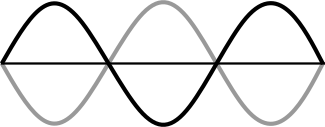
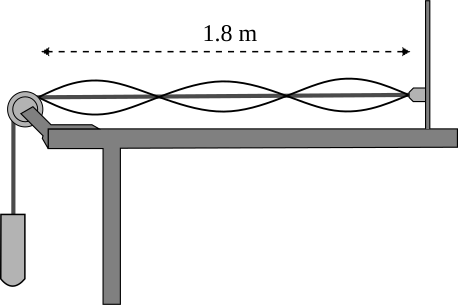
A tightly stretched string, fixed at both ends, is 1.80 m long. When it vibrates at a frequency of 90 Hz, it forms a standing wave pattern with three antinodes (loops) as seen below:
  1. What is the wavelength of the waves on the string?   (1 mark)

--- 2 WORK AREA LINES (style=lined) ---

  1. Calculate the wave speed along the string.   (1 mark)

--- 2 WORK AREA LINES (style=lined) ---

  1. Determine the fundamental frequency (lowest possible standing wave frequency) for this string. Show your reasoning.   (2 marks)

--- 4 WORK AREA LINES (style=lined) ---

Show Answers Only

a.    \(1.20\ \text{m}\)

b.    \(108\ \text{m/s}\)

c.    \(30\ \text{Hz}\)

Show Worked Solution

a.    There are \(\dfrac{3}{2}\lambda\) on the \(1.80\ \text{m}\) string.

\(\therefore \lambda = \dfrac{2}{3} \times 1.80 = 1.20\ \text{m}\)
 

b.    \(v = f\lambda = 90 \times 1.2 = 108\ \text{m/s}\).
 

c.    Fundamental frequency occurs when the wavelength of the standing wave is the largest.

  • This will occur when \(\dfrac{\lambda}{2} = 1.80\ \text{m} \ \Rightarrow \ \lambda = 3.6\ \text{m}\).
  •    \(f = \dfrac{v}{\lambda} = \dfrac{108}{3.6} = 30\ \text{Hz}\).

Filed Under: Sound Waves Tagged With: Band 3, Band 5, smc-4280-20-Modelling standing waves

PHYSICS, M3 EQ-Bank 2 MC

A standing wave with a wavelength of 48 cm is formed along a stretched string, as shown in the diagram.
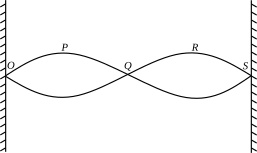
 

If Point \(P\) on the string is an antinode, what is the horizontal distance between Point \(P\) and the next closest antinode?

  1.  12 cm
  2. 24 cm
  3. 48 cm
  4. 96 cm
Show Answers Only

\(B\)

Show Worked Solution
  • The distance between two adjacent antinodes is \(\dfrac{1}{2} \lambda\).
  • Distance from \(P\) to the next antinode = \(48 \times \dfrac{1}{2} = 24\ \text{cm}\).

\(\Rightarrow B\)

Filed Under: Sound Waves Tagged With: Band 3, smc-4280-20-Modelling standing waves

PHYSICS, M3 EQ-Bank 1

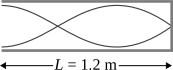
The diagram below shows a standing wave pattern in a closed pipe with a total length of 1.2 metres.
 

The speed of sound in air is 340 ms\(^{-1}\).

Determine the wavelength of the standing wave and state the number of nodes in the diagram.   (2 marks)

--- 4 WORK AREA LINES (style=lined) ---
Show Answers Only
  • \(\lambda = 1.6\ \text{m}\).
  • There are two nodes in the diagram.
Show Worked Solution
  • There is \(\dfrac{3}{4}\) of a wavelength in the closed pipe which is 1.2 m long.
  •    \(\dfrac{3}{4}\lambda=1.2\ \ \Rightarrow \ \ \lambda=1.2 \times \dfrac{4}{3}=1.6\ \text{m}\)
  • A node is a point along a standing wave where there is no movement. The displacement of the medium is always zero at that location.
  • There are two nodes in the diagram.

Filed Under: Sound Waves Tagged With: Band 4, smc-4280-20-Modelling standing waves

PHYSICS, M3 2023 VCE 11

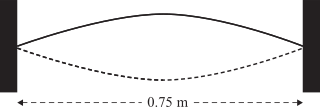
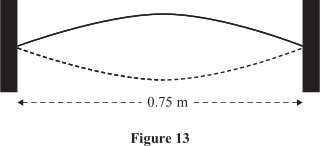
A guitar string of length 0.75 m and fixed at both ends is plucked and a standing wave is produced. The envelope of the standing wave is shown in the diagram.
 

The speed of the wave along the string is 393 m s\( ^{-1}\).

  1. What is the frequency of the wave?   (1 mark)

    --- 2 WORK AREA LINES (style=lined) ---

  2. Describe how the standing wave is produced on the string fixed at both ends.   (2 marks)

    --- 3 WORK AREA LINES (style=lined) ---

Show Answers Only

a.    262 Hz

b.   Standing wave:

  • When waves encounter fixed ends, they reflect.
  • If the string’s length is a multiple of half the wavelength, the reflected wave combines with the original wave, resulting in interference that forms a standing wave pattern
Show Worked Solution

a.   \(f=\dfrac{v}{\lambda}=\dfrac{393}{1.5}=262\ \text{Hz}\)
 

b.   Standing wave:

  • When waves encounter fixed ends, they reflect.
  • If the string’s length is a multiple of half the wavelength, the reflected wave combines with the original wave, resulting in interference that forms a standing wave pattern
♦ Mean mark (b) 47%.

Filed Under: Sound Waves, Wave Properties and Behaviour Tagged With: Band 4, Band 5, smc-4278-20-Wave calculations, smc-4280-20-Modelling standing waves

PHYSICS, M3 2017 VCE 16

Standing waves are formed on a string of length 4.0 m that is fixed at both ends. The speed of the waves is 240 m s\(^{-1}\).

  1. Calculate the wavelength of the lowest frequency resonance.  (2 marks)

    --- 3 WORK AREA LINES (style=lined) ---

  2. Calculate the frequency of the second-lowest frequency resonance.  (2 marks)

    --- 3 WORK AREA LINES (style=lined) ---

  3. Explain the physics of how standing waves are formed on the string. Include a diagram in your response.  (3 marks)

    --- 6 WORK AREA LINES (style=lined) ---

Show Answers Only

a.    30 Hz

b.    60 Hz

c.    Standing waves:

  • Produced when a wave travels down a string and is reflected back on itself such that the superposition of the two waves produce an interference pattern to form a standing wave.
  • The two waves must be travelling in opposite directions with the same frequency, wavelength and amplitude.


Show Worked Solution

a.     Lowest frequency resonance:

  • Occurs at the maximum wavelength. The maximum wavelength is 8 metres since the half wavelength is the length of the string (4m).
  •    \(f=\dfrac{v}{\lambda}=\dfrac{240}{8}=30\ \text{Hz}\) 

b.   When \(\lambda = 4: \)

    \(f=\dfrac{v}{\lambda}=\dfrac{240}{4}=60\ \text{Hz}\)
 

c.    Standing waves:

  • Produced when a wave travels down a string and is reflected back on itself such that the superposition of the two waves produce an interference pattern to form a standing wave.
  • The two waves must be travelling in opposite directions with the same frequency, wavelength and amplitude.


♦ Mean mark (c) 43%.

Filed Under: Sound Waves, Wave Properties and Behaviour Tagged With: Band 4, Band 5, smc-4278-20-Wave calculations, smc-4280-20-Modelling standing waves

PHYSICS, M3 2019 VCE 13

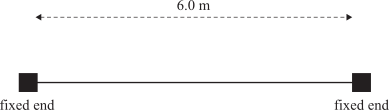
In an experimental set-up used to investigate standing waves, a 6.0 m length of string is fixed at both ends, as shown in diagram below. The string is under constant tension, ensuring that the speed of the wave pulses created is a constant 40 ms\(^{-1}\).


In an initial experiment, a continuous transverse wave of frequency 7.5 Hz is generated along the string.

  1. Determine the wavelength of the transverse wave travelling along the string.   (1 mark)

    --- 3 WORK AREA LINES (style=lined) ---

  2. Will a standing wave form? Give a reason for your answer.   (2 marks)

    --- 4 WORK AREA LINES (style=lined) ---

Show Answers Only

a.    \(\lambda=5.3\ \text{m}\)

b.    A standing wave will not form.

  • A standing wave will only form if the length of the string is equal to an integer multiple of \(\dfrac{\lambda}{2}\).
  • Since 6.0 m is not an integer multiple of \(\dfrac{5.3}{2}\) m, a standing wave will not form.

Show Worked Solution

a.    \(\lambda = \dfrac{v}{f} = \dfrac{40}{7.5} = 5.3\ \text{m} \) 

 
b.
   A standing wave will not form.

  • A standing wave will only form if the length of the string is equal to an integer multiple of \(\dfrac{\lambda}{2}\).
  • Since 6.0 m is not an integer multiple of \(\dfrac{5.3}{2}\) m, a standing wave will not form.
♦♦ Mean mark (b) 38%.

Filed Under: Sound Waves Tagged With: Band 3, Band 5, smc-4280-20-Modelling standing waves

PHYSICS, M3 2020 VCE 13

A 0.8 m long guitar string is set vibrating at a frequency of 250 Hz. The standing wave envelope created in the guitar string is shown in the diagram below.
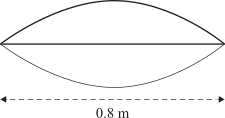
 

  1. Calculate the speed of the wave in the guitar string.   (2 marks)

    --- 4 WORK AREA LINES (style=lined) ---

  2. The frequency of the vibration in the guitar string is tripled to 750 Hz.
  3. On the guitar string below, draw the shape of the standing wave envelope now created.   (2 marks)


--- 0 WORK AREA LINES (style=lined) ---

Show Answers Only

a.   \(v=400\ \text{ms}^{-1}\)

b. 
       

Show Worked Solution
a.    \(v\) \(=f\lambda\)  
  \(=250 \times 1.6 \)  
  \(=400\ \text{ms}^{-1}\)  

  
b.
         

  • Tripling the frequency means decreasing the wavelength by a factor of 3, hence three half wavelengths will now fit on the string.

Filed Under: Sound Waves Tagged With: Band 3, Band 4, smc-4280-20-Modelling standing waves

Copyright © 2014–2025 SmarterEd.com.au · Log in