SmarterEd

Aussie Maths & Science Teachers: Save your time with SmarterEd

  • Login
  • Get Help
  • About

PHYSICS, M3 EQ-Bank 11 MC

Which of the following is always true when light undergoes refraction as it passes from one transparent medium into another?

  1. The light will always bend away from the normal.
  2. The frequency of the light will increase.
  3. The angle of incidence will always equal the angle of refraction.
  4. The speed and wavelength of light will change.
Show Answers Only

\(D\)

Show Worked Solution
  • A is incorrect as the light will bend towards or away from the normal depending on whether the light is a denser and less dense medium respectively.
  • B is incorrect as the frequency of light is independent of the medium the light is travelling through.
  • C is incorrect as this is only true if the two media have the same refractive index.
  • D is correct as light slows down or speeds up depending on the refractive index of the medium. Since frequency remains constant, a change in speed causes the wavelength to change.

\(\Rightarrow D\)

Filed Under: Ray Model of Light Tagged With: Band 4, smc-4281-10-Snell's Law, smc-4281-20-Snell's Law and TIR

PHYSICS, M3 EQ-Bank 5

Optical fibres are made using materials with different refractive indices to allow total internal reflection. The diagram below shows an optical fibre with a core and an outer cladding.

A laser beam with a wavelength of 620 nm in air is directed into the fibre from air.
 

  1. Calculate the frequency of the laser light before entering the optical fibre.   (2 marks)

--- 4 WORK AREA LINES (style=lined) ---

  1. The refractive index of the core is 1.50 and the cladding is 1.40. Calculate the critical angle at the core–cladding boundary.
    Show all working.   (2 marks)

--- 4 WORK AREA LINES (style=lined) ---

  1. What is the frequency of the light while it is travelling through the optical fibre?   (1 mark)

--- 2 WORK AREA LINES (style=lined) ---

Show Answers Only

a.    \(4.84 \times 10^{14}\ \text{Hz}\)

b.    \(61.9^{\circ}\)

c.    → Frequency of light is independent of the medium it is travelling through.

→ The frequency will be \(4.84 \times 10^{14}\ \text{Hz}\) as it travels though the optical fibre.

Show Worked Solution
a.     \(f\) \(=\dfrac{c}{\lambda}\)
    \(=\dfrac{3 \times 10^8}{620 \times 10^{-9}}\)
    \(=4.84 \times 10^{14}\ \text{Hz}\)


b.     \(\sin\theta_c\) \(=\dfrac{n_1}{n_2}\)
  \(\theta_c\) \(=\sin^{-1}\left(\dfrac{n_1}{n_2}\right)=\sin^{-1}\left(\dfrac{1.5}{1.7}\right)=61.9^{\circ}\)

 
c.   
Frequency of light:

  • Frequency of light is independent of the medium it is travelling through.
  • The frequency will be \(4.84 \times 10^{14}\ \text{Hz}\) as it travels though the optical fibre.

Filed Under: Ray Model of Light Tagged With: Band 4, Band 5, smc-4281-20-Snell's Law and TIR

PHYSICS, M3 EQ-Bank 4

Describe the two conditions must be met for total internal reflection to occur when light travels between two media?   (2 marks)

--- 4 WORK AREA LINES (style=lined) ---

Show Answers Only
  • Light must travel from a medium with a higher refractive index to a medium with a lower refractive index. This ensures that the light is moving from a denser to a less dense optical medium (e.g. from glass to air).
  • The angle of incidence must be greater than the critical angle. When this happens, instead of refracting, the light is completely reflected back into the denser medium.
Show Worked Solution
  • Light must travel from a medium with a higher refractive index to a medium with a lower refractive index. This ensures that the light is moving from a denser to a less dense optical medium (e.g. from glass to air).
  • The angle of incidence must be greater than the critical angle. When this happens, instead of refracting, the light is completely reflected back into the denser medium.

Filed Under: Ray Model of Light Tagged With: Band 4, smc-4281-20-Snell's Law and TIR

PHYSICS, M3 EQ-Bank 3

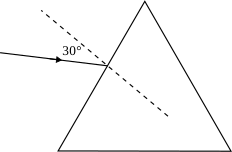
A light beam enters a glass prism with a refractive index \((n)\) of 1.60.
 

  1. What happens to the speed of the light as it enters the glass prism from air?   (1 mark)

--- 3 WORK AREA LINES (style=lined) ---

  1. A beam of green light with a frequency of 5.2 \(\times\) 10\(^{14}\) enters the glass. Calculate the wavelength of this light inside the prism.   (1 mark)

--- 2 WORK AREA LINES (style=lined) ---

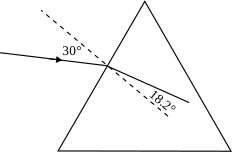
  1. The beam strikes the surface of the prism at an angle of incidence of 30\(^{\circ}\). Calculate the angle of refraction for the beam as it enters the prism, and draw a line on the diagram (above) to show the direction of the beam inside the prism.    (2 marks)

    --- 4 WORK AREA LINES (style=lined) ---

  2. Define the term critical angle, and calculate the critical angle for the glass-to-air boundary of the prism.   (2 marks)

--- 4 WORK AREA LINES (style=lined) ---

Show Answers Only

a.    The speed of the light will slow down.

b.    \(3.6 \times 10^{-7}\ \text{m}\)

c.    \(18.2^{\circ}\)

d.   Critical angle definition:

  • The minimum angle of incidence in a denser medium (like glass) at which light is refracted along the boundary between two media (i.e. refracted at 90° to the normal).
  • If the angle of incidence is greater than the critical angle, total internal reflection occurs. i.e. the light is reflected back entirely into the denser medium.
  • The critical angle for the glass to air boundary is 38.7°.
Show Worked Solution

a.    Using  \(n = \dfrac{c}{v}:\)

\(v_g = \dfrac{c}{n_g} = \dfrac{3 \times 10^8}{1.6} = 1.875 \times 10^8\ \text{ms}^{-1}\)

  • The speed of the light will slow down.
     

b.    Using  \(v=f \times \lambda\):

\(\lambda_g = \dfrac{v_g}{f} = \dfrac{1.875 \times 10^8}{5.2 \times 10^{14}} = 3.6 \times 10^{-7}\ \text{m}\)
 

c.    Using Snell’s Law:

\(n_1 \sin \theta_1\) \(=n_2 \sin\theta_2\)  
\(\theta_2\) \(=\sin^{-1}\left(\dfrac{n_1 \sin\theta_1}{n_2}\right)=\sin^{-1}\left(\dfrac{1 \times \sin30}{1.60}\right)=18.2^{\circ}\)  


d.   Critical angle definition:

  • The minimum angle of incidence in a denser medium (like glass) at which light is refracted along the boundary between two media (i.e. refracted at 90° to the normal).
  • If the angle of incidence is greater than the critical angle, total internal reflection occurs. i.e. the light is reflected back entirely into the denser medium.
  • Using  \(\sin \theta_c=\dfrac{n_2}{n_1}\)
  •    \(\theta_c= \sin^{-1}\left(\dfrac{n_2}{n_1}\right) = \sin^{-1}\left(\dfrac{1}{1.6}\right) = 38.7^{\circ}\)
  • The critical angle for the glass to air boundary is 38.7°.

Filed Under: Ray Model of Light Tagged With: Band 3, Band 4, smc-4281-20-Snell's Law and TIR, smc-4281-40-Speed of light in medium

PHYSICS, M3 EQ-Bank 1

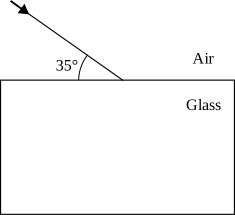
A ray of light of wavelength 4 \(\times\) 10\(^{-7}\) metres crosses from air into a block of glass as shown below. The refractive index of the glass is 1.6.
 

  1. What will be the angle of refraction in the glass?   (2 marks)

--- 4 WORK AREA LINES (style=lined) ---

  1. What is the speed of the light within the glass?   (1 mark)

--- 2 WORK AREA LINES (style=lined) ---

  1. What is the frequency of the light within the glass?   (2 marks)

--- 4 WORK AREA LINES (style=lined) ---

Show Answers Only

a.    \(30.8^{\circ}\)

b.    \(1.88 \times 10^8\ \text{ms}^{-1}\)

c.    \(7.5 \times 10^{14}\)

Show Worked Solution

a.    Using Snell’s Law:

\(n_1 \sin\theta_1\) \(=n_2 \sin \theta_2\)  
\(\theta_2\) \(=\sin^{-1}\left(\dfrac{n_1 \sin\theta_1}{n_2}\right)\)  
\(\theta_2\) \(=\sin^{-1}\left(\dfrac{1 \times \sin 55}{1.6}\right)\), where the angle of incidence is between the ray and the normal.   
  \(=30.8^{\circ}\)  


b.   \(v_g=\dfrac{c}{n_g}=\dfrac{3 \times 10^8}{1.6}=1.88 \times 10^8\ \text{ms}^{-1}\)
 

c.    The frequency of light is independent of the medium it is travelling through.

  • The frequency of the light in the glass will be the same as the frequency of the light in air.
  •    \(f=\dfrac{c}{\lambda_{\text{air}}} = \dfrac{3 \times 10^8}{4 \times 10^{-7}} = 7.5 \times 10^{14}\)

Filed Under: Ray Model of Light Tagged With: Band 4, Band 5, smc-4281-10-Snell's Law, smc-4281-20-Snell's Law and TIR, smc-4281-40-Speed of light in medium

PHYSICS, M3 EQ-Bank 8 MC

A beam of light is travelling from a transparent liquid into air. The refractive index of the liquid is 1.4.

What is the critical angle for light passing from the liquid into air?

  1. 30.0\(^{\circ}\)
  2. 45.6\(^{\circ}\)
  3. 54.6\(^{\circ}\)
  4. 65.4\(^{\circ}\)
Show Answers Only

\(B\)

Show Worked Solution
  • Using the critical angle formula:
\(\sin \theta_c\) \(=\dfrac{n_2}{n_1}\)  
\(\theta_c\) \(=\sin^{-1}\left(\dfrac{n_2}{n_1}\right)\)  
  \(=\sin^{-1}\left(\dfrac{1}{1.4}\right)\)  
  \(=45.6^{\circ}\)  

 
\(\Rightarrow B\)

Filed Under: Ray Model of Light Tagged With: Band 4, smc-4281-20-Snell's Law and TIR

PHYSICS, M3 EQ-Bank 5 MC

What is the critical angle for light travelling from water (refractive index 1.33) into air?

  1. \(35.0^{\circ}\)
  2. \(41.3^{\circ}\)
  3. \(48.8^{\circ}\)
  4. \(90.0^{\circ}\)
Show Answers Only

\(C\)

Show Worked Solution
  • Using the critical angle formula:
\(\sin \theta_c\) \(=\dfrac{n_2}{n_1}\)  
\(\theta_c\) \(=\sin^{-1}\left(\dfrac{n_2}{n_1}\right)\)  
  \(=\sin^{-1}\left(\dfrac{1}{1.33}\right)\)  
  \(=48.8^{\circ}\)  

 
\(\Rightarrow C\)

Filed Under: Ray Model of Light Tagged With: Band 4, smc-4281-20-Snell's Law and TIR

PHYSICS, M3 2023 VCE 12

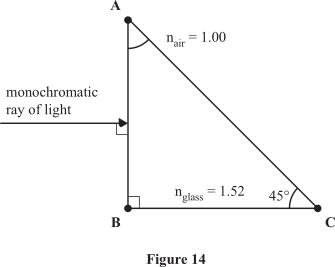
A ray of monochromatic light is incident on a triangular glass prism with a refractive index of 1.52 . The ray is perpendicular to the side \(\text{AB}\) of the glass prism, as shown in the diagram below.
  

The ray of light travels through the glass prism before reaching side \(\text{AC}\).

  1. Calculate the critical angle for the glass prism at the glass-air interface.   (2 marks)

    --- 4 WORK AREA LINES (style=lined) ---

  2. Will the ray of light undergo total internal reflection at side \(\text{AC}\) of the glass prism? Justify your answer.   (2 marks)

    --- 4 WORK AREA LINES (style=lined) ---

Show Answers Only

a.    41°

b.    Total internal reflection:

  • The angle of incidence 45° is greater than the critical angle 41°.
  • Therefore, total internal reflection will occur on side \(\text{AC}\).

Show Worked Solution

a.     \(\sin \theta_c\) \(=\dfrac{n_2}{n_1}\)
  \(\theta_c\) \(=\sin^{-1}(\dfrac{n_2}{n_1})=\sin^{-1}(\dfrac{1.0}{1.52})=41^{\circ}\)

 
b. 
  Total internal reflection:

  • The angle of incidence 45° is greater than the critical angle 41°.
  • Therefore, total internal reflection will occur on side \(\text{AC}\).
♦ Mean mark (b) 46%.

Filed Under: Ray Model of Light Tagged With: Band 4, Band 5, smc-4281-20-Snell's Law and TIR

PHYSICS, M3 2017 VCE 14

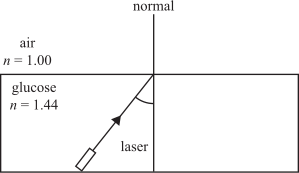
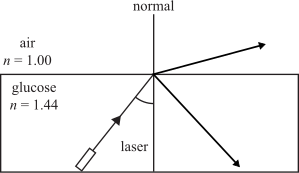
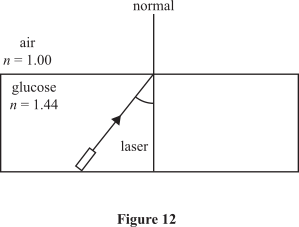
A light ray from a laser passes from a glucose solution \((n=1.44)\) into the air \((n=1.00)\), as shown in Figure 12.
 

  1. Calculate the critical angle (total internal reflection) from the glucose solution to the air.   (1 mark)

    --- 2 WORK AREA LINES (style=lined) ---

  2. The light ray strikes the surface at an angle of incidence to the normal of less than the critical angle calculated in part a.
  3. On the diagram above, sketch the ray or rays that should be observed.   (2 marks)

    --- 0 WORK AREA LINES (style=lined) ---

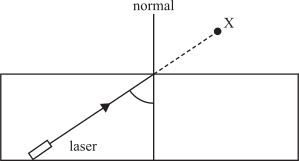
  4. The angle to the normal is increased to a value greater than the critical angle. An observer at point \(\text{X}\) in the image below says she cannot see the laser.
     

  1. Explain why the observer says she cannot see the laser.   (2 marks)

    --- 6 WORK AREA LINES (style=lined) ---

Show Answers Only

a.    \(\theta_c=44^{\circ}\)

b.    
       
  • As the light strikes the surface at an angle less than that of the critical angle, both reflection and refraction will be observed. 
c.    Observer cannot see the laser:
  • When the light strikes the surface at an angle greater than the critical angle, Total Internal Reflection will occur.
  • As a result of the total internal reflection, all the light will be reflected off the boundary back into the glucose solution and therefore will not travel to the observer.

Show Worked Solution

a.     \(\sin\theta_c\) \(=\dfrac{n_2}{n_1}\)
  \(\theta_c\) \(=\sin^{-1}\Big{(}\dfrac{1.00}{1.44}\Big{)}=44^{\circ}\)

 
b.


  • As the light strikes the surface at an angle less than that of the critical angle, both reflection and refraction will be observed.
♦♦ Mean mark (b) 37%.

c.    Observer cannot see the laser:

  • When the light strikes the surface at an angle greater than the critical angle, Total Internal Reflection will occur.
  • As a result of the total internal reflection, all the light will be reflected off the boundary back into the glucose solution and therefore will not travel to the observer.

Filed Under: Ray Model of Light Tagged With: Band 3, Band 4, Band 5, smc-4281-20-Snell's Law and TIR

PHYSICS, M3 2018 VCE 12

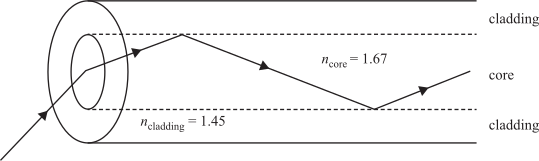
Optical fibres are constructed using transparent materials with different refractive indices.

The diagram below shows one type of optical fibre that has a cylindrical core and surrounding cladding. Laser light of wavelength 565 nm is shone from air into the optical fibre (\(v=3 \times 10^8\)).
 

  1. Calculate the frequency of the laser light before it enters the optical fibre.  (1 mark)

    --- 2 WORK AREA LINES (style=lined) ---

  2. Calculate the critical angle for the laser light at the cladding-core boundary. Show your working.  (2 marks)

    --- 4 WORK AREA LINES (style=lined) ---

  3. Calculate the speed of the laser light once it enters the core of the optical fibre. Give your answer correct to three significant figures. Show your working.  (2 marks)

    --- 4 WORK AREA LINES (style=lined) ---

Show Answers Only

a.    \(f=5.31 \times 10^{14}\ \text{Hz}\)

b.    \(\theta_c=60.3^{\circ}\)

c.    \(v_{\text{x}}=1.80 \times 10^8\ \text{ms}^{-1}\)

Show Worked Solution

a.     \(f\) \(=\dfrac{v}{\lambda}\)
    \(=\dfrac{3\times 10^8}{565 \times 10^{-9}}\)
    \(=5.31 \times 10^{14}\ \text{Hz}\)

 
b.
  \(\theta_c=\sin^{-1}\Big{(}\dfrac{n_2}{n_1}\Big{)}=\sin^{-1} \Big{(}\dfrac{1.45}{1.67} \Big{)}=60.3^{\circ}\) 

c.     \(v_{\text{x}}\) \(=\dfrac{c}{n_{\text{x}}}\)
    \(=\dfrac{3 \times 10^8}{1.67}\)
    \(=1.80 \times 10^8\ \text{ms}^{-1}\)
♦ Mean mark (c) 50%.

Filed Under: Ray Model of Light Tagged With: Band 4, Band 5, smc-4281-20-Snell's Law and TIR, smc-4281-40-Speed of light in medium

PHYSICS, M3 2019 VCE 10*

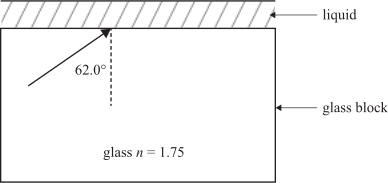
The horizontal face of a glass block is covered with a film of liquid, as shown below.

A monochromatic light ray is incident on the glass-liquid boundary with an angle of incidence of 62.0°.
 

Calculate the minimum value of the liquid's refractive index, so that some light will just cross the interface into the liquid.   (2 marks)

--- 4 WORK AREA LINES (style=lined) ---

Show Answers Only

\(1.55\)

Show Worked Solution
\(\sin\theta_c\) \(=\dfrac{n_2}{n_1}\)  
\(n_2\) \(=\sin\theta_c \times n_1\)  
  \(= \sin62^{\circ} \times 1.75\)  
  \(=1.55\)  

Filed Under: Ray Model of Light Tagged With: Band 4, smc-4281-20-Snell's Law and TIR

PHYSICS, M3 2021 VCE 12

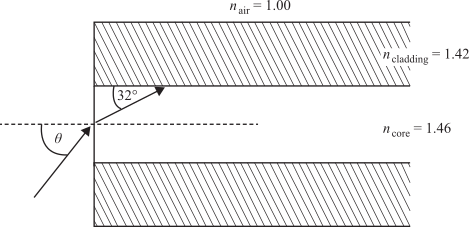
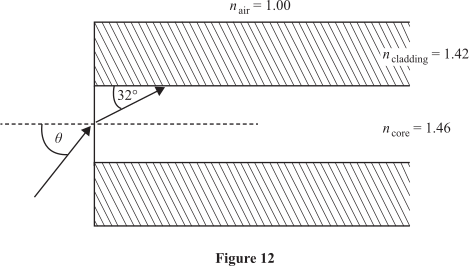
A Physics teacher is conducting a demonstration involving the transmission of light within an optical fibre. The optical fibre consists of an inner transparent core with a refractive index of 1.46 and an outer transparent cladding with a refractive index of 1.42. A single monochromatic light ray is incident on the optical fibre, as shown in diagram below.
 

  1. Determine the angle of incidence, \(\theta\), at the air-core boundary. Show your working.  (2 marks)

    --- 4 WORK AREA LINES (style=lined) ---

  2. Will any of the initial light ray be transmitted into the cladding? Explain your answer and show any supporting working.  (3 marks)

    --- 6 WORK AREA LINES (style=lined) ---

Show Answers Only

a.   \(\theta=51^{\circ}\)

b.    Find the critical angle for Total Internal Reflection (TIR):

\(\sin\theta_c\) \(=\dfrac{n_2}{n_1}\)  
\(\theta_c\) \(=\sin^{-1}\Big{(}\dfrac{n_2}{n_1}\Big{)} =\sin^{-1} \Big{(}\dfrac{1.42}{1.46} \Big{)}=76.6^{\circ}\)  
  • The angle of incidence \(=90^{\circ}-32^{\circ}=58^{\circ}\).
  • As the angle of incidence is less than the critical angle, TIR will not occur and light will be transmitted into the cladding.
Show Worked Solution

a.    Using Snell’s Law:

\(n_1\sin\theta_1\) \(=n_2\sin\theta_2\)  
\(\theta_1\) \(=\sin^{-1} \Big{(}\dfrac{n_2\sin\theta_2}{n_1} \Big{)} \)  
  \(=\sin^{-1}\Big{(}\dfrac{1.46 \times \sin32^{\circ}}{1.0}\Big{)} \)  
  \(=51^{\circ}\)  
     

b.    Find the critical angle for Total Internal Reflection (TIR):

\(\sin\theta_c\) \(=\dfrac{n_2}{n_1}\)  
\(\theta_c\) \(=\sin^{-1}\Big{(}\dfrac{n_2}{n_1}\Big{)} =\sin^{-1} \Big{(}\dfrac{1.42}{1.46} \Big{)}=76.6^{\circ}\)  
  • The angle of incidence \(=90^{\circ}-32^{\circ}=58^{\circ}\).
  • As the angle of incidence is less than the critical angle, TIR will not occur and light will be transmitted into the cladding. 
♦ Mean mark (b) 45%.

Filed Under: Ray Model of Light Tagged With: Band 4, Band 5, smc-4281-10-Snell's Law, smc-4281-20-Snell's Law and TIR

PHYSICS, M3 2022 VCE 12*

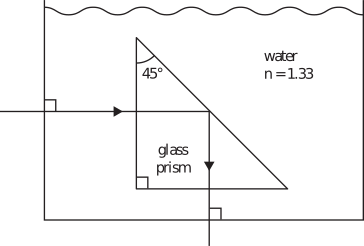
A 45° glass prism is submerged in water and oriented as shown in the diagram below. It is used to reflect a light ray through 90°.
 

What is the lowest refractive index of the glass prism that will ensure that total internal reflection occurs inside the prism?   (2 marks)

--- 4 WORK AREA LINES (style=lined) ---

Show Answers Only

\(1.88\)

Show Worked Solution

Using snell’s law where  \( \theta_2 = 90^{\circ}\):

\(n_1\sin\theta_1\) \(=n_2\sin\theta_2\)  
\(n_1 \times \sin 45^{\circ}\) \(=1.33 \times \sin 90^{\circ}\)  
\(n_1\) \(=\dfrac{1.33 \times 1}{\sin 45^{\circ}}\)  
  \(=1.88\)  
♦ Mean mark 51%.

Filed Under: Ray Model of Light Tagged With: Band 5, smc-4281-20-Snell's Law and TIR

PHYSICS, M3 2013 HSC 33b

Outline a first-hand investigation to demonstrate the transfer of light by optical fibres.   (2 marks)

--- 6 WORK AREA LINES (style=lined) ---

Show Answers Only
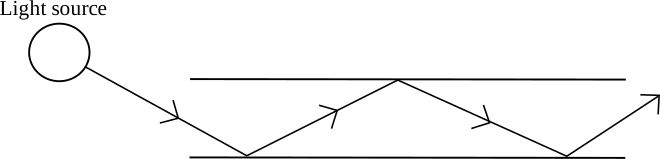
  • Using a laser beam or other light source, shine the light into a glass rod at an angle at an angle greater than the critical angle.
  • The light beam can then be seen to reflect off either side of the glass rod as it travels down the line of the rod.
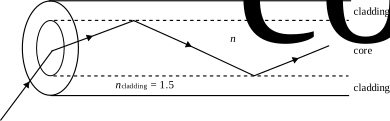
  • This is called total internal reflection (TIR) and demonstrates effectively how light travels through a optical fibre, As seen in the diagram below.


Show Worked Solution

  • Using a laser beam or other light source, shine the light into a glass rod at an angle at an angle greater than the critical angle.
  • The light beam can then be seen to reflect off either side of the glass rod as it travels down the line of the rod.
  • This is called total internal reflection (TIR) and demonstrates effectively how light travels through a optical fibre, As seen in the diagram below.


Filed Under: Ray Model of Light Tagged With: Band 4, smc-4281-20-Snell's Law and TIR

Copyright © 2014–2025 SmarterEd.com.au · Log in