SmarterEd

Aussie Maths & Science Teachers: Save your time with SmarterEd

  • Login
  • Get Help
  • About

PHYSICS, M3 EQ-Bank 8 MC

A 0.2 kg block of ice at 0\(^{\circ}\)C is dropped into 400 mL of water at 50\(^{\circ}\)C. Assuming no heat is lost to the surroundings and the latent heat of fusion of ice is \(3.3 \times 10^5\) J/kg, what will be the final state of the system?

  1. Some ice remains, and water is at 0\(^{\circ}\)C
  2. Ice melts completely, and final temperature is between 0\(^{\circ}\)C and 50\(^{\circ}\)C
  3. All the water freezes
  4. Ice melts completely and final temperature is 0\(^{\circ}\)C
Show Answers Only

\(B\)

Show Worked Solution
  • Energy required to melt the ice:
  •    \(Q = mL = 0.2 \times 3.3 \times 10^5 = 66\,000\ \text{J}\)
  • Energy available from cooling the water:
  •    \(Q = mc\Delta t = 0.4 \times 4200 \times 50 = 84\,000\ \text{J}\)
  • The water has enough energy to melt the ice and heat the result above \(0^{\circ}\).

\(\Rightarrow B\)

Filed Under: Thermodynamics Tagged With: Band 6, smc-4282-30-Q=mcΔt, smc-4282-35-Quantitative calcs

PHYSICS, M3 EQ-Bank 17

A sealed container contains 2.0 kg of steam at 100\(^{\circ}\)C. The container is placed in a fridge and cooled until all the steam has condensed and the resulting water has cooled to 5\(^{\circ}\)C. Using the specific latent heat of vaporisation of water: 2.3 \(\times\) 10\(^6\) J kg\(^{-1}\),

  1. Calculate the energy removed during condensation.   (1 marks)

--- 2 WORK AREA LINES (style=lined) ---

  1. Calculate the total energy that must be removed from the container.   (2 mark)

--- 4 WORK AREA LINES (style=lined) ---

  1. Explain why steam burns are more dangerous than boiling water burns.   (2 mark)

--- 2 WORK AREA LINES (style=lined) ---

Show Answers Only

a.    \(4.6 \times 10^6\ \text{J}\)

b.    \(5.4 \times 10^6\ \text{J}\)

c.   Steam burns are more dangerous than boiling water burns as:

  • Steam contains additional energy in the form of latent heat from the phase change.
  • When steam condenses on the skin, it releases this latent heat of vaporisation, transferring more energy than boiling water at the same temperature, causing more severe tissue damage.
Show Worked Solution

a.    Using the specific latent heat of vaporisation:

\(Q = 2 \times 2.3 \times 10^6 = 4.6 \times 10^6\ \text{J}\)
 

b.    The heat energy lost to reduce the temperature of water from 100\(^{\circ}\)C to 5\(^{\circ}\)C:

\(Q=mc\Delta T = 2 \times 4.18 \times 10^3 \times (100-5) = 7.942 \times 10^5\ \text{J}\)

  • The total energy that must be removed from the container is the latent heat of vaporization and the energy require to cool the water down to 5\(^{\circ}\).
  •     \(E_T= 4.6 \times 10^6 + 7.942 \times 10^5 = 5.4 \times 10^6\ \text{J}\) 

c.   Steam burns are more dangerous than boiling water burns because:

  • Steam contains additional energy in the form of latent heat from the phase change.
  • When steam condenses on the skin, it releases this latent heat of vaporisation, transferring more energy than boiling water at the same temperature, causing more severe tissue damage.

Filed Under: Thermodynamics Tagged With: Band 4, Band 5, smc-4282-30-Q=mcΔt, smc-4282-35-Quantitative calcs, smc-4282-50-Latent heat

PHYSICS, M3 EQ-Bank 16

A student places 200 g of aluminium at 80\(^{\circ}\)C into 300 g of water at 20\(^{\circ}\)C, in an insulated container. Use the specific heat capacity of aluminium (897 J kg\(^{-1}\) K\(^{-1}\)) to calculate the final equilibrium temperature.   (3 marks)

--- 6 WORK AREA LINES (style=lined) ---

Show Answers Only

\(27.5^{\circ}\text{C}\)

Show Worked Solution
  • By the Conservation of Energy, heat lost by aluminium will be gained by the water.
  • Using  \(m_{\text{a}}c_{\text{a}}\Delta T_{\text{a}}=m_{\text{w}}c_{\text{w}}\Delta T_{\text{w}}\):
\(0.2 \times 897 \times (80-T_f)\) \(=0.3 \times 4.18 \times 10^3 \times (T_f-20)\)  
\(14\,352-179.4T_f\) \(=1254T_f-25\,080\)  
\(1433.4T_f\) \(=39\,432\)  
\(T_f\) \(=27.5^{\circ}\text{C}\)  

Filed Under: Thermodynamics Tagged With: Band 4, smc-4282-30-Q=mcΔt, smc-4282-35-Quantitative calcs, smc-4282-40-Energy transfer

PHYSICS, M3 EQ-Bank 14

A student performs an experiment to determine the specific heat capacity of aluminium.

She heats a 0.40 kg block of aluminium to 90\(^{\circ}\)C, then quickly places it into a beaker containing 0.60 kg of oil at an initial temperature of 25\(^{\circ}\)C. After some time, the final equilibrium temperature of the aluminium and the oil is found to be 32\(^{\circ}\)C. The student knows that the specific heat capacity of the oil is 2.00 \(\times\) 10\(^3\) J kg\(^{-1}\)\(^{\circ}\)C\(^{-1}\).

Use this data to calculate the specific heat capacity of aluminium.   (4 marks)

--- 8 WORK AREA LINES (style=lined) ---

Show Answers Only

\(362\ \text{J/kg}^{\circ}\text{C}\)

Show Worked Solution
  • The energy lost by the block of aluminium is gained by the oil.
  •    \(Q_{\text{oil}} = mc \Delta T = 0.60 \times 2.00 \times 10^3 \times (32-25) = 8400\ \text{J}\).
  •    \(c_{\text{Al}} = \dfrac{Q}{m\Delta t} = \dfrac{8400}{0.4 \times (90-32)} = 362\ \text{J/kg}^{\circ}\text{C}\)
  • The specific heat capacity of Aluminium is \(362\ \text{J/kg}^{\circ}\text{C}\).

Filed Under: Thermodynamics Tagged With: Band 4, Band 5, smc-4282-10-Specific heat capacity, smc-4282-30-Q=mcΔt, smc-4282-35-Quantitative calcs

PHYSICS, M3 EQ-Bank 11

An electric kettle is connected to a 24 V power supply and draws a constant current of 2.5 A. It is used to heat 200 mL of water in an insulated container. The water starts at 20.0 \(^{\circ}\)C.

  1. Calculate how many joules of heat energy are added to the water every second. Assume 100% efficiency in energy transfer.   (2 marks)

--- 4 WORK AREA LINES (style=lined) ---

  1. Determine how long it takes to raise the water’s temperature to 60.0 \(^{\circ}\)C.   (3 marks)

--- 6 WORK AREA LINES (style=lined) ---

Show Answers Only

a.    60 joules of energy are added to the water every second.

b.    557 seconds

Show Worked Solution

a.    Joules of heat energy per second is equivalent to the power of kettle.

\(P = IV = 2.5 \times 24 = 60\ \text{W}\)

  • 60 joules of energy are added to the water every second.

b.    The energy required to heat the water to 60.0 \(^{\circ}\)C:

\(Q= mc\Delta T = 200 \times 4.18 \times (60-20) = 33\,440\ \text{J}\)

\(t = \dfrac{Q}{P} = \dfrac{33\,440}{60} = 557\ \text{s}\)

Filed Under: Thermodynamics Tagged With: Band 4, smc-4282-30-Q=mcΔt, smc-4282-35-Quantitative calcs

PHYSICS, M3 EQ-Bank 10

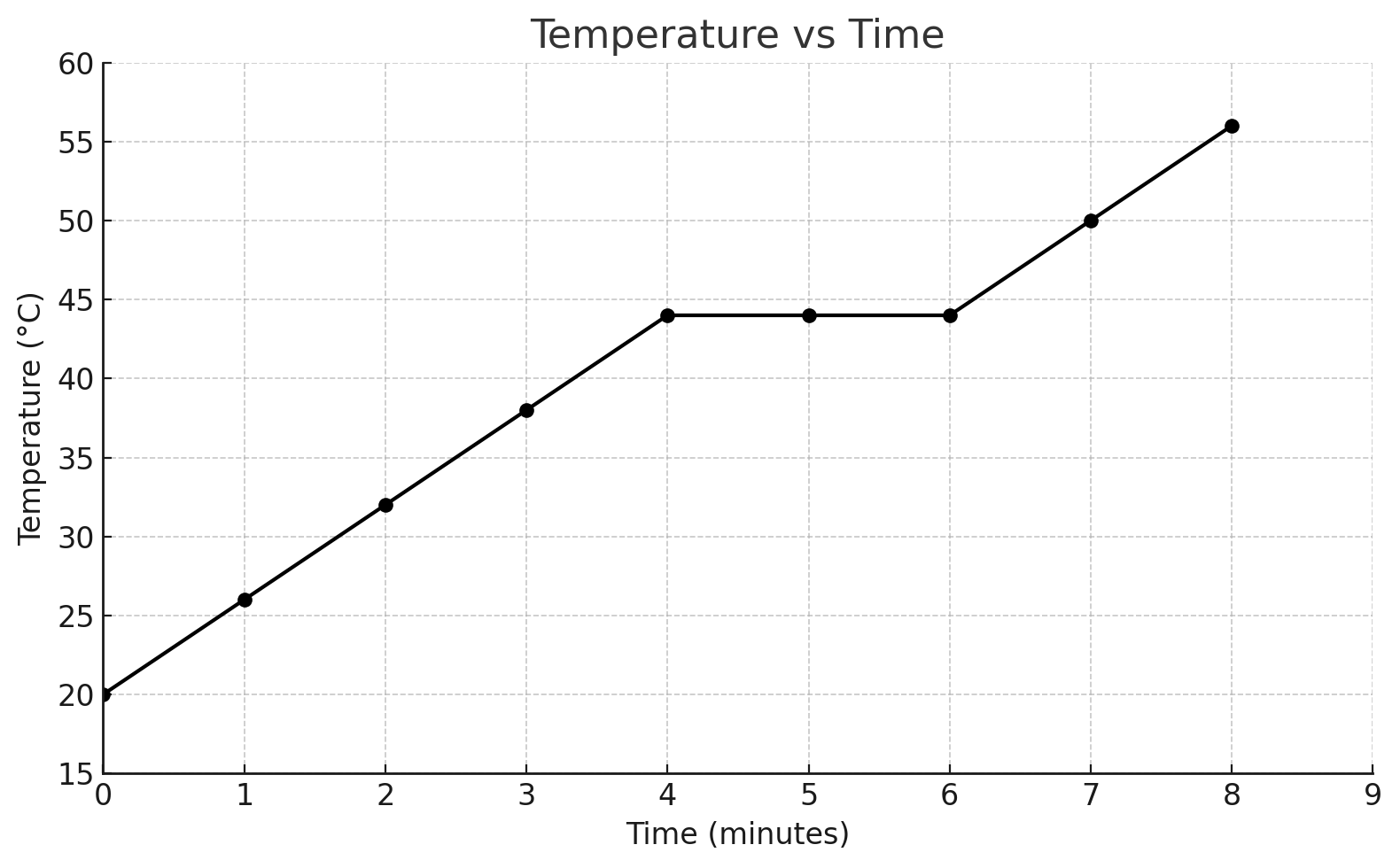
A 150 mL sample of a liquid substance was heated at a constant rate. The sample of this substance has a mass of 300 g. The specific heat capacity of the substance, \(c\), is 0.50 J g\(^{-1}\) K\(^{-1}\).

The heating curve obtained is shown below:
 

Calculate the latent heat absorbed by the sample during vaporization.   (3 marks)

--- 9 WORK AREA LINES (style=lined) ---

Show Answers Only

\(1.8\ \text{kJ}\)

Show Worked Solution
  • To calculate the latent heat absorbed during the flat portion of the heating curve (4–6 minutes), we use the concept that energy is supplied at a constant rate (constant power) throughout the process.
  • Since the heating source is the same, and the slope of the temperature increase before and after the phase change is linear, we can infer that the same amount of energy is delivered per second throughout the entire graph.
  • That means the power input (energy per unit time) is constant during both the heating and the vaporisation stages.
  • The thermal energy absorbed by the sample during the first 4 minutes is:
  •    \(Q= mc \Delta t = 300 \times 0.5 \times (44-20) = 3600\ \text{J}\)
  • The power of the first 4 minutes is:
  •    \(P = \dfrac{3600}{4} = 900\ \text{Jmin}^{-1}\).
  • As the power delivered remains constant throughout the entire process, the latent heat of vaporisation (minute 4-6 on the graph) is:
  •    \(Q_{\text{vap}} = 900 \times 2 = 1800\ \text{J} = 1.8\ \text{kJ}\).

Filed Under: Thermodynamics Tagged With: Band 5, smc-4282-30-Q=mcΔt, smc-4282-35-Quantitative calcs

PHYSICS, M3 EQ-Bank 3 MC

A metal block with a mass of 500 g is heated and it absorbs 10 000 J of thermal energy. As a result, its temperature increases by 20.0\(^{\circ}\)C. Based on this information, what is the specific heat capacity of the metal?

  1. 1.00 J g\(^{-1 \circ}\)C\(^{-1}\)
  2. 1.00 kJ g\(^{-1 \circ}\)C\(^{-1}\)
  3. 1.00 J kg\(^{-1 \circ}\)C\(^{-1}\)
  4. 1000 J g\(^{-1 \circ}\)C\(^{-1}\)
Show Answers Only

\(A\)

Show Worked Solution
\(Q\) \(=mc\Delta t\)  
\(c\) \(=\dfrac{Q}{m \Delta t} =\dfrac{10\,000\ \text{J}}{500\ \text{g} \times 20^{\circ}\text{C}} = 1\ \text{J/g}^{\circ}\text{C}\)  

 
\(\Rightarrow A\)

Filed Under: Thermodynamics Tagged With: Band 4, smc-4282-30-Q=mcΔt, smc-4282-35-Quantitative calcs

PHYSICS, M3 EQ-Bank 1

Jack enjoys drinking green tea at 60°C.

He pours 200 mL of 90°C green tea into a cup and then adds 4°C chilled water to the same cup to cool it down.

What is the minimum amount of chilled water, to the nearest mL, required to cool Jack's green tea to 60°C?   (4 marks)

(Assume the green tea is essentially water and no energy is lost to the surroundings) 

--- 9 WORK AREA LINES (style=lined) ---

Show Answers Only

\(107\ \text{mL}\)

Show Worked Solution
  • The energy contained in the temperature of the green tea that is lost to reduce it to 60°C needs to be used to heat up the chilled water from 4°C to 60°C.
  • Green tea’s change in temperature \(=90^{\circ}-60^{\circ}=30^{\circ}\).
  • The energy that needs to be lost from the green tea can be quantised:
  •    \(Q=mc\Delta t=200 \times 4.18 \times -30=-25\ 080\ \text{J}\)
  • This \(25\ 080\ \text{J}\) then goes into heating up a required amount of chilled water from \(4^{\circ}\) to \(60^{\circ}\).
\(Q\) \(=mc\Delta t\)  
\(25\ 080\) \(=m \times 4.18 \times 56\)  
\(m\) \(=\dfrac{25\ 080}{4.18 \times 56}\)  
  \(=107\ \text{g}\)  
  \(=107\ \text{mL}\)  

Filed Under: Thermodynamics Tagged With: Band 6, smc-4282-30-Q=mcΔt, smc-4282-35-Quantitative calcs

Copyright © 2014–2025 SmarterEd.com.au · Log in