SmarterEd

Aussie Maths & Science Teachers: Save your time with SmarterEd

  • Login
  • Get Help
  • About

PHYSICS, M3 EQ-Bank 6 MC

Thermal equilibrium occurs when:

  1. A substance changes state.
  2. Two objects are at the same temperature and no net heat flows between them.
  3. An object emits more heat than it absorbs.
  4. An object reaches its specific heat capacity.
Show Answers Only

\(B\)

Show Worked Solution
  • Thermal equilibrium describes the state where two or more objects or systems in contact have reached the same temperature, and there is no net transfer of heat between them.

\(\Rightarrow B\)

Filed Under: Thermodynamics Tagged With: Band 3, smc-4282-40-Energy transfer

PHYSICS, M3 EQ-Bank 18

A metal rod of length 2.0 m has one end maintained at 100\(^{\circ}\)C and the other end at 20\(^{\circ}\)C. The rod has a cross-sectional area of 0.001 m\(^2\) and thermal conductivity  \(k\) = 50 W m\(^{-1}\) K\(^{-1}\).

  1. Calculate the rate of heat transfer through the rod.   (2 marks)

--- 4 WORK AREA LINES (style=lined) ---

  1. Explain the process by which heat is transferred through the metal rod.   (2 marks)

--- 4 WORK AREA LINES (style=lined) ---

  1. Suggest two ways the rate of heat transfer could be increased.   (2 marks)

--- 4 WORK AREA LINES (style=lined) ---

Show Answers Only

a.    \(2\ \text{Js}^{-1}\)

b.    Heat is transferred through the metal rod by conduction.

→ In this process, vibrating particles at the hot end transfer energy to adjacent cooler particles by collisions, causing the energy to move along the rod without the particles themselves moving significantly.

c.    Two ways to increase the rate of heat transfer:

  • Increase the temperature difference between the two ends of the material.
  • Use a material with higher thermal conductivity, such as copper instead of wood.

Other answers could include:

  • Increasing the cross-sectional area of the material or decreasing the distance the heat has to travel.
Show Worked Solution

a.    \(\dfrac{Q}{t} = \dfrac{kA\Delta T}{d} = \dfrac{50 \times 0.001 \times (100-20)}{2} = 2\ \text{Js}^{-1}\)
 

b.    Heat is transferred through the metal rod by conduction.

  • In this process, vibrating particles at the hot end transfer energy to adjacent cooler particles by collisions, causing the energy to move along the rod without the particles themselves moving significantly.

c.    Two ways to increase the rate of heat transfer:

  • Increase the temperature difference between the two ends of the material.
  • Use a material with higher thermal conductivity, such as copper instead of wood.

Other answers could include:

  • Increasing the cross-sectional area of the material or decreasing the distance the heat has to travel.

Filed Under: Thermodynamics Tagged With: Band 3, Band 4, smc-4282-35-Quantitative calcs, smc-4282-40-Energy transfer

PHYSICS, M3 EQ-Bank 16

A student places 200 g of aluminium at 80\(^{\circ}\)C into 300 g of water at 20\(^{\circ}\)C, in an insulated container. Use the specific heat capacity of aluminium (897 J kg\(^{-1}\) K\(^{-1}\)) to calculate the final equilibrium temperature.   (3 marks)

--- 6 WORK AREA LINES (style=lined) ---

Show Answers Only

\(27.5^{\circ}\text{C}\)

Show Worked Solution
  • By the Conservation of Energy, heat lost by aluminium will be gained by the water.
  • Using  \(m_{\text{a}}c_{\text{a}}\Delta T_{\text{a}}=m_{\text{w}}c_{\text{w}}\Delta T_{\text{w}}\):
\(0.2 \times 897 \times (80-T_f)\) \(=0.3 \times 4.18 \times 10^3 \times (T_f-20)\)  
\(14\,352-179.4T_f\) \(=1254T_f-25\,080\)  
\(1433.4T_f\) \(=39\,432\)  
\(T_f\) \(=27.5^{\circ}\text{C}\)  

Filed Under: Thermodynamics Tagged With: Band 4, smc-4282-30-Q=mcΔt, smc-4282-35-Quantitative calcs, smc-4282-40-Energy transfer

PHYSICS, M3 EQ-Bank 15

What happens to the temperature of the air inside a can of compressed gas when the gas is suddenly released into the open air? Explain your answer using thermodynamic principles.   (3 marks)

--- 9 WORK AREA LINES (style=lined) ---

Show Answers Only
  • When the compressed gas is suddenly released, it undergoes rapid expansion. During this expansion, the gas does work on the surroundings as it pushes against the external pressure.
  • Because this happens quickly, there is little or no time for heat energy to enter the system from the surroundings.
  • As a result, the internal energy of the gas decreases, which leads to a decrease in temperature. This is explained by the first law of thermodynamics:
  •    \(\Delta U = Q-W\)
  • In this case, \(Q \approx 0\) (no heat input), so  \(\Delta U = -W\), meaning internal energy (and therefore temperature) drops.
Show Worked Solution
  • When the compressed gas is suddenly released, it undergoes rapid expansion. During this expansion, the gas does work on the surroundings as it pushes against the external pressure. Because this happens quickly, there is little or no time for heat energy to enter the system from the surroundings.
  • As a result, the internal energy of the gas decreases, which leads to a decrease in temperature. This is explained by the first law of thermodynamics:
  •    \(\Delta U = Q-W\)
  • In this case, \(Q \approx 0\) (no heat input), so  \(\Delta U = -W\), meaning internal energy (and therefore temperature) drops.

Filed Under: Thermodynamics Tagged With: Band 5, smc-4282-40-Energy transfer

PHYSICS, M3 EQ-Bank 13

Describe three different processes by which thermal energy can be transferred from an area of higher temperature to an area of lower temperature.   (3 marks)

--- 7 WORK AREA LINES (style=lined) ---

Show Answers Only
  • Thermal energy can be transferred from a region of higher temperature to a region of lower temperature through conduction, convection, and radiation.
  • Conduction occurs when heat is transferred through direct contact between particles in a solid. The particles with more kinetic energy vibrate and pass energy to neighbouring particles.
  • Convection happens in liquids and gases when warmer, less dense areas rise and cooler, denser areas sink. This movement creates a circulating current that transfers heat throughout the fluid.
  • Radiation involves the transfer of energy by electromagnetic waves, such as infrared radiation. It does not require a medium and can occur through a vacuum.
Show Worked Solution
  • Thermal energy can be transferred from a region of higher temperature to a region of lower temperature through conduction, convection, and radiation.
  • Conduction occurs when heat is transferred through direct contact between particles in a solid. The particles with more kinetic energy vibrate and pass energy to neighbouring particles.
  • Convection happens in liquids and gases when warmer, less dense areas rise and cooler, denser areas sink. This movement creates a circulating current that transfers heat throughout the fluid.
  • Radiation involves the transfer of energy by electromagnetic waves, such as infrared radiation. It does not require a medium and can occur through a vacuum.

Filed Under: Thermodynamics Tagged With: Band 4, smc-4282-40-Energy transfer

PHYSICS, M3 EQ-Bank 5 MC

A warm ceramic mug is placed on a cold metal bench. After a while, both the mug and the bench feel equally cool to the touch.

Which of the following best explains what happened?

  1. Temperature flowed from the mug to the bench until their energies were equal.
  2. Heat flowed from the mug to the bench because the mug had more internal energy.
  3. Heat flowed from the mug to the bench because the mug had a higher temperature.
  4. The mug cooled down because it had less mass than the bench.
Show Answers Only

\(C\)

Show Worked Solution
  • Temperature doesn’t “flow” from one substance to another, it is the heat (energy) that does.
  • Heat transfer is driven by the temperature difference between two substances, not the total internal energy of those substances.
  • Mass affects how much temperature changes, but not the direction of heat flow.

\(\Rightarrow C\)

Filed Under: Thermodynamics Tagged With: Band 3, smc-4282-40-Energy transfer

PHYSICS, M3 EQ-Bank 4 MC

On a cold morning, a sealed football is left outside on the field. Players notice that it feels softer and doesn't bounce as well as it did the day before when it was warmer.

Which statement best explains this observation using thermodynamic principles?

  1. The lower external temperature reduces the internal energy of the air in the ball, decreasing gas pressure and making the ball less elastic.
  2. The cold causes the mass of the gas particles inside the ball to decrease, reducing pressure.
  3. The ball absorbs energy from the cold air, which increases the pressure inside.
  4. The kinetic energy of the gas particles increases in the cold, causing the ball to lose pressure.
Show Answers Only

\(A\)

Show Worked Solution
  • The ball feels softer and doesn’t bounce as well because the colder temperature reduces the internal energy of the gas particles inside.
  • A lower temperature means the particles have less average kinetic energy, so they move more slowly and collide with the inner walls of the ball with less force.
  • This results in a decrease in gas pressure, making the ball less firm and less elastic, so it doesn’t rebound as effectively.

\(\Rightarrow A\)

Filed Under: Thermodynamics Tagged With: Band 4, smc-4282-40-Energy transfer, smc-4282-55-Temp and Energy

PHYSICS, M3 EQ-Bank 9

A cold metal can is placed inside a small insulated box of warm air. The system is left undisturbed for 30 minutes.

Identify and account for the changes that will occur in the system using appropriate physics principles.   (2 marks)

--- 5 WORK AREA LINES (style=lined) ---

Show Answers Only
  • Heat transfers from the warm air to the cold can because of the temperature difference.
  • Both the can and the air change temperature until the two systems reach thermal equilibrium where they will be the same temperature.
Show Worked Solution
  • Heat transfers from the warm air to the cold can because of the temperature difference.
  • Both the can and the air change temperature until the two systems reach thermal equilibrium where they will be the same temperature.

Filed Under: Thermodynamics Tagged With: Band 4, smc-4282-40-Energy transfer

PHYSICS, M3 EQ-Bank 1 MC

Objects \(\text{X}\) and \(\text{Y}\) are in thermal equilibrium. Objects \(\text{Y}\) and \(\text{Z}\) are also in thermal equilibrium.

Which of the following statements must be true?

\(\text{I.}\)  Objects \(\text{X}\), \(\text{Y}\), and \(\text{Z}\) are all at the same temperature.  
\(\text{II.}\)  Heat is flowing from object \(\text{X}\) to object \(\text{Z}\).  
\(\text{III.}\)  Objects \(\text{X}\) and \(\text{Z}\) are in thermal equilibrium.  
\(\text{IV.}\)  Object \(\text{Y}\) must be cooler than object \(\text{X}\).  


  1. \(\text{I}\) and \(\text{II}\)
  2. \(\text{I}\) and \(\text{III}\)
  3. \(\text{II}\) and \(\text{IV}\)
  4. \(\text{I}\) and \(\text{IV}\)
Show Answers Only

\(B\)

Show Worked Solution
  • \(\text{I}\) is true. If \(\text{X}\) is in thermal equilibrium with \(\text{Y}\), and \(\text{Y}\) is in thermal equilibrium with \(\text{Z}\), that means no heat is being exchanged between \(\text{X}\) and \(\text{Y}\) or between \(\text{Y}\) and \(\text{Z}\). This can only happen if all three objects are at the same temperature.
  • \(\text{II}\) is false. Since there is no temperature difference between any of the objects, no heat transfer occurs. Heat only flows from a hotter object to a cooler one.
  • \(\text{III}\) is true. If \(\text{X}\) and \(\text{Y}\) have equal temperatures, and \(\text{Y}\) and \(\text{Z}\) also have equal temperatures, then \(\text{X}\) and \(\text{Z}\) must also be at the same temperature. This means they are in thermal equilibrium, even if they are not directly in contact.
  • \(\text{IV}\) is false. They are all the same temperature as they are all in thermal equilibrium with one another.

\(\Rightarrow B\)

Filed Under: Thermodynamics Tagged With: Band 4, smc-4282-20-Thermal conductivity, smc-4282-40-Energy transfer

PHYSICS, M3 EQ-Bank 6

A student investigates how heat travels through different materials. They smear small pieces of wax onto rods made of aluminium and plastic, placing identical metal pins into the wax at regular intervals. The rods are then heated at one end using a Bunsen burner. The student times how long it takes for each pin to fall as the wax melts.

After testing the aluminium rod, the experiment is repeated using a plastic rod under the same conditions.

Using your understanding of heat transfer in solids, explain what property of the materials is being investigated. Describe what you expect to observe for each material, and explain your reasoning using principles of thermal conduction.   (4 marks)

Show Answers Only
  • This experiment investigates the thermal conductivity of different materials. When one end of each rod is heated by the Bunsen burner, heat energy travels along the rod via conduction, where thermal energy is transferred through collisions between particles.
  • Metals like aluminium are good conductors because they have free-moving electrons that rapidly transfer energy through the material.
  • In contrast, plastics are poor conductors (insulators) because they lack these free electrons, and energy is transferred only through slower molecular vibrations.
  • On the aluminium rod, the pins will fall off more quickly and in succession, starting from the end nearest the heat source. This shows that heat is conducted rapidly and efficiently along the metal rod.
  • On the plastic rod, the pins will either not fall off at all or will fall off much more slowly and inconsistently, because plastic does not effectively transfer heat along its length.
Show Worked Solution
  • This experiment investigates the thermal conductivity of different materials. When one end of each rod is heated by the Bunsen burner, heat energy travels along the rod via conduction, where thermal energy is transferred through collisions between particles.
  • Metals like aluminium are good conductors because they have free-moving electrons that rapidly transfer energy through the material.
  • In contrast, plastics are poor conductors (insulators) because they lack these free electrons, and energy is transferred only through slower molecular vibrations.
  • On the aluminium rod, the pins will fall off more quickly and in succession, starting from the end nearest the heat source. This shows that heat is conducted rapidly and efficiently along the metal rod.
  • On the plastic rod, the pins will either not fall off at all or will fall off much more slowly and inconsistently, because plastic does not effectively transfer heat along its length.

Filed Under: Thermodynamics Tagged With: Band 4, Band 5, smc-4282-20-Thermal conductivity, smc-4282-40-Energy transfer

PHYSICS, M3 2018 HSC 6 MC

The diagram shows a saucepan of water on an induction cooktop.
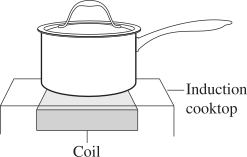
 

Which row of the table correctly identifies a property of the material used to make the saucepan and the frequency of the changing magnetic field produced by the coil?
 

  Property of saucepan      Frequency     
A.   Insulator High (50 kHz)
B. Conductor High (50 kHz)
C. Insulator Low (50 Hz)
D. Conductor Low (50 Hz)
Show Answers Only

\(B\)

Show Worked Solution
  • The saucepan needs to be able to transfer heat from the induction cooktop to the water. The heat is generated from the production of electrical currents in the saucepan, hence it needs to be a conductor.
  • The greater the frequency of the changing magnetic field in the coil correlates to a greater electrical current in the saucepan, hence it will heat up more quickly.

\(\Rightarrow B\)

Filed Under: Thermodynamics Tagged With: Band 4, smc-4282-40-Energy transfer

Copyright © 2014–2025 SmarterEd.com.au · Log in