SmarterEd

Aussie Maths & Science Teachers: Save your time with SmarterEd

  • Login
  • Get Help
  • About

PHYSICS, M4 EQ-Bank 4 MC

Two non-conducting spheres, \(\text{P}\) and \(\text{Q}\), are suspended from a horizontal insulating bar by identical length strings. Each sphere carries an electric charge and the strings are shown to be at different angles, as illustrated below. Assume the system is in static equilibrium and the diagram is to scale.
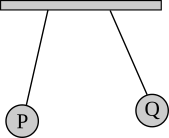
 

Which of the following pairs of statements best explains the behaviour of the system?

\begin{array} {|l|l|}
\hline
\rule{0pt}{2.5ex} \textbf{A} \rule[-1ex]{0pt}{0pt} & \text{• Sphere P has a greater charge than sphere Q.} \\ & \text{• The force of tension in P’s string is smaller than that in Q’s.} \\
\hline
\rule{0pt}{2.5ex} \textbf{B} \rule[-1ex]{0pt}{0pt} & \text{• The horizontal (electrostatic) force on P is equal in magnitude and opposite in direction to that on Q.} \\ & \text{• Sphere P is more massive than sphere Q.} \\
\hline
\rule{0pt}{2.5ex} \textbf{C} \rule[-1ex]{0pt}{0pt} & \text{• The net force acting on Q is greater than that on P.} \\ & \text{• The angle of Q's string is larger because it carries more charge.} \\
\hline
\rule{0pt}{2.5ex} \textbf{D} \rule[-1ex]{0pt}{0pt} & \text{• The larger angle on P's string means it experiences a stronger repulsive force.} \\ & \text{• This implies that the charge on P and Q are of opposite sign.} \\
\hline
\end{array}
Show Answers Only

\(B\)

Show Worked Solution
  • The electrostatic force between two charges is governed by Coulomb’s Law. Even if the spheres differ in mass or charge, the force each exerts on the other is always equal in magnitude and opposite in direction.
  • The strings are of equal length, but the angles are different, meaning one sphere is deflected more from the vertical. Both spheres are experiencing the same horizontal electrostatic force (magnitude), but if their angles differ, the vertical (gravitational) forces must be different to maintain equilibrium. This implies a difference in mass.
  • The greater the mass, the more vertical the string needs to be to balance the same horizontal force (smaller angle). So, the sphere with the smaller angle (less deflection) has a greater gravitational force pulling it down — hence, greater mass. Thus, \(\text{P}\) is more massive than \(\text{Q}\).

\(\Rightarrow B\)

Filed Under: Electrostatics Tagged With: Band 5, smc-4283-30-Forces on charges, smc-4283-40-Systems at equilibrium

PHYSICS, M4 EQ-Bank 4

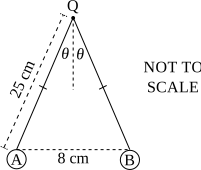
Two small identical spheres \(\text{A}\) and \(\text{B}\) are suspended from a common point \(\text{Q}\) by light, non-conducting threads of equal length. Each sphere is given the same positive charge, and they repel each other, settling into equilibrium as shown.
 

The mass of each sphere is 3.0 g, and at equilibrium the horizontal separation between the spheres is 8.0 cm, while the length of each thread is 25 cm.

Calculate the magnitude of the charge on each sphere.   (4 marks)

--- 8 WORK AREA LINES (style=lined) ---

Show Answers Only

The magnitude of the charge on each sphere is  \(5.8 \times 10^{-8}\ \text{C}\).

Show Worked Solution
\(\sin\theta\) \(=\dfrac{4}{25}\)  
\(\theta\) \(=\sin^{-1}\left(\dfrac{4}{25}\right) = 9.21^{\circ}\)  

 
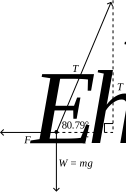
The following force diagram can be constructed from the diagram:

As the system is in equilibrium the weight force will be equal to \(T_v\)

\(T_v=mg=3 \times 10^{-3} \times 9.8=0.0294\ \text{N}\)

\(\tan(80.79)\) \(=\dfrac{T_v}{T_h}\)  
\(T_h\) \(=\dfrac{0.0294}{\tan80.79}=0.00477\ \text{N}\)  

 
As the system is in equilibrium, \(T_h = F_E\), therefore \(F_E = 0.00477\ \text{N}\)

\(F\) \(=\dfrac{1}{4 \pi \epsilon_0}\dfrac{q_1q_2}{r^2}\)  
\(0.00477\) \(=\dfrac{1}{4 \pi \epsilon_0}\dfrac{q^2}{0.08^2}\)  
\(q^2\) \(=3.397 \times 10^{-15}\)  
\(q\) \(=5.8 \times 10^{-8}\ \text{C}\)  

Filed Under: Electrostatics Tagged With: Band 5, smc-4283-30-Forces on charges, smc-4283-40-Systems at equilibrium

PHYSICS, M4 2023 VCE 1

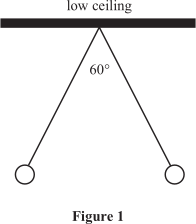
Some physics students are conducting an experiment investigating both electrostatic and gravitational forces. They suspend two equally charged balls, each of mass 4.0 g, from light, non-conducting strings suspended from a low ceiling.

The charged balls repel each other with the strings at an angle of 60°, as shown in Figure 1.
 

There are three forces acting on each ball:

    • a tension force, \(T\)
    • a gravitational force, \(F_{g}\)
    • an electrostatic force, \(F_{E}\).
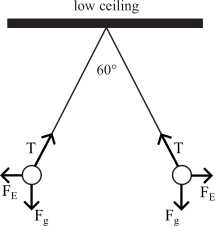
  1. On Figure 1, using the labels \(T, F_{g}\) and \(F_{E}\), draw each of the three forces acting on each of the charged balls.  (3 marks)

    --- 0 WORK AREA LINES (style=lined) ---

  2. Show that the tension force, \(T\), in each string is \(4.5 \times 10^{-2} \text{ N}\). Use  \(g=9.8 \text{ N kg}^{-1}\).
  3. Show your working.  (2 marks)

    --- 5 WORK AREA LINES (style=lined) ---

  4. Calculate the magnitude of the electrostatic force, \(F_{ E }\). Show your working.  (2 marks)

    --- 6 WORK AREA LINES (style=lined) ---

Show Answers Only

a.   


b. 
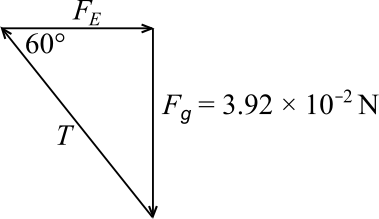
   System is in an equilibrium state:

  • The sum of the forces must add to zero as seen in the triangle below.
      

\(F_g = 9.8 \times 4 \times 10^{-3} = 3.92 \times 10^{-2}\ \text{N}\)

\(\sin\,60^{\circ}\) \(=\dfrac{3.92 \times 10^{-2}}{T}\)  
\(T\) \(=\dfrac{3.92 \times 10^{-2}}{\sin\,60^{\circ}}=4.5 \times 10^{-2}\ \text{N}\)  

 
c.   
Using the same triangle as part (b): 

\(\tan\,60^{\circ}\) \(=\dfrac{3.92 \times 10^{-2}}{F_E}\)  
\(F_E\) \(=\dfrac{3.92 \times 10^{-2}}{\tan\,60^{\circ}}=2.3 \times 10^{-2}\ \text{N}\)  

Show Worked Solution

a.   


b. 
   System is in an equilibrium state:

  • The sum of the forces must add to zero as seen in the triangle below.
      

\(F_g = 9.8 \times 4 \times 10^{-3} = 3.92 \times 10^{-2}\ \text{N}\)

\(\sin\,60^{\circ}\) \(=\dfrac{3.92 \times 10^{-2}}{T}\)  
\(T\) \(=\dfrac{3.92 \times 10^{-2}}{\sin\,60^{\circ}}=4.5 \times 10^{-2}\ \text{N}\)  

c.   Using the same triangle as part (b): 

\(\tan\,60^{\circ}\) \(=\dfrac{3.92 \times 10^{-2}}{F_E}\)  
\(F_E\) \(=\dfrac{3.92 \times 10^{-2}}{\tan\,60^{\circ}}=2.3 \times 10^{-2}\ \text{N}\)  
♦ Mean mark 41%.

Filed Under: Electrostatics Tagged With: Band 3, Band 4, Band 5, smc-4283-30-Forces on charges, smc-4283-40-Systems at equilibrium

Copyright © 2014–2025 SmarterEd.com.au · Log in