SmarterEd

Aussie Maths & Science Teachers: Save your time with SmarterEd

  • Login
  • Get Help
  • About

PHYSICS, M4 EQ-Bank 13

A student places a small compass on a horizontal cardboard sheet that has a vertical current-carrying wire passing through its centre. The student moves the compass in a circular path around the wire.

Explain what happens to the compass needle as it moves around the wire and account for this behaviour using the magnetic field produced by the current.   (3 marks)

--- 8 WORK AREA LINES (style=lined) ---
Show Answers Only
  • As compass is moved around the wire, the needle aligns tangentially to a circular path centred on the wire.
  • This occurs because the current in the wire produces a magnetic field with concentric circular field lines in the plane of the cardboard. According to the right-hand grip rule, the direction of these field lines depends on the direction of current flow.
  • The compass needle aligns with the local direction of the magnetic field at each point, always pointing along the tangent to the circular field line.
Show Worked Solution
  • As compass is moved around the wire, the needle aligns tangentially to a circular path centred on the wire.
  • This occurs because the current in the wire produces a magnetic field with concentric circular field lines in the plane of the cardboard. According to the right-hand grip rule, the direction of these field lines depends on the direction of current flow.
  • The compass needle aligns with the local direction of the magnetic field at each point, always pointing along the tangent to the circular field line.

Filed Under: Magnetism Tagged With: Band 5, smc-4285-20-Fields around wires/solenoids

PHYSICS, M4 EQ-Bank 10 MC

A current-carrying wire runs vertically through a horizontal cardboard sheet. Iron filings are sprinkled on the sheet and a circular pattern forms around the wire. A student places a compass near the wire and rotates it around in a circular path.

Which statement best explains both the pattern and compass behavior?

  1. The iron filings align with the electric field produced by the moving charges in the wire.
  2. The compass aligns with the magnetic field tangents which follow radial lines away from the wire.
  3. The iron filings form circular field lines due to the magnetic field, and the compass aligns tangentially to these circles, indicating the field direction.
  4. The magnetic field is strongest at the compass location, causing it to point directly at the wire’s centre.
Show Answers Only

\(C\)

Show Worked Solution
  • The magnetic field lines around a vertical wire are concentric circles, as described by the right-hand grip rule. Iron filings align with the magnetic field, not electric fields.
  • A compass needle aligns tangentially to these field lines, always pointing in the direction of the local magnetic field vector.
  • While the magnetic field is stronger closer to the wire, the compass responds to direction, not strength. This confirms it’s a magnetic field (i.e not an electric field) being observed.

\(\Rightarrow C\)

Filed Under: Magnetism Tagged With: Band 5, smc-4285-20-Fields around wires/solenoids, smc-4285-30-Magnetic field models

PHYSICS, M4 EQ-Bank 8 MC

If the current in a long straight wire is doubled, what happens to the magnetic field at a fixed distance?

  1. It stays the same.
  2. It doubles.
  3. It halves.
  4. It quadruples.
Show Answers Only

\(B\)

Show Worked Solution
  • The magnetic field strength of a current carrying wire is given by  \(B = \dfrac{\mu_0 I}{2\pi r}\)
  • Since the magnetic field strength around a wire is directly proportional to the current, doubling the current doubles the magnetic field at any given distance.

\(\Rightarrow B\)

Filed Under: Magnetism Tagged With: Band 4, smc-4285-20-Fields around wires/solenoids

PHYSICS, M4 EQ-Bank 12

An electromagnet consists of a solenoid with an iron core. The solenoid has 1200 turns wound on a cylindrical former that is 18 cm long. A current of 2.5 A flows through the solenoid.

  1. Calculate the magnetic field strength inside the solenoid (assuming air core).   (1 marks)

--- 2 WORK AREA LINES (style=lined) ---

  1. Explain why inserting an iron core significantly increases the magnetic field strength.   (2 marks)

--- 4 WORK AREA LINES (style=lined) ---

  1. A student suggests three ways to increase the magnetic field strength of this electromagnet:
      • Increase the current to 7.0 A
      • Add another 600 turns to the solenoid (keeping same length)
      • Compress the solenoid to half its length (keeping same number of turns)
  1. Determine which modification produces the greatest increase in magnetic field strength. Show calculations to support your answer.   (3 marks)

--- 6 WORK AREA LINES (style=lined) ---

Show Answers Only

a.    \(B = \dfrac{\mu_0 NI}{L} = \dfrac{4\pi \times 10^{-7} \times 1200 \times 2.5}{0.18} = 2.094 \times 10^{-2}\ \text{T}\).
   

b.   Magnetic field strength increases with iron core insertion because:

  • Iron is a ferromagnetic material, which means it contains magnetic domains that can align with an external magnetic field.
  • These domains align and reinforce the external field when the core is iron, significantly increasing the total magnetic field strength.

c.    Increasing the current to 7 A: \(\dfrac{7}{2.5} \times 2.094 \times 10^{-2} = 5.86 \times 10^{-2}\ \text{T}\).

Adding 600 turns: \(\dfrac{1800}{1200} \times 2.094 \times 10^{-2} = 3.14 \times 10^{-2}\ \text{T}\).

Halving the length: \(\dfrac{1}{0.5} \times 2.094 \times 10^{-2} = 4.19 \times 10^{-2}\ \text{T}\).

  • Increasing the current to 7 A will cause the greatest increase in magnetic field strength.
Show Worked Solution

a.    \(B = \dfrac{\mu_0 NI}{L} = \dfrac{4\pi \times 10^{-7} \times 1200 \times 2.5}{0.18} = 2.094 \times 10^{-2}\ \text{T}\).
   

b.   Magnetic field strength increases with iron core insertion because:

  • Iron is a ferromagnetic material, which means it contains magnetic domains that can align with an external magnetic field.
  • These domains align and reinforce the external field when the core is iron, significantly increasing the total magnetic field strength.

c.    Increasing the current to 7 A: \(\dfrac{7}{2.5} \times 2.094 \times 10^{-2} = 5.86 \times 10^{-2}\ \text{T}\).

Adding 600 turns: \(\dfrac{1800}{1200} \times 2.094 \times 10^{-2} = 3.14 \times 10^{-2}\ \text{T}\).

Halving the length: \(\dfrac{1}{0.5} \times 2.094 \times 10^{-2} = 4.19 \times 10^{-2}\ \text{T}\).

  • Increasing the current to 7 A will cause the greatest increase in magnetic field strength.

Filed Under: Magnetism Tagged With: Band 4, smc-4285-20-Fields around wires/solenoids, smc-4285-50-Properties of magnets

PHYSICS, M4 EQ-Bank 6 MC

Two long, straight, parallel conductors are placed 3.0 cm apart and carry equal currents of 20 A in opposite directions. Which of the following best describes the magnetic field at the midpoint between the two wires?

  1. The magnetic field is zero because the wires carry equal and opposite currents.
  2. The magnetic field at the midpoint is caused only by one of the wires, since the other field is canceled out by symmetry.
  3. The magnetic fields due to each wire are in the same direction and add, resulting in a non-zero net field.
  4. The magnetic field at the midpoint is directed along the wires due to symmetry.
Show Answers Only

\(C\)

Show Worked Solution
  • Use the right-hand grip rule, put your thumb in the direction of the current, and the fingers show magnetic field direction around wire.
  • At the midpoint the left wire’s (e.g., current up) field is into the page and the right wire’s (current down) field is also into the page
  • So both fields at the midpoint are in the same direction therefore they add together so the magnetic field at the midpoint is non-zero.

\(\Rightarrow C\)

Filed Under: Magnetism - draft Tagged With: Band 5, smc-4285-20-Fields around wires/solenoids

PHYSICS, M4 EQ-Bank 11

An electrical technician is installing a vertical power cable that will carry 60 A of current upward. For safety reasons, the magnetic field strength must not exceed \(2.0 \times 10^{-5}\ \text{T}\) at any point accessible to the public.

  1. Calculate the minimum horizontal distance from the cable at which members of the public should be allowed.   (2 marks)

--- 4 WORK AREA LINES (style=lined) ---

  1. The technician decides to install a second identical cable 4.0 m away from the first, also carrying 60 A upward. Determine whether this installation meets the safety requirements at the midpoint between the cables.   (3 marks)

--- 6 WORK AREA LINES (style=lined) ---

Show Answers Only

a.   \(0.6\ \text{m}\)

b.   The magnetic field around the wire circulates according to the right-hand rule:

  • At the midpoint between the wires, both points are equally distant (2.0 m from each wire).
  • Since the currents are equal in magnitude and direction (both upward), the magnetic fields they produce at the midpoint are equal in magnitude and opposite in direction.
  • Because the magnetic fields are equal and opposite, they completely cancel each other out at the midpoint and will be below the safety requirements of \(2 \times 10^{-5}\ \text{T}\).
Show Worked Solution

a.   The magnetic field strength around a wire is given by  \(B = \dfrac{\mu_0I}{2\pi r}\).

\(\therefore r = \dfrac{\mu_0 I}{2\pi B} = \dfrac{4\pi \times 10^{-7} \times 60}{2\pi \times 2 \times 10^{-5}} = 0.6\ \text{m}\).
 

b.   The magnetic field around the wire circulates according to the right-hand rule:

  • At the midpoint between the wires, both points are equally distant (2.0 m from each wire).
  • Since the currents are equal in magnitude and direction (both upward), the magnetic fields they produce at the midpoint are equal in magnitude and opposite in direction.
  • Because the magnetic fields are equal and opposite, they completely cancel each other out at the midpoint and will be below the safety requirements of \(2 \times 10^{-5}\ \text{T}\).

Filed Under: Magnetism Tagged With: Band 4, Band 5, smc-4285-20-Fields around wires/solenoids

PHYSICS, M4 EQ-Bank 5 MC

Two parallel vertical wires, each carrying current \(I\) in opposite directions, are separated by distance \(d\). At the midpoint between the wires, the net magnetic field is:

  1. Zero
  2. \(\dfrac{2\mu_0 I}{\pi d}\) directed horizontally
  3. \(\dfrac{\mu_0 I}{\pi d}\) directed horizontally
  4. \(\dfrac{\mu_0 I}{2\pi d}\) directed horizontally
Show Answers Only

\(B\)

Show Worked Solution
  • The magnetic field strength around a current carrying wire is  \(B = \dfrac{\mu_0 I}{2\pi r}\)
  • The distance halfway between the wires will be \(\dfrac{d}{2}\). Hence the magnetic field strength of each wire is:
  •    \(B = \dfrac{\mu_0 I}{2\pi \times \frac{d}{2}} = \dfrac{\mu_0 I}{\pi d}\).
  • Since currents are in opposite directions, fields add at midpoint:
  •    \(B_{\text{net}} = B_1 + B_2 = 2B = \dfrac{2\mu_0 I}{\pi d} \).

\(\Rightarrow B\)

Filed Under: Magnetism Tagged With: Band 5, smc-4285-20-Fields around wires/solenoids

PHYSICS, M4 EQ-Bank 10

A solenoid is a coil of wire that generates a magnetic field when an electric current passes through it. State three methods for increasing the magnetic field strength produced by the solenoid.

For each method, explain your reasoning by referring to a relevant equation.   (3 marks)

--- 6 WORK AREA LINES (style=lined) ---

Show Answers Only
  • The formula for the magnetic field strength of a solenoid is given by  \(B= \dfrac{\mu_0 NI}{L}\).
  • \(B \propto N\), therefore by increasing the number of coils around the solenoid will increase magnetic field strength with a constant \(L\) and \(I\).
  • \(B \propto I\), therefore by increasing the current through the solenoid will increase magnetic field strength with a constant \(N\) and \(L\).
  • \(B \propto \dfrac{1}{L}\), therefore by decreasing the length of the solenoid, the magnetic field strength will increase with a constant \(I\) and \(N\).
Show Worked Solution
  • The formula for the magnetic field strength of a solenoid is given by  \(B= \dfrac{\mu_0 NI}{L}\).
  • \(B \propto N\), therefore by increasing the number of coils around the solenoid will increase magnetic field strength with a constant \(L\) and \(I\).
  • \(B \propto I\), therefore by increasing the current through the solenoid will increase magnetic field strength with a constant \(N\) and \(L\).
  • \(B \propto \dfrac{1}{L}\), therefore by decreasing the length of the solenoid, the magnetic field strength will increase with a constant \(I\) and \(N\).

Filed Under: Magnetism Tagged With: Band 4, smc-4285-20-Fields around wires/solenoids

PHYSICS, M4 EQ-Bank 9

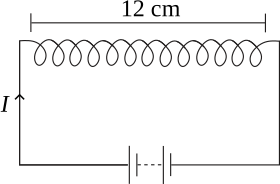
Determine the strength of the magnetic field within the solenoid illustrated below if the current through the circuit is 4 A.   (2 marks)
 

--- 4 WORK AREA LINES (style=lined) ---

Show Answers Only

\(3.8 \times 10^{-4}\ \text{T}\)

Show Worked Solution

\(\text{Convert cm → m: 12 cm = }\dfrac{12}{100} = 0.12\ \text{m}\)

\(B = \dfrac{\mu_0 NI}{L} = \dfrac{4\pi \times 10^{-7} \times 9 \times 4}{0.12} = 3.8\times 10^{-4}\ \text{T}\).

Filed Under: Magnetism Tagged With: Band 4, smc-4285-20-Fields around wires/solenoids

PHYSICS, M4 EQ-Bank 8

A student is investigating the magnetic field produced by a solenoid. The solenoid consists of tightly wound loops of wire carrying a current \(I\). A small piece of soft unmagnetised iron is placed inside the solenoid, and a bar magnet is placed outside the solenoid near one end.

  1. Describe the effect of placing the soft iron inside the solenoid on the magnetic field, and explain this effect in terms of ferromagnetic behaviour.   (3 marks)

--- 8 WORK AREA LINES (style=lined) ---
  1. Compare and contrast the magnetic field produced by a solenoid with the magnetic field produced by a bar magnet. Explain two similarities and two differences.   (4 marks)

--- 810 WORK AREA LINES (style=lined) ---
Show Answers Only

a.    Effect of placing a soft iron core inside a solenoid:

  • The strength and concentration of the magnetic field within the solenoid increases significantly.
  • This occurs because soft iron is a ferromagnetic material with a high magnetic permeability, meaning it allows magnetic field lines to pass through it more easily than air.
  • Ferromagnetic materials are made up of regions called magnetic domains. In an unmagnetised state, these domains are randomly oriented, so their individual magnetic fields cancel out.
  • However, when a soft iron core is placed inside the solenoid, the external magnetic field produced by the current causes the domains to align with the field, creating a net magnetic field that reinforces the original one.
  • Because soft iron is easily magnetised and demagnetised, it is ideal for use in electromagnets, where a strong, controllable, and reversible magnetic field is needed.

b.    Similarities:

  • Field Pattern: Both produce magnetic fields with a similar dipole shape — field lines emerge from the north pole, curve around, and enter at the south pole, forming closed loops. Internally, the field lines run from south to north, creating a uniform field inside both the solenoid and the bar magnet.
  • Effect on Magnetic Materials: Both fields can attract ferromagnetic materials (like iron) and influence their magnetic domains. A compass needle or small magnetic object placed near either field will align with the field lines.

Differences:

  • Source of the Magnetic Field: A bar magnet’s field is generated by the alignment of permanent magnetic domains in the material. In contrast, a solenoid’s field is produced by electric current flowing through the wire coils, and can be turned on or off.
  • Controllability: The magnetic field of a solenoid is adjustable, it can be increased by raising the current or number of turns and its direction reversed by changing current direction. A bar magnet’s field is fixed in strength and polarity unless the material is physically altered or demagnetised.
Show Worked Solution

a.    Effect of placing a soft iron core inside a solenoid:

  • The strength and concentration of the magnetic field within the solenoid increases significantly.
  • This occurs because soft iron is a ferromagnetic material with a high magnetic permeability, meaning it allows magnetic field lines to pass through it more easily than air.
  • Ferromagnetic materials are made up of regions called magnetic domains. In an unmagnetised state, these domains are randomly oriented, so their individual magnetic fields cancel out.
  • However, when a soft iron core is placed inside the solenoid, the external magnetic field produced by the current causes the domains to align with the field, creating a net magnetic field that reinforces the original one.
  • Because soft iron is easily magnetised and demagnetised, it is ideal for use in electromagnets, where a strong, controllable, and reversible magnetic field is needed.

b.    Similarities:

  • Field Pattern: Both produce magnetic fields with a similar dipole shape — field lines emerge from the north pole, curve around, and enter at the south pole, forming closed loops. Internally, the field lines run from south to north, creating a uniform field inside both the solenoid and the bar magnet.
  • Effect on Magnetic Materials: Both fields can attract ferromagnetic materials (like iron) and influence their magnetic domains. A compass needle or small magnetic object placed near either field will align with the field lines.

Differences:

  • Source of the Magnetic Field: A bar magnet’s field is generated by the alignment of permanent magnetic domains in the material. In contrast, a solenoid’s field is produced by electric current flowing through the wire coils, and can be turned on or off.
  • Controllability: The magnetic field of a solenoid is adjustable, it can be increased by raising the current or number of turns and its direction reversed by changing current direction. A bar magnet’s field is fixed in strength and polarity unless the material is physically altered or demagnetised.

Filed Under: Magnetism Tagged With: Band 5, Band 6, smc-4285-20-Fields around wires/solenoids, smc-4285-40-Properties of magnetic fields, smc-4285-50-Properties of magnets

PHYSICS, M4 EQ-Bank 4 MC

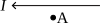
A long, straight conductor carries a current \(I\). Point \(\text{A}\) is located directly below the wire as seen in the diagram below.
 

Which of the following correctly describes the direction of the magnetic field at Point \(\text{A}\) due to this current?

  1. Toward the left
  2. Toward the right
  3. Into the page
  4. Out of the page
Show Answers Only

\(D\)

Show Worked Solution
  • By the right hand rule, place your thumb in the direction of the current (to the left) and the way your fingers curl is the direction of the magnetic field.
  • Hence, the magnetic field at point \(\text{A}\) will be out of the page.

\(\Rightarrow D\)

Filed Under: Magnetism Tagged With: Band 3, smc-4285-20-Fields around wires/solenoids

PHYSICS, M4 EQ-Bank 3 MC

A current \(I\) flows through a solenoid with \(N\) turns and length \(L\). A student wants to increase the magnetic field near the centre of the solenoid to three times its original strength.

Which combination of changes would achieve this?

\begin{align*}
\begin{array}{l}
\rule{0pt}{2.5ex} \ \rule[-1ex]{0pt}{0pt}& \\
\rule{0pt}{2.5ex}\textbf{A.}\rule[-1ex]{0pt}{0pt}\\
\rule{0pt}{2.5ex}\textbf{B.}\rule[-1ex]{0pt}{0pt}\\
\rule{0pt}{2.5ex}\textbf{C.}\rule[-1ex]{0pt}{0pt}\\
\rule{0pt}{2.5ex}\textbf{D.}\rule[-1ex]{0pt}{0pt}\\
\end{array}
\begin{array}{|c|c|}
\hline
\rule{0pt}{2.5ex}\text{Change to}\ I\rule[-1ex]{0pt}{0pt}& \text{Change to}\ N\rule[-1ex]{0pt}{0pt}& \text{Change to}\ L \\
\hline
\rule{0pt}{2.5ex}\text{no change}\rule[-1ex]{0pt}{0pt}&\text{no change}\rule[-1ex]{0pt}{0pt}&\text{triple} \\
\hline
\rule{0pt}{2.5ex}\text{triple}\rule[-1ex]{0pt}{0pt}& \text{triple}\rule[-1ex]{0pt}{0pt}&\text{no change} \\
\hline
\rule{0pt}{2.5ex}\text{no change}\rule[-1ex]{0pt}{0pt}& \text{triple}\rule[-1ex]{0pt}{0pt}&\text{triple} \\
\hline
\rule{0pt}{2.5ex}\text{triple}\rule[-1ex]{0pt}{0pt}& \text{triple}\rule[-1ex]{0pt}{0pt}&\text{triple} \\
\hline
\end{array}
\end{align*}

Show Answers Only

\(D\)

Show Worked Solution

The strength of a magnetic field is given by \(B= \dfrac{\mu_0 NI}{L}\)

Option \(A\): \(=\dfrac{\mu_0 \times N\times I}{3L} = \dfrac{B}{3}\)

Option \(B\): \(=\dfrac{\mu_0 \times 3N \times 3I}{L} = 9B\)

Option \(C\): \(=\dfrac{\mu_0 \times 3N \times I}{3L} = B\)

Option \(D\): \(=\dfrac{\mu_0 \times 3N \times 3I}{3L} = \dfrac{9B}{3} = 3B\)

\(\Rightarrow D\)

Filed Under: Magnetism Tagged With: Band 5, smc-4285-20-Fields around wires/solenoids

PHYSICS, M4 EQ-Bank 7

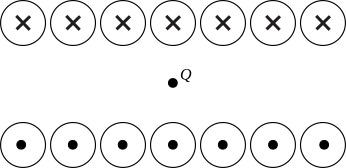
A cross-sectional diagram of a solenoid is shown below. The solenoid consists of 7 loops of wire stretched over a length of 15 cm, with a steady current of 2.8 A flowing through it. The direction of the current is shown along the loops.


  1. Calculate the magnitude of the magnetic field at point \(Q\) inside the solenoid.   (2 marks)

--- 3 WORK AREA LINES (style=lined) ---
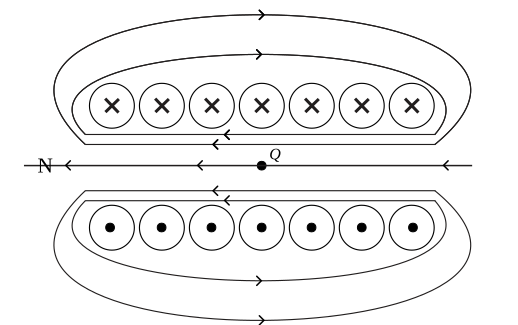
  1. On the diagram, sketch the magnetic field lines produced inside and around the solenoid due to the current and label the north pole of the solenoid with 'N'.   (3 marks)
Show Answers Only

a.    \(1.6 \times 10^{-4}\ \text{T}\)

b.    
       

Show Worked Solution
a.     \(B\) \(=\dfrac{\mu_0 NI}{L}\)
    \(=\dfrac{4\pi \times 10^{-7} \times 7 \times 2.8}{0.15}\)
    \(=1.6 \times 10^{-4}\ \text{T}\ \text{(2 sig.fig)}\)

 
b.    
       

  • Magnetic field lines should be solid, not cross over, form loops around the solenoid and be near uniform when inside of the solenoid.
  • Use of the Right hand rule to determine the direction of the field lines and north pole of the solenoid.

Filed Under: Magnetism Tagged With: Band 3, Band 4, smc-4285-20-Fields around wires/solenoids, smc-4285-30-Magnetic field models

PHYSICS, M4 EQ-Bank 6

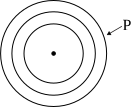
Consider the diagram below:
 

  1. A straight, vertical wire carries a steady current. Explain how you would determine the direction of the magnetic field around the wire and state the direction.   (2 marks)

--- 4 WORK AREA LINES (style=lined) ---
  1. The distance from the wire to point \(\text{P}\) is 80 mm, and the current flowing through the wire is 8 A. Calculate the magnitude of the magnetic field at point \(\text{P}\).   (2 marks)

--- 4 WORK AREA LINES (style=lined) ---
  1. Describe how ferromagnetic materials can become strongly magnetised and explain the underlying reason for this behaviour.   (3 marks)

--- 6 WORK AREA LINES (style=lined) ---
Show Answers Only

a.    Using the right-hand rule:

  • Thumb goes in the direction of the current (out of the page)
  • Fingers curl in the direction of the magnetic field.
  • Hence the direction of the field is anticlockwise.

b.    \(2.0 \times 10^{-5}\ \text{T}\)
 

c.   Ferromagnetic materials (like iron, cobalt, nickel) contain magnetic domains.

  • These domains are regions where atomic magnetic moments are aligned.
  • When placed in a magnetic field, the individual domains align with the field and no longer cancel each other out, causing strong magnetisation.
  • Even after the external field is removed, alignment may persist, making them useful for permanent magnets.
Show Worked Solution

a.    Using the right-hand rule:

  • Thumb goes in the direction of the current (out of the page)
  • Fingers curl in the direction of the magnetic field.
  • Hence the direction of the field is anticlockwise.
     
b.     \(B\) \(=\dfrac{\mu_0I}{2\pi r}\)
    \(=\dfrac{4\pi \times 10^{-7} \times 8}{2 \pi \times 80 \times 10^{-3}} =2.0 \times 10^{-5}\ \text{T}\) 


c.   Ferromagnetic materials (like iron, cobalt, nickel) contain magnetic domains.

  • These domains are regions where atomic magnetic moments are aligned.
  • When placed in a magnetic field, the individual domains align with the field and no longer cancel each other out, causing strong magnetisation.
  • Even after the external field is removed, alignment may persist, making them useful for permanent magnets.

Filed Under: Magnetism Tagged With: Band 4, Band 5, smc-4285-20-Fields around wires/solenoids, smc-4285-50-Properties of magnets

PHYSICS, M4 EQ-Bank 1 MC

A student constructs a 2000-turn solenoid that is 50 cm in length. She passes a current of 5 A through it.

What is the strength of the magnetic field produced inside this solenoid?

  1. \(0.0025\ \text{T}\)
  2. \(0.005\ \text{T}\)
  3. \(0.025\ \text{T}\)
  4. \(0.05\ \text{T}\)
Show Answers Only

\(C\)

Show Worked Solution

\(B=\dfrac{\mu_0NI}{L}=\dfrac{4\pi \times 10^{-7} \times 2000 \times 5}{0.5} = 0.025\ \text{T}\)

\(\Rightarrow C\)

Filed Under: Magnetism Tagged With: Band 3, smc-4285-20-Fields around wires/solenoids

PHYSICS, M4 EQ-Bank 2

A solenoid with a length of 25 cm has 100 coils of wire wrapped around it. If the magnetic field strength through the centre of the wire is \(1.2 \times 10^{-3}\ \text{T}\), determine the magnitude of the current running through the solenoid.   (2 marks)

--- 6 WORK AREA LINES (style=blank) ---

Show Answers Only

\(2.39\ \text{A}\)

Show Worked Solution

Rearranging  \(B=\dfrac{\mu_0 N I}{L}:\)

\(I\) \(=\dfrac{BL}{\mu_0 N}\)  
  \(=\dfrac{1.2 \times 10^{-3} \times 0.25}{4\pi \times 10^{-7} \times 100}\)  
  \(=2.39\ \text{A}\)  

Filed Under: Magnetism Tagged With: Band 4, smc-4285-20-Fields around wires/solenoids

PHYSICS, M4 EQ-Bank 4

A wire with a current of \(I\) amps running through it was measured to have a magnetic field strength of 2 × 10\(^{-3}\) T at a distance of \( r\) metres from the wire.

If the current through the wire is halved and the distance \(r\) is increased to \(3r\), find the new magnetic field strength measured.  (2 marks)

--- 4 WORK AREA LINES (style=blank) ---

Show Answers Only

\(3.33 \times 10^{-4}\ \text{T}\)

Show Worked Solution

\(B_{\text{initial}}= 2 \times 10^{-3} = \dfrac{\mu_0 \times I}{2\pi \times r}\)

\(\text{Find}\ B\ \text{when}\ I → \dfrac{I}{2},\ \text{and}\ r → 3r:\)

\(B_{\text{new}}\) \(=\dfrac{\mu_0 \times \frac{I}{2}}{2\pi \times 3r}\)  
  \(=\dfrac{1}{6} \times \dfrac{\mu_0 \times I}{2\pi \times r}\)  
  \(=\dfrac{1}{6} \times 2 \times 10^{-3}\)  
  \(=3.33 \times 10^{-4}\ \text{T}\)  

Filed Under: Magnetism Tagged With: Band 5, smc-4285-20-Fields around wires/solenoids

PHYSICS, M4 EQ-Bank 1

Determine the magnetic field intensity within a solenoid with 20 coils and a length of 15 cm, given that a direct current of 4 amperes flows through it.   (3 marks)

--- 5 WORK AREA LINES (style=lined) ---

Show Answers Only

\(6.7 \times 10^{-4}\ \text{T}\)

Show Worked Solution
\(B\) \(=\dfrac{\mu_0 N I}{L}\)  
  \(=\dfrac{4\pi \times 10^{-7} \times 20 \times 4}{0.15}\)  
  \(=6.7 \times 10^{-4}\ \text{T}\)  

Filed Under: Magnetism Tagged With: Band 4, smc-4285-20-Fields around wires/solenoids

PHYSICS, M4 2023 VCE 3a

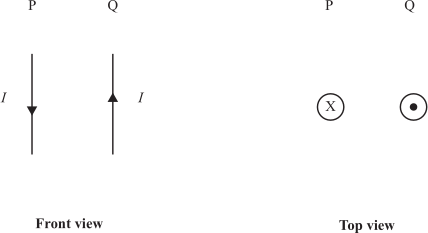
Two long, straight current-carrying wires, \(\text{P}\) and \(\text{Q}\), are parallel, as shown below. The current in the wires is the same in magnitude and opposite in direction.

The Top View diagram below shows the wires as viewed from above.
 

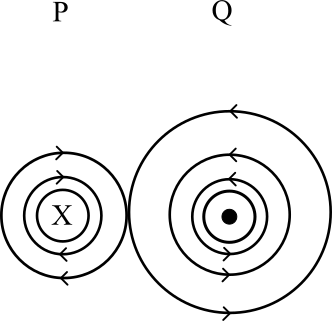
On the Top View diagram, sketch the magnetic field around the wires, showing the direction of the magnetic field. Use at least five field lines.   (3 marks)

--- 0 WORK AREA LINES (style=blank) ---

Show Answers Only
 

Show Worked Solution

  • Use the right-hand grip rule to determine the directions of the magnetic fields surrounding the currents, remembering that an \(X\) means “into the page” and the dot means “out of the page”.
  • As the distance from the wire increases the field strength decreases according to the inverse square law and therefore does not decrease at a linear rate (as seen in the diagram by the greater distances between field lines the further from the wires).
♦ Mean mark 48%.

Filed Under: Magnetism Tagged With: Band 5, smc-4285-20-Fields around wires/solenoids

PHYSICS, M4 2018 VCE 3 MC

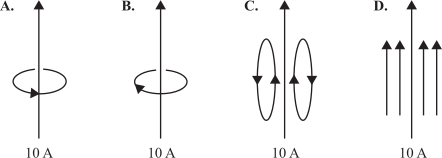
A straight wire carries a current of 10 A.

Which one of the following diagrams best shows the magnetic field associated with this current?
 

Show Answers Only

\(A\)

Show Worked Solution
  • Using the right hand grip rule, the thumb points up and the fingers curl in an anticlockwise direction as seen from above.

\(\Rightarrow A\)

Filed Under: Magnetism Tagged With: Band 3, smc-4285-20-Fields around wires/solenoids

PHYSICS, M4 2014 HSC 23

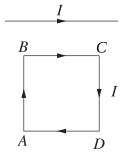
A square current-carrying wire loop is placed near a straight current-carrying conductor, as shown in the diagram.

Explain how the current in the wire loop affects the straight conductor.   (3 marks)

--- 9 WORK AREA LINES (style=lined) ---

Show Answers Only

  • Using the right hand rule on side \(BC\), the current produces a magnetic field going into the page on the bottom side of it and a magnetic field going out of the page on the top side of it.
  • Using the right hand rule on side \(DA\), the current produces a magnetic field going into the page on the top side of it and a magnetic field going out of the page on the bottom side of it.
  • The straight current carrying conductor itself will produce a magnetic field going into the page on the bottom side of it and a magnetic field going out of the page on the top side of it, same as side \(BC\).
  • Therefore, the straight conductor and side \(BC\) will be attracted to each other and the straight conductor and side \(DA\) will repel each other.
  • As \(BC\) is closer to the straight conductor than \(DA\), the overall net force on the straight conductor will be an attractive force towards the wire.
  • Note the perpendicular sides \(AB\) and \(CD\) have no effect on the straight conductor.

Show Worked Solution

  • Using the right hand rule on side \(BC\), the current produces a magnetic field going into the page on the bottom side of it and a magnetic field going out of the page on the top side of it.
  • Using the right hand rule on side \(DA\), the current produces a magnetic field going into the page on the top side of it and a magnetic field going out of the page on the bottom side of it.
  • The straight current carrying conductor itself will produce a magnetic field going into the page on the bottom side of it and a magnetic field going out of the page on the top side of it, same as side \(BC\).
  • Therefore, the straight conductor and side \(BC\) will be attracted to each other and the straight conductor and side \(DA\) will repel each other.
  • As \(BC\) is closer to the straight conductor than \(DA\), the overall net force on the straight conductor will be an attractive force towards the wire.
  • Note the perpendicular sides \(AB\) and \(CD\) have no effect on the straight conductor.
♦ Mean mark 51%.

Filed Under: Magnetism Tagged With: Band 5, smc-4285-20-Fields around wires/solenoids

Copyright © 2014–2025 SmarterEd.com.au · Log in