SmarterEd

Aussie Maths & Science Teachers: Save your time with SmarterEd

  • Login
  • Get Help
  • About

PHYSICS, M4 EQ-Bank 14

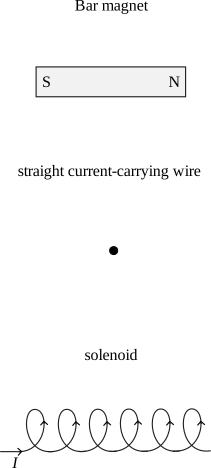
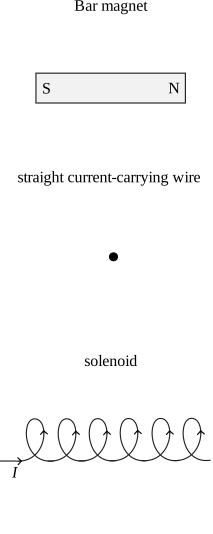
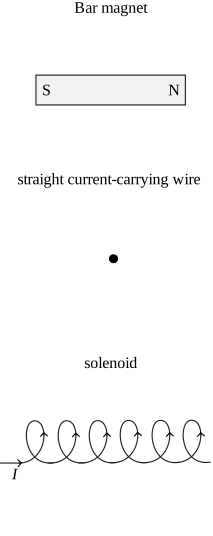
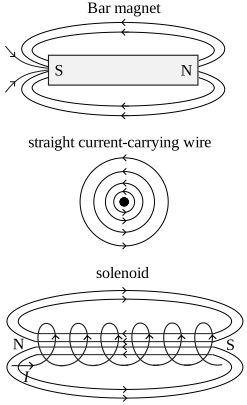
On each of the three images below, draw and clearly label the magnetic field lines.   (6 marks)
 

Show Answers Only

Show Worked Solution

  • Bar magnet: Magnetic field lines do not cross over and enter and leave the magnet at right angles.
  • Straight current-carrying conductor: The distance between magnetic field lines should increase as the distance from the wire increases, as the field strength decreases.
  • Solenoid: The magnetic field is uniform and travels from the south pole to the north pole inside of the solenoid. 
Filed Under: Magnetism Tagged With: Band 4, smc-4285-30-Magnetic field models

PHYSICS, M4 EQ-Bank 10 MC

A current-carrying wire runs vertically through a horizontal cardboard sheet. Iron filings are sprinkled on the sheet and a circular pattern forms around the wire. A student places a compass near the wire and rotates it around in a circular path.

Which statement best explains both the pattern and compass behavior?

  1. The iron filings align with the electric field produced by the moving charges in the wire.
  2. The compass aligns with the magnetic field tangents which follow radial lines away from the wire.
  3. The iron filings form circular field lines due to the magnetic field, and the compass aligns tangentially to these circles, indicating the field direction.
  4. The magnetic field is strongest at the compass location, causing it to point directly at the wire’s centre.
Show Answers Only

\(C\)

Show Worked Solution
  • The magnetic field lines around a vertical wire are concentric circles, as described by the right-hand grip rule. Iron filings align with the magnetic field, not electric fields.
  • A compass needle aligns tangentially to these field lines, always pointing in the direction of the local magnetic field vector.
  • While the magnetic field is stronger closer to the wire, the compass responds to direction, not strength. This confirms it’s a magnetic field (i.e not an electric field) being observed.

\(\Rightarrow C\)

Filed Under: Magnetism Tagged With: Band 5, smc-4285-20-Fields around wires/solenoids, smc-4285-30-Magnetic field models

PHYSICS, M4 EQ-Bank 9 MC

Which of the following best describes the direction of magnetic field lines in and around the magnet?

  1. From south to north, inside and outside the magnet.
  2. From north to south, inside and outside the magnet.
  3. From south to north inside the magnet and north to south outside the magnet.
  4. From north to south outside the magnet and south to north inside the magnet.
Show Answers Only

\(D\)

Show Worked Solution
  • Magnetic field lines by convention emerge from the north pole and enter the south pole outside the magnet.
  • Inside the magnet, the field lines travel from south to north, completing a continuous loop.
  • This direction models how magnetic forces act on materials placed near the magnet.

\(\Rightarrow D\)

Filed Under: Magnetism Tagged With: Band 5, smc-4285-30-Magnetic field models

PHYSICS, M4 EQ-Bank 7

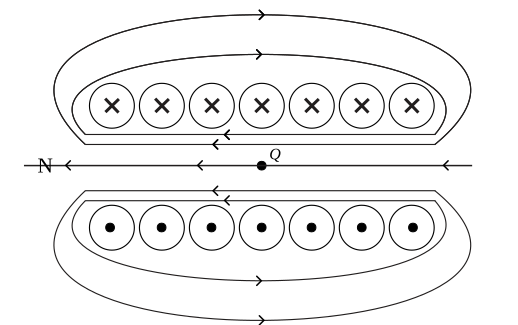
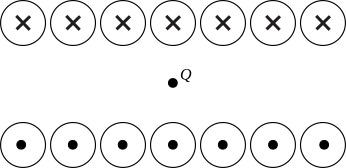
A cross-sectional diagram of a solenoid is shown below. The solenoid consists of 7 loops of wire stretched over a length of 15 cm, with a steady current of 2.8 A flowing through it. The direction of the current is shown along the loops.


  1. Calculate the magnitude of the magnetic field at point \(Q\) inside the solenoid.   (2 marks)

--- 3 WORK AREA LINES (style=lined) ---

  1. On the diagram, sketch the magnetic field lines produced inside and around the solenoid due to the current and label the north pole of the solenoid with 'N'.   (3 marks)
Show Answers Only

a.    \(1.6 \times 10^{-4}\ \text{T}\)

b.    
       

Show Worked Solution
a.     \(B\) \(=\dfrac{\mu_0 NI}{L}\)
    \(=\dfrac{4\pi \times 10^{-7} \times 7 \times 2.8}{0.15}\)
    \(=1.6 \times 10^{-4}\ \text{T}\ \text{(2 sig.fig)}\)

 
b.    
       

  • Magnetic field lines should be solid, not cross over, form loops around the solenoid and be near uniform when inside of the solenoid.
  • Use of the Right hand rule to determine the direction of the field lines and north pole of the solenoid.

Filed Under: Magnetism Tagged With: Band 3, Band 4, smc-4285-20-Fields around wires/solenoids, smc-4285-30-Magnetic field models

PHYSICS, M4 2020 VCE 1

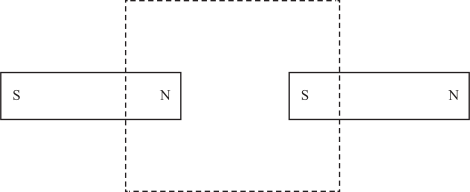
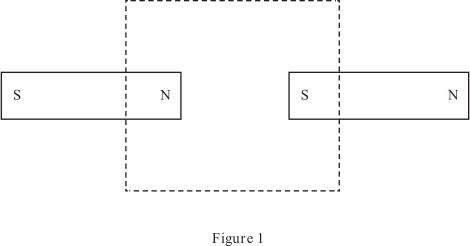
Two bar magnets are placed close to each other, as shown in the diagram.

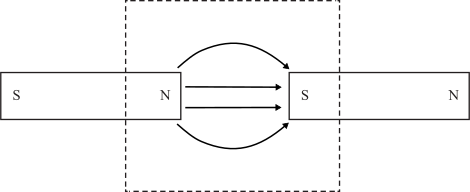
Sketch the shape and the direction of at least four magnetic field lines between the two poles within the dashed border shown in Figure 1.   (2 marks)
 

Show Answers Only
 

Show Worked Solution

Filed Under: Magnetism Tagged With: Band 3, smc-4285-30-Magnetic field models

PHYSICS, M4 2021 VCE 1

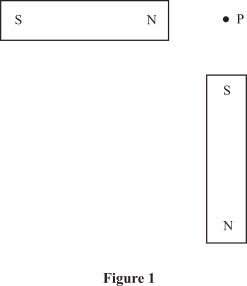
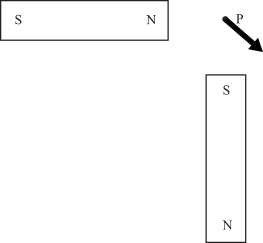
Two identical bar magnets of the same magnetic field strength are arranged at right angles to each other and at the same distance from point \(\text{P}\), as shown in Figure 1.
 

  1. At point \(\text{P}\) on Figure 1, draw an arrow indicating the direction of the combined magnetic field of the two bar magnets.  (1 mark)

    --- 0 WORK AREA LINES (style=lined) ---

  2. Calculate the magnitude of the combined magnetic field strength of the two bar magnets if each bar magnet has a magnetic field strength of 10.0 mT at point \(\text{P}\).  (2 marks)

    --- 5 WORK AREA LINES (style=lined) ---

Show Answers Only

a. 
           

b.     \(\text{14.1 mT} \)

Show Worked Solution
a. 
           

♦ Mean mark (a) 39%.

 
b. 
 \(\text{Using Pythagoras:}\)

\(\text{Magnetic field strength}\) \(=\sqrt{(10.0 \times 10^{-3})^2 + (10.0 \times 10^{-3})^2}\)  
  \(=\sqrt{2 \times 10^{-4}}\)  
  \(=14.1 \times 10^{-3}\ \text{T}\)  
  \(=14.1\ \text{mT}\)  
♦♦ Mean mark (b) 33%.

Filed Under: Magnetism Tagged With: Band 5, smc-4285-30-Magnetic field models

PHYSICS, M4 2014 HSC 32ai

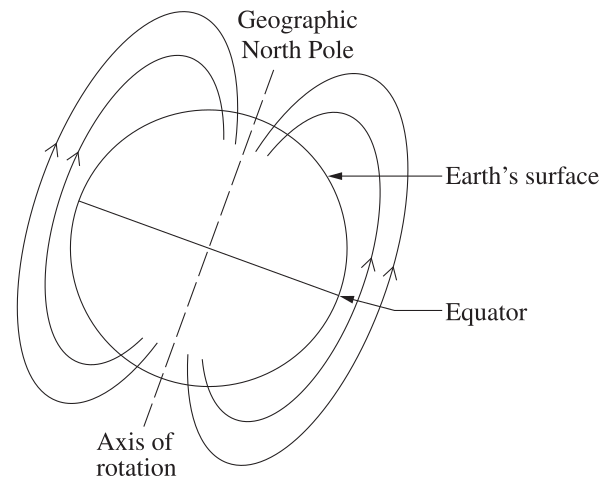
Draw a labelled diagram to describe Earth’s present magnetic field.  (2 marks)

--- 7 WORK AREA LINES (style=lined) ---

Show Answers Only

Show Worked Solution

♦ Mean mark 47%.

Filed Under: Magnetism Tagged With: Band 5, smc-4285-30-Magnetic field models

Copyright © 2014–2025 SmarterEd.com.au · Log in