SmarterEd

Aussie Maths & Science Teachers: Save your time with SmarterEd

  • Login
  • Get Help
  • About

BIOLOGY, M3 EQ-Bank 3

"In the post industrial age, human activities have become increasingly influential on nature, reshaping the very foundations of our planet's ecosystems."

Describe two abiotic selection pressures caused by human activity and their potential impact on organisms in the ecosystem.   (4 marks)

--- 8 WORK AREA LINES (style=lined) ---
Show Answers Only

Answers could include two of the following.

Climate warming:

  • One major abiotic pressure is the increase in global temperatures due to climate change. This increase has affected both the atmosphere and the oceans.
  • Ocean warming has led to heat-tolerant coral species in the Great Barrier Reef having a survival advantage over less tolerant species. 

Pollution (plastics):

  • Another significant selection pressure is from plastic waste, particularly in rivers and oceans.
  • Sea turtles frequently mistake plastic bags for jellyfish, leading to blockages in their digestive systems and sometimes fatal outcomes. 

Light pollution:

  • Light pollution is another abiotic selection pressure created by humans.
  • In urban areas, light pollution has been shown to affect the breeding behaviour of birds, favouring those that can adapt to nesting and foraging under artificial light conditions.
Show Worked Solution

Answers could include two of the following.

Climate warming:

  • One major abiotic pressure is the increase in global temperatures due to climate change. This increase has affected both the atmosphere and the oceans.
  • Ocean warming has led to heat-tolerant coral species in the Great Barrier Reef having a survival advantage over less tolerant species. 

Pollution (plastics):

  • Another significant selection pressure is from plastic waste, particularly in rivers and oceans.
  • Sea turtles frequently mistake plastic bags for jellyfish, leading to blockages in their digestive systems and sometimes fatal outcomes. 

Light pollution:

  • Light pollution is another abiotic selection pressure created by humans.
  • In urban areas, light pollution has been shown to affect the breeding behaviour of birds, favouring those that can adapt to nesting and foraging under artificial light conditions.

Filed Under: Effects of the Environment on Organisms Tagged With: Band 4, smc-4307-10-Biotic/Abiotic Factors, smc-4307-40-Selection pressures

BIOLOGY, M3 EQ-Bank 2 MC

A new predatory bird species is introduced to an island ecosystem. Which of the following best describes the likely impact on the small mammal populations on the island?

  1. All small mammal species will be equally affected.
  2. Nocturnal species will have an immediate advantage.
  3. Species with better camouflage may have higher survival rates.
  4. The mammal population size will remain stable.
Show Answers Only

\(C\)

Show Worked Solution
  • The introduction of a new predator creates a selection pressure that favours individuals with traits that help them avoid predation.
  • Small mammals with better camouflage are less likely to be spotted by the predatory birds, giving them a survival advantage and potentially higher reproductive success.

\(\Rightarrow C\)

Filed Under: Effects of the Environment on Organisms Tagged With: Band 4, smc-4307-40-Selection pressures

BIOLOGY, M3 EQ-Bank 1 MC

In a grassland ecosystem, a prolonged drought occurs. Which of the following is most likely to be an immediate effect on the plant population?

  1. Increased genetic diversity.
  2. Rapid evolutionary changes.
  3. Selection for drought-tolerant individuals.
  4. Uniform growth across all plant species.
Show Answers Only

\(C\)

Show Worked Solution
  • In a prolonged drought, plants that are better adapted to conserve water or tolerate dry conditions are more likely to survive and reproduce.
  • This selection pressure favours drought-tolerant individuals in the short term, although evolutionary changes would take many generations to occur.

\(\Rightarrow C\)

Filed Under: Effects of the Environment on Organisms Tagged With: Band 4, smc-4307-40-Selection pressures

BIOLOGY, M3 2022 VCE 34 MC

Consider a hypothetical animal species, Species X, that can neither fly nor swim. Separate populations of Species X live in the same geographical area and often interbreed. After a period of time, a new species, Species Z, arises from Species X. The following list describes some barriers that may have contributed to the formation of Species Z:

    1. A newly formed river separated one population of Species X from the other populations.
    2. One population of Species X developed a new mating ritual that was not recognised by members of the other populations of Species X.
    3. One population of Species X began to breed several weeks later than the other populations of Species X.
    4. A volcanic eruption created a mountain that separated one population of Species X from the other populations of Species X.

The barrier(s) that could have led to the formation of Species Z by sympatric speciation is

  1. either barrier 1 or barrier 4 .
  2. either barrier 2 or barrier 3 .
  3. barrier 1 only.
  4. barrier 2 only.
Show Answers Only

\(B\)

Show Worked Solution

By Elimination

  • Sympatric speciation is the evolution of a new species (Species Z) from an ancestral species (Species X) while both continue to inhabit the same geographical location.
  • Therefore the physical separation by barrier 1 does not fit the definition (Eliminate A and C).
  • Both barrier 2 and 3 are barriers which could lead to the formation of Species Z, while both Species Z and X can continue to occupy the same area.

\(\Rightarrow B\)

Filed Under: Effects of the Environment on Organisms Tagged With: Band 4, smc-4307-40-Selection pressures

BIOLOGY, M3 2014 HSC 7 MC

Which of the following is essential in any model of natural selection?

  1. High reproductive rates
  2. Random selection of prey
  3. A population of predators
  4. Differences in the population
Show Answers Only

\(D\)

Show Worked Solution
  • For natural selection to take effect there must be differences within the population in which a factor will favour a certain characteristic.

\(\Rightarrow D\)

Filed Under: Effects of the Environment on Organisms Tagged With: Band 4, smc-4307-40-Selection pressures

BIOLOGY, M3 2004 HSC 18a

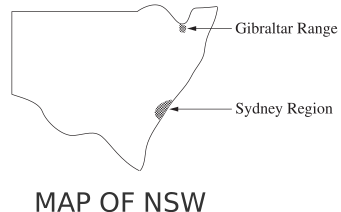
A plant species found in the area immediately around Sydney has also been found in a small area in the Gibraltar Range in the far north of NSW. 
 

Predict what might happen to the TWO populations over the next 5 million years, in terms of Darwin/Wallace's theory of evolution.   (3 marks)

Show Answers Only

  • According to Darwin/Wallace’s theory of evolution these two plant populations will undergo divergent evolution over the next 5 million years due to their seperate geographical location.
  • The Sydney population will likely experience significantly more rainfall than the Gibralter range population. As a result, this plant will evolve to require more water and have less resistance to drier conditions.
  • The Gibralter range species exist further inland and at a higher altitude and are likely to experience less rainfall and a greater range of temperatures. This species could evolve to be more drought resistant and hardier in extreme temperatures.
  • While the theory of evolution can provide a prediction, the actual outcome may be vastly different due to other abiotic and biotic factors, such as the presence of predators.

Show Worked Solution

  • According to Darwin/Wallace’s theory of evolution these two plant populations will undergo divergent evolution over the next 5 million years due to their seperate geographical location.
  • The Sydney population will likely experience significantly more rainfall than the Gibralter range population. As a result, this plant will evolve to require more water and have less resistance to drier conditions.
  • The Gibralter range species exist further inland and at a higher altitude and are likely to experience less rainfall and a greater range of temperatures. This species could evolve to be more drought resistant and hardier in extreme temperatures.
  • While the theory of evolution can provide a prediction, the actual outcome may be vastly different due to other abiotic and biotic factors, such as the presence of predators.

Filed Under: Effects of the Environment on Organisms, Natural Selection Tagged With: Band 4, smc-4307-40-Selection pressures, smc-4309-35-Convergent/Divergent

BIOLOGY, M3 2009 HSC 27

Most offspring resemble their parents in a number of characteristics, but there are often some characteristics in the offspring that are unexpected.  

Explain, using examples, how genetics and the environment can affect the phenotype of individuals.  (8 marks)

--- 16 WORK AREA LINES (style=lined) ---

Show Answers Only

→ Offspring inherit characteristics based off their parents. Their are various factors which can influence what characteristics, or phenotype, they actually exhibit.

→ When offspring exhibit characteristics that are unexpected, this is often due to the characteristic being a recessive trait. In this way, both parents had the allele for it but it was masked by the dominant trait. The offspring then inherited both of these recessive alleles, meaning it could no longer be masked.

→ One such example is if the parents are both type A but their son/daughter is type O as a result of inheriting the recessive allele for no surface proteins.

→ Traits can also be unexpected if they are sex-linked, meaning the allele lies on an X sex chromosome. In this way, males will only have to have one recessive X allele for it to be expressed, while females need them both. In this way, the ratios for sex-linked characteristics is different than if they were autosomal.

→ When genes are being copied, mistakes (mutations) are made in the process and new genes or combinations of genes can be generated in the process.

→ These can be passed on to offspring, giving them characteristics different from their parents. For example, the peppered moth. Dark coloured peppered moths appeared in the population due to a mutation.

→ The environment can affect the way in which genes are expressed so that an individuals phenotype is affect by environmental conditions. For example, malnutrition can lead to individuals being shorter in height compared to their genetic potential.

Show Worked Solution

→ Offspring inherit characteristics based off their parents. Their are various factors which can influence what characteristics, or phenotype, they actually exhibit.

→ When offspring exhibit characteristics that are unexpected, this is often due to the characteristic being a recessive trait. In this way, both parents had the allele for it but it was masked by the dominant trait. The offspring then inherited both of these recessive alleles, meaning it could no longer be masked.

→ One such example is if the parents are both type A but their son/daughter is type O as a result of inheriting the recessive allele for no surface proteins.

→ Traits can also be unexpected if they are sex-linked, meaning the allele lies on an X sex chromosome. In this way, males will only have to have one recessive X allele for it to be expressed, while females need them both. In this way, the ratios for sex-linked characteristics is different than if they were autosomal.

→ When genes are being copied, mistakes (mutations) are made in the process and new genes or combinations of genes can be generated in the process.

→ These can be passed on to offspring, giving them characteristics different from their parents. For example, the peppered moth. Dark coloured peppered moths appeared in the population due to a mutation.

→ The environment can affect the way in which genes are expressed so that an individuals phenotype is affect by environmental conditions. For example, malnutrition can lead to individuals being shorter in height compared to their genetic potential.

Filed Under: BIO - Ex-syllabus checks required Tagged With: Band 4, Band 5, smc-4307-40-Selection pressures

BIOLOGY, M3 2013 HSC 26

A virus was used to kill rabbits in Australia. After first release of the virus nearly all rabbits were killed, but over time the numbers recovered. 

Outline how Darwin/Wallace's theory of evolution could be used to explain the recovery of rabbit numbers.  (3 marks)

--- 7 WORK AREA LINES (style=lined) ---

Show Answers Only
  • Darwin/Wallace’s theory of evolution suggests variation in a population and the fittest survive to pass on their characteristics.
  • When the virus emerged, it killed most of the rabbits, however, some rabbits would be resistant and survive.
  • The survivors reproduced and passed this characteristic (resistance) on to their offspring and as the population increased, most rabbits were then resistant to the virus.
Show Worked Solution
  • Darwin/Wallace’s theory of evolution suggests variation in a population and the fittest survive to pass on their characteristics.
  • When the virus emerged, it killed most of the rabbits, however, some rabbits would be resistant and survive.
  • The survivors reproduced and passed this characteristic (resistance) on to their offspring and as the population increased, most rabbits were then resistant to the virus.

Filed Under: Effects of the Environment on Organisms Tagged With: Band 3, smc-4307-40-Selection pressures

Copyright © 2014–2025 SmarterEd.com.au · Log in