SmarterEd

Aussie Maths & Science Teachers: Save your time with SmarterEd

  • Login
  • Get Help
  • About

BIOLOGY, M3 EQ-Bank 6

Many plants in hot climates exhibit leaf droop, where their leaves hang downwards during the hottest parts of the day.

  1. Describe this type of adaptation.   (1 mark)

    --- 1 WORK AREA LINES (style=lined) ---

  2. Provide two reasons why this adaptation might be beneficial for plants in these environments.   (2 marks)

    --- 4 WORK AREA LINES (style=lined) ---
Show Answers Only

a.   Behavioural adaptation.

  • Leaf droop is classified as a behavioural adaptation because it involves a dynamic response to environmental conditions rather than a fixed structural or physiological change. 

b.   This adaption is beneficial because:

  • it reduces the surface area of the leaf directly exposed to intense sunlight, minimising water loss and protecting the leaf from heat damage.
  • when drooping leaves are arranged vertically, they direct water to the base of the plant where the roots can more efficiently absorb it. This is particularly beneficial in arid environments.
Show Worked Solution

a.   Behavioural adaptation.

  • Leaf droop is classified as a behavioural adaptation because it involves a dynamic response to environmental conditions rather than a fixed structural or physiological change. 

b.   This adaption is beneficial because:

  • it reduces the surface area of the leaf directly exposed to intense sunlight, minimising water loss and protecting the leaf from heat damage.
  • when drooping leaves are arranged vertically, they direct water to the base of the plant where the roots can more efficiently absorb it. This is particularly beneficial in arid environments.

Filed Under: Adaptations Tagged With: Band 4, Band 5, smc-4308-18-Behavioural adaptations

BIOLOGY, M3 EQ-Bank 3 MC

Consider the following adaptations in Australian organisms:

\(\text{I.}\)   The ability of koalas to detoxify eucalyptus leaves.  
\(\text{II.}\)   The migration of bogong moths to alpine areas in summer.  
\(\text{III.}\)   The spines on an echidna.  
\(\text{IV.}\)   The camouflage patterns on a leaf-tailed gecko.  

 
Which combination correctly identifies one of each type of adaptation (structural, physiological, and behavioural)?

  1. \(\text{I, II,}\) and \(\text{III}\)
  2. \(\text{I, II,}\) and \(\text{IV}\)
  3. \(\text{I, III,}\) and \(\text{IV}\)
  4. \(\text{II, III,}\) and \(\text{IV}\)
Show Answers Only

\(D\)

Show Worked Solution

Consider each statement:

  • \(\text{I.}\) Physiological adaptation. The ability of koalas to detoxify eucalyptus leaves involves internal metabolic processes.
  • \(\text{II.}\) Behavioral adaptation. The migration of bogong moths is a seasonal behavior that helps them survive and reproduce.
  • \(\text{III.}\) Structural adaptation. The spines on an echidna are physical features that provide protection.
  • \(\text{IV.}\) Structural adaptation. The camouflage patterns on a leaf-tailed gecko are physical characteristics, though they can change slightly which could be considered physiological.

\(\Rightarrow D\)

Filed Under: Adaptations Tagged With: Band 5, smc-4308-10-Structural adaptations, smc-4308-15-Physiological adaptations, smc-4308-18-Behavioural adaptations

BIOLOGY, M3 EQ-Bank 2 MC

Which of the following is an example of a behavioural adaptation in Australian wildlife?

  1. The waxy cuticle on eucalyptus leaves .
  2. The salt glands in marine birds.
  3. The burrowing of the desert frill-neck lizard during extreme heat.
  4. The pouch of a kangaroo.
Show Answers Only

\(C\)

Show Worked Solution
  • The burrowing of the desert frill-neck lizard during extreme heat is a behavioural adaptation because it’s a learned action that helps the animal cope with environmental challenges, rather than a physical feature or internal process.

\(\Rightarrow C\)

Filed Under: Adaptations Tagged With: Band 3, smc-4308-18-Behavioural adaptations

BIOLOGY, M3 EQ-Bank 3

Analyse the role of behavioural adaptations in enhancing species survival. In your response, describe a specific behavioural adaptation in an Australian plant species and a specific Australian native animal.   (3 marks)

--- 6 WORK AREA LINES (style=lined) ---

Show Answers Only
  • Behavioural adaptations play a crucial role in enhancing species survival by allowing organisms to respond to environmental challenges through learned or instinctive actions.
  • In Australian plants, trigger plants display a distinctive behavioural adaptation in which their column rapidly snaps forward to deposit pollen onto insect pollinators, thereby enhancing their reproductive success.
  • Among Australian native animals, the frill-neck lizard erects a large frill around its neck and opens its brightly-coloured mouth when threatened. This makes itself appear larger and more intimidating to potential predators, increasing its chances of survival.
Show Worked Solution
  • Behavioural adaptations play a crucial role in enhancing species survival by allowing organisms to respond to environmental challenges through learned or instinctive actions.
  • In Australian plants, trigger plants display a distinctive behavioural adaptation in which their column rapidly snaps forward to deposit pollen onto insect pollinators, thereby enhancing their reproductive success.
  • Among Australian native animals, the frill-neck lizard erects a large frill around its neck and opens its brightly-coloured mouth when threatened. This makes itself appear larger and more intimidating to potential predators, increasing its chances of survival.

Filed Under: Adaptations Tagged With: Band 4, smc-4308-18-Behavioural adaptations

BIOLOGY, M3 EQ-Bank 5-6 MC

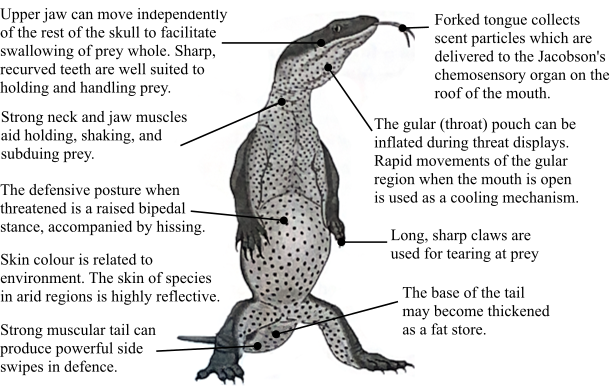
The following diagram shows features which relate to the goanna.
 

Question 5

Which of the following features is a behavioural adaptation?

  1. Skin colour related to the environment.
  2. The base of the tail becoming thick to store fat.
  3. Long, sharp claws that are used for tearing at prey.
  4. Rapid movements of the gular region to cool down.

 
Question 6

Which of the following features is a physiological adaptation?

  1. Skin colour related to the environment.
  2. The base of the tail becoming thick to store fat.
  3. Long, sharp claws that are used for tearing at prey.
  4. Rapid movements of the gular region to cool down.
Show Answers Only

Question 5: \(D\)

Question 6: \(B\)

Show Worked Solution

Question 5

  • A behavioural adaptation is an action that is carried out by the organism. This would be the action of moving the gular region to cool down.

\(\Rightarrow D\)
 

Question 6

  • A physiological adaptation is a process which occurs within the organism. This would be the thickening of the tail to store fat.

\(\Rightarrow B\) 

Filed Under: Adaptations Tagged With: Band 4, smc-4308-15-Physiological adaptations, smc-4308-18-Behavioural adaptations

Copyright © 2014–2025 SmarterEd.com.au · Log in