SmarterEd

Aussie Maths & Science Teachers: Save your time with SmarterEd

  • Login
  • Get Help
  • About

BIOLOGY, M4 EQ-Bank 7

Examine the diagram provided, which depicts the biological relationships within an ecosystem.
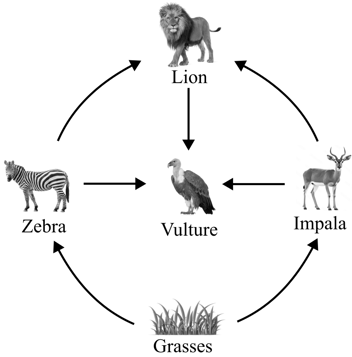
 

  1. Describe how food webs differ from food chains in representing the flow of energy within an ecosystem.   (2 marks)

    --- 4 WORK AREA LINES (style=lined) ---

  2. Name a consumer from the second trophic level in the diagram.   (1 mark)
  3. Poaching has pushed impala populations towards extinction in certain African regions. Describe the potential ecological consequences for other species in the food web shown.   (2 marks)
Show Answers Only

a.   Food webs vs food chains:

  • Food webs and food chains both represent energy flow in ecosystems, but differ in complexity and scope.
  • While a food chain shows a single, linear path of energy transfer from one organism to another, a food web illustrates multiple interconnected food chains within an ecosystem.
  • Food webs thus provide a more comprehensive and realistic depiction of the complex feeding relationships and energy transfers that occur among various species. 

b.   Second trophic level  \(\Rightarrow\)  first order consumer

Zebra or Impala
 

c.   Ecological consequences:

  • The decline or extinction of impalas would impact lions and vultures as they are an important food source of both.
  • Zebras would benefit from increased available vegetation due to reduced competition from impalas, leading to potential population growth.
  • The potential increase in zebra population would provide a more abundant food source for lions and vultures eventually, mitigating but not replacing the loss of impalas to these predator.
  • This scenario illustrates the complex interdependencies within the ecosystem and the cascading effects of species loss on different trophic levels.
Show Worked Solution

a.   Food webs vs food chains:

  • Food webs and food chains both represent energy flow in ecosystems, but differ in complexity and scope.
  • While a food chain shows a single, linear path of energy transfer from one organism to another, a food web illustrates multiple interconnected food chains within an ecosystem.
  • Food webs thus provide a more comprehensive and realistic depiction of the complex feeding relationships and energy transfers that occur among various species. 

b.   Second trophic level  \(\Rightarrow\)  first order consumer

Zebra or Impala
 

c.   Ecological consequences:

  • The decline or extinction of impalas would impact lions and vultures as they are an important food source of both.
  • Zebras would benefit from increased available vegetation due to reduced competition from impalas, leading to potential population growth.
  • The potential increase in zebra population would provide a more abundant food source for lions and vultures eventually, mitigating but not replacing the loss of impalas to these predator.
  • This scenario illustrates the complex interdependencies within the ecosystem and the cascading effects of species loss on different trophic levels.

Filed Under: Population Dynamics Tagged With: Band 3, Band 4, smc-4311-30-Food Webs

BIOLOGY, M4 EQ-Bank 36


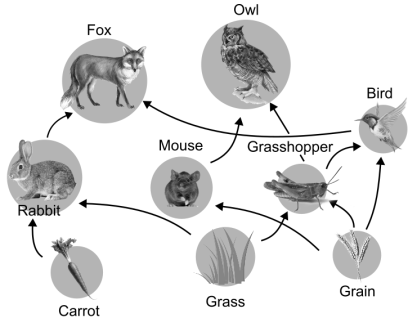
  1. What is/are the producer(s) in this food web?   (1 mark)

    --- 1 WORK AREA LINES (style=lined) ---

  2. Identify ONE carnivore and ONE herbivore.   (2 marks)

    --- 2 WORK AREA LINES (style=lined) ---

  3. If the grasshopper species became extinct, describe THREE changes that may occur.   (3 marks)

    --- 6 WORK AREA LINES (style=lined) ---

Show Answers Only

a.    Grass, carrots and grain.

b.   Carnivore: Owl or fox

Herbivore: Bird

c.   Extinction of the grasshopper effects:

  • Will result in a greater availability of the grass and grain they (previously) ate.
  • Subsequently, there will be less competition for food among the other species which also eat grass and grain. These species will thrive and an increase in the bird, mouse and rabbit populations would be expected.
  • The grasshoppers’ extinction will also cause its consumers, the bird and the owl, to have to find other food sources.
  • Population fluctuations of birds and owls would be expected as they adapt to new hunting or grazing habits to replace their lost food source.
  • The complexity of nature in such extinction events can be seen particularly on birds who benefit from more grain availability but lose grasshoppers as a direct food source.
Show Worked Solution

a.    Grass, carrots and grain.

b.   Carnivore: Owl or fox

Herbivore: Bird
 

c.   Extinction of the grasshopper effects:

  • Will result in a greater availability of the grass and grain they (previously) ate.
  • Subsequently, there will be less competition for food among the other species which also eat grass and grain. These species will thrive and an increase in the bird, mouse and rabbit populations would be expected.
  • The grasshoppers’ extinction will also cause its consumers, the bird and the owl, to have to find other food sources.
  • Population fluctuations of birds and owls would be expected as they adapt to new hunting or grazing habits to replace their lost food source.
  • The complexity of nature in such extinction events can be seen particularly on birds who benefit from more grain availability but lose grasshoppers as a direct food source.

Filed Under: Population Dynamics Tagged With: Band 3, Band 5, smc-4311-30-Food Webs

Copyright © 2014–2025 SmarterEd.com.au · Log in