SmarterEd

Aussie Maths & Science Teachers: Save your time with SmarterEd

  • Login
  • Get Help
  • About

BIOLOGY, M4 EQ-Bank 10

Ecosystems are dynamic, shaped not only by physical forces but also by the living organisms within them. Including a specific example, explain one biotic factor that has significantly impacted past ecosystems:

  1. Over a relatively short timescale (within a few decades or centuries)   (2 marks)

    --- 3 WORK AREA LINES (style=lined) ---

  2. Over an extended geological timescale (millions of years)   (2 marks)

    --- 3 WORK AREA LINES (style=lined) ---
Show Answers Only

a.   Short timescale biotic factor: introduction of invasive species

  • The introduction of cane toads in Australia in 1935 has rapidly altered local ecosystems within decades.
  • Cane toads have caused declines in native predator populations that attempt to eat the toxic toads, leading to cascading effects throughout the food web. 

b.   Geological timescale biotic factor: evolution of land plants

  • The development of land plants around 470 Mya led to increased oxygen production, soil formation, and the creation of new habitats.
  • This gradual but profound change altered atmospheric composition and weather patterns. This reshaped terrestrial ecosystems and paved the way for the evolution of terrestrial animal life.
Show Worked Solution

a.   Short timescale biotic factor: introduction of invasive species

  • The introduction of cane toads in Australia in 1935 has rapidly altered local ecosystems within decades.
  • Cane toads have caused declines in native predator populations that attempt to eat the toxic toads, leading to cascading effects throughout the food web. 

b.   Geological timescale biotic factor: evolution of land plants

  • The development of land plants around 470 Mya led to increased oxygen production, soil formation, and the creation of new habitats.
  • This gradual but profound change altered atmospheric composition and weather patterns. This reshaped terrestrial ecosystems and paved the way for the evolution of terrestrial animal life.

Filed Under: Past Ecosystems Tagged With: Band 3, Band 4, smc-4312-05-Changes in ecosystems, smc-4312-20-Biotic/Abiotic factors

BIOLOGY, M4 EQ-Bank 6

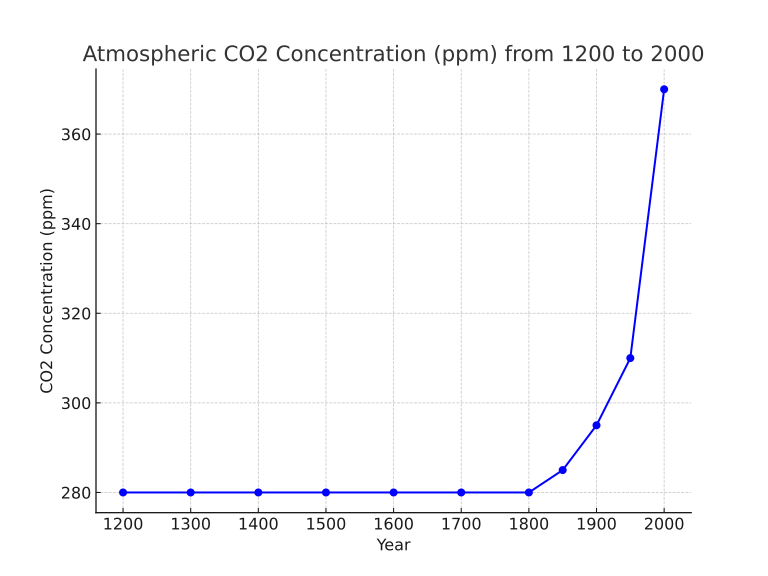
The graph below shows the concentration of \(\ce{CO2}\) in the earth's atmosphere over the last 800 years.

  1. How would scientists obtain these historical levels of \(\ce{CO2}\)?   (1 mark)

    --- 1 WORK AREA LINES (style=lined) ---

  2. Explain the shape of the graph over the 800 years of data presented.   (3 marks)

    --- 6 WORK AREA LINES (style=lined) ---

Show Answers Only

a.   Data would be obtained by gas analysis within ice cores.

b.   Graph shape over the past 800 years:

  • Atmospheric levels of \(\ce{CO2}\) were very steady between the period 1200-1800 at approximately 280 ppm.
  • In the period 1800-2000, \(\ce{CO2}\) levels increased exponentially from 280 ppm to 370 ppm.
  • This increase coincided with industrialisation which saw the widespread use of fossil fuels like coal, oil, and natural gas for energy.
  • The use of these energy sources released large amounts of (\ce{CO2}\) into the atmosphere and is regarded as a major contributing factor to rise in atmospheric \(\ce{CO2}\) levels over this period.
Show Worked Solution

a.   Data would be obtained by gas analysis within ice cores.

b.   Graph shape over the past 800 years:

  • Atmospheric levels of \(\ce{CO2}\) were very steady between the period 1200-1800 at approximately 280 ppm.
  • In the period 1800-2000, \(\ce{CO2}\) levels increased exponentially from 280 ppm to 370 ppm.
  • This increase coincided with industrialisation which saw the widespread use of fossil fuels like coal, oil, and natural gas for energy.
  • The use of these energy sources released large amounts of (\ce{CO2}\) into the atmosphere and is regarded as a major contributing factor to rise in atmospheric \(\ce{CO2}\) levels over this period.

Filed Under: Past Ecosystems Tagged With: Band 3, Band 4, smc-4312-05-Changes in ecosystems, smc-4312-10-Dating technologies

BIOLOGY, M4 EQ-Bank 4

Geologists often say that rocks are pages in Earth's history book.

Explain how scientists use paleontological and geological evidence from rock structures and formations to reconstruct past ecosystems and their changes over time. Include a specific example in your answer.   (3 marks)

--- 6 WORK AREA LINES (style=lined) ---

Show Answers Only
  • Rock formations like sedimentary layers can preserve a wealth of information about past ecosystems.
  • For example, the Green River Formation in the USA contains sediments deposited in a lake system over 50 million years ago.
  • These layers contain fossils of plants, insects, and fish, providing a detailed snapshot of a lush, subtropical ecosystem very different from the current arid environment.
  • The presence of certain minerals and sediment types in the layers also indicates changes in water depth and chemistry over time.
  • By analysing these fossils and sediment characteristics, scientists can reconstruct how the ecosystem changed in response to environmental factors over millions of years.
Show Worked Solution
  • Rock formations like sedimentary layers can preserve a wealth of information about past ecosystems.
  • For example, the Green River Formation in the USA contains sediments deposited in a lake system over 50 million years ago.
  • These layers contain fossils of plants, insects, and fish, providing a detailed snapshot of a lush, subtropical ecosystem very different from the current arid environment.
  • The presence of certain minerals and sediment types in the layers also indicates changes in water depth and chemistry over time.
  • By analysing these fossils and sediment characteristics, scientists can reconstruct how the ecosystem changed in response to environmental factors over millions of years.

Filed Under: Past Ecosystems Tagged With: Band 4, smc-4312-05-Changes in ecosystems

BIOLOGY, M4 EQ-Bank 3

Describe two ways in which ice core data provides evidence of past changes in ecosystems.   (2 marks)

--- 4 WORK AREA LINES (style=blank) ---

Show Answers Only

Answers could include two of the following:

  • Ice cores provide valuable information about past climates through trapped air bubbles, which reveal historical atmospheric compositions, including greenhouse gas levels that influenced past ecosystems.
  • Ice cores also contain dust particles, pollen, and other organic materials that offer direct evidence of past vegetation and environmental conditions, allowing scientists to reconstruct ancient ecosystems and their changes over time.
  • The thickness and composition of annual ice layers in cores provide a record of past precipitation rates, offering insights into historical patterns of rainfall and drought.
Show Worked Solution

Answers could include two of the following:

  • Ice cores provide valuable information about past climates through trapped air bubbles, which reveal historical atmospheric compositions, including greenhouse gas levels that influenced past ecosystems.
  • Ice cores also contain dust particles, pollen, and other organic materials that offer direct evidence of past vegetation and environmental conditions, allowing scientists to reconstruct ancient ecosystems and their changes over time.
  • The thickness and composition of annual ice layers in cores provide a record of past precipitation rates, offering insights into historical patterns of rainfall and drought.

Filed Under: Past Ecosystems Tagged With: Band 4, smc-4312-05-Changes in ecosystems

BIOLOGY, M4 EQ-Bank 2

Aboriginal rock paintings provide valuable insights into Australia's past ecosystems and the changes they've undergone over time.

Explain why Aboriginal rock paintings are considered a valid source of ecological information and how it complements other forms of paleontological data in understanding ecosystem changes.   (4 marks)

--- 7 WORK AREA LINES (style=lined) ---

Show Answers Only
  • Aboriginal rock paintings provide direct visual records of flora and fauna from thousands of years ago.
  • These paintings were created by people who closely observed their environment.
  • A notable example is the Nawarla Gabarnmang rock art site in Arnhem Land, which features a painting of a thylacine (Tasmanian tiger) dated to be at least 17,000 years old.
  • This painting provides evidence that thylacines once inhabited mainland Australia, long after they had disappeared from the fossil record in this region.
  • In this way, Aboriginal rock art sites help to fill gaps in the paleontological record and provides insights into the distribution of this species before its mainland extinction.
  • By comparing such rock art with current ecosystems, scientists can infer changes in biodiversity, contributing to our understanding of long-term ecological changes in Australia.
Show Worked Solution
  • Aboriginal rock paintings provide direct visual records of flora and fauna from thousands of years ago.
  • These paintings were created by people who closely observed their environment.
  • A notable example is the Nawarla Gabarnmang rock art site in Arnhem Land, which features a painting of a thylacine (Tasmanian tiger) dated to be at least 17,000 years old.
  • This painting provides evidence that thylacines once inhabited mainland Australia, long after they had disappeared from the fossil record in this region.
  • In this way, Aboriginal rock art sites help to fill gaps in the paleontological record and provides insights into the distribution of this species before its mainland extinction.
  • By comparing such rock art with current ecosystems, scientists can infer changes in biodiversity, contributing to our understanding of long-term ecological changes in Australia.

Filed Under: Past Ecosystems Tagged With: Band 4, Band 5, smc-4312-05-Changes in ecosystems

BIOLOGY, M4 EQ-Bank 1

Describe two examples of paleontological evidence from Australia that provide insights into past changes in ecosystems.   (4 marks)

--- 8 WORK AREA LINES (style=lined) ---

Show Answers Only

Example 1: Megafauna fossils in the Naracoorte Caves, South Australia

  • The Naracoorte Caves contain fossil record of Australian megafauna, including giant kangaroos and marsupial lions, dating back to the Pleistocene epoch.
  • These fossils provide evidence of a dramatic shift in Australia’s ecosystem, from one that supported large herbivores and their predators to the current environment dominated by smaller species.
  • The disappearance of these megafauna species from the fossil record around 46,000 years ago coincides with human arrival in Australia, suggesting a potential link between human activity and ecosystem change.  

Example 2: Plant microfossils from the Atherton Tablelands, Qld

  • Sediment cores from crater lakes in the Atherton Tablelands contain plant microfossils such as pollen grains that date back over 200,000 years.
  • Analysis of these microfossils reveals changes in vegetation types over time, indicating shifts between rainforest and dry forest dominance in response to climate fluctuations.
  • This evidence provides a detailed record of how Australian plant communities have responded to past climate changes, including glacial and interglacial periods. 
Show Worked Solution

Example 1: Megafauna fossils in the Naracoorte Caves, South Australia

  • The Naracoorte Caves contain fossil record of Australian megafauna, including giant kangaroos and marsupial lions, dating back to the Pleistocene epoch.
  • These fossils provide evidence of a dramatic shift in Australia’s ecosystem, from one that supported large herbivores and their predators to the current environment dominated by smaller species.
  • The disappearance of these megafauna species from the fossil record around 46,000 years ago coincides with human arrival in Australia, suggesting a potential link between human activity and ecosystem change.  

Example 2: Plant microfossils from the Atherton Tablelands, Qld

  • Sediment cores from crater lakes in the Atherton Tablelands contain plant microfossils such as pollen grains that date back over 200,000 years.
  • Analysis of these microfossils reveals changes in vegetation types over time, indicating shifts between rainforest and dry forest dominance in response to climate fluctuations.
  • This evidence provides a detailed record of how Australian plant communities have responded to past climate changes, including glacial and interglacial periods. 

Filed Under: Past Ecosystems Tagged With: Band 4, Band 5, smc-4312-05-Changes in ecosystems

Copyright © 2014–2025 SmarterEd.com.au · Log in