SmarterEd

Aussie Maths & Science Teachers: Save your time with SmarterEd

  • Login
  • Get Help
  • About

Probability, SMB-014

Students studying vocational education courses were surveyed about their living arrangements.
  

  1. One of these students is selected at random. What is the probability, correct to the nearest percentage, that this student is male and living with his parent(s)?   (2 marks)

    --- 4 WORK AREA LINES (style=lined) ---

  2. A female student is selected. What is the probability that she is not living with her parent(s)?   (2 marks)

    --- 4 WORK AREA LINES (style=lined) ---
Show Answers Only
  1.  `\text{31%}`
  2. `91/114`
Show Worked Solution

i.     `text{Number of males living with parents = 155}`

`text{Total students surveyed = 505}`

`P\text{(male and living with parents)}` `=155/505`  
  `=0.3069…`  
  `=31\text{%  (nearest %)}`  

 
ii. 
  `text{Number of females = 228}`

`text{Females not living with parents = 182}`

`P\text{(selected female not living with parents)} = 182/228 = 91/114`

Filed Under: Relative Frequency and Venn Diagrams Tagged With: num-title-ct-pathb, smc-4815-10-2-Way tables, smc-4815-50-Conditional probability

Probability, SMB-007

Some men and women were surveyed at a football game. They were asked which team they supported. The results are shown in the two-way table.

\begin{array} {|l|c|c|c|}
\hline
\rule{0pt}{2.5ex} &\ \textit{Team A }\ \rule[-1ex]{0pt}{0pt} &\ \textit{Team B}\ \ &\ \textit{Totals}\ \ \\
\hline
\rule{0pt}{2.5ex}\text{Men}\rule[-1ex]{0pt}{0pt} & 125 &  100 &  225 \\
\hline
\rule{0pt}{2.5ex}\text{Women}\rule[-1ex]{0pt}{0pt} & 75 & 90 & 165 \\
\hline
\rule{0pt}{2.5ex}\text{Totals}\rule[-1ex]{0pt}{0pt} & 200 & 190 & 390 \\
\hline
\end{array}

A man was chosen at random. What is the probability that he supports Team B, correct to the nearest percent?   (2 marks)

--- 4 WORK AREA LINES (style=lined) ---

Show Answers Only

`44%`

Show Worked Solution

`text{Total number of men}\ = 225`

`text{Number of men who support Team B}\ = 100`

`P(\text{chosen man supports Team B})`

`=100/225`

`=4/9`

`=44%\ \text{(nearest %)}`

Filed Under: Relative Frequency and Venn Diagrams Tagged With: num-title-ct-pathb, smc-4815-10-2-Way tables, smc-4815-50-Conditional probability

Probability, SMB-006

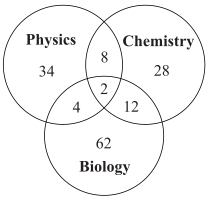
The subject choices in science at a high school are physics, chemistry and biology.

This Venn diagram shows the number of students who are studying each of the subjects.
 

A student studying Biology is chosen a random. 

What is the probability that the student also studies Chemistry?   (2 marks)

--- 5 WORK AREA LINES (style=lined) ---

Show Answers Only

`7/40`

Show Worked Solution

`text(Students studying Biology)\ = 4 + 2 + 12 + 62 = 80`

`text(Students studying Biology and Chemistry)\ = 2 + 12 = 14`

`:. P\text{(chosen student studies Chemistry)}`

`= 14/80`

`=7/40`

Filed Under: Relative Frequency and Venn Diagrams Tagged With: num-title-ct-pathb, smc-4815-30-Venn diagrams, smc-4815-50-Conditional probability

Probability, STD2 S2 2016 HSC 23 MC

A group of 485 people was surveyed. The people were asked whether or not they smoke. The results are recorded in the table.
 

A person is selected at random from the group.

What is the approximate probability that the person selected is a smoker OR is male?

  1. 33%
  2. 18%
  3. 68%
  4. 87%
Show Answers Only

`=> C`

Show Worked Solution

`P(text(Smoker or a male))`

`= (text(Total males + female smokers))/(text(Total surveyed))`

`= (264 + 68)/485`

`= 0.684…`
 

`=> C`

♦♦ Mean mark 34%.

Filed Under: Relative Frequency, Relative Frequency (Std 1), Relative Frequency (Std 2), Relative Frequency (Y11), Relative Frequency and Venn Diagrams Tagged With: Band 6, common-content, num-title-ct-pathb, num-title-qs-hsc, smc-1133-10-Surveys/Two-Way Tables, smc-4815-10-2-Way tables, smc-4815-50-Conditional probability, smc-827-10-Surveys/Two-Way Tables, smc-990-10-Surveys/Two-Way Tables

Probability, STD2 S2 2005 HSC 16 MC

On a television game show, viewers voted for their favourite contestant. The results were recorded in the two-way table.

\begin{array} {|l|c|c|}
\hline
\rule{0pt}{2.5ex} \rule[-1ex]{0pt}{0pt} & \textbf{Male viewers} & \textbf{Female viewers} \\
\hline
\rule{0pt}{2.5ex}\textbf{Contestant 1}\rule[-1ex]{0pt}{0pt} & 1372 & 3915\\
\hline
\rule{0pt}{2.5ex}\textbf{Contestant 2}\rule[-1ex]{0pt}{0pt} & 2054 & 3269\\
\hline
\end{array}

One male viewer was selected at random from all of the male viewers.

What is the probability that he voted for Contestant 1?

  1. `1372/(10\ 610)`
  2. `1372/5287`
  3. `1372/3426`
  4. `1372/2054`
Show Answers Only

`C`

Show Worked Solution

`text(Total male viewers)\ = 1372 + 2054= 3426`

  
`P\ text{(Male viewer chosen voted for C1)}`

`= text(Males who voted for C1)/text(Total male viewers)`

`= 1372/3426`
 

`=>  C`

Filed Under: Relative Frequency, Relative Frequency (Std 1), Relative Frequency (Std 2), Relative Frequency (Y11), Relative Frequency and Venn Diagrams Tagged With: Band 4, common-content, num-title-ct-pathb, num-title-qs-hsc, smc-1133-10-Surveys/Two-Way Tables, smc-4815-10-2-Way tables, smc-4815-50-Conditional probability, smc-827-10-Surveys/Two-Way Tables, smc-990-10-Surveys/Two-Way Tables

Copyright © 2014–2025 SmarterEd.com.au · Log in