SmarterEd

Aussie Maths & Science Teachers: Save your time with SmarterEd

  • Login
  • Get Help
  • About

Statistics, STD2 S1 2010 HSC 27b

The graphs show the distribution of the ages of children in Numbertown in 2000 and 2010.
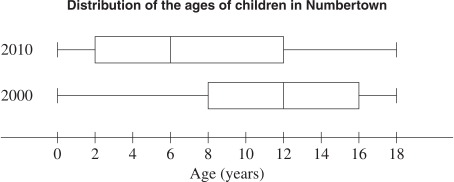
  

  1. In 2000 there were 1750 children aged 0–18 years.


    How many children were aged 12–18 years in 2000?   (1 mark)

    --- 1 WORK AREA LINES (style=lined) ---

  2. The number of children aged 12–18 years is the same in both 2000 and 2010.


    How many children aged 0–18 years are there in 2010?    (1 mark)

    --- 1 WORK AREA LINES (style=lined) ---

  3. Identify TWO changes in the distribution of ages between 2000 and 2010. In your answer, refer to measures of location or spread or the shape of the distributions.   (2 marks)

    --- 5 WORK AREA LINES (style=lined) ---

  4. What would be ONE possible implication for government planning, as a consequence of this change in the distribution of ages?   (1 mark)

    --- 2 WORK AREA LINES (style=lined) ---

Show Answers Only

i.    `875`

ii.    `3500`

iii.  `text{Changes in distribution (include 2 of the following):}`

  • `text(the lower quartile age is lower in 2010)`
  • `text(the median is lower in 2010)`
  • `text(the upper quartile age is lower in 2010)`
  • `text(the interquartile range is greater in 2010)`
  • `text(2010 is positively skewed while 2000 is negatively)`

iv.  `text(Implication for government planning:)`

`text(Since the children are getting younger in 2010,)`

  • `text(Approve and build more childcare facilities)`
  • `text(Build more school and public playgrounds)`
Show Worked Solution

i.    `text{Since the median = 12 years}`

♦ Mean mark (i) 45%

`=>\ text{50% of children are aged 12–18 years}`

`:.\ text{Children aged 12–18}\ = 50\text{%}\ xx 1750 = 875`


♦♦ Mean mark (ii) 25%

ii.   `text{Upper quartile (2010) = 12 years}`

`text{Children in upper quartile = 875 (from part (i))}`

`:.\ text{Children aged 0–18}\ =4 xx 875= 3500`
 

iii.  `text{Changes in distribution (include 2 of the following):}`

♦ Mean mark (iii) 35%
MARKER’S COMMENT: A number of students incorrectly identified “positive” skew as “negative” skew here.
  • `text(the lower quartile age is lower in 2010)`
  • `text(the median is lower in 2010)`
  • `text(the upper quartile age is lower in 2010)`
  • `text(the interquartile range is greater in 2010)`
  • `text(2010 is positively skewed while 2000 is negatively)`

iv.  `text(Implication for government planning:)`

♦ Mean mark (iv) 46%
MARKER’S COMMENT: Answers should reflect the 1 mark allocation.

`text(Since the children are getting younger in 2010,)`

  • `text(Approve and build more childcare facilities)`
  • `text(Build more school and public playgrounds)`

Filed Under: Box Plots and 5-Number Summary, Stem & Leaf, Box & Whisker, Summary Statistics - Box Plots (Std 2), Summary Statistics - Box Plots (Std2-2027), Summary Statistics - Box Plots (Y12) Tagged With: Band 5, common-content, num-title-ct-corea, num-title-qs-hsc, smc-1000-20-Parallel Box-Plots, smc-5021-60-Box plots (parallel), smc-5021-80-Inferences from dataset, smc-6313-20-Parallel Box Plots, smc-825-20-Parallel Box-Plots

Copyright © 2014–2025 SmarterEd.com.au · Log in