SmarterEd

Aussie Maths & Science Teachers: Save your time with SmarterEd

  • Login
  • Get Help
  • About

Bivariate Data, SM-Bank 009

The height (in cm) and foot length (in cm) for each of eight Year 12 students were recorded and displayed in the scatterplot below.

A line of best fit has been fitted to the data as shown.
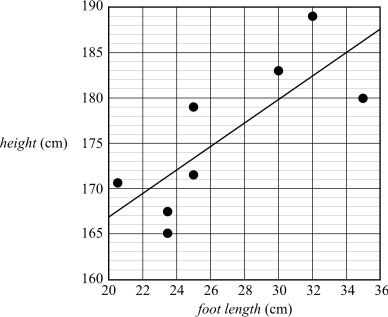
 

  1. Determine the predicted foot size of a student who is 176 centimetres tall.   (1 mark)

    --- 1 WORK AREA LINES (style=lined) ---

  2. Calculate the gradient of the line of best fit, giving your answer correct to two decimal places.   (2 marks)

    --- 4 WORK AREA LINES (style=lined) ---

  3. What is the equation of the line of best fit?   (2 marks)

    --- 5 WORK AREA LINES (style=lined) ---
Show Answers Only

i.    \(\text{Height 176 cm}\ \ \Rightarrow\ \ \text{Foot length = 27 cm} \)

ii.    \(1.29 \)

iii.    \(\textit{height}\ = 141.2 + 1.29 \times \textit{foot length} \)

Show Worked Solution

i.    \(\text{Height 176 cm}\ \ \Rightarrow\ \ \text{Foot length = 27 cm} \)
 

ii.    \(\text{LOBF passes through (20, 167) and (34, 185):}\)

\(\text{Gradient}\ = \dfrac{y_2-y_1}{x_2-x_1} = \dfrac{185-167}{34-20} = \dfrac{18}{14} = 1.285… = 1.29 \)
 

iii.   \(\text{Equation}\ \ \Rightarrow \ \ \text{Gradient = 1.29, passes through (20, 167)} \)

\(y-y_1 \) \(=m(x-x_1) \)  
\(y-167\) \(=1.29(x-20) \)  
\(y\) \(=1.29x + 141.2\)  

 
\(\textit{height}\ = 141.2 + 1.29 \times \textit{foot length} \)

Filed Under: Bivariate Data Tagged With: num-title-ct-coreb, smc-5022-10-Line of best fit graphs, smc-5022-28-LOBF equations

Bivariate Data, SM-Bank 008 MC

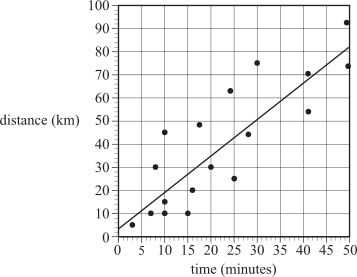
A line of best fit has been fitted to the scatterplot above to enable distance, in kilometres, to be predicted from time, in minutes.

The equation of this line is closest to

  1. distance `= 3.5 + 1.6 ×`time
  2. time `= 3.5 + 1.6 ×`distance
  3. distance `= 1.6 + 3.5 ×`time
  4. time `= 1.8 + 3.5 ×`distance
Show Answers Only

`A`

Show Worked Solution

`text{Line passes through  (0, 3.5) and (50, 82)`

\(\text{Gradient}\ = \dfrac{y_2-y_1}{x_2-x_1} \approx \dfrac{82-3.5}{50-0} \approx 1.57 \)
 

`text{Distance is the dependent variable}\ (y)\ \text{and the}`

`y text(-intercept is approximately 3.5.)`

`=> A`

Filed Under: Bivariate Data Tagged With: num-title-ct-coreb, smc-5022-28-LOBF equations

Bivariate Data, SM-Bank 003

Ahmed collected data on the age (`a`) and height (`h`) of males aged 11 to 16 years.

He created a scatterplot of the data and constructed a line of best fit to model the relationship between the age and height of males.
 

  1. Determine the gradient of the line of best fit shown on the graph.   (1 mark)

    --- 2 WORK AREA LINES (style=lined) ---

  2. Determine the equation of the line of best fit shown on the graph.  (2 marks)

    --- 5 WORK AREA LINES (style=lined) ---

  3. Use the line of best fit to predict the height of a typical 17-year-old male.   (1 mark)

    --- 1 WORK AREA LINES (style=lined) ---

  4. Why would this model not be useful for predicting the height of a typical 45-year-old male?   (1 mark)

    --- 2 WORK AREA LINES (style=lined) ---

Show Answers Only
  1. `text(Gradient = 6)`
  2. `h = 6a + 80`
  3. `text(182 cm)`
  4. `text(People slow and eventually stop growing)`
  5.  

    `text(after they become adults.)`

Show Worked Solution

i.    `text{Gradient}\ =(176-146)/(16-11)=30/5=6`
 

ii.   `text{Gradient = 6,  Passes through (11, 146)}`

`y-y_1` `=m(x-x_1)`
`h-146` `=6(a-11)`
`:. h` `=6a-66+146`
  `=6a + 80`
♦♦ Mean marks of 38% and 25% respectively for parts (i)-(ii).
COMMENT: Choose extreme points for calculating gradient.

 
iii.
   `text{Substitue}\ \ a=17\ \ \text{into equation from part (ii):}`

`h=(6 xx 17) +80=182`

`:.\ text{A typical 17 year old is expected to be 182cm.}`
  

iv.    `text(People slow and eventually stop growing)`
  `text(after they become adults.)`

Filed Under: Bivariate Data Tagged With: num-title-ct-coreb, smc-5022-28-LOBF equations, smc-5022-40-Gradient, smc-5022-60-Limitations

Statistics, STD1 S3 2023 HSC 19

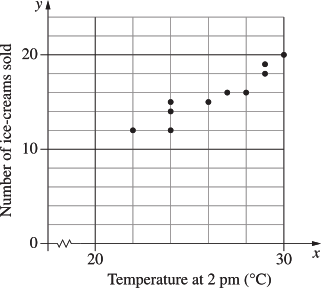
The scatterplot shows the number of ice-creams sold, \(y\), at a shop over a ten-day period, and the temperature recorded at 2 pm on each of these days.
 

  1. The data are modelled by the equation of the line of best fit given below.

\(y=0.936 x-8.929\), where \(x\) is the temperature.

  1. Sam used a particular temperature with this equation and predicted that 23 ice-creams would be sold.
  2. What was the temperature used by Sam, to the nearest degree?  (2 marks)

    --- 4 WORK AREA LINES (style=lined) ---

  3. In using the equation to make the prediction in part (a), was Sam interpolating or extrapolating? Justify your answer.  (2 marks)

    --- 3 WORK AREA LINES (style=lined) ---

Show Answers Only

a.    \(34^{\circ}\text{ (nearest degree)}\)

b.    \(\text{See worked solutions}\)

Show Worked Solution

a.             \(y\) \(=0.936x-8.929\)
\(23\) \(=0.936x-8.929\)
\(0.936x\) \(=23+8.929\)
\(x\) \(=\dfrac{31.921}{0.936}\)
  \(=34.112\ldots ^{\circ}\)
  \(= 34^{\circ}\text{ (nearest degree)}\)

♦♦ Mean mark (a) 31%.

b.     \(\text{Sam is extrapolating as 34°C is outside the range of data}\)

\(\text{points shown on the graph (i.e. temp between 0 and 30°C).}\)


♦♦ Mean mark (b) 33%.

Filed Under: Bivariate Data, S3 Further Statistical Analysis (Y12) Tagged With: Band 5, num-title-ct-coreb, num-title-qs-hsc, smc-1113-10-Line of Best Fit, smc-5022-10-Line of best fit graphs, smc-5022-28-LOBF equations, smc-5022-70-Inter/extrapolating

Statistics, STD2 S4 2009 HSC 28b

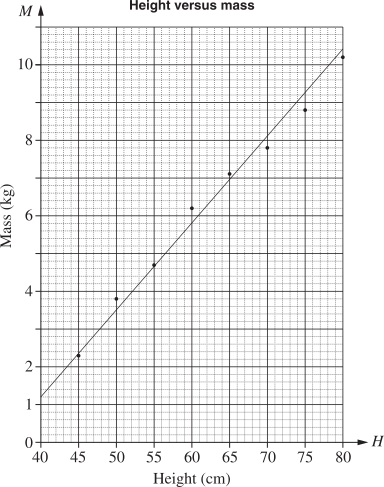
The height and mass of a child are measured and recorded over its first two years. 

\begin{array} {|l|c|c|}
\hline \rule{0pt}{2.5ex} \text{Height (cm), } H \rule[-1ex]{0pt}{0pt} & \text{45} & \text{50} & \text{55} & \text{60} & \text{65} & \text{70} & \text{75} & \text{80} \\
\hline \rule{0pt}{2.5ex} \text{Mass (kg), } M \rule[-1ex]{0pt}{0pt} & \text{2.3} & \text{3.8} & \text{4.7} & \text{6.2} & \text{7.1} & \text{7.8} & \text{8.8} & \text{10.2} \\
\hline
\end{array}

This information is displayed in a scatter graph. 
 

  1. Describe the correlation between the height and mass of this child, as shown in the graph.   (1 mark)

    --- 2 WORK AREA LINES (style=lined) ---

  2. A line of best fit has been drawn on the graph.


    Find the equation of this line.   (2 marks)

    --- 4 WORK AREA LINES (style=lined) ---

Show Answers Only
  1. `text(The correlation between height and)`


    `text(mass is positive and strong.)`

  2. `M = 0.23H-8`
Show Worked Solution

i.  `text(The correlation between height and)`

♦ Mean mark 48%. 

`text(mass is positive and strong.)`


ii.  `text(Using)\ \ P_1(40, 1.2)\ \ text(and)\ \ P_2(80, 10.4)`

♦♦♦ Mean mark 18%. 
MARKER’S COMMENT: Many students had difficulty due to the fact the horizontal axis started at `H= text(40cm)` and not the origin.
`text(Gradient)` `= (y_2-y_1)/(x_2-x_1)`
  `= (10.4-1.2)/(80-40)`
  `= 9.2/40`
  `= 0.23`


`text(Line passes through)\ \ P_1(40, 1.2)`

`text(Using)\ \ \ y-y_1` `= m(x-x_1)`
`y-1.2` `= 0.23(x-40)`
`y-1.2` `= 0.23x-9.2`
`y` `= 0.23x-8`

 
`:. text(Equation of the line is)\ \ M = 0.23H-8`

Filed Under: Bivariate Data, Bivariate Data Analysis (Y12), Life Expectancy, Other Linear Modelling, S3 Further Statistical Analysis (Y12), S4 Bivariate Data Analysis (Y12) Tagged With: Band 5, Band 6, common-content, num-title-ct-coreb, num-title-qs-hsc, smc-1001-10-Line of Best Fit, smc-1001-30-Correlation, smc-1113-10-Line of Best Fit, smc-1113-30-Correlation, smc-5022-28-LOBF equations, smc-5022-30-Correlation, smc-785-10-Line of Best Fit, smc-785-30-Correlation

Copyright © 2014–2025 SmarterEd.com.au · Log in