SmarterEd

Aussie Maths & Science Teachers: Save your time with SmarterEd

  • Login
  • Get Help
  • About

HMS, TIP 2012 HSC 15 MC

Which types of training methods would be most suitable for an elite basketball player?

  1. Anaerobic interval, ballistic flexibility, elastic resistance
  2. Anaerobic interval, continuous, hydraulic resistance
  3. Aerobic interval, static flexibility, free weights
  4. Circuit, dynamic flexibility, free weights
Show Answers Only

\(A\)

Show Worked Solution
  • A is correct: Basketball requires anaerobic power, ballistic flexibility and functional resistance training.

Other Options:

  • B is incorrect: Continuous training less relevant for intermittent basketball demands.
  • C is incorrect: Static flexibility less functional than ballistic for basketball movements.
  • D is incorrect: Circuit training less specific than anaerobic interval for basketball.

♦♦♦♦ Mean mark 29%.

Filed Under: Types of training and training methods Tagged With: Band 6, smc-5459-05-Anaerobic, smc-5459-15-Flexibility

HMS, TIP 2013 HSC 15 MC

Features of a resistance training program are listed.

\begin{array}{|l|l|}
\hline \textit{Sets}\quad & 3-6 \\
\hline \textit{Reps} & 5-6 \\
\hline \textit{Load} & 35\%-50\% \ \text{of 1 Repetition Maximum (RM) } \\
\hline \textit{Rest} & 3-4 \text{ minutes (between sets) } \\
\hline \textit{Speed} & \text {Fast} \\
\hline
\end{array}

What is this training program specifically designed to improve?

  1. Endurance
  2. Hypertrophy
  3. Power
  4. Strength
Show Answers Only

\(C\)

Show Worked Solution
  • C is correct: Moderate load with fast speed develops explosive power output.

Other Options:

  • A is incorrect: Endurance requires higher reps, lower load, shorter rest.
  • B is incorrect: Hypertrophy needs moderate reps, higher load, shorter rest.
  • D is incorrect: Strength requires higher load percentage, slower controlled movements.

♦♦ Mean mark 50%.

Filed Under: Types of training and training methods Tagged With: Band 5, smc-5459-05-Anaerobic

HMS, TIP 2018 HSC 5 MC

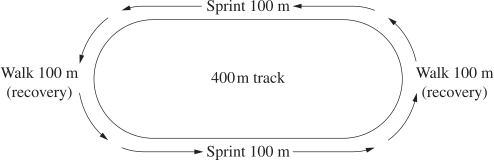
In training, an athlete completes TWO laps of the following activity.
 

What type of training does this activity represent?

  1. Aerobic fartlek
  2. Aerobic interval
  3. Anaerobic fartlek
  4. Anaerobic interval
Show Answers Only

\(D\)

Show Worked Solution

  • D is correct: Structured sprint-recovery pattern represents anaerobic interval training with defined work-rest periods.

Other Options:

  • A is incorrect: Fartlek involves varied intensity without structured recovery periods.
  • B is incorrect: Sprints are anaerobic intensity, not aerobic training zones.
  • C is incorrect: Fartlek training lacks the structured work-rest pattern shown here.

♦♦♦♦ Mean mark 33%.

Filed Under: Types of training and training methods Tagged With: Band 5, smc-5459-05-Anaerobic

HMS, TIP 2019 HSC 31a

  1. Describe TWO different types of training methods that are best suited to the performance requirements of an athlete in a particular sport.   (4 marks)

    --- 12 WORK AREA LINES (style=lined) ---

  2. How can the training adaptations for the athlete identified in part (i) be measured and monitored?   (4 marks)

    --- 12 WORK AREA LINES (style=lined) ---

Show Answers Only

i.    Athlete – 400 metre runner

  • A 400-metre runner requires anaerobic interval training and plyometric training to meet performance demands.
  • Anaerobic interval training involves high-intensity efforts with incomplete recovery periods, developing lactate tolerance essential for 400-metre racing. This method trains the glycolytic energy system predominantly used during the race duration and intensity.
  • Plyometric training develops explosive power through rapid muscle contractions involving stretch-shortening cycles. This training method enhances sprint acceleration and stride power crucial for 400-metre performance. Exercises include depth jumps, bounding and reactive movements. These exercises improve neuromuscular coordination and force production rates necessary for competitive sprinting speeds.

ii.   Measuring and monitoring

  • Anaerobic capacity can be measured through repeated sprint tests and lactate threshold protocols. This determines the athlete’s ability to maintain high-intensity efforts over race distance. Time trials provide specific performance indicators, showing training adaptation effectiveness.
  • Power development is monitored using vertical jump tests and sprint acceleration measurements. These assessments reveal improvements in explosive strength from plyometric training. Standing broad jump distance measures horizontal power development, indicating neuromuscular adaptation improvements.
  • Heart rate recovery patterns demonstrate cardiovascular adaptation efficiency and can be analysed using heart rate monitors or smart watches. These devices track resting heart rate changes and recovery rates after training sessions. Faster recovery rates indicate improved anaerobic fitness and training adaptation success for 400-metre performance requirements.

Show Worked Solution

i.    Athlete – 400 metre runner

  • A 400-metre runner requires anaerobic interval training and plyometric training to meet performance demands.
  • Anaerobic interval training involves high-intensity efforts with incomplete recovery periods, developing lactate tolerance essential for 400-metre racing. This method trains the glycolytic energy system predominantly used during the race duration and intensity.
  • Plyometric training develops explosive power through rapid muscle contractions involving stretch-shortening cycles. This training method enhances sprint acceleration and stride power crucial for 400-metre performance. Exercises include depth jumps, bounding and reactive movements. These exercises improve neuromuscular coordination and force production rates necessary for competitive sprinting speeds.

♦♦ Mean mark (i) 52%.

ii.   Measuring and monitoring

  • Anaerobic capacity can be measured through repeated sprint tests and lactate threshold protocols. This determines the athlete’s ability to maintain high-intensity efforts over race distance. Time trials provide specific performance indicators, showing training adaptation effectiveness.
  • Power development is monitored using vertical jump tests and sprint acceleration measurements. These assessments reveal improvements in explosive strength from plyometric training. Standing broad jump distance measures horizontal power development, indicating neuromuscular adaptation improvements.
  • Heart rate recovery patterns demonstrate cardiovascular adaptation efficiency and can be analysed using heart rate monitors or smart watches. These devices track resting heart rate changes and recovery rates after training sessions. Faster recovery rates indicate improved anaerobic fitness and training adaptation success for 400-metre performance requirements.

♦♦ Mean mark (ii) 42%.

Filed Under: Performance/fitness testing, Types of training and training methods Tagged With: Band 5, smc-5459-05-Anaerobic

HMS, TIP 2020 HSC 10 MC

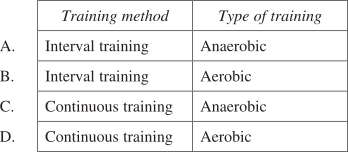
Which row in the table identifies the training method and type of training that is most appropriate for improving the performance of an elite 50-metre swimmer?

Show Answers Only

\(A\)

Show Worked Solution
  • A is correct: 50m swimming requires high-intensity anaerobic power with interval training.

Other Options:

  • B is incorrect: 50m swimming is anaerobic not aerobic event.
  • C is incorrect: Cannot do continuous training at anaerobic intensity.
  • D is incorrect: 50m swimming requires anaerobic not aerobic training.

Filed Under: Types of training and training methods Tagged With: Band 4, smc-5459-05-Anaerobic

HMS, TIP 2022 HSC 21a

Outline ONE anaerobic training method that is appropriate for an athlete who is competing in a high intensity, short duration event. Provide an example to support your answer.   (3 marks)

--- 7 WORK AREA LINES (style=lined) ---

Show Answers Only
  • Anaerobic interval training uses repeated high-intensity efforts with incomplete recovery periods. Athletes perform multiple sets at maximum effort with short rest intervals between each repetition.
  • For example, a 100-metre sprinter could perform 8 × 50-metre sprints at maximum effort, leaving every 90 seconds. The athlete runs as fast as possible for each repetition. The incomplete recovery forces the body to work under fatigue conditions, improving power maintenance during competition.
Show Worked Solution
  • Anaerobic interval training uses repeated high-intensity efforts with incomplete recovery periods. Athletes perform multiple sets at maximum effort with short rest intervals between each repetition.
  • For example, a 100-metre sprinter could perform 8 × 50-metre sprints at maximum effort, leaving every 90 seconds. The athlete runs as fast as possible for each repetition. The incomplete recovery forces the body to work under fatigue conditions, improving power maintenance during competition.

Filed Under: Types of training and training methods Tagged With: Band 4, smc-5459-05-Anaerobic

HMS, TIP 2023 HSC 31a

Choose ONE type of training to answer BOTH Question 31 (a) (i) and (ii).

  1. For the type of training chosen, outline TWO methods an athlete can use to improve performance.  (3 marks)

    --- 7 WORK AREA LINES (style=lined) ---

  2. For the type of training chosen, explain TWO measurements that can be used by an athlete to monitor improved performance.  (5 marks)

    --- 15 WORK AREA LINES (style=lined) ---

Show Answers Only

Sample answer

i.   Anaerobic Training

  • Sprint Interval Training (SIT)
    • In this method an athlete performs repeated bouts of all-out sprints (e.g., 30-second maximal effort) followed by longer rest periods (e.g., 2-4 minutes).
    • Anaerobic capacity is improved by stressing the lactic acid system, enhancing the ability to perform high-intensity efforts.
  • Plyometrics
    • This method involves explosive movements such as box jumps, depth jumps, or medicine ball throws.
    • These exercises utilise the stretch-shortening cycle to develop power, improving performance in sports requiring explosive movements like basketball or volleyball.

ii.  Performance Measurements – Anaerobic Training

  • The Wingate test measures anaerobic power through a 30-second all-out cycling assessment. This test works by recording peak power output and power decline over the duration. Athletes can monitor improvement because pre and post-training comparisons reveal increased anaerobic capacity. For example, a soccer player showing increased peak power demonstrates improved ability to perform repeated sprints during matches. This measurement is effective because it directly reflects the energy system adaptations resulting from anaerobic training programs.
  • Vertical jump testing assesses lower body power development from explosive training methods. The measurement functions through precise height recording using contact mats or jump platforms. Athletes track progress because increased jump height indicates enhanced muscular power and coordination. A basketball player who improves their vertical jump after plyometric training demonstrates better explosive capacity. This measurement proves valuable because it directly translates to improved in-game performance when jumping for rebounds or blocking shots, showing clear functional application of training adaptations.

Show Worked Solution

Sample answer

i.   Anaerobic Training

  • Sprint Interval Training (SIT)
    • In this method an athlete performs repeated bouts of all-out sprints (e.g., 30-second maximal effort) followed by longer rest periods (e.g., 2-4 minutes).
    • Anaerobic capacity is improved by stressing the lactic acid system, enhancing the ability to perform high-intensity efforts.
  • Plyometrics
    • This method involves explosive movements such as box jumps, depth jumps, or medicine ball throws.
    • These exercises utilise the stretch-shortening cycle to develop power, improving performance in sports requiring explosive movements like basketball or volleyball.

ii.  Performance Measurements – Anaerobic Training

  • The Wingate test measures anaerobic power through a 30-second all-out cycling assessment. This test works by recording peak power output and power decline over the duration. Athletes can monitor improvement because pre and post-training comparisons reveal increased anaerobic capacity. For example, a soccer player showing increased peak power demonstrates improved ability to perform repeated sprints during matches. This measurement is effective because it directly reflects the energy system adaptations resulting from anaerobic training programs.
  • Vertical jump testing assesses lower body power development from explosive training methods. The measurement functions through precise height recording using contact mats or jump platforms. Athletes track progress because increased jump height indicates enhanced muscular power and coordination. A basketball player who improves their vertical jump after plyometric training demonstrates better explosive capacity. This measurement proves valuable because it directly translates to improved in-game performance when jumping for rebounds or blocking shots, showing clear functional application of training adaptations.

♦ (ii) Mean mark 55%.

Filed Under: Types of training and training methods Tagged With: Band 4, Band 5, smc-5457-30-Specific tests, smc-5459-05-Anaerobic

Copyright © 2014–2025 SmarterEd.com.au · Log in