SmarterEd

Aussie Maths & Science Teachers: Save your time with SmarterEd

  • Login
  • Get Help
  • About

HMS, TIP EQ-Bank 233

A swimming coach is designing training programs for two different athletes: a 1500-metre freestyle swimmer and a water polo player. Both athletes need improved aerobic capacity but have different performance requirements.

Discuss the use of continuous training versus aerobic interval training for these two athletes, considering their specific sport demands.   (6 marks)

--- 20 WORK AREA LINES (style=lined) ---

Show Answers Only

For Continuous Training

  • [P] Continuous training provides sustained aerobic development through uninterrupted effort lasting 20-30 minutes minimum.
  • [E] This approach directly supports the 1500-metre swimmer’s race demands requiring steady-state aerobic capacity throughout the event.
  • [Ev] Research demonstrates continuous training improves oxygen delivery efficiency and enhances cardiovascular endurance for prolonged swimming efforts.
  • [L] Therefore continuous training effectively develops the aerobic base essential for distance swimming performance.

Against Continuous Training for Water Polo

  • [P] Continuous training limitations become apparent when considering water polo’s intermittent high-intensity demands.
  • [E] Water polo requires rapid acceleration, explosive movements and frequent direction changes rather than sustained steady effort.
  • [Ev] Studies show continuous training alone fails to develop the anaerobic power and recovery capacity needed for repeated sprints.
  • [L] Consequently continuous training provides insufficient preparation for water polo’s varied intensity requirements.

For Aerobic Interval Training

  • [P] Aerobic interval training offers superior specificity for both athletes through work-rest manipulation.
  • [E] The method allows coaches to target specific energy system development while maintaining aerobic stress through incomplete recovery.
  • [Ev] Evidence indicates interval training improves both VO2 max and lactate threshold more effectively than continuous methods alone.
  • [L] This versatility makes aerobic interval training suitable for both swimming disciplines despite different performance demands.
Show Worked Solution

For Continuous Training

  • [P] Continuous training provides sustained aerobic development through uninterrupted effort lasting 20-30 minutes minimum.
  • [E] This approach directly supports the 1500-metre swimmer’s race demands requiring steady-state aerobic capacity throughout the event.
  • [Ev] Research demonstrates continuous training improves oxygen delivery efficiency and enhances cardiovascular endurance for prolonged swimming efforts.
  • [L] Therefore continuous training effectively develops the aerobic base essential for distance swimming performance.

Against Continuous Training for Water Polo

  • [P] Continuous training limitations become apparent when considering water polo’s intermittent high-intensity demands.
  • [E] Water polo requires rapid acceleration, explosive movements and frequent direction changes rather than sustained steady effort.
  • [Ev] Studies show continuous training alone fails to develop the anaerobic power and recovery capacity needed for repeated sprints.
  • [L] Consequently continuous training provides insufficient preparation for water polo’s varied intensity requirements.

For Aerobic Interval Training

  • [P] Aerobic interval training offers superior specificity for both athletes through work-rest manipulation.
  • [E] The method allows coaches to target specific energy system development while maintaining aerobic stress through incomplete recovery.
  • [Ev] Evidence indicates interval training improves both VO2 max and lactate threshold more effectively than continuous methods alone.
  • [L] This versatility makes aerobic interval training suitable for both swimming disciplines despite different performance demands.

Filed Under: Types of training and training methods Tagged With: Band 5, smc-5459-10-Aerobic

HMS, TIP EQ-Bank 232

A soccer midfielder needs to maintain performance throughout a 90-minute match that requires frequent changes in intensity. Their fitness coach recommends using fartlek training and circuit training to improve their aerobic capacity.

Analyse the relationship between these training methods and the specific demands of soccer performance.   (5 marks)

--- 18 WORK AREA LINES (style=lined) ---

Show Answers Only

Overview Statement

  • Fartlek and circuit training both connect to soccer’s varied intensity demands through complementary physiological adaptations for sustained match performance.

Component Relationship 1

  • Fartlek training interacts with soccer’s unpredictable pace changes by developing simultaneous aerobic and anaerobic energy system capacity.
  • This relationship enables rapid transitions between moderate jogging phases and explosive sprinting bursts throughout competitive matches.
  • Evidence shows fartlek’s random intensity variations mimic game-specific demands which results in improved lactate clearance during play.
  • The training specificity means midfielders maintain optimal speed and endurance over 90 minutes without significant performance decline.
  • Additionally, the varied terrain component enhances proprioceptive awareness required for changing field conditions.

Component Relationship 2

  • Circuit training connects to soccer’s multi-directional movement patterns through sequential station-based sport-specific exercises targeting different muscle groups.
  • This method influences cardiovascular endurance development while simultaneously building functional strength, agility and coordination capacities.
  • Research demonstrates circuit training formats affect metabolic recovery rates between repeated high-intensity efforts during competitive matches.
  • Therefore players sustain optimal decision-making abilities and consistent physical output throughout the entire game duration.

Implications and Synthesis

  • These training relationships work synergistically to optimise comprehensive aerobic capacity for soccer’s complex and demanding physical requirements.
  • The broader implication demonstrates that combined training approaches enhance overall match performance more effectively than isolated training methods.
Show Worked Solution

Overview Statement

  • Fartlek and circuit training both connect to soccer’s varied intensity demands through complementary physiological adaptations for sustained match performance.

Component Relationship 1

  • Fartlek training interacts with soccer’s unpredictable pace changes by developing simultaneous aerobic and anaerobic energy system capacity.
  • This relationship enables rapid transitions between moderate jogging phases and explosive sprinting bursts throughout competitive matches.
  • Evidence shows fartlek’s random intensity variations mimic game-specific demands which results in improved lactate clearance during play.
  • The training specificity means midfielders maintain optimal speed and endurance over 90 minutes without significant performance decline.
  • Additionally, the varied terrain component enhances proprioceptive awareness required for changing field conditions.

Component Relationship 2

  • Circuit training connects to soccer’s multi-directional movement patterns through sequential station-based sport-specific exercises targeting different muscle groups.
  • This method influences cardiovascular endurance development while simultaneously building functional strength, agility and coordination capacities.
  • Research demonstrates circuit training formats affect metabolic recovery rates between repeated high-intensity efforts during competitive matches.
  • Therefore players sustain optimal decision-making abilities and consistent physical output throughout the entire game duration.

Implications and Synthesis

  • These training relationships work synergistically to optimise comprehensive aerobic capacity for soccer’s complex and demanding physical requirements.
  • The broader implication demonstrates that combined training approaches enhance overall match performance more effectively than isolated training methods.

Filed Under: Types of training and training methods Tagged With: Band 4, smc-5459-10-Aerobic

HMS, TIP EQ-Bank 231

A cross-country runner is preparing for a 10-kilometre race and wants to improve their aerobic endurance. Their coach suggests incorporating both continuous training and aerobic interval training into their program.

Explain how these two aerobic training methods would improve the runner's performance in long-distance running.   (4 marks)

--- 12 WORK AREA LINES (style=lined) ---

Show Answers Only
  • Continuous training involves sustained effort for at least 20-30 minutes without rest intervals.
  • This causes the heart rate to rise above aerobic threshold and remain in target zone.
  • Reaching the threshold leads to improved oxygen delivery to muscles and enhanced cardiovascular efficiency for distance running.
  • Aerobic interval training alternates work periods with short recovery phases.
  • The short recovery periods enable the maintenance of stress on the aerobic system through incomplete recovery between intervals.
  • Therefore the runner develops greater aerobic capacity and improved lactate clearance for race performance.
Show Worked Solution
  • Continuous training involves sustained effort for at least 20-30 minutes without rest intervals.
  • This causes the heart rate to rise above aerobic threshold and remain in target zone.
  • Reaching the threshold leads to improved oxygen delivery to muscles and enhanced cardiovascular efficiency for distance running.
  • Aerobic interval training alternates work periods with short recovery phases.
  • The short recovery periods enable the maintenance of stress on the aerobic system through incomplete recovery between intervals.
  • Therefore the runner develops greater aerobic capacity and improved lactate clearance for race performance.

Filed Under: Types of training and training methods Tagged With: Band 3, smc-5459-10-Aerobic

HMS, TIP 2014 HSC 19 MC

The table below shows an athlete’s adaptations from training that occurred over 14 weeks.

\begin{array}{|l|l|}
\hline \text{Adaptation} & \text{Result} \\
\hline \text{% slow-twitch muscle fibre} \quad & \text{Increase} \\
\hline \text{Aerobic capacity} & \text{Increase} \\
\hline \text{Number of capillaries} & \text{Increase} \\
\hline \text{Anaerobic capacity} & \text{No change} \\
\hline
\end{array}

Which is the most likely method of training to have been undertaken?

  1. Circuit training
  2. Fartlek training
  3. Resistance training
  4. Continuous training
Show Answers Only

\(D\)

Show Worked Solution
  • D is correct: Continuous training produces purely aerobic adaptations without anaerobic improvements.

Other Options:

  • A is incorrect: Circuit training would improve both aerobic and anaerobic capacity.
  • B is incorrect: Fartlek training would improve some anaerobic capacity due to intervals.
  • C is incorrect: Resistance training would primarily improve anaerobic not aerobic capacity.

Filed Under: Types of training and training methods Tagged With: Band 4, smc-5459-10-Aerobic

HMS, TIP 2015 HSC 12 MC

How could a coach use a circuit training program to develop the aerobic capacity and strength of her athletes?

  1. By increasing the time allowed for the circuit to be completed
  2. By increasing the resistance and the time at each of the stations
  3. By decreasing the time allowed for the circuit to be completed
  4. By decreasing the resistance and the time at each of the stations
Show Answers Only

\(B\)

Show Worked Solution
  • B is correct: Higher resistance builds strength while longer time develops aerobic capacity.

Other Options:

  • A is incorrect: More time doesn’t increase training intensity effectively.
  • C is incorrect: Less time reduces aerobic development opportunities.
  • D is incorrect: Lower resistance and time reduces both strength and aerobic benefits.

Filed Under: Principles of training, Types of training and training methods Tagged With: Band 4, smc-5459-10-Aerobic, smc-5459-20-Strength, smc-5460-05-Adaptations

HMS, TIP 2016 HSC 12 MC

An athlete trains by running 4 km in 20 minutes without stopping. For 30 seconds in each minute the athlete increases the intensity significantly before returning to the normal intensity.

Which row in the table indicates the type of training and the method that is being used?

  Type of training Training method
A.   Aerobic Fartlek
B. Anaerobic Fartlek
C. Aerobic Interval
D.  Anaerobic Interval
Show Answers Only

\(A\)

Show Worked Solution
  • A is correct: 20-minute continuous run with varied intensity describes aerobic fartlek training.

Other Options:

  • B is incorrect: Extended duration indicates aerobic system, not anaerobic.
  • C is incorrect: Fartlek varies intensity randomly, interval training uses set periods.
  • D is incorrect: Both training type and method are incorrectly identified.

Filed Under: Types of training and training methods Tagged With: Band 4, smc-5459-10-Aerobic

HMS, TIP 2017 HSC 1 MC

What type of training involves an activity with intermittent bursts of speed?

  1. Circuit
  2. Fartlek
  3. Flexibility
  4. Continuous
Show Answers Only

\(B\)

Show Worked Solution
  • B is correct: Fartlek training involves varied speed bursts during continuous activity.

Other Options:

  • A is incorrect: Circuit training uses different exercise stations, not speed variations.
  • C is incorrect: Flexibility training focuses on range of motion, not speed.
  • D is incorrect: Continuous training maintains steady pace without speed bursts.

Filed Under: Types of training and training methods Tagged With: Band 3, smc-5459-10-Aerobic

HMS, TIP 2019 HSC 16 MC

The diagram shows the exercise intensity for an athlete during different stages of a 20-minute continuous running activity.
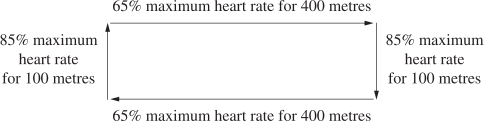
Which type of training method does this activity represent?

  1. Circuit training
  2. Fartlek training
  3. Continuous training
  4. Aerobic interval training
Show Only

\(B\)

Show Worked S11olution

  • B is correct: Fartlek involves varied intensity periods during continuous running activity.

Other Options:

  • A is incorrect: Circuit training uses different exercise stations, not continuous running.
  • C is incorrect: Continuous training maintains steady intensity throughout the session.
  • D is incorrect: Aerobic interval training has structured work-rest periods with recovery.

♦♦ Mean mark 54%.

Filed Under: Types of training and training methods Tagged With: Band 5, smc-5459-10-Aerobic

Copyright © 2014–2025 SmarterEd.com.au · Log in