SmarterEd

Aussie Maths & Science Teachers: Save your time with SmarterEd

  • Login
  • Get Help
  • About

HMS, TIP EQ-Bank 240

A cyclist has been following a progressive overload training program for 8 weeks, gradually increasing training duration from 30 minutes to 60 minutes per session. However, they decide to take a 4-week break from training due to work commitments.

Explain how the principle of reversibility would affect the physiological adaptations this cyclist has gained from their progressive overload training program.   (4 marks)

--- 12 WORK AREA LINES (style=lined) ---
Show Answers Only
  • Progressive overload training creates cardiovascular adaptations including increased stroke volume and enhanced oxygen delivery capacity.
  • The training stimulus causes improved VO2 max and greater muscular endurance for sustained cycling performance
  • When training ceases, the principle of reversibility begins as the body no longer receives adequate stimulus for adaptation maintenance.
  • This leads to decreased stroke volume and reduced oxygen uptake capacity within several weeks of inactivity.
  • Consequently the cyclist experiences declining cardiovascular efficiency and reduced endurance performance compared to their peak training condition.
Show Worked Solution
  • Progressive overload training creates cardiovascular adaptations including increased stroke volume and enhanced oxygen delivery capacity.
  • The training stimulus causes improved VO2 max and greater muscular endurance for sustained cycling performance
  • When training ceases, the principle of reversibility begins as the body no longer receives adequate stimulus for adaptation maintenance.
  • This leads to decreased stroke volume and reduced oxygen uptake capacity within several weeks of inactivity.
  • Consequently the cyclist experiences declining cardiovascular efficiency and reduced endurance performance compared to their peak training condition.

Filed Under: Principles of training Tagged With: Band 4, smc-5460-30-Reversibility, smc-5460-70-Adaptations

HMS, TIP 2014 HSC 18 MC

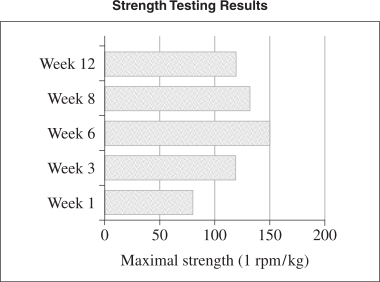
The graph shows results of testing an athlete’s strength for competition. These strength levels were recorded at the start of training (Weeks 1–3), right before competition (Week 6) and after a break from training (Weeks 8–12).
 

Which principle of training has the athlete displayed from Weeks 6 to 12?

  1. Peaking
  2. Overload
  3. Reversibility
  4. Progressive overload
Show Answers Only

\(C\)

Show Worked Solution
  • C is correct: Strength decreased after training stopped demonstrating reversibility principle.

Other Options:

  • A is incorrect: Peaking involves planned performance optimization not fitness loss.
  • B is incorrect: Overload requires increasing training load not stopping training.
  • D is incorrect: Progressive overload involves gradual increases not decreases in performance.

Filed Under: Principles of training Tagged With: Band 3, smc-5460-30-Reversibility

HMS, TIP 2024 HSC 9 MC

Which of the following is a recommended strategy to minimise reversibility for an athlete following a knee injury?

  1. Eliminating all forms of exercise while setting realistic goals
  2. Increasing rest days and maintaining psychological wellbeing
  3. Remaining active and gradually increasing intensity upon returning to training
  4. Suddenly increasing the intensity of each session to compensate for the reduced time spent training
Show Answers Only

\(C\)

Show Worked Solution
  • C is correct: Gradual activity resumption and progressive intensity increases effectively minimise fitness loss (reversibility) after injury.

Other Options:

  • A is incorrect: Complete inactivity accelerates deconditioning.
  • B is incorrect: Excess rest contributes to deconditioning.
  • D is incorrect: This approach risks re-injury and overtraining.

Filed Under: Principles of training Tagged With: Band 3, smc-5460-30-Reversibility

Copyright © 2014–2026 SmarterEd.com.au · Log in